In the Jubilee year, the field shall return to the one from whom he bought it, namely, the one whose inherited land it was. ~ Leviticus 27:24
I would like to acknowledge that
all of my possessions come from the Earth
and long after I’m gone (and maybe sooner)
they will return to it.
I take pride in having the ability
to exchange currency (another invention
of humans that, even in its physical form
comes from materials taken from the Earth
which, someday, will be dust again)
for objects and pieces of paper that
say I own tracts of land.
I acknowledge the tract of land
I sit on was once caretaken by
another group of humans who
may have done a better job and
who, before them, was just a random
confluence of Big Bang dust.
Or (go ahead and believe the story) all of this
was created by the great dust organizer
in the sky upon whose graces we
get to pretend the things in our wallet
have any meaning at all.
They say possession is nine-tenths of the law but even that is just something
that is just said as no actual law says that.
Take heed of all of this as you consider
using the word mine, as you worry
about people treading on your lawn
as you consider the physicalities of
what you have achieved.
We are barely a blink in the universe’s eye.
The dust is coming again.
Sooner than you think.
Rick Lupert, a poet, songleader and graphic designer, is the author of 28 books including “God Wrestler: A Poem for Every Torah Portion.” Find him online at www.JewishPoetry.net
A Holocaust survivor said that he felt a consolation
during the Shoah, knowing He could only die one single way:
from being beaten, from starvation or from being shot.
This extremely morbid reasoning most tragically is not
a counterintuition whose importance we’re permitted to downplay.
Though it applied to single individuals, not the Jewish nation,
all Jews are more than merely individual; we’re part of a collective
in which a focus on its individuals is divisively defective.
The whole collective’s in the driver’s seat — and without a quorum
we call a minyan riding only pillion on the Israel forum.
To continue to survive, survivors should not be benighted
as individuals causing their collective to become indicted.
On, 5/27/24 Meir Soloveichik’s podcast, “Paul Johnson, Rabbi Soloveitchik, and the Meaning of Jewish Prayer” discussed Jonathan Sacks’ article, “Individual and Collective Responsibility,” Covenant and Conversation, 2011,in which Paul Johnson told Rabbi Sacks that he attributed the greatness of Judaism to the way that it links the responsibility of all Jewish individuals to their collective, the Jewish community throughout the world
Meir Soloveichik also cited the explanation of the Rov, Rabbi Joseph Soloveitchik, for God’s rejection of Moses’ plea to God in Deut. 3:23 to spare his life and allow him to enter the land of Israel. Deut. 3:23 states:
He explained that God rejected Moses’ plea because the Israelite collective did not join Moses when he made his plea. Deut. 3:23 implies this with the word וָאֶתְחַנַּ֖ן, “and I pleaded,” the singular construction of the verb suggesting to the Rov that no other Israelites joined Moses’ plea, failing as a collective to support this great individual.
Gershon Hepner is a poet who has written over 25,000 poems on subjects ranging from music to literature, politics to Torah. He grew up in England and moved to Los Angeles in 1976. Using his varied interests and experiences, he has authored dozens of papers in medical and academic journals, and authored “Legal Friction: Law, Narrative, and Identity Politics in Biblical Israel.” He can be reached at gershonhepner@gmail.com.
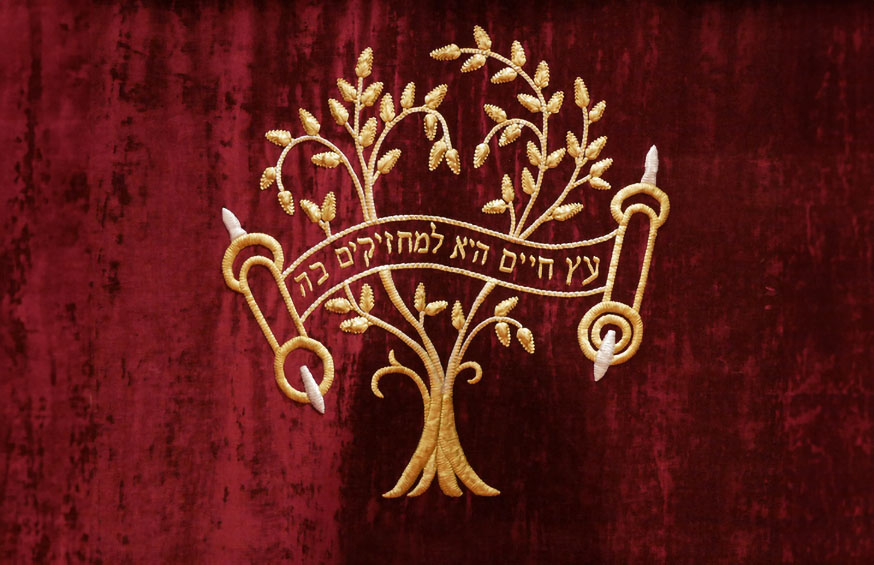
The Torah is often compared to “a tree of life.” As we sing when we return to the Torah to the ark, “It is a tree of life for those that hold fast to it.” What is the essence of the analogy? What is a tree of life?
A tree, even the tallest and grandest emanates from a tiny seed. The seed produces roots, anchored and overlapping. Over time, branches grow and fruit develops. The cycle begins again, with new life sprouting and spreading.
So too, Torah gives us grounding in an ever changing and challenging world. We stretch our minds and expand our souls, with Torah leaving positive imprints on the paths we choose to take. With each footstep, we leave behind traces of Torah, allowing our history, values, mitzvot and traditions shape future generations. None other than a tree of life that endures through the wisdom of the mind and actions of the heart.
Grasp onto Torah. Like a tree deeply planted, surviving the elements and reaching towards the heavens, we too will find ourselves in similar states of growth. Rooted by faith, nurturing seeds waiting to inspire the next generation.
Shabbat shalom
Rabbi Nicole Guzik is senior rabbi at Sinai Temple. She can be reached at her Facebook page at Rabbi Nicole Guzik or on Instagram @rabbiguzik. For more writings, visit Rabbi Guzik’s blog section from Sinai Temple’s website.
There’s a story I once heard (so sorry – I don’t have nor could I find the original source) about a king who wondered if God heard his prayers.
One day, the royal archer asked the king to meet him at midnight for target practice. “How will I know if I hit the target in the darkness?” asked the king.
”Trust me” said the archer.
The king spent a full hour shooting the arrows. His arms were aching as he released tension with each shot. When he was finished, he looked at the archer and asked, “Ok – what did I actually accomplish? I can’t tell if I hit the targets at all.”
The archer responded, “How do you feel?”
”Well, I put all my heart and soul into letting go of these arrows. I did it over and over. I feel a bit spent. But you know …. I also feel quite uplifted.”
”Then you hit the target.”
The king then realized it was the same with prayer. So long as he was sincere in releasing what was inside of him, his prayers were going in the right direction.
Dear friends, I believe that God hears our prayers. God may not answer right away. And God may not respond the way we hope. But God hears. And so we pray. We pray on our own. We pray as a community. We pray for healing. We pray for shalom. We pray for Israel. And we pray for humanity.
Indeed, each moment in time we pray, we empty our hearts so the world can be more full.
In my day, graduations only took place at middle school, high school and college. Now, however, kids are honored at commencement ceremonies beginning in pre-kindergarten.
With a crop of graduation ceremonies to attend this season, you’ll need to come up with graduation gifts as well. Here’s an easy and creative way to present a cash gift: mason jars topped with a graduation cap, filled with dollar bills rolled up like diplomas.
It almost makes me feel like going back to school so I can graduate and get a gift like this. Almost.
What you’ll need:
Glass jar
Black cardstock
Scissors
Brad fastener
Yarn
Dollar bills
Ribbon
1. Cut a square piece of black cardstock that is larger than the diameter of your jar lid by about an inch. I cut mine to five inches. Instead of black cardstock, you can use the graduate’s school color.
2. Poke a hole in the center and attach a brass brad. Wrap a piece of yarn around the brad so that it extends past the edge of the black square by about four inches.
3. Create loops out of another piece of yarn until you have five loops that are four inches long. Using the yarn that is wrapped around the brad, tie a knot in the middle of the loops. Cut off the ends of the loop. Then tape or glue the cap to the top of a glass jar.
4. Roll dollar bills and tie a ribbon around them to look like diplomas. Place the dollar bill diplomas inside the jar.
Jonathan Fong is the author of “Flowers That Wow” and “Parties That Wow,” and host of “Style With a Smile” on YouTube. You can see more of his do-it-yourself projects at jonathanfongstyle.com.
A new documentary, “The Commandant’s Shadow,” chronicles the lives of two elderly people who, as children, lived on opposite sides of the Auschwitz Concentration Camp: 98-year old Anita Lasker-Wallfisch, a Jewish cellist who was ordered to play music to pacify the arrivals of Jews at Auschwitz, and 87-year old Hans Jürgen Höss, the son of Rudolf Höss, the notorious Commandant of Auschwitz.
Spoiler: the two meet on camera. It’s a story that many people will find remarkable — watching the grandchildren of Nazis grapple with their family history. The burdens they carry in action will put viewers through a range of emotions. It’s part of the real story behind the 2023 Academy Award-nominated film “The Zone of Interest.”
The majority of the documentary is a buildup before that meeting. Half of the film is Hans’ son Kai (Rudolf’s grandson) getting his father to talk (in German) about how he has spent his life wrestling with the burden of his father’s atrocities: Rudolf presided over the murder of over a million Jews.
The other half of the documentary follows Anita and her daughter, Maya, an English-born psychologist now based in Germany. Anita was 19 years old when her talent as a cellist saved her life — she was selected to play in the Women’s Orchestra of Auschwitz. Anita would also survive Bergen-Belsen concentration camp. After the war, Anita moved to England and co-founded the English Chamber Orchestra. In 2000, she authored the memoir “Inherit the Truth: A Memoir of Survival and the Holocaust.”
The documentary also highlights Maya’s relationship with her mother. Since she was young, Maya endured separation anxiety, self-harming, obesity and alcohol and drug addiction. At one point, she was homeless in Jamaica. But with the support of her family, Maya was able to recover and eventually became a psychotherapist. When she moved to Germany in 2020, a place her mother never set foot in since the Holocaust — it was a watershed moment in Maya’s life.
“The Commandant’s Shadow” began as Maya’s idea following the success of her first book, “Briefe nach Breslau” (“Letter to Breslau,”) which explores intergenerational trauma from her grandparents who died in the Holocaust to her own generation. Anita has forbidden Maya from publishing the book in English until after she passes. As a psychoanalytic psychologist and educator, Maya studies and treats patients experiencing trauma and the complex web that has effects across generations.
“I was and still am very interested in working with the children of perpetrators, I think their suffering is irreconcilable,” Maya told The Journal. “There’s this ‘hierarchy of suffering’ where you can’t compare, but the self-punishment among descendants of perpetrators is so profound that it’s almost impossible to find peace.”
For Hans’ meeting with Anita in England, it would be Hans’ first time having a meeting with a concentration camp survivor. Hans and Kai arrive with a Breslau kugel as a gift. Maya talks about her father and tells Hans “You weren’t asked whose son you want to be.” Kai says unequivocally he hates his grandfather Rudolf. For Hans’ answer to the hate question, you’ll have to watch the documentary, but he does describe the thought as ‘unbearable.”
Director Daniela Völker does a phenomenal job of documenting so many emotional moments, interspersed with black and white footage from the days when Hans and Anita were mere acres from each other at Auschwitz.
There’ s a defiant moment during an interview with Hans’ sister, Brigitte, prior to Hans and Anita’s meeting. Brigitte, living in Virginia, expressed her own troubled perspectives on her father Rudolf’s atrocities.
“Sometimes I even thought, ‘why do I have to suffer, like physically, so bad?’” Brigitte said in the documentary. “And I even thought if this G-d will be angry with me because my dad did things? But I said I will never be angry with my dad. He must’ve been a very strong person to live like this and do what he had to do.”
Director Völker responded to Brigitte, “What he had to do was to basically kill more than a million people — ” before Brigitte interrupted her question with a terse “I don’t think that way.” Brigitte continued, “look at all the people they say died in the camps, but all the survivors, why didn’t they die? They’re still living and they get money now from Germany, from the Jewish people and, so whatever you want to believe, you do.”
Völker pressed Brigitte further: “Do you think you’re in denial?” Brigitte retorted to Völker, “It was the way it was. It was the Third Reich, a long time ago. It’s history, what can I do? What can I say?”
The on-camera meeting between Anita and Hans would be their only contact.
“Sadly, I hoped, I hoped the invitation would be reciprocated, but that’s not how it has panned out, so it is what it is,” Maya said. “And I didn’t really have any expectations from Hans, but it hasn’t been in a relational sense. It has not been a beginning, but what it was in time, so be it.”
Höss was captured in 1946 and tried for murder. He was sentenced to death by hanging, which was carried out on the grounds of the former Auschwitz death camp. Hans still lives in Germany. Brigitte died in October 2023. Anita will turn 99 years old in a few weeks. She still lives on her own in England and smokes about 40 cigarettes a day.
“We can’t forgive what has happened, but the important thing is that we talk to each other and understand each other.” -Anita Lasker-Wallfisch
“We can’t forgive what has happened,” Anita said in the documentary. “But the important thing is that we talk to each other and understand each other,”
The Journal asked Maya a few more questions about the “The Commandant’s Shadow.” The conversation has been edited for length and clarity.
JEWISH JOURNAL: What lessons have you learned from working with descendants of Nazis?
MAYA LASKER WALLFISCH: The key thing is that their suffering is worse because there is no peace to find. And I’m not suggesting there’s peace to find for the descendants of survivors. If there is, I haven’t quite found it yet, I think the self-punishment is so profound and so distorted that it is almost impossible to have a space where what we did do was possible. And of course, every human being is different. This is just the experience, how it was with these particular people. I have worked quite a lot with another less prolific famous child of a Nazi. It’s a kind of infamy in a way. What worries me actually about the film, if anything, is that I really hope it doesn’t somehow sensationalize something that really is still not understood very well at all.
JJ: What do you say to people who are struggling to share the story of their parents’ atrocities out there?
MLW: Do it. It doesn’t need to be for a wider audience, but bottling it up is never a good thing. Talk about it in whatever context is comfortable. It’s better out than in.
JJ: As a mental health professional, how do you explain the “hierarchy of suffering” and “inherited trauma” to people?
MLW: Well, I think context is everything. Context is everything. And when the whole sort of discovery of epigenetics and the advances of neuroscience and new ways of understanding, it just gave me such a relief. Talking about the way in which to begin to educate people is by talking about it in a relatable way. This hierarchy of suffering is a concept that I began to think about and write about many, many years ago when I realized that there was no space for my suffering, because how can you compare? Well, you can’t compare. I was brought up with messages like, ‘you are not going to the gas chamber, you’re not starving, you’re hungry? What are you talking about? You’ve had a piece of bread. What’s your problem?’ And so there’s a complete distortion of what is suffering, what is suffering, and again, to think about this whole concept of the hierarchy of it, which is such an interesting thing in survivors as well, between survivors, Kindertransport, this one, the whole thing, and the competitiveness of suffering. It’s a really, really challenging thing. But I think it is something that once, it’s like any taboo: talk about it and people are relieved.
Over the past few years, podcasting has exploded. Cathy Heller, host of “Abundant Ever After,” is one of the pioneers in podcasting in the entrepreneurship and spirituality spaces.
Heller, a successful songwriter, launched a podcast where she interviews celebrities and people at the top of their industries about how they made it, tying her talks to spiritual concepts like manifestation and alignment. The wife and mom of three quickly became a star; today, her show has been downloaded more than 40 million times and has shot to the top of the spirituality podcasts chart on Apple Podcasts.
To show other women how they could prosper in the podcasting world, she held the “Her Turn to Podcast” summit in Los Angeles on May 20 and 21. “I put this summit together to give aspiring female podcasters a safe space to learn and grow from other women who have flourished in the space,” Heller said. “We [focused] not only the nuts-and-bolts of building a podcast, but also on what it means as a woman to authentically share your experiences and your unique journey through life.”
“They deserve to be the fully abundant, fully visible and powerful women they were meant to be.” – Cathy Heller
With Jenny Garth. Photo by Stephanie Day, Ographr.
At “Her Turn to Podcast,” Heller spoke with a number of women making waves in the world of podcasting, including “Beverly Hills, 90210” actress Jennie Garth, host of the “90210MG!” show. Other guests included brand expert Julie Solomon of “The Influencer Podcast,” psychotherapist Terri Cole of “The Terri Cole Show” and personal finance coach Patrice Washington of “Redefining Wealth with Patrice Washington.” About 300 women attended the summit, held at the Harmony Gold Theater on Sunset Boulevard.
“I wanted to create a space where women in podcasting can connect and have honest conversations, not just about what it takes to grow an audience and what it takes to monetize the show – but also in a way that truly speaks to the gifts that we have as women,” Heller said. “We [had] a really holistic discussion about what it really means to create a gorgeous show and how we can manifest from the feminine perspectives so that we’re not hustling, but we’re aligning.”
The podcaster has built a large following by holding summits like “Her Turn to Podcast,” writing a book, “Don’t Keep Your Day Job,” and teaching musicians how to license their songs through a course called “6 Figure Songwriting.”
On “Abundant Ever After,” she is open about her dedication to Judaism, often interviewing her spiritual guide, Jerusalem-based Rabbi David Aaron. She’s also had on Jewish celebrities like Mayim Bialik, Bobbi Brown, Nate Berkus, Howard Schultz, Phil Rosenthal, Jonathan Adler, Alicia Silverstone, Lisa Loeb and Jennifer Weiner.
Along with being proud of her Judaism, Heller is also proud to support women and help them realize their dreams. Through podcasting, she believes they can do just that. “For so long, women have been conditioned to be good, to be nice and to not speak out, but I think we’re at a point where women are waking up to the fact that their voice matters,” she said. “They deserve to be the fully abundant, fully visible and powerful women they were meant to be. When one of us rises, we all rise. I’m really excited that this gathering [gave] them the path and the courage to stand out and let their message be heard.”
On my recent visit to Israel, my cousin Mimi hosted a family reunion at her home on a tree-lined street, high on the hill in Haifa, above the Bahai Gardens. All my cousins came with their children and grandchildren and they each brought a dish. The table was bountiful with roasted salmon, Moroccan fish balls, pasta, pizza (for the kids), fresh salads and a cheese board. There were half a dozen “pashtidot” Israeli style quiches, each one with a different vegetable filling.
Noa, who is the daughter of my beloved cousin David who passed away too young from ALS (Lou Gehrig’s disease), is a professional baker. She was in charge of dessert and brought incredibly moist, flaky chocolate babke and a smooth citrusy lemon curd tarte.
It was a veritable feast.
That’s the beauty of traveling — seeing the different ways people cook and entertain.
That’s the beauty of traveling — seeing the different ways people cook and entertain.
I always think of quiche as a brunch dish. Always served on a beautiful sunny day, for a bridal shower, a baby shower, or Mother’s Day.
Quiche is always elegant and pretty. It’s also an easy, foolproof, crowd-pleasing dish that enhances a buffet.
After that dinner, I realized that I don’t ever think of making it as a weeknight dish. But it really should be a go-to dish for family meals. So many times a simple quiche and a salad would be perfect.
In the past, I used to make my own crust, but I’ve learned that using a store-bought pie crust or puff pastry is just as lovely and tasty.
Sharon and I are very fond of using puff pastry as a time-saving shortcut. It’s fail-safe and works with any filling. Some stores carry a butter puff pastry and that is extra special. But Pepperidge Farm’s puff pastry always performs (and isn’t too greasy).
Recently, Sharon and I made an exquisite asparagus & pesto quiche and it was so good!
Like my cousins in Israel, let this delicious custard filling inspire you to use different ingredients — sautéed mushrooms, spinach, thinly sliced zucchini, sun-dried tomato. I’ve even made a roasted butternut squash and salty cheese quiche that was so good. The list and inspiration is endless.
—Rachel
I love vegetables. Cauliflower. Zucchini. Butternut. Mushrooms. Eggplant. Sweet potato. Broccoli. So much of my cooking is figuring out a way to get as many veggies into a recipe as possible.
That’s why I love to make a good quiche. Quiche is a wonderful make-ahead dish that can truly take as many vegetables as your imagination allows.
This asparagus and pesto recipe has everything I love — caramelized onions, fresh tomatoes, herby pesto, as well as three yummy cheeses (feta, mozzarella and Parmesan). All baked into a light crispy puff pastry crust.
Of course, the star of this quiche is the bright green asparagus. The delightfully creamy egg custard and savory cheeses are the perfect foil for the tender, nutty, earthy flavors of the fresh, lightly sautéed asparagus.
Rachel and I hope you make this indulgently delicious quiche for your Shavuot table!
—Sharon
ASPARAGUS AND PESTO QUICHE
1 sheet frozen puff pastry, defrosted
3 Tbsp olive oil
1 large onion, thinly sliced
1 lb asparagus, stems cut in 1 inch pieces, stalks left in 3 inch pieces, kept separate
4 large eggs
1 cup heavy whipping cream
3 Tbsp pesto
1/2 cup feta cheese
1/2 cup mozzarella cheese
1 cup cherry tomatoes, halved
1 tsp salt
1/2 tsp pepper
1/2 cup freshly grated Parmesan cheese
Lay the puff pastry on a lightly floured work surface. Use a rolling pin to gently spread the pastry. Cut into a circle and place in an ovenproof pie dish. Use a fork to prick the bottom and sides of the pastry.
In a skillet, warm 1 tablespoon of the olive oil over medium heat. Add the onions and allow to caramelize to a golden brown. Remove from heat and set aside.
Warm another tablespoon of olive oil. Then add the stems of the asparagus and sauté for 2 to 3 minutes. Place stems on the bottom of the pie crust.
Warm remaining olive oil and add the asparagus stalks. Sauté for two minutes and set aside.
Preheat oven to 425°F.
In a large bowl, combine the eggs and heavy whipping cream. Add the pesto, onions, feta, mozzarella, tomatoes, salt and pepper. Stir gently to combine.
Pour the cream mixture into the pie dish.
Place the asparagus stalks in a decorative pattern, then sprinkle Parmesan cheese on top.
Bake for 20 to 30 minutes until the puff pastry is a golden color and the center of the quiche is completely cooked.
Serve hot.
Sharon Gomperts and Rachel Emquies Sheff have been friends since high school. The Sephardic Spice Girls project has grown from their collaboration on events for the Sephardic Educational Center in Jerusalem. Follow them on Instagram @sephardicspicegirls and on Facebook at Sephardic Spice SEC Food. Website sephardicspicegirls.com/full-recipes.
One verse, five voices. Edited by Nina Litvak and Salvador Litvak, the Accidental Talmudist
These are the statutes, the ordinances, and the laws that the Lord gave between Himself and the children of Israel on Mount Sinai, by the hand of Moses.
– Lev. 26:46
Gila Muskin Block Executive Director, Yesh Tikva
This verse is a summary of the binding covenant between us and God. And many of the commentaries focus on the technicalities of this covenant. Yet the commentaries that struck me the most were the Midrash Lekach Tov and Aderet Eliyahu who highlight Moshe’s role in this covenant. They both comment “Moshe had the privilege of being a messenger between the Jewish people and their Father in Heaven.”
As inheritors of this tradition, we are called to study and uphold these laws with diligence and reverence, and like Moshe, we are tasked to become messengers of God within this world. These laws challenge us to act with integrity and compassion, to seek justice for the oppressed, and to strive for a society founded on righteousness and peace. And in doing so, we have the opportunity to sanctify the name of God throughout the world.
My mind is constantly looking for the connection between the texts and our daily lives; and what could be more clear than this message: To act like Moshe. To be privileged to stand proud as Jewish people in the face of hate and barbarity, and meet it with dignity and compassion. To stand up for what we believe in through unity and song, instead of disturbance and destruction. To have the privilege of upholding our Jewish traditions and increased resolve in our connection to God, the land of Israel and our people.
Rabbi Elchanan Shoff Beis Knesses of Los Angeles
The verse that Table For Five chose for us this time around struck me, for it is a song on the Miami Boys Choir’s most recent album, “One Voice.” Jewish boys with inspired voices sing this verse proudly proclaiming to one and all that we still believe this ancient truth – that the Torah of Moshe is Divine and was given by God to humans at Sinai. My children hear this song when we drive in the car in its original Hebrew, and even before they know what it means it begins burning an impression into their minds. Play Jewish music for yourselves and your children. Words of Jewish verses and ethical teaching become part of your lingo, they become alive. Billboards that just simply show a photo of an iPhone, or say “Enjoy Coca Cola” cost fortunes to rent! What we just see or hear strongly impacts our subconscious minds. When our children grow up on music that glorifies warped ideas about love, or glorifies depressive thinking, that has no small impact. Music is powerful and impactful. When I heard of the singer who is presently in the news for his alleged horrible treatment of people, using others as objects for trafficking and other crimes so heinous that I refuse to mention them, I wondered why I was so surprised. After all, that is what he sang about in his music! Women as objects, killing others, belittling others terribly. It’s not “just music.” Let’s inspire ourselves and your children.
Rabbi Michael Barclay Temple Ner Simcha, Westlake Village
All too many secular Jews view the laws of Torah as a “Chinese menu”: they pick a few and reject most, feeling that the commandments are archaic and meaningless. This verse is the beautiful explanation for why the commandments are so necessary, and what they can actually accomplish for each individual on a personal level. The purpose of all the commandments is explained here: They are a bridge between each individual and God.
Each commandment we observe gives us a deeper personal experience of Divinity. This verse teaches us that the commandments in the Torah are not random instructions nor onerous dictates from an authoritarian deity, but are loving pathways to enhance the intimacy of our personal relationship with God.
This is one of the most important verses in the entire Torah for our times, when so many Jews have rejected Judaism in favor of politics, activism, etc. By leaving the path of our ancestors, many Jews have lost that intimate personal relationship with God, and we live in a time when that bridge with God is desperately needed. This verse asks each of us to take on a new commandment and see how it affects our lives. If you don’t already, start lighting Shabbat candles. Become kosher, or at least stop eating treif. Wrap tefillin once a week. Just take on one commandment and try it for a few months.
In taking on just one more commandment, may we all find the personal benefits that our people have found for centuries: A deeper and more intimate connection with God.
Kari Gila Bookbinder Sacks LCSW, Partners in Torah Mentor, LA Jewish Ladies Chorale member
This Parsha reminds me of an old debate I had with my father a”h, while becoming more religious: Which is loftier? Loving Hashem or Fearing Him? My Dad would vie for the former, I the latter, but as we grew Jewishly, we began to see them as inextricable.
Approaching Hashem as a loving Father who wants only good for us naturally leads to respect and awe of His greatness. When we further grasp that Hashem is perfect and does not need our mitzvot but gave them to us for the sole purpose of connecting with Him, we are compelled to serve Him with greater love.
Similarly, “chukim” (fixed statutes with no logical reasoning, like the prohibition against mixing wool and linen) and “mishpatim” (societal laws of understanding, like honoring your parents) seem diametrically opposed at first. Then, we are taught that whether our mitzvot have an explicit reason or not, simply following G-d’s Will reaps the highest rewards. That is why “chukim” are related to the word “chakuk,” engraved. Just as the indelible engraving on a loved one’s tombstone becomes an eternal tribute, so do the words of the Torah become etched in our hearts, bridging this world and the next. The stone and the engraving become one, as we and our Creator work as partners in making the best world possible. We are inseparable from Hashem, our Torah, Israel and each other. May we speedily see the triumph of our People in Our Ancestral Land for which our sisters and brothers have given their lives.
Rabbi Jonathan Leener Prospect Heights Shul
Why does the Hebrew rendering of this verse refer to the Torah in the plural? Rashi provides the most practical answer by suggesting that we did, in fact, receive two Torahs: one in writing (the Written Torah) and one by word of mouth (the Oral Torah). This verse, therefore, tells us that Hashem gave both Torahs at Sinai, and they are of equal importance and authority. Perhaps, in addition to this literal meaning, the plurality of the Torah refers to different conceptions of the Torah.
In his introduction to his commentary on Pirkei Avot, the Maharal of Prague (Rabbi Judah Loew ben Bezalel) suggests that the Torah can be compared to both a light and a tree of life. What does it mean to compare the Torah to a light? On one level, the Torah can illuminate darkness and guide us. On a more mystical level, the Maharal suggests that, like a flame, the Torah transcends time and space.
What about the Torah as a tree of life? Like a tree with strong roots deeply planted in the earth’s surface, the Torah remains steadfast and unaffected by strong winds. In other words, Hashem gave us a version of the Torah that transcends time and place, and paradoxically, He also gave us a version bound to time and place.
As we prepare for Shavuot and receiving the Torah anew, we should take a moment to reflect on when we experience the Torah as a burning flame and when we experience the Torah as a steadfast tree.