fbpx

May 30, 2024

The Saad Truth

Gad Saad has been on sabbatical from his job as a marketing professor at Concordia University since January 1.

Thank goodness for that.

Students at the Montreal-based school, which has been colloquially referred to as “Gaza University” for the past 20 years, only ramped up their anti-Israel, antisemitic rhetoric following Oct. 7. After Jewish students set up a table on campus to commemorate the kidnapped hostages, people accosted them, threw water bottles, attempted to rip down their posters and yelled, “Go back to Poland!” 

This past March, the group Solidarity for Palestinian Human Rights Concordia protested bringing IDF reservists to the school, posting on their social media, “Zionist soldiers will not be welcomed on our campus.” 

A class-action lawsuit against the university and its student union accuses both of cultivating a safe space for antisemitism at Concordia since Oct. 7. 

This is the same university where a riot broke out in 2002, when Prime Minister Benjamin Netanyahu was scheduled to speak. Several hundred pro-Palestinian protesters blocked people from going to the speech and attacked a Holocaust survivor, Thomas Hecht, as well as Rabbi Howard Joseph and his wife, Norma, a professor at the school. 

In November 2023, Saad, a Lebanese Jew, wrote an essay for The National Post claiming that Concordia University was unsafe for Jews. “Over the past few years, I have had Jewish students privately advise me that they have felt unsafe to advertise their Jewish identity whilst on campus,” he wrote. “It is difficult to feel safe when one hears deeply antisemitic cries such as the ‘From the River to the Sea, Palestine Will Be Free’ chanted by a large gathering of overzealous individuals who greatly outnumber Jewish students and faculty members.”
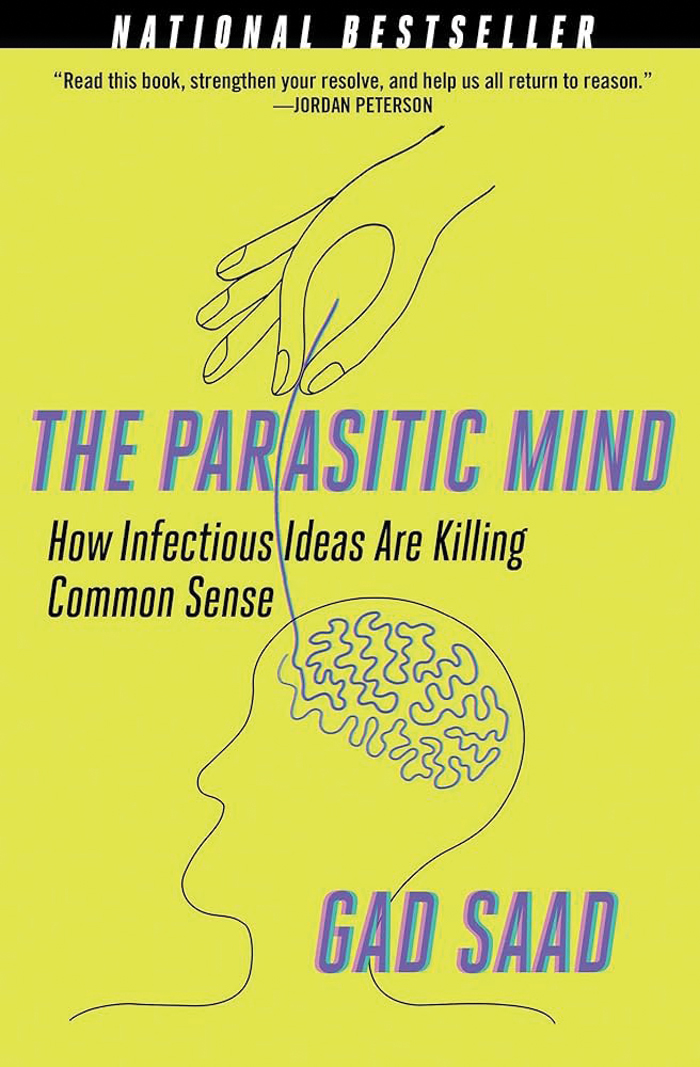
Saad, who is also an author (“The Parasitic Mind,” “The Saad Truth About Happiness”), has mostly been away from campus due to his sabbatical; when he is on campus, he is escorted by a security detail. 

“It’s a very hostile environment,” Saad told The Journal. “It doesn’t mean every student is a rabid activist, but there is certainly a demographic reality at my university that doesn’t make it hospitable to folks like me.”

Saad is used to being a target; he’s been dealing with it his entire life. Born and raised in Beirut, Lebanon, he was surrounded by antisemitism growing up. In 1970, when Egyptian president Gamal Abdel Nasser died, 5-year-old Saad saw a group of protestors walking by his home, shouting, “Death to Jews!” And later, when a teacher asked students what they wanted to be when they got older, one stood up and yelled, “a Jew killer!” The class exploded in applause. 

When Saad and his family finally escaped Lebanon, his mother pulled out a Jewish necklace for him as soon as the pilot announced they cleared Lebanese air space. She told him he could wear the necklace from that day forward; he didn’t have to worry about concealing his Jewish identity anymore.

A few decades later, Saad’s son went to play soccer in Montreal’s East End and had a vastly different experience. “My son tells me, ‘If you had been wearing a Star of David where I played soccer, you’d be dead,’” Saad said. “He said this in Montreal in 2023.”

None of this is surprising to Saad. He’s been warning us about it for years. “I saw the writing on the wall,” he said. “You don’t need to be a fancy professor to extrapolate patterns and see what’s coming down the pipeline.”  

Saad, an expert in the application of evolutionary psychology in marketing and consumer behavior, has witnessed the societal decline in the West over the past few decades. He outlined it in his well-known 2020 anti-woke book, “The Parasitic Mind: How Infectious Ideas Are Killing Common Sense.” It illustrates how bad ideas, which he calls “idea pathogens,” are eroding Western society and threatening truth, reason and freedom. He highlights the anti-intellectual discourse taking place on college campuses, the tyranny of political correctness, the danger of identity politics and the triumph of feelings over facts. 

The controversial book made him a target of progressives, who have been active participants in the “pro-Palestinian” antisemitic protests on campuses and in city streets. 

One of the defining marks of wokeism, Saad said, is viewing the entire world as either part of the oppressor or the oppressed group – which has made it excusable to attack Jews. “Irrespective of what the truth is, the Jews are inherently the oppressors, and the Palestinians are noble, innocent people,” Saad said. “The Columbia political science department – and other every university in the U.S. and Canada – teach that until 1948, Jews and Muslims lived in peace in the Middle East, holding hands and playing John Lennon’s ‘Imagine’ on repeat. Out of nowhere, these bloodthirsty, white Zionists who had absolutely no connection to the ancestral land of Judea came in and were brutal. They founded modern-day Israel on the principle of Zionism and have participated in the daily genocide of the Palestinian people ever since. If I’m a 20-year-old kid who’s learning this, it’s not surprising if I don the keffiyeh.” 

Kent Nishimura/Getty Images

Unlike other professors in American and Canadian universities, Saad doesn’t bring his personal opinions into the classroom. “I’m very disciplined and never mix my professorial responsibilities with my outside responsibilities,” he said. “I’m mandated to teach a course on evolutionary or consumer psychology. I never talk about Israel in the classroom.”

Even when faced with hostility, he won’t bring it up. “Usually, I take a selfie with my students, and there’s love everywhere,” he said. “Three students once refused to be in the selfie. They were all of a certain demographic background. One of them said she doesn’t want a selfie with me because she’s seen my tweets and she’s appalled.”

Since Oct. 7, a number of university presidents have been questioned by Congress, and some have been fired or forced to resign over their response to antisemitism on campus. While this is a move in the right direction, according to Saad, it’s only a Band-Aid.

“You’re not going to get rid of the endemic Jew hatred you see everywhere without eradicating the ideas that have been allowed to proliferate on these campuses. We can get rid of a few presidents, but it won’t do much.”

“It’s a highly visible move that’s meant to placate the big donors who might otherwise say, ‘You can forget about my $100 million donation if you don’t do something,’” he said. “We need a much larger solution. While animals and human beings can have actual brain worms, human beings can experience ideological brain worms, too. Many of these were spawned on university campuses over the past 40 to 80 years. You’re not going to get rid of the endemic Jew hatred you see everywhere without eradicating the ideas that have been allowed to proliferate on these campuses. We can get rid of a few presidents, but it won’t do much.”

Another troubling trend that has emerged post-Oct. 7 is the union of progressives with the radical Islamists to team up against Jews and the West. Because of shortsighted immigration policies like open borders, Saad argues, there is now the huge problem of anti-Jewish, anti-West sentiment in swaths of society. “When you let in millions of people who come from societies where the definition of those societies is to hate Jews, it doesn’t take rocket science to see that antisemitism will go up,” he said.

Right now, Saad calls the progressive-Islamist union a “marriage of convenience – until the snake turns and eats its head.”

Right now, Saad calls the progressive-Islamist union a “marriage of convenience – until the snake turns and eats its head. Progressives say, ‘Capitalism is evil,’ ‘Down with the bourgeois’ and ‘We hate the West.’ They say, ‘Here is another group of guys saying the West is diseased. That’s great.’ Once the West has been destroyed, good luck progressives. Watch what is coming for you.”

“I’m pessimistic until people hopefully wake up. If they had woken up 20 years ago, the solution would be a lot less painful today. If we don’t stop it now, in five to 10 years, it’ll keep getting worse.” 

With all this unfolding, Saad sees two ways it can go. “The optimistic lens is that the great silent majority hates this stuff,” he said. “The pessimistic conclusion is that they are the silent majority. If people don’t find their spines and testicular fortitude, then it can’t be resolved. I’m pessimistic until people hopefully wake up. If they had woken up 20 years ago, the solution would be a lot less painful today. If we don’t stop it now, in five to 10 years, it’ll keep getting worse.”

As someone who escaped an extremist society, Saad was still surprised by the post-Oct. 7 antisemitism. “I was somewhat taken aback by the extent of the orgiastic Jew hatred,” he said. “It came from different sources: the Islamic sources, the Neo-Nazi right-wing, ‘The Jews won’t replace us’ Charlottesville types, the academic progressives who called us ‘Zionist baby killers.’ In any direction I turned, Jew hatred was coming at me.” 

The professor, who taught at UC Irvine from 2001-2003, even contemplated leaving Canada and finding refuge elsewhere. 

“I was seeing the protests unfolding in Montreal and wanted to say, ‘Take me back to the Middle East, because it’s safer there,’” he said. “My wife and I were sitting in a café and she said, ‘Where do we go next, Gad?’ I said, ‘Maybe some island in the Bahamas or Argentina. I jokingly say that notwithstanding what happened to Hungarian Jews in World War II, we could live in Hungary. You don’t see protests there. They aren’t very tolerant of open border policies. Jews may have to find refuge in 20 or 100 years in societies that do not succumb to suicidal empathy. We are so empathetic that we are letting in millions of people that say, ‘We will destroy your society.’”

Many people in the silent majority don’t speak up because they are afraid the woke mob will cancel them, or they are worried about their safety. In Saad’s experience, most of the hate has only been on the internet.  “I’ve received many death threats, but typically they’re online,” he said. “I was only threatened in person once, while walking with one of my children, who was 10 years old at the time. You have to be concerned. But I’ve been fortunate because there have been innumerable times when people come up to me, and only one was negative.”

Despite all the doom and gloom, despite all the antisemitism and threats and existential crises he’s facing as a Canadian, Saad is a remarkably cheerful person. He describes himself as playful, and often jokes around in interviews, like in his 10 appearances on “The Joe Rogan Experience” and his own show, “The Saad Truth with Dr. Saad.” 

Despite all the doom and gloom, despite all the antisemitism and threats and existential crises he’s facing as a Canadian, Saad is a remarkably cheerful person. He describes himself as playful, and often jokes around in interviews, like in his 10 appearances on “The Joe Rogan Experience” and his own show, “The Saad Truth with Dr. Saad.” 

His newest book, “The Saad Truth about Happiness: 8 Secrets for Leading the Good Life,” (the paperback edition was published on May 14) is a lighter turn for the author. In it, he writes about how resilience is the key to happiness, the importance of finding a spouse who is as playful as you, doing things in moderation and why your career must serve a higher purpose than a paycheck. It’s about building a life that is true to you – one that you look forward to living every single day.

“I wrote the book because people said to me, ‘You always seem to be playful,’ and they wanted to know my secrets,” he said. “While 50% of our happiness score stems from our genes, that other 50% is up for grabs. The types of decisions I make or mindset I have can ameliorate or worsen my disposition.” 

What makes Saad happy is being creative: teaching classes, writing books, recording his podcast and fulfilling his higher purpose. He could only reach that level of happiness by doing what he wanted. Even though his colleagues may have preferred that he stayed in the university setting, writing academic papers that only a few people would have seen, he went out into the world, creating valuable content for everyone to see. “I’m not a stay-in-your-lane professor,” he said. “I took advantage of social media. I knew it was a great opportunity to spread good ideas to millions of people.”

Now, Saad is encouraging others to do the same, and showing that even the simplest of actions matter in life. In the past, when returning to Southern California with his wife and kids, he’d use the time there to teach a valuable lesson.

“My family and I would always go to the beach, and we’d do the very small gesture of filling up a bag with any garbage we saw,” he said. “I’d tell my children that literally as a result of us being at the beach that day, we picked up a lot of garbage and made the world a better place. If everyone approached it that same way, it’d be a cleaner beach. That’s a metaphor. Hopefully, I’m doing something good. Hopefully, they will say I did my best, and that I made a positive contribution.”


Kylie Ora Lobell is the Community Editor of the Jewish Journal. 

The Saad Truth Read More »

The Lost Gaza War Is Not the End of Israel

Yes, Israel has lost the war in Gaza.

No, it’s not the bitter, bloody end of the Jewish state.

When Israeli Prime Minister Golda Meir famously said that if the Arabs lose a war, they lose a war, but if Israel loses a war, it loses everything, she was right—for her time. The 1973 war threatened Israel’s existence. Heroic Israeli army operations and a huge American airlift of weapons and ammunition saved the Jewish state but left it in a deep, decades-long trauma.

The pogrom of last October 7, when Hamas sent thousands of bloodthirsty terrorists across the border and killed, maimed, mutilated, and raped more than 1,200 Israelis, most of them civilians, taking more than 200 hostages, equally traumatized Israelis. However, the state itself was never in danger of destruction. Israel is many times stronger than it was in 1973. Today, defeat in war is painful, but it does not mean losing everything.

And defeat it is. Israel has failed to achieve its stated goals: wiping out Hamas and returning all the hostages.

Even the capture and occupation of Rafah, the Gaza city on the Egyptian border that hides dozens of huge tunnels Hamas uses to smuggle weapons, ammunition, rockets, and vehicles, will not bring about the achievement of those goals.

So, Israel lost the Gaza war. But did Hamas win?

That depends on the definition of “win.” It can be said that Hamas already won on Oct. 7, when its terrorists embarrassed the vaunted Israeli military, overran army bases, killed so many Israelis, and made it back to Gaza with the hostages.

It can also be said that Hamas won by continuing to exist as a force in Gaza despite the devastation wrought by the Israeli military, which has killed many top Hamas commanders and thousands of lower-ranking terrorists, blown up dozens of tunnels, and destroyed weapons stockpiles and workshops.

Most of all, Hamas has won by putting the Palestinians back on the international map after years of neglect, making Israel a pariah in the world again, and endangering the grand US plan of forging an alliance between Israel and moderate Arab nations.

Does it make sense for Israel to continue pressing for the achievement of its unachievable goals? Or should it shift gears and work toward something attainable?

Does it make sense for Israel to continue pressing for achievement of its unachievable goals? Or should it shift gears and work toward something attainable?

If the answer is the latter, then Israel needs new leadership. In the current government, Prime Minister Benjamin Netanyahu is trapped by the demands of the most extreme elements in his cabinet, who take the most hawkish stands on everything, foreign and domestic, and likely don’t want an end to the war.

New Israeli leadership must adopt a practical plan of action to salvage as much as possible from the Gaza war wreckage and rehabilitate Israel’s image and place in the world.

First, Israel must accept these principles:
Israel cannot go against the world alone.
Israel should not fight Hamas, Hezbollah, and Iran by itself.

The first item may be hard to swallow. Generations of Israelis have been brought up in the shadow of the Holocaust, when the world stood by as the Nazis and their collaborators murdered 6 million Jews. Israelis were taught that Israel can count only on itself.

That is no less true today than 75 years ago, but it’s a luxury Israel cannot afford. Facing enemies like Iran, backed by Russia and China, and threats on all of its borders, Israel cannot continue to alienate its natural allies in the West and the Arab world. The ad hoc alliance that helped Israel repel the Iranian attack of hundreds of missiles and drones in April illustrates that. It might mean giving in to some demands Israel doesn’t like, but that’s the new reality.

Hamas and its extremist, genocidal Islamist ideology threaten not only Israel but also the West as a whole. Likewise, Hezbollah. Iran guides both groups, and just as the West banded together to negotiate a nuclear accord with Iran, it needs to band together again to deal with these threats.

This fits in with the second point. Hamas and its extremist, genocidal Islamist ideology threaten not only Israel but also the West as a whole. Likewise, Hezbollah. Iran guides both groups and just as the West banded together to negotiate a nuclear accord with Iran, it needs to band together again to deal with these threats.

In fact, there is a UN Security Council resolution that bans Hezbollah from operating anywhere near the Israeli border. So, clearly, it isn’t Israel’s responsibility alone to stop the Hezbollah rocket and drone attacks on Israel’s north.

But is it practical to expect the world to switch over to Israel’s side after more than seven months of devastating warfare in Gaza and the tsunami of anti-Israel sentiment sweeping the world?

No, not as Israel is currently led. What’s more, it’s hard to imagine an Israeli leader who would agree to these points, the minimum for changing the world’s blanket criticism:

Agreeing to end the war in Gaza and pull Israeli troops out.

Allowing the Palestinian Authority a role in ruling Gaza after the pullout and leaving the administration of Gaza to them and their Arab partners.

Accepting negotiations toward the creation of a Palestinian state. I’ve written here previously that this is just a mantra—the Palestinians will never accept an offer of a state.

These steps will not bring peace. After the Oct. 7 attack, peace is many years, maybe decades, away. At best, these steps may restore a reality Israel can live with, if painfully. It’s part of the price to be paid for falling into a “conception” that Hamas would not use the tens of millions of Qatari dollars flowing through Israel for four years to prepare for a war.

And as long as Israel is trapped in its “conception” of total victory and us-against-the-world, the war will drag on and on; Israeli casualties will mount, and no hostages will be freed.

If, on the other hand, Israel changes course and teams up once again with the more sensible elements in the world, with their help, there’s a chance that Gaza can be relatively pacified, the hostages freed, and Hezbollah put back under its rock.

That’s the only way to turn this defeat into anything that resembles a victory.


Mark Lavie has been covering the Middle East for major news outlets since 1972. His second book, Why Are We Still Afraid?, which follows his five-decade career and comes to a surprising conclusion, is available on Amazon.

The Lost Gaza War Is Not the End of Israel Read More »

The Resonance of Rabbi Goren’s Prayer for Jerusalem

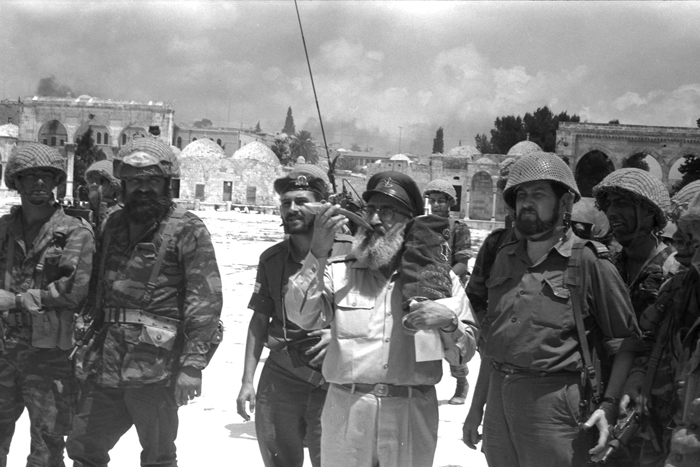
Fifty-seven years ago, Rabbi Shlomo Goren slid down the side of a tank that was blocking the entry to the Temple Mount in Jerusalem. Shofar in hand, the IDF’s Chief Rabbi blew blasts of encouragement, gratitude and disbelief as he shouted to his fellow soldiers battling the Jordanians, “In the name of God, take action and succeed. In the name of God, liberate Jerusalem, go up and be successful!”

Ascending to the area where his ancestors brought sacrifices two millennia prior, he took his position next to Commander Motta Gur. He then offered a prayer. 

As Jerusalem Day is celebrated this year, beginning Tuesday evening June 4, Rabbi Goren’s words then are worth revisiting now, as Israel stands once more waging war against those who question our connection to our biblical homeland and seek our destruction.

“Israeli soldiers, beloved of the nation,” the rabbi began, as he recounts in his autobiography, “decorated with courage and victory, may God be with you.” Goren then hearkened to the ancient biblical figure Isaiah, manifesting the moment as the fulfillment of an ancient prophecy. 

“I am speaking to you from the plaza of the Kotel, the remnant of our Holy Temple. ‘Comfort my people, comfort them, says your God’ (Isaiah 40:1). This is the day we have waited for … the dream of all generations has come true before our eyes. The city of God, the place of the Temple, the Temple Mount and the Kotel, the symbol of the messianic redemption of the nation, have been redeemed this day by you, the heroes of the Israel Defense Forces. Today you have fulfilled the oath of generations – ‘If I forget you, O Jerusalem, may my right hand forget its cunning’ (Psalms 137:5). Indeed, we have not forgotten you, Jerusalem, our holy city, home of our glory, and your right hand, the right hand of God, has made this historic redemption.”

The rabbi then proclaimed his own prophetic vision, in which the “builders and liberators in Israel” would be joined by “Jews throughout the Diaspora who will arise and come to pour out their supplications to God, the Creator of the universe.” So it would be.

In the meantime, his remarks moved to the memory of the exodus from Egypt and the miraculous shelter that shielded the Children of Israel. “The Divine Presence that has never moved from the Kotel now goes before the hosts of Israel like a pillar of fire to light our way to victory, and surrounds us with clouds of glory before the people and the world.”

Anticipating complaints of exclusivity of access for Jewish worshippers, Goren offered a benevolent benediction:

“To the nations of the world we declare — we will respect all the holy places of all the nations that seek peace and faith. Their gates will be open to members of all religions.”

Stringing together sacred verses from Jeremiah, Zechariah and Lamentations, he emphasized once more how the assembled had found themselves in “fulfillment of the prayers of generations and the vision of the prophets.” He finished by reciting the traditional prayer of gratitude, “Blessed are You, our Lord O God, King of the universe, who has kept us alive, sustained us, and brought us to this day.” Tweaking the timeless aspiration expressed at the conclusion of Yom Kippur in the Passover Haggadah, he then ended by declaring: “This year in rebuilt Jerusalem!”

Rabbi Goren’s address serves as a source of reassurance and strength today. 

He was, first and foremost — like countless Jews across the globe in our own era — grateful for the self-sacrifice, boldness and bravery of those who battled on behalf of the Jewish nation. Courageous under fire and committed to the mission, they continue to serve with steely determination.

Secondly, Rabbi Goren appreciated what had been granted by God, though victory, and ultimate salvation, was not yet complete. In the ongoing conflict against Hamas and Hezbollah, it is crucial that accomplishments be recognized and acknowledgment expressed for the small miracles that accompany Israel’s ongoing survival in the face of unceasing hatred.

He envisioned a time of peaceful international cooperation and admiration for the Jewish people, when, to quote another prophet, “nation will no longer lift up sword against nation.”

Lastly, he envisioned a time of peaceful international cooperation and admiration for the Jewish people, when, to quote another prophet, “nation will no longer lift up sword against nation.” Though today’s headlines attest to how distant such a dream seems, it can and should remain steadily in our sights. 

After recounting his speech in his memoir, Goren adds a humorous but profound postscript. He ordered the soldiers nearby to sing “Hatikvah,” Israel’s national anthem. They, in typical Israeli fashion, disagreed. Instead they sang Naomi Shemer’s “Jerusalem of Gold,” a song Goren admits he did not know at the time. The song begins:

The mountain air is clear as wine
And the scent of pines
Is carried on the breeze of twilight
With the sound of bells.

This Jerusalem Day, let us pray that the scent of pines and peace, the sound of bells and not battles, emerge once more from the streets of God’s city.


Rabbi Dr. Stuart Halpern is Senior Adviser to the Provost of Yeshiva University and Deputy Director of Y.U.’s Straus Center for Torah and Western Thought. His books include “The Promise of Liberty: A Passover Haggada,” which examines the Exodus story’s impact on the United States, “Esther in America,” “Gleanings: Reflections on Ruth” and “Proclaim Liberty Throughout the Land: The Hebrew Bible in the United States.”

The Resonance of Rabbi Goren’s Prayer for Jerusalem Read More »

Dear Status Leftists

If only you hadn’t unfriended your publicly pro-Israel friends, ashamed to be connected to us even on social media;

If only you hadn’t mocked us privately, as though defending the one Jewish state was a sin equal in outrage to being insufficiently Botoxed; 

If only you hadn’t withheld information about anti-Israel nonprofits, information that could have saved Israeli lives;

If only you hadn’t shown numerous times that your Judean identity was dispensable, to be “used” only when it could help build your status.

If only you hadn’t shown numerous times that your Judean identity was dispensable, to be “used” only when it could help build your status. That your obsession with maintaining your status came before not just your extended Judean family but your close family and friends. Even your kids.

And then Oct. 7 happened. I truly believed this would mark a turning point in your lives. And for some, it did. Hamas’ barbarism had finally crossed too many lines, awakening an existential fear and the corresponding desire to fight back.

But for most of you, it was business as usual. If anything, you seemed to withdraw even further from your Jewish identities, boasting incessantly about your careers, as though that was the only thing of note happening in the world.

At that point, you embarrassed me. How could I have ever been friends with people who are loudly ignoring the worst atrocity to our people since the Holocaust?

And then you ignored the details as they emerged: The rapes, the beheadings, the burning of children and the elderly alive. The hostages. The campus intifada also had no effect on you, even though many of you have kids in the Ivies (of course).

And then you ignored the horrific video showing the barbarians kidnapping five young female Israeli soldiers, covered in blood. And the interrogations in which the terrorists bragged about gang-raping and then murdering women.

And then I began to understand. Conforming to trends — ideological or sartorial — is everything to you, even if those trends could eventually kill you and your family. Indeed, you would literally rather be dead than be seen fighting for the truth, correcting the avalanche of lies that have been thrown at our people. 

You have somehow convinced yourselves that the barbarians and their cult followers now set the trends: Jihad is the new black.

But it’s deeper than that. We all have a moral obligation to speak out in the face of evil. Moreover, many of you are in positions — as professors, heads of nonprofits, on boards — to have stopped the tsunami of antisemitism that is now consuming us. Your silence this past decade is not just immoral. It is complicity.

It’s also a version of moral narcissism. You adopt a moral position only if you think it will improve your status. As Richard Landes wrote, “signaling virtue trumps acting virtuously.”

I used to wonder how you could look at the photos of the hostages and say nothing. I no longer wonder. You feel nothing.

The hypocrisies abound. You call yourselves liberal, but liberalism entails bravery. You call yourselves feminists, but feminists don’t look away when the victims are Jewish.

And then there are the ironies. None of you have reached the level of “fame” that motivates everything you do. Why? Most likely because of your obsessive hyper-conformity. The Judean people innovate, create, change the course of history — because we have always been the ultimate nonconformists, from Abraham and Moses to Theodore Herzl, Sigmund Freud, Albert Einstein, Ayn Rand, and Leonard Cohen.

In stark contrast, life for you is a never-ending popularity contest. But one literally cannot innovate while pathologically idolizing fame.

At some point, a 21st century Tom Wolfe will write an updated “Radical Chic” about today’s status worshippers. The term “terrorist chic” has already been coined. Most of you don’t actually wear keffiyehs. But what you’ve enabled in the past decade is far worse.

At the end of my “Passage to Israel” book, I wrote: “Israel is indeed a mirror to one’s soul. Those who see the beauty, who stand up for the truth, who understand the meaning, will never regret where they stood in this moment in history, when silence is not an option.”

Little did I know in 2016 that some who I considered my closest friends would proudly show the world that they are soulless.


Karen Lehrman Bloch is editor in chief of White Rose Magazine. 

Dear Status Leftists Read More »

Is Judaism a Universalist or a Particularist Religion?

Shema Yisrael, Adonai Eloheinu, Adonai Echad!
Hear, O Israel! The Lord is our God; the Lord is One!

There are two meanings hidden in this message of Oneness — two visions of Judaism. 

The Lord is our God—a particularist religion and a particularist God who serves as the patron of a particular tribe. 

The Lord is One—a universalist religion and a universalist God who alone created the universe and all that is in it. 

This tension is explored more explicitly in the blessing read before the morning recitation of the Shema. It is a strange and beautiful piece of liturgy, which invites us to imagine two choirs of angels standing across from one another in the heavens, singing words of Torah. 

One choir sings a verse from Isaiah: “Holy, holy, holy, is the Lord of hosts: the whole earth is full of his glory!”

The other choir sings a verse from Ezekiel, “Blessed be the glory of the Lord from His place.” 

Both choirs, it is written, are saying  “words of the living God,” a phrase that indicates that this heavenly choir is no choir at all, but rather a cacophonous yet harmonious debate club.

The more famous usage of the phrase “words of the living God” comes from the Talmud: 

“For three years the House of Shammai and the House of Hillel disagreed. These said: The halakha is in accordance with our opinion, and these said: The halakha is in accordance with our opinion. Ultimately, a Divine Voice emerged and proclaimed: Both these and those are the words of the living God.”

In other words, the angels are having what is known in rabbinic thought as a machloket—a dispute. 

According to the first choir, God’s presence is boundless and omnipresent. All the earth is God’s domain. 

According to the second choir, God’s presence is localized to “His place,” which is to say Jerusalem.

Both perspectives, according to the blessing of the Shema, are “words of the living God,” which is to say that this tension is not a tangle to be combed out, but rather an integral part of the Jewish ethos. 

Both arguments are equally compelling. Our job, however, is not to decide which choir is correct. After all, both are the “words of the living God,” which is to say that this tension is not a tangle to be combed out, but rather an integral part of the Jewish ethos. 

The debates of the houses of Hillel and Shammai, when we look at them, seem to be earthly echoes of this heavenly dispute. Hillel’s Torah is expansive, flexible, and generous. Shammai’s Torah is strict, formalist, and uncompromising. Later Jewish debates (Hasid vs Misnaged, Orthodox vs Reform) will revolve around the same axis. 

It is said that a machloket for the sake of heaven will endure. True, but a machloket that loses its tension becomes a schism. When Paul stripped Judaism of its particularity, focusing exclusively on the universality of Jesus’ message, a new religion was born. Judaism, without the tension between the universal and the particular, ceases to be Judaism.

The blessing of the Shema states that each heavenly choir “gives permission” to the other to chant its verse. Though they sing different songs, they sing in harmony.

It would be beautiful if we could achieve such harmony here on earth, but the war in Gaza has raised the stakes for pluralism. We are hurt, frightened, and deeply concerned about the future of Judaism and the Jewish people. And while we can try to learn from the example of the angels, we are not angels ourselves.

Too many of us have already lost the balance. We have seen Jews abandon all tribal affinity in favor of a pastiche of universalist progressive values wrapped in a keffiyeh. We have also seen Jews abandon the Torah’s universalist message in favor of chauvinist, far-right iteration of Jewish nationalism.  

Those who hold the tension—honoring Judaism’s universalist morals even as they participate in the particularist life of the tribe—are little more than a remnant, but they are the true inheritors of the Shema’s message.

On their behalf, we read the plaintive prayer from our siddur, “Guardian of Israel, guard the remnant of Israel, and let not Israel perish, who say, ‘Shema Yisrael.’”


Matthew Schultz is a Jewish Journal columnist and rabbinical student at Hebrew College. He is the author of the essay collection “What Came Before” (Tupelo, 2020) and lives in Boston and Jerusalem.  

Is Judaism a Universalist or a Particularist Religion? Read More »

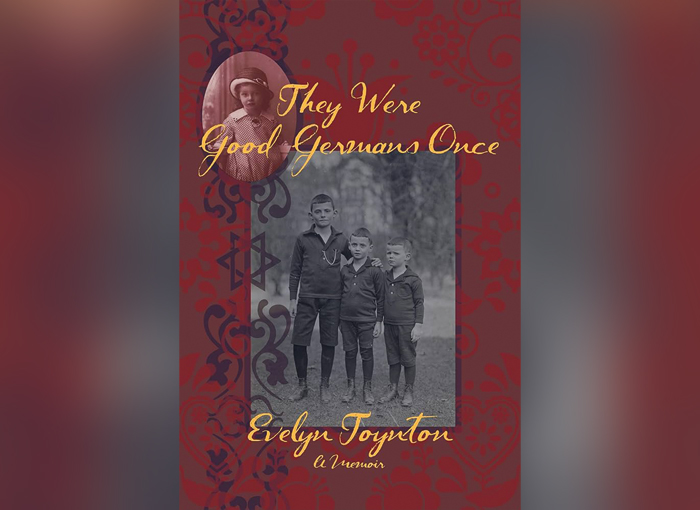
Marooned for Life: A Review of ‘They Were Good Germans Once’

When she was seventeen years old, novelist Evelyn Toynton and her sister were taken on a Grand Tour of Europe with their moody yet extravagant Uncle Hans. Their last night in Paris, they had dinner with a man who told them about his family’s terrible sufferings during World War II, after which Toynton said reproachfully to her uncle, “I don’t see how you can not hate the Germans.” She relates: “[My uncle] grabbed me without warning, shaking me so ferociously that the wind was knocked out of me, and screamed that they hadn’t known, nobody had told them what was really going on; the Nazis were only the scum, the German people had hated them, too, but what could they do, they had the guns; it was my precious English who had invented concentration camps…” 

This scene comprises the backbone of Toynton’s fascinating memoir, “They Were Good Germans Once: My Jewish Émigré Family.” This slim volume (I devoured it in a day) is less an account of Toynton’s life than it is a collage of her family, with various members navigating complicated emotions about a homeland—Germany—that in their youth seemed to offer culture, prosperity and acceptance, only to savagely betray them because no matter how assimilated they were, no matter how deep their loyalty and love for their country, they were Jews. 

Despite their good fortune in escaping Germany for new lives in America and elsewhere, each of Toynton’s relatives, with their German accents and German ways, their love of Schiller and Beethoven, is forced to reconcile his or her knowledge of what their country did to Jews, with lingering attachment they may have for the land and its people. No figure in Toynton’s memoir is so tormented as the above Uncle Hans, who she remembers in his beloved hometown, Nuremberg, his face revealing “bewilderment at the vagaries of history, at what had been done to him, which was so much less than what was done to so many others, and yet enough to leave him marooned for life.” 

The memoir’s early chapters struck a personal note. The stories about growing up in America in a thoroughly assimilated, secular Jewish family so closely resembled aspects of my own maternal Dutch Jewish family I found it almost eerie. No one in Toynton’s family spoke, even in whispers, about the Holocaust; aged ten Toynton discovered “The Diary of Anne Frank” on her own and was powerfully affected by it, but understood it was a subject not to be discussed. 

The silence was studied and selective. When Toynton was young, her grandmother had a friend, a fellow German refugee, who walked with a limp because an SA man threw her down a flight of stairs during Kristallnacht; whose husband was beaten to death in Dachau; whose two sons had been murdered in Auschwitz—but all her grandmother ever told Toynton about this friend was that she had prevented Toynton’s grandmother from perfecting her French, because she was forever luring her out to play tennis. (For all my grandmother’s sufferings at the hands of the Germans, the only charge I ever heard her make against them was that they’d stolen her horses.) When it came to those who populated Toynton’s early life, a tacit understanding prevailed that certain experiences were literally unspeakable. 

Of all the relatives profiled in Toynton’s memoir, only her Uncle George, or Giora, Hans’ brother, apparently responded to the Nazi rise to power by embracing his Jewish identity and becoming a fervent Zionist. He refused to celebrate Christmas with the family and married a German Jew his horrified parents called a “shtetl Jew”—because her family actually practiced Judaism. He smuggled money, people and maybe arms into Palestine during the British Mandate; brought his parents to live there in 1939; and had a hard life in Palestine before becoming a significant enough political figure that today in Israel, according to Toynton, “there are hospitals and schools and streets bearing his name.” 

Because he died before Toynton could really know him, most of the chapter about this uncle is related through his widow, Senta, that “shtetl Jew” who went with him to Palestine. Toynton describes Senta as a brusque, stoic, no-nonsense woman she didn’t know if she liked, but who made Toynton feel humble, “a smaller person than she was.” It was Senta who inspired Toynton’s WASP husband to remark, mournfully: “You think when you marry a Jew, you’re going to be part of this warm, loving family that hugs you and tells you great stories and gives you delicious things to eat. I got a bunch of Krauts.”

That Zionist uncle and his wife aside, the men and women of Toynton’s memoir visibly struggle with a desire to belong, retrospectively, to a country they consider, despite everything, as culturally superior. “They had all thought of themselves as Germans, after all, that being the only identity they’d been taught,” Toynton writes. “None of them had been given religious training, celebrated Jewish holidays, attended a synagogue except for weddings and funerals—and even weddings, in my uncle’s case, were often civil affairs, since many of the family married Gentiles. They had prided themselves on their assimilation; Germanness had pervaded their lives; and suddenly permission was withdrawn, they were not allowed to be German any longer.”

Upon moving to America, the schism between “shtetl Jew” and assimilated Jew was imported. Assimilation had failed in Germany, but in America, they seemingly believed, it was not only the path to acceptance, but the sign of enlightenment over religious backwardness. 

Upon moving to America, the schism between “shtetl Jew” and assimilated Jew was imported. Assimilation had failed in Germany, but in America, they seemingly believed, it was not only the path to acceptance, but the sign of enlightenment over religious backwardness. When Toynton’s sister became a practicing Jew, her mother was appalled. (“If this were television, I would turn it off,” she whispered to Toynton during the bar mitzvah of one of her grandsons.) The “good Germans” of Toynton’s title became good Americans, as indistinguishable as possible from their neighbors.

But not all assimilations are created equal. As much as they preferred assimilation into crass Americanism to a regression back to Jewish shtetlism, there is still a poignant if grudging nostalgia for the high culture of their former German lives. With the vagaries of history come the vagaries of identity.

Still, it is impossible to read this book, in post-October 7 America, without reflecting on the apparent limits of assimilation in this very country of freedom. Jews are still welcome in American universities, liberal political and professional groups and institutions, but, in many cases, only if they renounce their Zionism. A familiar dilemma presents itself, in which Jews are forced to weigh their attachment to their people against their desire, and need, to belong in the country they love. Toynton’s memoir is a reminder that nothing is new under the sun.


Kathleen Hayes is the author of ”Antisemitism and the Left: A Memoir.”

Marooned for Life: A Review of ‘They Were Good Germans Once’ Read More »

Rabbi Yanky Kahn’s Trips to Israel a Family Affair

When The Journal interviewed Chabad of the Valley’s Rabbi Yanky Kahn after his four previous trips to Israel, his two youngest sons — Menachem Mendel, 10, and Efi, almost 12 — sat quietly in the room. But before giving his perspective on trip number five to the war zone, Kahn invited the boys into the conversation

In almost a whisper, Efi said, “It was, like, sad. Just really sad. I don’t know what I expected. But the streets are empty.” Menachem recalled that Efi found a bullet next to the Nova Festival where 360 Jews were murdered on Oct. 7. “They were finishing putting up a stone for one who had died at the festival,” he said. “It was sad.”

Taking a wider perspective, Rabbi Kahn said that “people are trying to get back into their daily routines. You can feel it in the air. They are trying to adapt. Families who have been evacuated from their homes now have new homes, and they are trying to adapt to their extremely challenging new lives.”

One of the people Kahn and his family met was Shlomo, a father from Kibbutz Nir Oz. He told Kahn that on Oct. 7 all his neighbors on one side of his home were taken hostage while everyone on the other side were burned alive.

When Hamas terrorists took over his home, Shlomo and his wife fled to a nearby bomb shelter. Hamas terrorists spent their time consuming the family’s food supply while noisily destroying their property. “A small, humble house,” Kahn said. “The terrorists came inside and took whatever they wanted. A free-for-all.”

Shlomo told Kahn that he and his wife were just sitting there in a shelter, fighting to keep themselves safe because the shelter did not have a lock on the outside. Only a handle. They used a stamp collection to hold the handle tight. Shlomo stood there for eight hours, trying to protect his wife. The rabbi called it “a miracle” they survived.

Except for Jerusalem, everywhere the Rabbi, Rebbetzin Hindy Kahn and their four children went, there was destruction. “I don’t think there is one Israeli house that has not been affected,” Kahn said, “either by a family member or friends lost or injured, running to shelters, having a father who is running in or out of the army, having a mother who is trying to take care of all of the kids. You realize the stress in every single family. The impact is huge.”

During their two weeks in Israel, the Kahns tried to go all around Israel and visit as many people as we could. “We spent a lot of time next to Gaza and a lot of time in the West Bank, meeting old friends, widows, people who lost their children.”

Rebbetzin Kahn reflected on the first days. “When we landed in Israel, you walk through the airport and see the many signs about hostages,” she said. “You get emotional. These are people who are families, friends. Not just names but actual people with lives that have been cut short. I tried to stop by each sign. Then you feel as if you have connected with each one.” But when they met families of soldiers,” the rebbetzin said, “it was so much more emotional. We were all just crying.” 

What do the rabbi and rebbetzin do to help them? “We danced, believe it or not, with some families whose kids were taken hostage,” Kahn said. “We went to restaurants with some families whose kids were killed. Some families we visited, we gave them money. Just trying to help them. Every family reacts differently.”

Rebbetzin Kahn recalled a particularly touching scene. When the family went to Hostage Square “they were having a large protest, it was the hottest day in Tel Aviv and some family members were fainting,” she said. “Yanky gave a pair of tefillin to a father of one of the hostages. He said ‘This is for your son when he comes back. This is the hope for your son when he comes back, that he is going to put on these tefillin.’  The father was so touched, so happy to receive the tefillin. He was one of the people we were dancing with. The hostage’s brother was there.” Rebbetzin Kahn said nine members were taken from one family. A wife and two of the children were returned.  

On their daily visits with Israeli families victimized by the war, the Kahn were regularly reminded of two constants:

• Households respond in a variety of ways to tragedy.
• We Jews, worldwide, are a single family.

“In Los Angeles we live in one of the largest communities in the world. It is time to realize that we all are really one family. The people of Israel appreciate when Jews from Los Angeles come and give them support.”

In Los Angeles, Kahn said “we live in one of the largest communities in the world. It is time to realize that we all are really one family. The people of Israel appreciate when Jews from Los Angeles come and give them support.”

Near the end of their trip, on the day after Passover, there was a terrorist attack in Israel. Kahn immediately spun into action. “We said ‘We’re going to do something for the police who are risking their lives,’ so the Kahns threw a pizza party for all the police of Jerusalem. 

Every day requests for help come in, which Rabbi Kahn fields via Chabad of the Valley’s WhatsApp feed. (To donate, go to chabadofthevalley.com/israelrelief.) On each of his five trips since Oct. 7, he has pledged: “We will be victorious. The hostages will come home. The soldiers will come home safe. But it’s up to each one of us to do our work.” Since the war against Hamas is not over, Rabbi Kahn  isn’t pausing. Trip number six will be in June or early July.  

Each time he’s traveled to Israel Kahn has delivered a load of gifts – toys, clothes, bullet-proof vests, helmets and money. For his next trip, he ordered 250 mezuzahs.

The rabbi thanked Jeff and Rita Weiss for helping support his trips, and Mr. and Dr. Schmuel Izaac for sponsoring 100 mezuzahs. “Our goal,” Kahn said, “is to make sure every army base has a mezuzah.”

Rabbi Yanky Kahn’s Trips to Israel a Family Affair Read More »

Milken Student’s Art Installation, The Guardians Celebrate LA Jewish Health

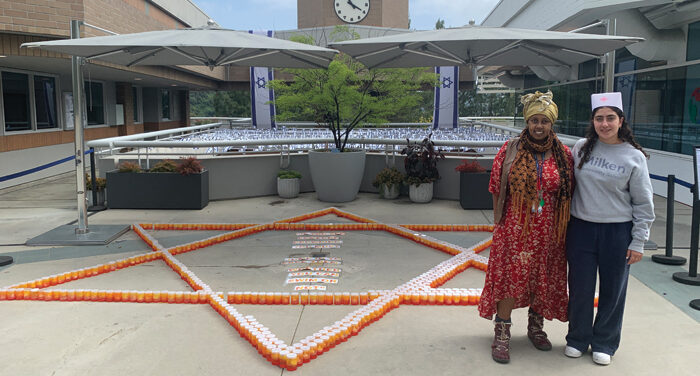
Julia Refoua, an eighth-grade student at Milken Community School, has created an art installation inspired by the little-known story of Irena Sendler, a Polish nurse and social worker during World War II who saved 2,500 Jewish children by smuggling them out of the Warsaw Ghetto. 

Julia designed the art piece – featuring 2,500 jars, each painted a translucent red, orange and yellow, with a LED candle floating in water inside – as part of her coursework for her Milken art class and as her official submission to the Lowell Milken “Unsung Heroes” competition.

Milken eight-grade student Julia Refoua poses with her recently unveiled art installation, on display at Milken’s upper campus. Photo by Ryan Torok

The jars are arranged to form a large Star of David, which encircles the quote, “If you see someone drowning you must jump in to save them, whether you can swim or not.” These were works reportedly spoken to Sendler by her father when she was just seven years old.

Julia created the piece in collaboration with her art teacher, Mimi Klabon. It was on display at Milken, greeting visitors to the school as they descended the outdoor stairs at the upper campus’ front entrance, from May 22-28. Over the course of those days, Julia’s classmates were encouraged to take a jar, place a candle inside and add it to the ever-growing red, orange and yellow Magen David – which Julia said was purposely colored to resemble a sunrise. The sunrise, she said, symbolized the new beginning each rescued child was given thanks to Sendler’s courageous efforts during the war.

“This was a piece not just for me to get involved with but for everyone to get involved,” the 14-year-old Milken student told the Journal. 

During the process of making the piece, Klabon exposed Julia to iconic works including Israeli sculptor Menashe Kadishman’s “Fallen Leaves,” an installation featuring 10,000 faces with open mouths cut from heavy iron plates, and Japanese artist Yayoi Kusama’s “Obliteration Room,” an interactive experience that begins as a sparse, white space and is decorated over time by colorful stickers. Klabon also introduced Julia to artwork by Yoko Ono.

As Klabon anticipated, Julia absorbed these influences when creating her own installation.

“She’s a brilliant and smart kid,” Klabon said. “This is a massive undertaking.”

Julia also became familiar with Sendler’s amazing story. During the war, Sendler kept lists of the real names of the Jewish children she saved in jars that she then buried in a garden. Years after the war, in 1965, she was honored by Israel’s Yad Vashem as one of the Righteous Among the Nations. She died in 2008 at age 98. 


From left: Guardians Co-Chairs Gideon Orion and Jeff Schlesinger, honorees Fred Leeds and Ben Leeds, Chair Tony Berns, Guardians President Anthony Behar and Co-Chair Brian Good. Courtesy of The Guardians of LA Jewish Health

On May 9, at the Fairmont Century Plaza, The Guardians—a support group of Los Angeles Jewish Health—honored Ben Leeds and Fred Leeds at their 2024 Real Estate Dinner. The nearly 700 guests in attendance had an unforgettable fun-filled night, while breaking The Guardians’ fundraising records.

 For more than 85 years, The Guardians have supported the thousands of seniors cared for by Los Angeles Jewish Health, formerly known as the Los Angeles Jewish Home, while simultaneously building personal and professional relationships through philanthropic endeavors. In addition to real estate dinners, Guardians events include annual golf and poker tournaments, comedy nights, networking speaker series and more. For further information, call (310) 479-2468 or email michael@laguardians.org.

Milken Student’s Art Installation, The Guardians Celebrate LA Jewish Health Read More »

The Wait

In the late 1950s, my parents moved us to 2032 Creston Ave in The Bronx. It was a six-story walk-up, which meant no elevator. You walked up and walked down and back up when it was time. If I realized I had forgotten my homework, I’d take the zero instead of climbing back up Everest. For years, I logged thousands of steps a week, and I’m probably alive today because of them. 

For my first three years of school, my parents sent me to an Orthodox yeshiva called Yeshivat Zikhron Moshe. We had two sets of dishes at home, but not for kosher reasons; one was to eat off, and the other was to throw against the wall during fights. I was not sent to yeshiva because we were religious, but because my parents worked full-time and needed a place to keep me until 5:00 p.m. On Fridays, we were let out at 1:00 p.m. because of Shabbos.

On Fridays, the school bus dropped me off at The Royal Luncheonette on the Grand Concourse. I’d arrive around 1:00 pm and wait until my mother picked me up around five. I sat at the counter in the back on the last stool and loved every minute of it. 

So on Fridays, the school bus dropped me off at The Royal Luncheonette on the Grand Concourse. I’d arrive around 1:00 pm and wait until my mother picked me up around five. I sat at the counter in the back on the last stool and loved every minute of it. Sitting alone made me feel grown up. There is nothing like studying Shlomo Yitzchaki, generally known as Rashi, while eating treif a la mode.

The owner, Julie, was one of the nicest men I ever met. Julie wore a Jewish star that sat comfortably on his curly light brown chest hair. His white apron covered both slacks and his button-down. Somehow, his apron was always spotless. The apron only came off when he went to put money in the meter or was going home. 

Julie worked the register and made egg creams, root beer floats, and lime rickeys. If I wanted candy, I’d grab something, hold it up for Julie to see, and he would write it down. My mother worked out a deal with him: I could eat and drink anything I wanted, and she’d pay for it when she got there. I loved it. At seven years old, I wasn’t like the proverbial kid in the candy store; I was him.

I sat directly in front of the grill where Hank, the short-order cook, performed his magic. When I was eight, Hank seemed ancient, probably in his early 40s. His hair was a deep gray, like the hide of an elephant. His wrinkled cheeks reminded me of ocean waves. Before heading home, he wore a cross that he’d wipe and then buff clean of work grease.

When I sat down, Hank would ask, “You want a soda?” “Yes. Thanks, Hank.” All drinks came in a six-ounce glass with the Coke logo. When someone ordered a burger, Hank would reach into a chest freezer, pull out a frozen patty, and toss it from five feet. On landing, the burger would spin like a top until collapsing onto the blazing hot grill.

Friday’s blue plate special was always meatloaf. Oh, how I loved Hank’s meatloaf. My mother never cooked anything that topped it. No offense to my wife, but to this day, it’s still perhaps the best thing I ever tasted. He would put a giant slice of meatloaf between two pieces of soft caraway seed rye bread, top it with some beef gravy, add fries, drop a few half sours, and the gates of heaven swung open.

Watching Hank love what he was doing made me want to be a cook. I’d sit for four hours, watch him, and watch dozens of customers coming in and out. Many of them thanked Hank and told him how great their meal was. He never complained and always smiled when he put a plate of his best in front of you. 

When I was 18, I considered going to culinary school in Connecticut. Thank God I was not accepted, so I cooked something at home almost daily instead of cooking for the public. Eventually, I cooked up jokes and stories to earn a living, which I loved more than you could imagine. Finding something you love to do can unlock a door to happiness.


Mark Schiff is a comedian, actor and writer, and hosts, along with Danny Lobell, the ‘We Think It’s Funny’ podcast. His new book is “Why Not? Lessons on Comedy, Courage and Chutzpah.”

The Wait Read More »