fbpx

May 9, 2024

ADL, Brandeis Center File Complaints Against Occidental, Pomona College Over Antisemitism

The Anti-Defamation League and Louis Brandeis Center for Human Rights Under Law announced on May 9 that they have filed complaints to the Department of Education’s Office of Civil Rights against Occidental and Pomona Colleges over allegations that both schools have allowed severe climates of antisemitism to be fostered on their respective campuses.

Both complaints document allegations of Jewish students being bullied and harassed on campus. Students who are employed at Occidental, the complaint claims, have had their employment adversely affected by campus antisemitism. One anonymous student quit her job at the student-run campus coffee shop after her friend was asked by her supervisor if the student is a Zionist; her friend lied and denied it. The student’s supervisor then allegedly said that she had “better start showing up to SJP’s [Students for Justice in Palestine] events or risk having students believe that she is a Zionist and she would not ‘want people thinking that.’” The student felt that she would have “to hide her identity” in order to avoid harassment at work; she ended up later hiding her Star of David necklace after “being confronted about it in the dining hall,” the complaint states.

Jewish students at Occidental also allege that they are harassed by anti-Israel protesters if they refuse “to take pro-Hamas pamphlets or pamphlets containing ancestry-based anti-Semitic content … protesters block the path so that the Jewish students cannot walk past. In some cases, Jewish students who try to walk away are tailed by the protesters, who continue to demand they take the flyers. Or protesters shout that the Jewish student is a ‘f—ing Zionist,’ ‘f—ing Jew,’ or  ‘k—’ who should ‘go back to the gas chamber.’ The protesters are often masked, compounding the anxiety created by their conduct.” According to the complaint, the college has not taken action when these incidents are reported.
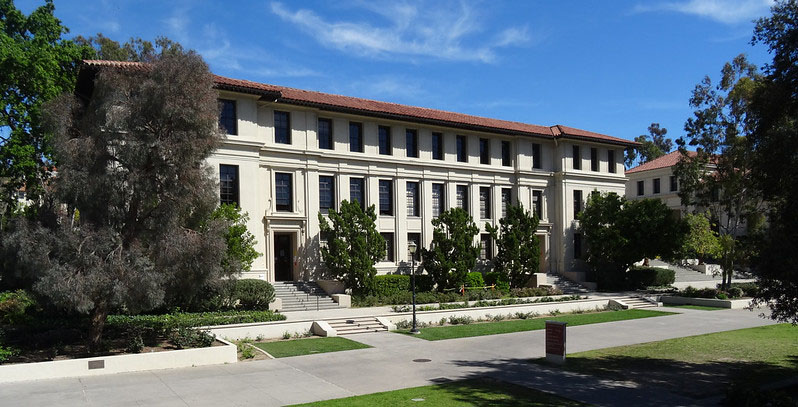
Occidental College, Administration Building. (Jeffrey Beall CC BY-SA 2.0 DEED
Attribution-ShareAlike 2.0 Generic)

The complaint also contends that when anti-Israel protesters occupied the Coons Center building on Occidental’s campus — where President Harry Elam, Jr.’s office resides — the college “rewarded” the protesters, as “President Elam sent an email to the entire school listing the demands of the group that organized the occupation, SJP, and stating that the administration looked forward to a continued dialogue and relationship with SJP. SJP proclaimed victory on Instagram.” The protesters had been chanting “there is only one solution, intifada revolution” and were aided by the college’s faculty and staff who provided them with food, water and other supplies and even participated in the chanting, per the complaint.

The complaint also accuses Occidental of unevenly enforcing the college’s policies in favor of the anti-Israel students, alleging that blue ribbons on trees to commemorate the victims of the Oct. 7 massacre were taken by down because they did not receive approval from Student Leadership, Involvement, & Community Engagement (SLICE) beforehand. But this policy was not enforced for SJP’s posters and messages that they wrote in chalk on the sidewalk.

Further, the complaint states that faculty have played a role in fostering the hostile climate against Jewish students, citing one alleged instance in which a faculty member told the class she was “invigorated” by the Oct. 7 massacre and the class erupted with applause. Other faculty members have allegedly canceled classes in order to participate in SJP’s walkouts.

The effect on Occidental’s Jewish students, the complaint claims, is that “several Jewish students chose to transfer to other schools to avoid the antisemitic environment at Occidental, including one student who chose to attend a community college next semester rather than continuing to endure the Occidental environment. Some Jewish students leave campus for days when they know that there are protests planned. Other students remain in their dorm rooms during the protests, sometimes skipping meals and class. Many students report that their ability to study is impaired.” And despite meetings with parents on the matter, the college has “failed to act in any meaningful or effective way” to address the situation.

Occidental College said in a statement to the Journal, “We’ve been made aware of a complaint from the ADL and Brandeis Center to the Department of Education Office for Civil Rights (OCR) concerning the College. Currently, there are no open OCR investigations into Occidental. If OCR decides to open an investigation related to this complaint, we will of course cooperate and answer any questions that they may raise. As Inside Higher Ed has reported, OCR has approximately 145 open cases relating to similar complaints tied to shared ancestry. We’ve sought to engage and work with our students and the broader campus community to demonstrate our commitment to preventing antisemitism.” They added that they shared a “letter with the ADL, which details many steps the College takes to combat antisemitism and promote constructive dialogue.”

The statement referenced a Dec 5 letter Elam sent to the AOL (which was obtained by the Journal) that outlined how the college established a Task Force on Promoting Community and Safety. The Task Force’s actions include “requiring student-service departments (including those listed in your letter) to remove their ‘likes’ of politically oriented posts on social media, and instructing them to avoid similar activity through Oxy-affiliated accounts … requiring SJP and other groups that participated in recent, non-compliant demonstrations to attend specialized training on the College’s Posting & Publicity and Dissent & Demonstration policies,” and “instructing faculty that they may not impose their political affiliations on students in the form of canceled (and not rescheduled) classes.” Additionally, Elam claimed that the Task Force has been “holding accountable student organizations and individual community members regarding their comments and actions that could contribute to a hostile environment for Jewish students on campus.”

Elam further argued that Occidental’s Office for Religion and Spiritual Life “has been meeting regularly with Jewish students, and has hosted several communal holding spaces for Jewish students since Oct. 7” and has a “strong” relationship with the Jewish Federation of Greater Los Angeles. The office has also hosted yearly events featuring Holocaust survivors sharing their stories, contended Elam. “My goal in meeting with dozens of Jewish students, parents, trustees, and advocacy groups in the past few weeks has been to listen actively, and respond thoughtfully,” he said toward the end of the letter. “Occidental is a living institution that continually grows and adapts to the circumstances it faces. We rely on the many, diverse, and dedicated members of our community to shine light on those among us who need more support.”

“We’ve continued to build on these efforts throughout the academic year, including a required anti-bias training for students in the spring of 2024 and a planned, required program on preventing antisemitism for the fall of 2024,” the college added in its statement to the Journal. “We have consistently shown our commitment to proactively creating an environment free of antisemitism and actively investigating concerns when they are reported regarding discrimination based on protected categories. Our top priority is to ensure a climate where our students and the entire College community can thrive and engage in dialogue on complex, sometimes painful, issues.”

***

At Pomona College, on Oct. 20, at least 15 student groups built a shrine at a campus fountain for “the insurgents who have died for the liberation of Palestine” and held a rally at that location. The anti-Israel protesters at the rally saw two Jewish students and the Hillel’s executive director putting up posters raising awareness of those being held hostage by Hamas, at which point “they approached them, surrounded them, physically stood in front of them to prevent them from hanging up the posters, and refused to move.” “The SJP and JVP [Jewish Voice for Peace] students then trailed the Jewish students and the Jewish staff member, obstructed their paths, stepped on one of the Jewish students’ feet, verbally harassed and yelled at them (accusing them of supporting genocide and chanting antisemitic slogans such as, ‘from the river to the sea, Palestine will be free’), ripped down the posters they had put up, and tore up at least 300 of their pre-approved flyers,” the complaint continued.  “As the students ripped down images of innocent hostages, the Executive Director of Hillel calmly told the protestors ‘excuse me, that is approved, you are not allowed to remove that flyer.’ One angry SJP or JVP student responded, ‘you can dig it out of the trash where it belongs.’”

Also during the Oct. 20 rally, a Jewish student was allegedly assaulted by one of the anti-Israel protesters who “aggressively pushed him into a wall” after accusing the student of recording them; the Jewish student claimed that his phone was out as he was passing by the rally but wasn’t recording. Two other anti-Israel protesters allegedly followed the student and “questioned him in an intimidating manner.” The Jewish student, who is traumatized by the assault, was unable to file a report to Pomona College about it because the alleged assailant was masked, nor were there any security around at the time of the rally.

The complaint goes onto highlight “disruptive” actions taken by anti-Israel protesters, such as blocking entrances to campus buildings, including when Pomona College’s annual “Harry Potter Dinner” was held in December — the protesters forced the event to be shut down altogether. President G. Gabrielle Starr lamented the “hundreds of pounds of food going to waste” in a subsequent email but did not mention the protesters’ antisemitism. Additionally, the protesters “harassed tour groups” at the end of March, causing one prospective student to “tremble and sob” and leave early. And on March 29, the anti-Israel protesters occupied the lawn in front of the Smith Campus Center and built an “apartheid wall”  and stayed “well into the afternoon.”

Events on campus eventually reached a boiling point April 5, when staff members started removing “signs and other materials protesters had put up on the Smith Campus Center lawn.”  “The masked individuals, however … verbally harassed campus staff for more than two hours (including addressing a campus administrator with an anti-Black racial slur), refused to remove their signs, and refused to identify themselves for administrators,” the complaint states. “In protest, demonstrators then stormed Alexander Hall and invaded President Starr’s office.  President Starr ordered the demonstrators to leave or face suspension or arrest.  These students — many of them masked — occupied President Starr’s office and refused to leave.” Police later arrested 19 people involved. Starr sent out a subsequent email condemning the events that occurred that day and warned that students at Pomona College and at other campuses in the Claremont Consortium (of which Pomona College is a part of) will be subjected to disciplinary measures.

In response, anti-Israel protesters held a sit-in in front of Alexander Hall, blocking “the avenue for at least 33 minutes” on April 11; campus security has continued to remain in front of Alexander Hall ever since, per the complaint, although they acknowledged that was “as of last week.” That same day, faculty members passed “a resolution condemning the college and in support of the students who were arrested on April 5” and urged the college to revoke the charges and disciplinary measures against those students.

The effect of all this on the Jewish community on campus, the complaint contends, is that “some Jewish students have transferred to other schools; others have tried to study abroad or study remotely since Oct. 7.” “Others have had to refrain from participating in certain educational and/or extracurricular activities, including attending certain dining halls or cafés, areas on campus, or events,” the complaint states. “For yet others, it has meant seeking mental health counseling for the trauma they have endured. Prospective and admitted students have decided not to apply or matriculate at Pomona because of the intimidation they experienced while visiting the campus. The harassment, marginalization, alienation, and exclusion of Jewish and Israeli students at Pomona have become so bad, they are inescapable.”

One Pomona college student, Ayelet Kleinerman, said in a statement, “I have seen antisemitism here grow tremendously in the last 3 years. I have raised it with the administration many times, but even when they had the opportunity to take it seriously, they didn’t. They’ve called the police for their own safety, but they are not doing enough to protect Jewish students. From hate speech to retaliation in class and outside it to the mob that is occupying our campus and has taken over much of campus life, Jewish students are scared.”

Pomona College said in a statement to the Journal, “Pomona College is committed to confronting antisemitism in a sustained and comprehensive manner. We will continue to enforce our policies, promote safety and actively challenge this destructive form of hate.”

Anti-Defamation League CEO Jonathan Greenblatt said in a statement, “There’s simply no excuse for the persistent and pervasive antisemitic harassment being faced by Jewish students at Occidental and Pomona colleges. No student should be forced to transfer due to continual harassment. We urge the U.S. Department of Education to investigate these schools for potential civil rights violations and to take effective measures to protect Jewish students on these campuses.”

In his statement, Brandeis Center Founder and Chairman Kenneth Marcus said, “Jewish students on these campuses are hiding in their dorms and avoiding their own campus rather than risk verbal and physical attacks. Pomona and Occidental know full well this is happening. But instead of enforcing the law and their own policies, they are caving to the anti-Semitic mob and letting them bully, harass, and intimidate Jewish students.  Antisemitism left unaddressed will not go away.  It will only snowball and escalate until the problem is faced head on as the law requires.”

ADL, Brandeis Center File Complaints Against Occidental, Pomona College Over Antisemitism Read More »

Beit Issie Shapiro’s Global Impact: Transforming Lives and Communities

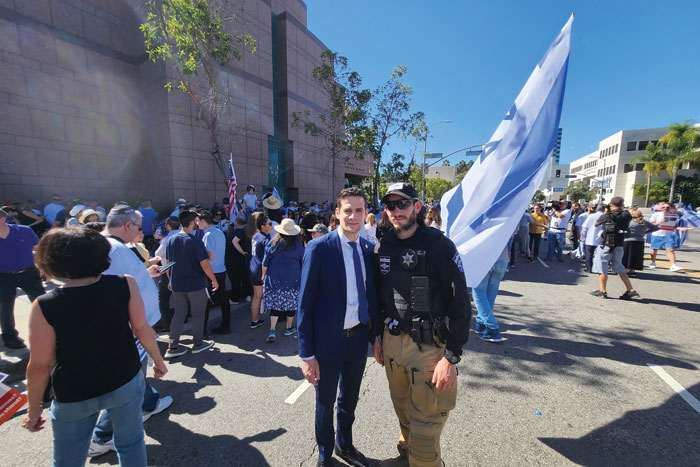
Ahmir Lerner, the executive director of Beit Issie Shapiro, arrived in Los Angeles in April for a series of events. Meeting with the Jewish community in town, he talked about the role of the organization in helping injured soldiers and civilians since October 7.

Ahmir Lerner (first from the right)

The organization which is based in Israel provides innovative therapies and state-of-the-art services for children and adults.

Lerner’s journey into the realm of social service began after a distinguished career in the Israeli Air Force and 22 years of service in the Prime Minister’s office. Over the past five years, he has been actively involved with Beit Issie Shapiro, a role that has taken him to Los Angeles on several occasions.

In an interview with the Journal, Lerner shed light on the organization’s multifaceted initiatives and its global impact.

“Whenever I journey abroad, my goal is to increase awareness about individuals with disabilities,” he said. “By fostering understanding, educating others, and securing financial support, we can make significant strides in providing assistance to those in need.”

“Whenever I journey abroad, my goal is to increase awareness about individuals with disabilities.” – Ahmir Lerner

During his trip to Los Angeles, Lerner delved into collaborative ventures, including a visit to the early intervention center at UCLA. He emphasized the significance of knowledge exchange, stating, “There are innovations we can share that are ahead of the curve, fostering professional connections for mutual growth.”

Beit Issie Shapiro’s distinctive approach spans across all age groups, catering to diverse needs within the community. Lerner highlighted their mission of raising awareness and funds globally, facilitating reciprocal learning and support networks.

Post-October 7, amidst shifting national priorities, Beit Issie Shapiro redirected efforts towards aiding wounded soldiers, leveraging their expertise in assistive technology.  A recent partnership with another non-profit aims to facilitate smoother transitions for soldiers returning home. Lerner emphasized the importance of independence through technological empowerment.

“We just finished a project with the JDC (the leading global Jewish humanitarian organization), on how to create smart phones for people with disabilities,” said Lerner. “What we do now is to take all these knowledge and models that we had developed and apply them to soldiers who are leaving the rehabilitation centers and going back home. We want to ensure that the transition would be as smooth as possible so they can be independent.”

With over 2,000 individuals benefiting monthly from Beit Issie’s services, the organization’s impact extends to an astounding 500,000 people in Israel. This includes their efforts in passing 15 proactively legislated laws in Israel. Additionally, extensive professional training programs and support services have been instrumental in fostering community resilience.

After the beginning of the war, Beit Issie Shapiro welcomed evacuees with and without disabilities to receive free services ranging from dental care to mental health support. A unique income model, comprising government funding, self-generated revenue and philanthropy, ensures sustainability and credibility.

The dental clinic stands out as a testament to innovation and inclusivity. Lerner proudly shared, “Statistics show that most people with disability when they go to a dental clinic 46% of them will do treatment under full anesthesia. We developed another method of work that lowered it to 6%. It’s a very significant change.”

Furthermore, Beit Issie Shapiro has introduced hydrotherapy pools to the community as a therapeutic solution.

Lerner said, “We are the first to bring this invaluable resource to our community, empowering individuals with disabilities to experience the therapeutic benefits of hydrotherapy. Additionally, we take pride in our role as educators, providing comprehensive training to hydro therapists, ensuring the widespread adoption of this effective treatment modality.”

In a groundbreaking endeavor, Beit Issie Shapiro established an inclusive university tailored for individuals with severe learning disabilities. This visionary initiative aims to instill a sense of capability and self-assurance in its students, fostering an environment of trust and empowerment. Lerner elaborated, “Our inclusive university not only equips students with academic knowledge but also nurtures their identity of capability, empowering them to pursue their aspirations with confidence.”

During the pandemic, Dr. Benjamin Hozmi, Beit Issie Shapiro’s academic director, published a book titled “Identity of Capability.” This invaluable resource garnered attention from esteemed institutions such as Florida International University, where it was incorporated into their curriculum.

“This collaboration exemplifies our dedication to sharing knowledge on a global scale, ensuring that our transformative initiatives reach and benefit communities far beyond our borders,” Lerner said.

Volunteerism lies at the heart of Beit Issie Shapiro, with hundreds actively contributing to social change initiatives.

“We have a few hundred volunteers, but we see our volunteers differently from other organizations,” Lerner said. “We are not looking for volunteers only to come and help us with our work, but actually also instruct them how to take our world view to their own communities.  We see it as a way for them to create social change.”

Beit Issie Shapiro’s Global Impact: Transforming Lives and Communities Read More »

Remembering Joe Lieberman

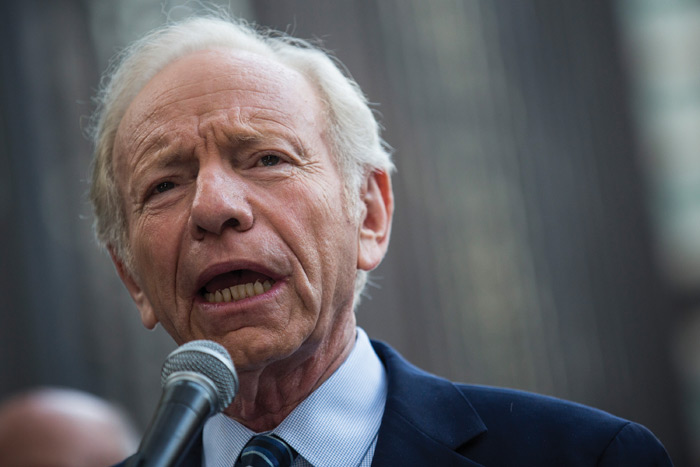
The shloshim (thirty-day) mourning period for Senator Joseph Lieberman was completed on April 27, but I miss him more than ever.

I became an adoring fan of Joe Lieberman before he became “famous.” A friend living in Connecticut told me of a Shabbat-observant Jewish politician trying to win the nomination for Attorney General of Connecticut. The nomination convention was held over Shabbat. He attended the convention out of respect for the process but would not campaign as this would violate his principled Shabbat observance. (He won the nomination nevertheless.) Thus I learned that the person — Joe Lieberman — was deeply principled, that his religious observance was a strong expression of his character.

When I came to know him in person, I realized that he combined a fundamental religious orientation of life with liberal social views and a non-judgmental acceptance of all people in his orbit. Deeply religious — not based on superiority claims or looking down on others who differed — that was my fantasy of an ideal religious person. But Joe Lieberman was a real person, not a product of my imagination.

That year, 1982, he met Hadassah Freilich Tucker, fell in love and married her. Hadassah’s parents were survivors, members of my community and dear friends. Thus I got to know him in person. Up close, one experienced his lovability which grew out of his embrace of life, his natural friendliness and enjoyment of people. In conversations, one got to see his intelligence and powers of persuasion, his American patriotism and his commitment to Israel.

In 1988, he decided to run for the United States Senate. Some friends and I organized a Jewish support committee. I was in close touch with AIPAC then. In our communal leadership education program, the National Jewish Center for Learning And Leadership (CLAL) spread the importance of Jewish political activism (including building AIPAC) and the need to influence America politically. Joe was running against a popular incumbent, Lowell Weicker (R), who was supportive of Israel. AIPAC’s policy was to back any incumbent who supported Israel-America relations and not help any candidate who ran against such an incumbent. Weicker complained to AIPAC about Lieberman’s campaign and a number of friends at AIPAC contacted me, urging us to step back and not undermine AIPAC’s policy on incumbents.

We pushed back. We promised to make clear that we were operating independently of AIPAC. Still, we were convinced that Lieberman would be more valuable to Israel and AIPAC than Weicker was. He would be a leader. Joe would persuade and rally others to this cause. Lieberman would represent more than one vote in the Senate because he would offer wisdom and good policy advice as well. Joe won the election narrowly and went on to deliver beyond ourpredictions because people looked up to him and followed him.

As Senator, he showed some of his greatest qualities: integrity and sticking to his principles independently, pushing not the party line but what was best for the country. Joe was a natural centrist, as well as open-minded and a good listener. As a result, he was able to reach across the aisle and garner bipartisan support for needed causes. American society benefitted from his leadership but Israel, too, was a major beneficiary of his special talents. Because of his religious values, he was able to connect with the rising stream of evangelicals. He appreciated and worked with them at a time when most secular liberals and Democrats feared them and refused to deal with them. Again, Israel greatly benefitted from this one-man political force in American life.

Joe continued to observe Shabbat and his model reverberated throughout the capital. More than once, he stayed overnight on a cot in his Senate office to be present and vote rather than violate Shabbat with travel. Finally, Al Gore invited him to rest at his apartment in D.C. rather than walk many miles more to return to Lieberman’s home in Georgetown. Gore then began to escort Joe on these walks. Their conversations cemented their friendship and undoubtedly played an important role in Gore inviting Lieberman to run as his vice president—the first Jew in American history to run on the national presidential ticket.

One might say that Lieberman was a walking Kiddush Hashem: a sanctification of God’s name and of the Jewish religion. The Talmud offers one definition of Kiddush Hashem as being someone who offers a model so noble that others say, “This is the kind of God and tradition that I would like to be part of.” His honesty, bipartisanship, patriotism and statesman-like approach to issues were attributed to his wholesome religious outlook on life.

Then there was the contested outcome of the election of 2000. I always felt that the United States Supreme Court intervened in a partisan and politically improper way in stopping the recount of ballots in Florida. But Gore and Lieberman were gentlemen who put the welfare of the country ahead of their personal cause. They believed that further conflict would harm the main institutions of American democracy by undermining public trust in them — so they accepted this unjust result. I never heard a bitter word or attempt to demean the electoral process from Joe — an amazing testimony to his love of country and embrace of life without self-seeking pettiness.

Many times I have reflected on how the quality of American life has been harmed by the defeat of Gore-Lieberman. The extreme polarization in American life would have been prevented by Lieberman’s active outreach across political lines and ability to find compromises that met the needs of both sides. After 9/11, America would have entered the war in Iraq — because Lieberman and Gore voted for the war. But the outcome was more disastrous because of the failure to invest in a functional Iraqi government and a secure, post-war civil society. This reflected the weakness and vainglory of Bush/Cheney/Rumsfeld. Gore — and certainly Joe Lieberman — would have been much more attuned to the need to secure Iraqi society, lest the corruption and violence undermine the American war effort.This is what happened and it soured the American people on the war and against interventions to save democracy, because it made the sacrifice of American soldiers’ lives (and trillions of dollars) as being in vain.

I believe that had Gore-Lieberman won, then Lieberman, as a highly effective V.P., would have been the (winning) Democratic nominee in 2008. Joe’s 2004 Presidential campaign was undermined by frustration with the war and with the radicalization of the left wing of the Democratic party in response to the war’s failure.

I often reflect what if, in 2008, the winner was the barrier-busting first Jew to serve as President, rather than the first African-American President. In the end, Obama was not able to advance the improvement of African-Americans and the end of systemic racism all that much. And his foreign policy — especially in appeasing Iran — was bad for America, for the world and especially for Israel. After retiring from the Senate, Joe was a key leader in the non-governmental opposition to the treaty with Iran that gave it leeway to pursue nuclear arms.

To this day, I regret that in 2008, McCain did not go with his instincts and ask Joe to run as his vice-presidential mate. Palin was a disaster. Joe would have given a powerful lift to bipartisanship, win or lose. And the Republican Party would not have fallen into the hands of the extremists, conspiracy theorists and Trump, et al.

To this day, I regret that in 2008, McCain did not go with his instincts and ask Joe to run as his vice-presidential mate. Palin was a disaster. Joe would have given a powerful lift to bipartisanship, win or lose. And the Republican Party would not have fallen into the hands of the extremists, conspiracy theorists and Trump, et al.

We miss Joe Lieberman as a human being even more than as a role model. We feel orphaned especially now, when we need his judgment and leadership in facing a great upsurge in anti-Semitism and a shocking anti-Israel, anti-Zionist outburst that glorifies terrorism and cruelty. Even more disturbing, the Hamas enthusiasts support would-be genocide and defend it by falsely labeling the victims of Hamas (i.e., the State of Israel) as genocidal.

Sadly, we cannot call him back. The Talmud says: “Woe to us. We have lost that which we cannot regain.” (Sanhedrin 111A) However, we can let his memory inspire us. Going forward, we need to ask ourselves: What would Joe do? Then, giving our all — as he always did — we need to fight through to another golden age for American Jewry (and Israel-Diaspora relations). The first golden age which was so brutally upended was the age which he incarnated and in which he led us to great heights. May his memory always be a blessing.


Rabbi Yitz Greenberg serves as the President of the J.J. Greenberg Institute for the Advancement of Jewish Life (JJGI) and as Senior Scholar in Residence at Hadar.

Remembering Joe Lieberman Read More »

Let There Be Love – A poem for Parsha Kedoshim

And a man who lies with a male as one would with a woman both of them have committed an abomination; they shall surely be put to death; their blood is upon themselves. ~ Leviticus 20:13

I remember being on a plane with a friend
flying somewhere, for sure, because
that’s what planes do.

He started reading a book whose title
gave away his preferred gender to
commingle with.

I said, and I thought I was being funny
now everyone will assume I’m gay.
He replied if I didn’t have this book out

everyone would assume I’m straight.
I’m still trying to learn this lesson –
the struggle any individual goes through

just trying to be who they are
in a society rooted in ancient words
that tell them they are an abomination.

Don’t we have enough to worry about?
The planet is melting. People have
never stopped killing each other.

Greed is a never-ending force that
isolates the other and leads to misery.
These are the true abominations.

The word love appears too many times
in our story to allow for hate. Let that be
the word we take away from this.

Let love be love.
Let love be love.
Let love be love.


Rick Lupert, a poet, songleader and graphic designer, is the author of 27 books including “God Wrestler: A Poem for Every Torah Portion.” Find him online at www.JewishPoetry.net

Let There Be Love – A poem for Parsha Kedoshim Read More »

From Unexpected Offer to Cannes Triumph: The Jewish Succession

The offer to star in a German series caught Mike Burstyn completely off guard. Here he was, leading a quiet life in Los Angeles, working as a dubbing director for Netflix, and occasionally jetting off to Israel for acting gigs, when suddenly he found himself approached to take the lead role in a major television production.

“The creator/writer was in search of someone fluent in both Yiddish and German, and that’s how they came across me,” said Burstyn in an interview with the Journal. “Once my agent received the casting call, she promptly said, ‘Look no further. I have just the man you need.'”

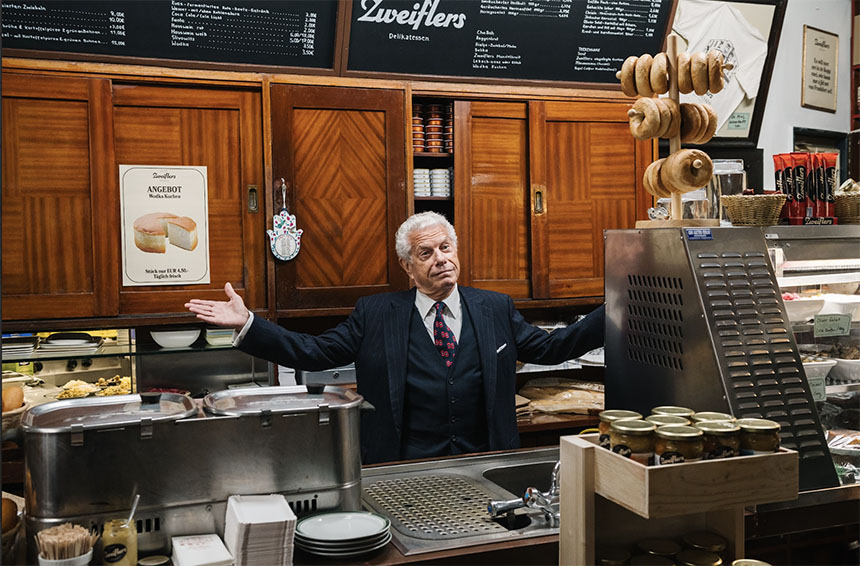
The story of ‘Die Zweiflers’ takes place in 2015, Frankfurt. Holocaust survivor Symcha Zweifler wishes to retire and bequeath his business to his children and grandchildren. He invites them over and tells them about his plans, but they are not interested in the Delicatessen business. And so, Symcha decided to sell the business to a large German company. The story about the sell is published in the press which brings someone who knew him in his younger years. He threatens to expose Symcha’s past if Symcha doesn’t pay him.

The creator and showrunner of the series is David Hadda, himself a grandson of Holocaust survivors who chose to remain in Germany after the war. “David told Variety that if he hadn’t discovered me, the series might never have come to fruition,” Burstyn said. “They scoured Germany for an actor who could authentically embody the persona of a Holocaust survivor but couldn’t find one. Additionally, they required someone fluent in Yiddish and German. It felt as though the role had been tailor-made for me.”

There are plentiful of series and movies which explore Germany’s Nazi history. Yet, amidst this sea of content, few Germans can readily recall a series that delves into the daily lives of a Jewish family within contemporary Germany.

Burstyn believes that the first season will ignite discussions once it’s going to start airing on May 1 in Germany. It’s currently being sold worldwide by ZDF Studios.

Burstyn was born in New York to Yiddish-language actors Pesach Burstein and Lillian Lux. He embarked on his acting journey alongside his twin sister in his parents’ productions from a tender age. By seven, they were traversing the globe, gracing stages with Yiddish performances. During the time the family lived in South America, Burstyn mastered Spanish and Portuguese; in France, he honed his French; and upon the family’s immigration to Israel in 1954, he learned Hebrew.

“During my theater days in Israel, I worked with German actors, prompting me to learn German as well. Working on the series provided an opportunity to further refine my German skills, and now I am fluent,” he said. In total, the versatile actor commands proficiency in eight languages.

Reflecting on his unexpected role, Burstyn admitted it took him entirely by surprise. At 78, he never imagined landing the lead in a German TV series. He considers himself fortunate, acknowledging the transformative roles that have punctuated his career. “The first was ‘Two Kunilmel’ in 1966 [in Israel], which changed my trajectory. People still reminisce, telling me, ‘We grew up watching you.’ Then came Broadway in 1981, where I made history as the first Israeli actor to headline. Subsequently, I embarked on a three-year stint on Dutch television. Amidst COVID-19, I was offered a chance to direct dubbing for Netflix. In 2017, I persuaded friends to invest in ‘Azimut,’ my directorial debut. I’m a fortunate man. Life surprises you when you least anticipate it.”

“The series resemble the American show ‘Succession,'” Burstyn observed, “with a patriarch at its helm and his children quarreling with each other. In today’s climate, marked by resurgent anti-Semitism worldwide, it’s remarkable to see German television tackling a narrative centered on a Holocaust survivor. The Germans are the only ones still on our side when the whole world is against us.”

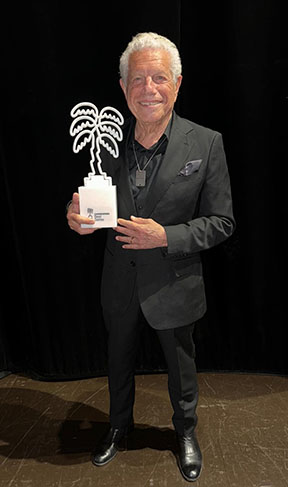
Hadda submitted the series to competition at the Cannes Film Festival and it was accepted along with 7 other series out of 200 submitted from all over the world. On April 10, Burstyn headed off to the festival, where the initial two episodes were premiered to glowing reviews from both critics and audiences alike. To everyone’s delight, the show received the prestigious award for Best TV Series at Canneseries.

Mike Burstyn with Canneseries award

Burstyn along with the cast, creator and director came on stage to the sound of cheers from the audience. “I was wearing a “Bring them home now’ silver disk,” said Burstyn. “It was important for me.”

Addressing the audience, he expressed gratitude to ARD and Degeto, the two companies behind the show, for their bravery in bringing the narrative of a Holocaust survivor to German television. Then concluded his speech by saying, “Am Israel Chai.”

After stepping off the stage, Burstyn was approached by local Jews who commended his words. “They discreetly revealed similar disks, some plated in gold, tucked inside their shirts, expressing their apprehension about openly wearing them as I did onstage,” Burstyn said. “They admitted they were simply too scared to walk around with them in France.”

Burstyn confessed that he had always wondered why so many Polish children opted to remain in Germany after the war. After all, the Nazis had stripped them of everything—their families, homes, and childhoods. Portraying Symcha helped him grasp their perspective better. His character was only ten years old when he left Auschwitz and arrived in Frankfurt. Post-war, American soldiers transported the surviving children from the camps to Germany, providing them with matches, cigarettes, chocolates, and nylon socks from their stockpiles. The children sold these items to the Germans to sustain themselves.

“In the ’60s and ’70s, they shifted to establishing brothels in Frankfurt and amassed considerable wealth before transitioning to real estate investments,” Burstyn explained. “Today, half of Frankfurt’s real estate is owned by Jewish families. From the 1960s onwards, they began investing in real estate and hotels in Israel.”

Samuel (Aaron Altars) and Symcha (Mike Burstyn) in the Synagoge. Photo: Elliott Kreyenberg

This mirrors Symcha’s journey and how he initiated his delicatessen business.

“Those kids capitalized on the Germans’ post-war guilt. It was an opportunity to forge a new life in the very place where their oppressors had sought to destroy them. It was a defiant proclamation: ‘Not only did you fail to eliminate us, but we will thrive here. ’We are survivors.”

From Unexpected Offer to Cannes Triumph: The Jewish Succession Read More »

A Moment in Time: “Because That’s What Jews Do”

Dear all,

Following the Holocaust, Pastor Martin Neilmoller wrote these incredible words regarding his initial silence during the Nazi years:

First they came for the Communists

And I did not speak out

Because I was not a Communist

Then they came for the Socialists

And I did not speak out

Because I was not a Socialist

Then they came for the trade unionists

And I did not speak out

Because I was not a trade unionist

Then they came for the Jews

And I did not speak out

Because I was not a Jew

Then they came for me

And there was no one left

To speak out for me

I think deeply about his words as I reflect on the realities of today.  And so, with deep respect for his words, I share the following:

When women didn’t have the right to vote, I spoke out – because that’s what Jews do.

When Jim Crow laws segregated blacks in America, I spoke out – because that’s what Jews do.

When LGBTQ were denied the right to marry, I spoke out – because that’s what Jews do.

When immigrants needed asylum, I spoke out – because that’s what Jews do.

And yet when Jews are being harassed, bullied, and targeted – where are others to speak out?

Dear world, this is your moment in time to make a difference.

With love and Shalom,

Rabbi Zach Shapiro

A Moment in Time: “Because That’s What Jews Do” Read More »

A Bisl Torah – We Will Find a Way

Sinai Temple Religious School educator, Elaine Seltzer shared the story of how her parents met:

Elaine’s mother and aunt were suffering in Auschwitz. Elaine’s mother was forever protecting her younger, more vulnerable sister and when her sister complained about the state of her shoes (they didn’t properly fit), she was determined to help. Proper fitting shoes were often the difference between life and death.

Elaine’s mother carefully went to the fence that separated the women’s and men’s camps. A high fence with electrical wiring on top to prevent any escapees. She called out to a young man and asked for his help. Seeing her, he couldn’t turn away. He agreed to help find this woman’s sister a pair of better fitting shoes.

For several days, Elaine’s mother would go back to the fence. The first pair of boots didn’t fit at all. The man vowed to find another a pair. He refused to let this caring woman down, especially in a place of perpetual fear and tragedy.

After receiving shoes that fit, Elaine’s mother told her sister, “I’m going to marry that man.” And yet, it was the man that managed to find this woman after the war, for he too was smitten with the woman that took such good care of her sister.

They married and now, their beloved daughter Elaine is the one that shares their story. As she spoke I realized that Elaine’s testimony will soon be our direct link to the eye witness accounts of the Holocaust. We must encourage children and grandchildren of Holocaust survivors to speak, for they are our connection to the greatest horrors experienced by our people.

Recently, musical artist Matisyahu performed to raise awareness about an organization: ifyouheardwhatiheard. The organization documents grandchildren sharing the stories of their grandparents, all survivors of the Holocaust. Matisyahu brought on stage Holocaust survivors with their grandchildren and great grandchildren. With this visual and his songs of peace and courage ringing in our ears, it was clear: with our commitment to never forget, even through these pummeling times, we will find a way and rise again.

Shabbat Shalom


Rabbi Nicole Guzik is senior rabbi at Sinai Temple. She can be reached at her Facebook page at Rabbi Nicole Guzik or on Instagram @rabbiguzik. For more writings, visit Rabbi Guzik’s blog section from Sinai Temple’s website.

A Bisl Torah – We Will Find a Way Read More »

Print Issue: Who’s Funding It? | May 10, 2024

CLICK HERE FOR FULLSCREEN VERSION

Print Issue: Who’s Funding It? | May 10, 2024 Read More »

Modern (Orthodox) Dating ft. Mikey Greenblatt (@jewishvibes)

The Schmuckgirls have BIG news this week. MAZEL MAZEL because Libby and Jack are engaged! A full debrief episode to come, but in the meantime Libby gives a little preview of how the engagement went down. Marla shares dating updates from the past month. The girls discuss dating app profiles and common mistakes that men make. Marla also shares her comparison between dating in NY vs. LA.

This week they welcome Mikey Greenblatt, aka jewishvibes on Instagram. Mike starts by sharing the meet cute of meeting his girlfriend on a line not to be confused with online. He shares his strong options against gold Jewish star chains and suggested men wear kippers because that’s what made his girlfriend like him. He talks about his Jewish journey and how going to yeshiva in Israel guided him down a more religious path. He discusses about how he got to be involved with the popular jewishvibes instagram page and how him and his co-creator realized there was a market for modern-orthodox Jewish comedy. He talks about he doesn’t love the typical bagel and lox comedy and thinks it’s overdone. He talks about his stand up journey, starting, ending it, and ultimately choosing to get back into it. He talks about how Eli Lebowicz inspired him and showed him you can bring Orthodox Judaism into comedy and how the two of them and Ami Kozak started JSketch. He talks about how he enjoys performing Jewish comedy for non jews because he gets to educate them and humanize judaism. He talks about the importance of being funny about Judaism without bashing judaism. He shares about his connection to torah and how it also helps make him a better comedian. He shares that the likes content but that it also hurts society. When it comes to social media, he feels that people will find anything to get angry about and he usually ignores the comments. He talks about dating in the Jewish community, specifically on the UES and in the modern-orthodox world. They end with a game of mensch or schmuck. 


You can follow Mikey and his comedic journey at @jewishvibes and @jsketch on instagram. 

Modern (Orthodox) Dating ft. Mikey Greenblatt (@jewishvibes) Read More »

Magen Am Expands: Strengthening Jewish Community Security in Orange County

The recent surge in antisemitism has driven a sharp rise in demand for Magen Am services. This non-profit Jewish security organization, based in Los Angeles, was established by Rabbi Yossi Eilfort seven years ago.  With a professional MMA and Chabad Rabbi background, Rabbi Yossi was able to marry his two passions of defense and Judaism when he established Magen Am.

The organization trains members of the community to become fully licensed and insured armed guards and volunteer their time to secure synagogues and community events through Magen Am’s Community Team Member (CTM) program. Additional classes are offered to the public to give the community tools to feel more secure and enable them to protect their own homes and communities. 

Seven years after it was founded in L.A.,  it’s now expanded to other locations, with branches now established in Phoenix, Arizona, and Orange County. This expansion south and east of Los Angeles comes amid significant growth and urgency, particularly since the start of the Israel-Hamas War on Oct. 7.

“Around seven months ago, a rabbi from the community reached out and said that they have someone that wants to speak with us. Just before September of 2023 they decided that they wanted to write a check and get our CTM program launched in Orange County,” Eilfort said. 

He noted that Orange County, like Los Angeles, has witnessed a rise in antisemitic incidents. Recruitment is currently underway for the Orange County Chapter of the CTM program. CTMs undergo an additional 100 hours of Magen Am training and are available to volunteer at events and secure institutions such as schools and synagogues. “The City Council has recently faced challenges, particularly with an uptick in incidents, including those on campuses such as UC Irvine,” Eilfort said. 

Many other Jewish communities around the United States have approached Magen Am; requests had come from San Diego and San Francisco. Eilfort said the main problem is obtaining funding. “We’re getting requests from everywhere like Denver and Houston. I’m probably going to be doing some training in Nashville and New Mexico next month. We need the bandwidth, we need the resources to be able to grow, but thankfully, Orange County got that together so we can get started.”

Volunteers from the Orange County community have already begun signing up for the training program. While the majority are men, including many Orthodox Jews, there are also women and less religiously observant individuals participating. The programs typically last between three to six months, with three months required for indoor guarding and longer for external guarding.

It’s difficult to estimate the number of antisemitic incidents prevented by Magen Am, as the mere presence of volunteers can serve as a deterrent against hate crimes. The assurance of security provided by these volunteers is deeply valued by community members. Particularly during High Holy Days and Shabbat, when Orthodox people may not carry cell phones and might be unable to contact the police, the knowledge that Magen Am volunteers are walking around in the Jewish communities and posted in and around synagogues offers reassurance.

“It’s a blessing to be in the position to do something to better secure our community.” – Rabbi Yossi Eilfort

“We have many partners guiding us in navigating this new terrain, including members of the Chabad Community, the ADL, the Jewish Federation, and the Merage JCC of Orange County,” said Eilfort. “Our expansion to Orange County is bittersweet – we wish we weren’t needed, but we are – and it’s a blessing to be in the position to do something to better secure our community. Our expansion is also a symbol of unity, bridging Jews across the political and observance spectrums alike with one shared goal: Our continued protection so that we may live and practice in peace.”

Magen Am Expands: Strengthening Jewish Community Security in Orange County Read More »