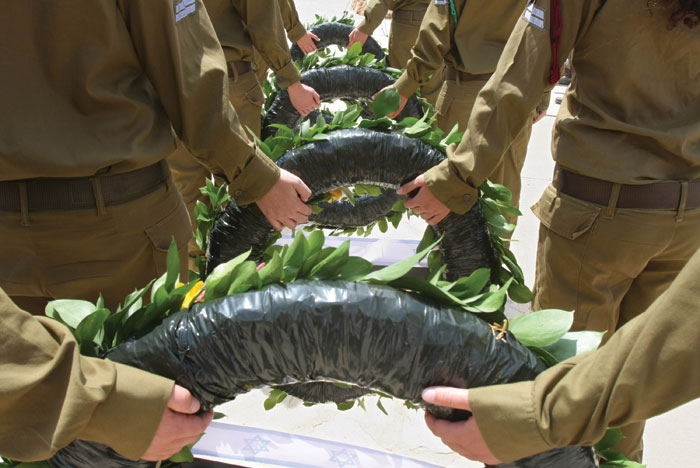
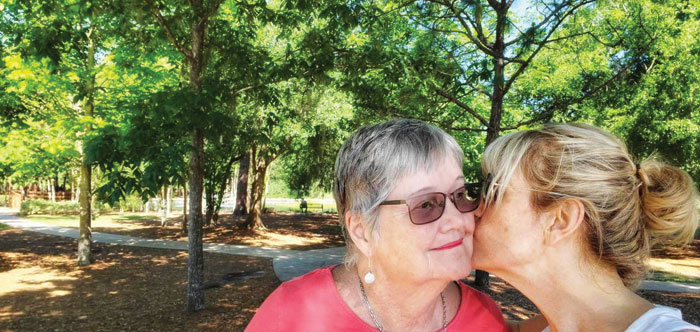
In a few short days, we will stand together. The chill of a dusk breeze will make the hairs on our arms stand on end, but we will already have goosebumps. Clad in blue and white, draped in sorrow, we will listen to the names of the fallen reverberate, marking the annual day to commemorate Israel’s fallen, Yom HaZikaron.
The raw human tragedy of the day demands authenticity. But in order to truly honor it, we grapple with its essence. To whom does Yom HaZikaron belong? What is its purpose?
Is it a day for the martyred, a time to be honored and remembered? Or is it a day for us, the living, to immerse ourselves in grief and memory? To confront loss and survivor’s guilt, wrestling with questions that have no answers?
Our Sages shed light on the importance of burial, not merely as a mark of reverence for the deceased, but as a transformative experience for the living. Even a kohen, ritually forbidden from contact with a corpse, is compelled to bury his immediate family. Commentators like Maimonides consider this not a gracious exception, but a divine command. The Talmud teaches that proper burial is more important than both the study of Torah and the Temple service itself. It is a confrontation with mortality we are not permitted to deny ourselves.
But what about those of us who did not sit shiva in the chill of October, who did not experience firsthand loss? What is Yom HaZikaron to those who do not fear a knock at their door, and who do not gather at tables with empty seats?
Are they secondary participants in a commemoration meant for others?
Leviticus teaches, “the life of all flesh is its blood” (Lev. 17:14). It is blood that represents a being, distilled. Whatever values man holds most dear to him, they run through his veins, bring life to his cheeks, and quicken his pulse. Man is defined by the force that propels him forward each morning, his lifeblood. In death this blood ceases to flow, marking the end of his unique essence that once empowered his impact on the world.
Consequently, Jewish law mandates that when a Jew is slain in the name of God —murdered because he is a Jew — he is buried not in shrouds but in his bloodied clothing. The very act of martyrdom has sanctified his spilled essence. This is an act of sacred transformation, the blood itself has become a vessel of sanctity. Whatever the blood of the slain has stained, be it clothing, weaponry, or the very ground itself, it is similarly consecrated. The immutable values that defined those who made the ultimate sacrifice become synonymous with the faith and nation for which they gave their lives.
The revelation of our active obligation on Yom HaZikaron is anchored in the very first narrative of bloodshed in the Torah, the murder of Abel at the hands of his brother Cain. God ponders aloud where Abel has gone and Cain poses the perennial question, “Am I my brother’s keeper?” God, disappointed, responds: “The voice of your brother’s bloods calls out to me from the ground” (Gen. 4:10). Rashi explains that the plural “bloods” encapsulates not only Abel’s very life but the entirety of his potential — any future progeny or accomplishments preemptively erased by violence — demonstrating the depths of irreplaceable loss when lives are unjustly cut short and futures forfeited.
Yom HaZikaron is no more an obligation than it is a privilege, an opportunity to demonstrate that these sacrifices do not lay dormant within us but pulsate through our collective as one man with one heart.
But Yom HaZikaron is the day that those who remain alive declare that we are indeed the keepers of brothers slain and sisters martyred, and we carry forth the torch of their ideals and aspirations. With each act of self-sacrifice and unwavering commitment, this nation and this land are revitalized with renewed accountability. Yom HaZikaron is no more an obligation than it is a privilege, an opportunity to demonstrate that these sacrifices do not lie dormant within us but pulsate through our collective as one man with one heart.
A kohen must bury his kin even though it will render him temporarily unable to perform his Temple service because the entire nation is compelled — irrespective of status or occupation. All must internalize our responsibility to our nation’s unfolding, and pledge an active commitment to the ideals once embodied by men and women who now remain only in spirit. The blood of those who lie in the ground does not discriminate as the living do, it stains us all blue and white.
Yom HaZikaron is a call to duty for all — for those who knew the lost while they lived and for those who know them only in death. It is not our proximity to suffering that defines our right to claim this day as our own, but our willingness to carry their sacrifices forward. All have a stake in their legacy. The fallen, the taken — they are enshrined in the actions we take, the lives we lead, and the future we forge together, entrusted with the sacred duty of guarding their legacy in death as they guarded us in life.
As the siren wails on this year’s day of remembrance, echoes of Eden resound from soil enriched by sacrifice, urging forth seeds of renewed commitment and responsibility, compelled to be nurtured by those who walk above it.
Adina Feldman is a Straus Scholar and Sophomore at Yeshiva University.
Columbia Cancels Main Graduation Ceremony Following Pro-Palestinian Protests
Columbia University announced on May 6 that they are canceling their main commencement ceremony after the university has been ravaged by pro-Palestinian protests.
According to NBC News, the university made the decision for safety reasons and that the ceremonies would be “smaller-scale, school-based celebrations … These past few weeks have been incredibly difficult for our community,” Columbia officials told NBC. “Just as we are focused on making our graduation experience truly special, we continue to solicit student feedback and are looking at the possibility of a festive event on May 15 to take the place of the large, formal ceremony.”
The university has asked the New York Police Department (NYPD) to stay on campus until May 17 as a result of the protests.
13 Federal Judges Say They Won’t Hire Columbia Graduates Over University’s Handling of Pro-Palestinian Encampment
Thirteen federal judges sent a letter to Columbia University on May 6 declaring that they will not hire any graduates from the university due to how Columbia handled the pro-Palestinian encampment on campus.
The letter accused Columbia of being “an incubator of bigotry” and applying “double standards when it comes to free speech and student misconduct. … If Columbia had been faced with a campus uprising of religious conservatives upset because they view abortion as a tragic genocide, we have no doubt that the university’s response would have been profoundly different,” the letter stated. “By favoring certain viewpoints over others based on their popularity and acceptance in certain circles, Columbia has failed as a legitimate, never mind elite, institution of higher education.”
Additionally, the letter contended that “both professors and administrators are on the front lines of the campus disruptions, encouraging the virulent spread of antisemitism and bigotry … Considering recent events, and absent extraordinary change, we will not hire anyone who joins the Columbia University community — whether as undergraduates or law students — beginning with the entering class of 2024.” The letter stated that their boycott is necessary to “restore” academic freedom at Columbia.
UCLA Implements Remote Classes Following Pro-Palestinian “Disruptions”
The university announced on May 6 that all classes will be remote for the rest of the week due to “ongoing disruptions” reportedly from pro-Palestinian protesters.
NBC Los Angeles reported that protesters were chanting “Free Palestine” outside and inside of Dodd Hall; before that, the protesters were holding a sit-in at Moore Hall before police told them to leave, The Los Angeles Times reported, although police did not give them a formal dispersal order. The protesters eventually moved to Bruin Plaza, where there were as many as 200 attendees.
Additionally, UCPD Patrol Division Lieutenant Richard Davis told The Daily Bruin thatafter initially stopping them over possible curfew violations, the individuals in question refused to show student identification. Forty-three people — including students — were arrested over an alleged conspiracy to commit burglary. Both The Bruin and The Times reported that those arrested were pro-Palestinian protesters; one student claimed to the Times that the detained protesters were “dropping off supplies for the sit-in.”
Jewish Woman Assaulted by Pro-Palestinian Protesters at UCLA During Pro-Israel Rally Speaks Out
A young Jewish woman who was assaulted by pro-Palestinian protesters at UCLA during a pro-Israel rally on April 28 opened up about the incident in an interview with NBC Los Angeles.
The woman identified herself as being Eleanor, a student at Pierce College in Woodland Hills. Eleanor explained that the assault occurred when she attempted to pick up an Israeli flag that her sister dropped. “I’m going down to get it, it’s being kicked and stepped on, and then I’m being kicked and stepped on,” she said. Her mother told the outlet that “they kicked her back and her head slammed [on] the ground, and for a minute I thought, ‘That’s it. I lost her.’” NBC Los Angeles described as Eleanor as being “shaken” by the incident but “is recovering.”
USC Clears Another Pro-Palestinian Encampment
USC cleared another pro-Palestinian encampment on May 5, which had been rebuilt after the previous one was removed on April 24, Fox 11 Los Angeles reported.
University President Carol Folt said in a statement that the removal was “peaceful” and that the encampment “had to stop.” “Areas of campus were blocked, people walking down Trousdale, our main thoroughfare, were harassed, and iconic Trojan symbols were defaced,” she said. “In addition, university property was stolen, and commencement structures were dismantled. Residence halls, campus throughfares, and libraries had become places of confrontation. Some finals were disrupted with noise and chanting during mandated quiet periods. Yesterday afternoon, outside agitators jumped the perimeter fencing and assaulted our officers … We will not tolerate illegal encampments of any kind at USC.”
Food always tastes better when made with love. To celebrate Mother’s Day, here are some food memories and recipes to go with them.
Rachael Narins’ mother grew up in Pittsburgh across the street from a meat market. “She was raised on a steady diet of heavy German influenced foods, local specialties and a lot of pie,” Narins, a trained chef, cookbook author and culinary speaker, told the Journal.
When Narins’ mother escaped the city, she visited relatives with a farm in the country and ate fresh vegetables, fruit from the trees and even more pies. “She never became much of a baker — neither did I — but every once in a while, we get ambitious, put on aprons and giggling the whole time, make her great grandmother’s grape pie,” Narins said. “It’s a deep purple mess and an absolute delight to eat.”
As she’s never seen it on a menu, Narins thinks of this “grape jelly tart” as the ultimate home-baked treat. “Look for really ripe Concord grapes with slip skins and it’s a breeze to make,” she said. “Nowadays I like to do this with Kyoho grapes when I can find them.”
Narins, who is based in Los Angeles, said her mother happily retired to Florida and “does not recommend making this with the local muscadine grapes.”
Grape Pie
For this deep dish pie, use your favorite all-butter pie crust.
For the filling:
10 cups, large, in-season, Concord grapes
1 cups water, plus 2 teaspoons
¾ cup white sugar
¼ cup cornstarch
1 Tbsp fresh lemon juice
Milk, for glazing
Divide your pie dough into two pieces and roll out. Wrap one disk of dough and refrigerate for later use. Line the bottom of a 10” metal deep dish pie pan with the other disk of dough, cover and refrigerate while you make the filling.
Separate the skins and the pulp of the grapes. Discard the skins.
Over medium low heat, gently cook the grape pulp in a sauce pan with 1 cup of water and all the white sugar for about 20 minutes. Stir often and mash as you go to make sure it doesn’t stick or burn.
While it’s still warm, strain the grape pulp to remove the seeds. Let cool.
Stir together the remaining ¼ cup of water and the cornstarch to make a slurry, then stir that into the cooled grapes along with the lemon juice.
Preheat your oven to 400°F.
Fill the pie crust with the grapes and cover with the second disk of dough and crimp the edges. Pierce a few times with a fork to allow venting.
Brush the top with milk.
Place the pie on a baking sheet, then put on the middle rack in your oven. Bake for 35-40 minutes.
Cool completely before eating.
Lulu Fairman’s mother, Seemah Levi, was born and raised in Calcutta, India, and loved to cook.
“She was never a very demonstrative person, but she showed her love for my brother and me by cooking for us Sephardic Jewish foods specific to an Indian kitchen,” Fairman, Chair of Caring Connections, at ChaiVillageLA, told the Journal. “Up until a year ago, my mother, who is now 98 and had to move to an assisted living facility, lovingly cooked meals for my brother — and me when I visited — that we miss.”
While she has handed down her recipes, Fairman said it’s not the same as her cooking. “This is my small tribute to her on Mother’s Day,” she said.
Hari Kabob
(Chicken with Indian spices and Potatoes)
1 whole chicken
2 tsp cut fresh ginger
2 tsp cut fresh garlic
3 tsp of turmeric
1 tsp of Garam Masala
Couple of bay leaves
1/2 cup of vegetable or corn oil
12 small potatoes
3 cups water
Cut up a whole chicken into 8 pieces. Remove fat and loose skin. Wash thoroughly under cold water. (Add salt to taste if you so desire – she never cooked with salt!)
Mix ginger, garlic, turmeric and Garam Masala in a small bowl; set aside. Note: You can substitute powdered spices for the ginger and garlic if you wish; just use about half the amount.
Pat half of the spice mix into the chicken; rub in thoroughly and marinate for an hour or so. (You can do this the night before if you like. I have even made it at the last minute without marinating.)
Peel potatoes, rinse and soak in a pot of water with some salt (if you want) for 1 hour. (I pierce the potatoes with a fork.)
Add in the rest of the spice mix, plus the bay leaves, and bring water to a boil; keep on moderate heat. Continue cooking until potatoes are soft; about 15-20 minutes. Remove potatoes gently and put in a separate dish.
Add chicken to the pot with the gravy from the potatoes and stir thoroughly. Brown the chicken over moderate heat. Add a little water to the chicken and cook over moderate fire for 15 or 20 minutes.
Put potatoes back into the pot with chicken; stir gently and continue to cook for another 15 – 20 minutes or until chicken and potatoes are cooked; mix and brown every so often by turning it over. By the end, the water should have evaporated so that everything is absorbed by potatoes, chicken and spices. Remove the bay leaves before serving.
Serve with Pulau rice with peas (rice cooked with turmeric and bay leaves, a couple of cardamom pods and cloves) and Jewish salad: Finely cut cucumber, celery, red pepper, tomatoes and baby carrots, cut into small pieces. Chop coriander and parsley and mix all together. Add fresh lemon juice and a little salt.
“I love my mom’s cooking; I know I probably don’t need to say that explicitly, but it’ll be nice for her to read.“ – Jeff Frymer
“Iam an aspiring chef, but more importantly, I am the son of a mom who is a chef – but not in the conventional, head-of-a-restaurant kind of way,” Jeff Frymer told the Journal. “My mom, Madeleine, prepares a meal that is not only nutritious (mom’s first priority), but also delicious.” He added, “I love my mom’s cooking; I know I probably don’t need to say that explicitly, but it’ll be nice for her to read.
Jeff Frymer is a full-time licensed marriage and family therapist and certified inner bonding facilitator, and a part-time chef for family, friends and the occasional soiree or exotic catamaran adventure.
When he was in his pre-teen/teen years Frymer remembers delighting in the guilty pleasure of how his friends would comment about his mom’s cooking: “Do you always eat like this?” He’d typically reply, “Yep,” or give a sideways nod in agreement, because he was too busy feasting to look up. “At dinner time we always had salad, soup, meat/chicken/fish and a vegetable; appetizers and desserts were rare occasions,” he said. “And if my description has you saying to yourselves, “That sounds so European” you would be correct.
His family is a mélange of Eastern European, French and Sephardic (Turkish) traditions. “There’s a lot of alchemy in the cooking magic of my family and I endeavor to carry that apron, which I have to a great extent, except for one thing, my mom’s chicken soup,” Frymer said. “I take great pride in my bouillon-making ability, and I have tried to emulate, replicate and stand-over-my-mom’s-shoulder-duplicate every salt shake and skimming of fat of the rendering chicken in the boiling pot.
“As close as I have ever gotten, and again, I’m no slouch, my dear wife tells me: ‘It’s not quite as good as your mom’s,’” he said. “And I humbly have to agree.”
Chef Jeff’s Mom’s Chicken Soup
1 whole cut-up chicken, cleaned of any organs (liver, kidneys, etc.) OR equivalent quantity of chicken from only backs, necks, and rip-cages (3 chickens)
1 whole leek, rinsed well, coarsely chopped
1 large yellow onion, cleaned and quartered
2 large carrots, peeled, trimmed and sliced
1 medium parsnip, peeled, trimmed and quartered
1 medium turnip, peeled, trimmed and quartered
1 medium tomato, quartered
2 sticks leafy celery (the tender smaller ones on the inside)
2 cloves garlic, peeled
1 heaping teaspoon salt, more to taste
“And sometimes,” mom tells me, “I put in lamb shank/beef bone, parsley, cilantro, daikon.” Which I take to say, “You really can’t go wrong.” Whew, that takes the pressure off.
Add ingredients (veggies first then chicken) to a large, 8 quart stock pot. Fill water to about an inch from top. Bring to a boil, cover, and allow to simmer for 2-3 hours. Depending on how full the pot and how high a simmer, it may be necessary to leave uncovered at first, or allow a bit of an air gap, as not to boil over. Skim the foamy scum from the surface as necessary (2-3 times), and that is it!
Allow soup to cool enough to be handled safely (this can be hastened in a bath of ice water in the sink), then strain, and set aside cooked veggies, chicken, bones, etc. Once sufficiently cooled, refrigerate everything overnight.
The next day, the bouillon will have a thin layer of hardened fat (schmaltz) on top to be removed, leaving just the golden broth. The strained veggies and chicken can be carefully separated from bits of bone to add back to bouillon, made into a chicken salad or used to make an entirely different soup. The chicken soup is now ready to reheat then adjust salt to taste. It can be accompanied by noodles, matzah balls, potatoes, kreplach and/or leftover veggies and chicken.
So even though following my mom’s recipe perfectly, it will never be quite as delicious as hers. I will always be missing that one essential ingredient that is impossible for me to add: my mother’s love.
In the past, you may have read articles in which Sharon and I describe our friend group as The G-d Squad. While some of us have known each other since high school, our sisterhood solidified through our involvement with the Sephardic Educational Center. We were all in our early 20s. We all married around the same time and our children grew up together.
Our friend Mona christened us The G-d Squad when we banded together to help her organize her eldest daughter’s bat mitzvah. Nowadays, that is the name of our group chat (our kids think it’s really funny, but they know that it’s the truth).
Weeks can go by without a single text and then sometimes I will look at my phone and there are over 50 messages. I know that means that my girls have been having some fun chats or serious conversations or are planning something wonderful.
We try to gather for a girls’ night every month or so. When our children were little, we would go to restaurants. Nowadays, we enjoy spoiling each other by setting beautiful tables and cooking special meals.
Everyone in the Squad acknowledges that our friend Shira is just one of the most talented women we know. She is definitely someone I turn to for inspiration. Her father is Moroccan and her mother is Japanese and she truly inherited the best qualities of both cultures. She has amazing vision and incredible patience for the finer details of cooking, baking and entertaining. Her tablescapes are wildly creative and her flower arrangements are breathtakingly beautiful: a talent that served her well when she was a party planner.
As you can imagine, she is an amazing cook who takes the time to perfect every dish that she creates. Many, many years ago, for one of our get-togethers, she served us the most divine herby salmon.
I instantly adopted this fish recipe and it has become one of my go-to dishes for a brunch or an easy dinner main course. The bed of herbs poaches the fish, keeping it nice and moist and full of flavor.
—Rachel
All the birthday celebrations in The G-d Squad are paired up, because of our crazy schedules. Shira’s birthday and my birthday are five days apart. I love celebrating my birthday and Shira hates attention of any kind (proving that astrology has little effect on personality). So I always have to coax Shira into sharing the limelight with me.
The difference in personality extends to our approach in the kitchen. Many years ago, Shira threw a birthday for her sweet daughters. There was a tea party theme with the most exquisite cookies iced with pretty pastel Royal sugar icing, all layered with hand painted flowers, dots and stripes. Fifteen years later, I can still picture the Carousel she made — horses iced in different colors, all riding at different levels on the poles, just like a real carousel.
A short while later, I was hosting a bridal shower for my new sister-in-law Lemor. Inspired by Shira’s artistry, I bought the cookie cutters and the frosting kit. I baked the cookies and then I started the frosting process. After five minutes of struggle, I gave up. I took that frosting and drizzled a single layer over each cookie. No one is dreaming about my cookies!
In contrast, this recipe for herby salmon is the best of both of our approaches to cooking—perfection (Shira) and easy (me).
There are a few steps to the recipe but nothing too demanding. The first step is to dry brine your salmon by placing it on a dish lined with paper towel, then sprinkling some kosher salt over the salmon. Let it sit in the refrigerator for at least an hour to draw out the excess moisture.
When you’re ready to cook the salmon, slather it with a good Dijon mustard and a light sprinkling of freshly ground pepper.
The best thing about this recipe is the fresh herbs that are layered on top of the fish. They look so impressive. You can use any fresh herbs, salmon pairs beautifully with any and all. Rachel loves to pair her salmon with green onions, mint, cilantro, dill and basil. I am not a huge fan of cilantro, so in this recipe I used green onions, dill, basil and Italian parsley.
I just served this herby salmon for Friday night dinner and without exaggeration, there were gasps when my guests tasted the fish.
I just served this herby salmon for Friday night dinner and without exaggeration, there were gasps when my guests tasted the fish.
—Sharon
Herby Salmon Recipe
1 large salmon fillet, center cut
2 Tbsp kosher salt
Freshly ground black pepper, to taste
3 Tbsp Dijon mustard
4 green onions, finely chopped
2 small bunches basil, roughly chopped
1 small bunch Italian parsley, roughly chopped
2 bunches dill
1 large lemon, sliced into thin rings
1/4 cup extra virgin olive oil
Place salmon skin side down on a dish lined with parchment paper. Sprinkle kosher salt evenly over the fish. Place in refrigerator for at least one hour.
Preheat oven to 400°F.
Line a baking sheet with parchment paper, then place fish skin side down in the center. Pat the fish with paper towel to absorb excess moisture and salt.
Spread the mustard over the fish.
Sprinkle with black pepper.
Layer with green onions, basil, parsley and dill.
Place lemon around the fish.
Drizzle olive oil over the herbs.
Bake for 15 minutes.
Sharon Gomperts and Rachel Emquies Sheff have been friends since high school. The Sephardic Spice Girls project has grown from their collaboration on events for the Sephardic Educational Center in Jerusalem. Follow them on Instagram @sephardicspicegirls and on Facebook at Sephardic Spice SEC Food. Website sephardicspicegirls.com/full-recipes.
One verse, five voices. Edited by Nina Litvak and Salvador Litvak, the Accidental Talmudist
You shall commit no injustice in judgment; you shall not favor a poor person or
respect a great man; you shall judge your fellow with righteousness.
– Lev. 19:15
Rebbetzin Miriam Yerushalmi CEO SANE; Author, “Reaching New Heights”
We cannot judge others simply by the external trappings of wealth, social position, or success. Rather, we should look at them (and ourselves) through the lens of “soul levels.” One person might have a “low-level” soul that is comparable to a first-grader, while his brother’s soul is comparable to a college professor. Some souls are “newer” with much more to accomplish; other souls are in their last incarnation, and having refined themselves over the years, have only a small amount of rectification to complete. Just as we can accept that a first-grader cannot understand graduate level mathematics, so too we can accept one’s apparent defects may indicate a high-level soul and a great potential for holiness.
The higher the soul level, the more G-dly light it can receive. Yet an expensive, delicate vessel will shatter if too much is poured into it too quickly. Many people suffer mental and emotional disorders caused by an overabundance of “light” and a paucity of “vessels,” absorptive capacity. People may experience problems in daily functioning because they are not internalizing the light and energy flowing down to them. Adding holiness to one’s life — performing more mitzvot, and particularly, meditative prayer and profound study of the inner aspect of Torah (namely, Chassidus) — can correct this imbalance and allow one to become a proper vessel for this holy energy. Understanding this pattern of development can give us the proper perspective on the behavior of others and enable us to judge them with righteousness.
Generally, helping the poor and honoring the wealthy is a good thing, therefore we are warned against this behavior in court.
Don’t say, “This is a poor man, the rich man has a duty of supporting him; I will vindicate him, thus enabling him to obtain support in a respectable fashion.” We must also not honor a rich, great, or wise man in judgment. For when a litigant sees the other side receiving honor, this will distress them and confuse their thinking. Judging a case truthfully brings peace to the world. Injustice leads to chaos and the opposite of peace. Making peace and compromise between the litigants is a good thing.
The judge who perverts judgment is called an “unjust person,” hateful, detested, doomed to destruction, and an abomination. This warning is also addressed to litigants to not try and secure favorable judgment by ruses. This is considered an injustice and perversion of justice, for a judge may reach a faulty decision when one of the litigants has deceived him.
The main thing to pursue in judgment is equal footing between the litigants, fairness being applied in the judicial process. Doing this strengthens the throne of the Almighty. As it is said of Hashem’s throne, as “righteousness and justice are the foundation of Your throne.” If the judge judges righteously the Shechinah (the divine presence) is with them. Perverting the judicial system thereby undermines Hashem’s throne, demeaning Hashem’s Glory. If the judges fail to apply these standards the Shechinah withdraws.
David Sacks Happy Minyan of Los Angeles
How do we judge each other righteously? The Talmud tells of a near-death experience. When Rav Yoseph awoke, he saw that the people who are on top in this world are on the bottom in heaven. And the people who are on top in heaven, are on the bottom here.
Sounds interesting — but what does that mean? Imagine two people racing against each other. One runs on a track that’s newly paved. Meanwhile, the other runs on a track filled with ditches and barbed wire. The runner on the smooth track runs five miles in the time it takes the other to go a few yards. Who won? At first, it seems obvious. But then the Judge says, “You only ran five miles? You were supposed to run 50 miles!” The Judge then turns to his competitor amazed. “You ran 30 yards? That’s 10 times better than we thought you could do!”
That first runner is the person born into this world with all the advantages: Health, intelligence, and a supportive family. The second runner has none of those things but keeps striving in the face of adversity. What looks like envious levels of achievement in this world can be laughably deficient in the next world where we’ll be judged against what we could have done. So, before you judge another person, remember this: The question isn’t what you have; it’s what you do with what you have. Remember that and you will judge everyone righteously including yourself.
Rabbi/Cantor Eva Robbins N’vay Shalom & Faculty, AJRCA
After spending a majority of Leviticus focused on the sacrificial cult, expounding on the many types of offerings as a way to speak and connect with G-d, the Torah turns to what is called the Holiness Code. The focus shifts to remind the people that the offerings are not enough. It is our behavior that fulfills the Covenant and partnership with G-d. It is our actions that reflect Divine and holy emanation; observing the Shabbat, honoring our mother and father, not stealing, lying, cheating, not withholding workers’ salaries overnight, or cursing those with disabilities. It culminates with this statement, “not to pervert justice,” that all people shall be judged the same, rich or poor, famous or unknown.
In light of our present political landscape, how powerful this is. It is a reminder that no one is above the law. For though every human being is holy because a spark of the Divine is within them, making them a unique expression of the Holy One, yet they have no exceptional place when being judged for their sins or misdeeds. Holiness is not protectsia! Titles, positions, or influence are only place-holders of skill, experience, and renown, but behavior is what is judged. Righteous judgment demands equality. Even for less offenses, T’shuvah, the process of healing relationships after hurting another, demands the same actions of each one of us, no matter our age or profession. We should remember, “Lady Justice” is blindfolded representing our value of true righteous judgement for all.
Judy Gruen Author, “Bylines and Blessings”
We take for granted the concept that each human being has inherent dignity, but this was a transformational, revolutionary idea when God introduced it through the Torah more than 3,300 years ago. In the ancient world, the vast majority were ruled by a tiny handful of the powerful. Laws weren’t designed by morality or ethics, only by the rulers’ current whims, political and military goals. Individual rights? Who had ever heard of such a thing?
God’s laws provided a framework for a just society based on respect for individual dignity and responsibility. They provided a pathway for us to become Kedoshim — holy people, living by a distinct moral code. This means that justice cannot be defined or redefined by someone’s popularity, social status, political views, or our own biases. Today, these Torah laws jump out at me with particular resonance. We see dramatically different treatment given to people based on their perceived political leverage, trendy victim status, or other biases. Were those “mostly peaceful protests” or an “insurrection?” Was that protected free speech or violent hate speech? Some people who commit violent crimes are arrested and then released; others may shoplift to their hearts’ content, based on a political urge to right previous wrongs.
Capricious application of the law and of justice undermines our dignity and undermines authority. It tears at the increasingly fragile fabric of society. A civilized society needs to make sure the scales of justice are equally measured.
To read more articles from The Media Line, click here.
The sight of shattered windows in Columbia University buildings; masked, keffiyeh-wearing hoodlums running through halls destroying college property, bloodied protesters, chains of youth blocking the entry of Jewish students into their universities, California Highway Patrol officers lining the University of California, Los Angeles’ encampment, more than 1,000 arrests, and shuttering of universities.
These are some of the scenes the world is watching; scenes that are playing out across Europe, and in Canada and Australia to a lesser degree. Bystanders are in shock, as many ask how this emerged into one of the most disturb-ing Western stories of recent years.
It is the table talk of nearly every Jewish home and of those who respect civilized debate and an inalienable right to free speech that is not being perverted, while U.S.-recognized terrorist organizations’ manifestos are methodically rolling out across the campuses of universities and beyond.
What we’ve seen is just the tip of the iceberg; no university should think the movement has run its course. May 15 marks Nakba (“catastrophe” in Arabic) Day, which commemorates the exodus of more than 700,000 Palestinians who fled or were expelled by Israeli forces during the 1948 war. The timing is not accidental; May 15 was the day after Israel declared its independence. Universities have been warned that an intifada is coming their way on this day.
This week marks Holocaust Remembrance Day, when Jews mourn the 6 million who were systematically exterminated due to racial antisemitism — not being of the pure Aryan race, notes Dr. Charles Small, who heads the Institute for the Study of Global Antisemitism and Policy (ISGAP).
Signs of the weakening of the college campus compass didn’t begin on Oct. 7, when thousands of Hamas terrorists stormed the Gaza border by land, sea, and air to murder, rape, burn, maim, and kidnap Israeli civilians. It began more than two decades ago.
Signs of the weakening of the college campus compass didn’t begin on Oct. 7, when thousands of Hamas terrorists stormed the Gaza border by land, sea, and air to murder, rape, burn, maim, and kidnap Israeli civilians. It began more than two decades ago, evolving into a coordinated and incestuous advocacy framework on behalf of the Palestinian cause and against the Jewish state.
How Pro-Palestinian Movements on Campus Emerged
The Israeli-Palestinian conflict has been brewing for decades prior to and after the formation of the State of Israel which is marking its 76th anniversary.
Twenty-three years ago, toward the end of the Oslo process and the beginning of the Second Intifada, the World Conference against Racism, known as the Durban Conference, took place, charting a course for the antisemitic explosion we are witnessing today.
Professor Gerald Steinberg, who founded and presides over NGO Monitor and has studied NGOs and their accountability for decades, told The Media Line that the Durban Conference, which brought together 5,000 organizations from over 100 countries to adopt a platform to end racial discrimination, was hijacked for the Palestinian cause. This massive event brought together Amnesty International, Human Rights Watch, all the Palestinian NGOs that are using the label of human rights, the Popular Front for the Liberation of Palestine (PFLP), and hundreds of other groups, many of which work closely with the governments of European countries, Canada, and several other countries that partially foot the bill.
The common language used was that Israel was an apartheid, genocidal state that regularly commits ethnic cleansing and war crimes. Some called for the complete isolation of Israel in the international community. Many, including Steinberg, point to this defining moment where the blueprint was established.
In the 1990s and early 2000s, more organized forms of Palestinian support emerged, with the University of California, Berkeley hosting the first Students for Justice in Palestine (SJP) chapter; gradually, its chapters began to multiply on other campuses. Professor Hatem Bazian, a part-time academic who teaches Ethnic Studies at the University of California at Berkeley, is the force behind SJP. Previously, he was a speaker and advocate for the now defunct Islamic Association for Palestine (IAP) and a major fundraiser for an Ohio-based nonprofit, KindHearts. Both IAP and KindHearts were dissolved after legal battles due to allegations that they raised money for Hamas. In 2004, IAP was shut down after it was found liable in civil court for aiding and abetting in a terrorist attack that killed an American boy. The U.S. Treasury Department sanctioned KindHearts in 2006 for supporting Hamas, which led to litigation, a settlement, and the organization’s dissolving in 2012.
“You see various versions of this. It’s not just Students for Justice in Palestine,” Steinberg said. “You see an ostensibly Jewish framework of support, a fig leaf called Jewish Voice for Peace (JVP), the largest progressive anti-Zionist Jewish organization, that began to establish branches and said, we’re the Jewish branch of the Palestinian movement, very closely working with and cooperating with SJP, the U.S. Campaign for Palestinian Rights [USCPR]and other organizations like that.”
“Simultaneously you have these human rights groups that are active on campuses, some of which are linked to the PFLP. You see them doing programs in law schools and in the Middle East Studies Program, where you see these individuals, the heads of these organizations, and they’re within a quasi- or pseudo-academic framework. These are often not academics. Sometimes they’re perpetual students, sometimes they’re not. Sometimes they’re faculty support.” Steinberg said.
To understand the context of the “pro-Palestine” movement’s origins, one needs to view the historical background of these groups and the blurring of lines between these organizations.
Samidoun is the NGO representation of the PFLP on university campuses, and according to Steinberg, active in this group. He notes, “It’s sometimes hard to tell the difference, and I don’t mean that in a casual sense. It’s hard for anybody like NGO-Monitor, who looks at the organizations, to see the division.
“‘They seem to’ is probably an understatement. They often work together in these kinds of events and conferences. And you see them sharing resources.”
Asked if there is direct proof that these groups are associated with the PFLP, Steinberg added, “There’s no question about it; they are linked to the PFLP.
“They use PFLP symbols now in various campuses, all of a sudden, something you never saw before. I’m sure 90% of those students have no idea what those symbols are.
“They are not Hamas, but it’s important to note the PFLP participated in the events of Oct. 7. They held and may still be holding hostages in Gaza.”
The Pillars of Funding and Consequences
I asked Dr. Steinberg to illustrate the current funding pattern for the reader, based on a report he just released. This does include other foundations, such as the Ford Foundation, that provided significant funding in the past. In October 2023, the Ford Foundation announced that it had severed ties with the Arizona-based Alliance for Global Justice (AFGJ) due to its alleged links to Palestinian terrorist groups. This decision was made following an investigation by the Washington Examiner and amid concerns raised after the Oct. 7 attacks in Israel.
“We see that came out right after Oct. 7, and SJP came out with a sort of guidebook to tell all their people how to, what they should be doing, the slogans, the signs, the actions that were taken.” – Dr. Gerald Steinberg
“We see the bottom layer, the ground layer and that’s all these mobs and encampments. … And we see the coordination between them all. We see that came out right after Oct. 7, and SJP came out with a sort of guidebook to tell all their people how to, what they should be doing, the slogans, the signs, the actions that were taken. That’s visible.
“And then comes the question, who’s funding them? And that’s hidden, (though) not entirely. And it’s deliberately hidden.”
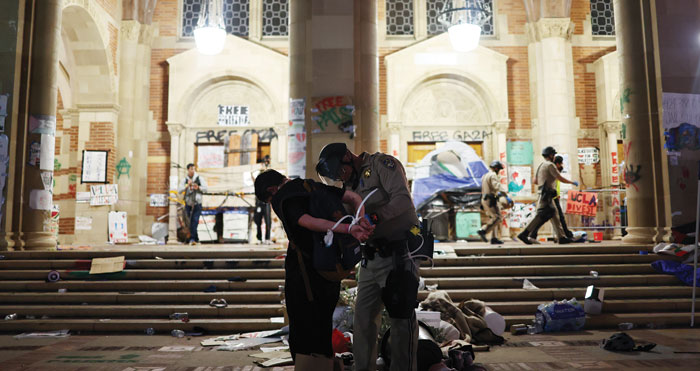
A California Highway Patrol (CHP) officer detains a protester while clearing a pro-Palestinian encampment after dispersal orders were given at the University of California, Los Angeles (UCLA) campus, on May 2, 2024. (Photo by Mario Tama/Getty Images)
Most political PACs, action committees, and NGOs that promote causes are registered with the IRS as nonprofits. According to Steinberg, “These organizations don’t do that.” There are no records, nor receipts, but a concealed operation runs through fiscal sponsors he calls pass-throughs, which are registered with the IRS.
1. The Rockefeller Brothers Fund provided the largest amount over the years. It is headed by President and CEO Stephen Heintz, who was Senator Joe Lieberman’s (I-Conn.) chief of staff. Steinberg says they have pushed this funding under the false label of Middle East peace and will have to answer to the campus takeovers and attacks against Jews. “Heintz is hands-on,” he says.
2. The Open Society Foundation, which was established by George Soros, has funded JVP, which has supported protests across the US since the Oct. 7 attack. The Open Society provides hundreds of thousands of dollars in multiyear contracts.
Steinberg doesn’t think it is right to single out Soros. “Soros is a diversion and exaggeration. The funding has been irresponsible but doesn’t come to the level of the Rockefeller Brothers Fund. Unlike Heintz, Soros does not get involved personally in his empire, certainly not for the last decade.”
3. The Tides Foundation is another pass-through. It receives funding from various donors, including Rockefeller Brothers and Open Society, and dispenses funding, for example to JVP, IfNotNow (INN), and Palestine Legal. There is no direct link between donors and recipients, allowing donors to hide their involvement.
4. Samidoun, the Palestinian Prisoner Solidarity Network, was founded in 2012 and was a major organizer in the Day of Rage and Day of Resistance. Its chief coordinator is Khaled Barakat, head of the PLFP abroad. In 2023, the German government banned it. In April this year, the Belgian government moved to revoke the refugee status of Mohammed Khatib, its European coordinator. Israel designated it as a terrorist organization and part of the PFLP in 2021, but Canada hosts the registered nonprofit in Vancouver. The US has not banned the organization though the PFLP is a designated terrorist organization.
According to Steinberg, Samidoun has the most visible terror connections through Hatem Bazian and SJP, but it is much more indirect and problematic in terms of the legal process. It is most visible in terms of its connections to the PFLP and has greatly increased its activity since Oct. 7.
It has been much more active in Europe but now has increased its activity and visibility on U.S. college campuses. The international coordinator, Charlotte Kates, was featured with Dr. Basem Naim, a senior Hamas official who described the Oct. 7 attack as a “heroic operation.” Samidoun has co-sponsored events led by Within Our Lifetime (WOL) and the Palestinian Youth Movement (PYM).
Samidoun’s website boasts a network of chapters and affiliates in the U.S., Canada, Germany, Britain, France, Sweden, the Netherlands, Belgium, Greece, Spain, Palestine, and Lebanon. It collects donations through the AFGJ.
The Israel-based Zachor Legal Institute brought an action against AFGJ and subsequently, in 2023 its online credit card donations, which fund 140 organizations, were shut down. The website currently states: “AFGJ cannot currently accept credit donations” and encourages donations via paper checks.
5. Westchester Peace Action Committee (WESPAC Foundation), a White Plains, New York-based foundation, is a Palestinian pass-through. Although it is registered with the IRS, it does not have to report where its money comes from.
Fourth-generation cantor Deborah Katchko-Gray, a Good Samaritan and founding member of Women Fighting Antisemitism, has been following the money trail for years. She told The Media Line that WESPAC is behind much of the funding that fuels the anti-Israel protests.
WESPAC is a 501(c)(3) that processes donations for several anti-Israel organizations, including WOL and SJP.
SJP has a long history of antisemitic activities across university campuses and easy access to several US politicians. It opposes anything connected to the State of Israel.
An SJP chapter once protested because of the availability of Sabra hummus at Northwestern University. SJP also sponsored the Oct. 12, 2023 Day of Resistance on college campuses across the US. Its flyers celebrated the Hamas “resistance” that swooped into Israel on Oct. 7 on paragliders, trucks, and boats. While WESPAC is open about its association with organizations like SJP, it is not so open about how it receives its funding.
“They support terror, quite honestly,” Katchko-Gray told The Media Line. “I know that Rep. Jamaal Bowman (D-N.Y.) probably is protecting WESPAC. He’s part of ‘The Squad,’” she says, referring to the nine congressional Democrats who occupy the left flank of American politics and are vocal opponents of Israel. “And it’s his district that they exist under,” she continued.
After Columbia University suspended SJP and JVP last November, New York Democratic Reps. Bowman, Nydia Velázquez and Alexandria Ocasio-Cortez signed a letter in support of the anti-Israel organizations.
6. National Students for Justice in Palestine (NSJP), JVP, INN, WOL, and USCPR are organizations that are directly involved in the protests and have substantial hidden funding.
NSJP, WOL, and Samidoun are not registered with the IRS and are entirely nontransparent, receiving funds anonymously through “fiscal sponsors.”
JVP and USCPR are registered as tax-exempt entities but are not required to report on their donors and income sources. Some of their donors, such as Rockefeller Brothers and Open Society, report on funding these groups, but most of their funding is hidden.
The websites of some of these organizations utilize pass-throughs, as well. For example, when you go to the donate link on the NSJP site, it takes you to WESPAC.
INN collects tax-deductible donations for its IfNotNow Education Fund through ActBlue Charities, “a qualified 501(c)(3) tax-exempt organization.” In FY 2021-2022, total income was $514,447 and total expenses were $460,014. It also operates the IfNotNow Movement, a 501(c)(4) organization. Donations to the movement are not tax-deductible. In FY 2021-2022, total income was $170,142; total expenses were $138,258.
IfNotNow does not report any donor information or sources of funding on its website, reflecting a complete lack of transparency and accountability. Independent research shows that, between 2017 and 2023, IfNotNow received $160,000 from the Rockefeller Brothers Fund “for general support.”
7. Another pass-through is a group of brokerage firms such as Goldman Sachs, Charles Schwab and Lehman Brothers, which enable their clients to donate anonymously to registered NGOs like JVP and USCPR and get tax deductions. Individuals, corporations and foreign entities can have accounts and direct their charitable contributions so their names don’t appear.
Steinberg says that groups like SJP, USCPR and Samidoun are major operations run by a tightly connected network of Muslims and Arabs, where people move from one organization to another. These people one day are seen organizing an event at CUNY in New York, and then at Hunter College and now Columbia. “You can’t be a student at all simultaneously, but maybe somebody wants to pay tuition,” he tells The Media Line. “Obviously they have to have salaries, travel funding, there’s social media, and how many of them are there, and who’s paying their salaries?”
Steinberg estimates that around $3 million in visible annual funding has been funneled into the coffers of these organizations but it’s hard to define the amounts due to the lack of transparency. SJP is not registered with the IRS or in any other format as a legal entity.
Ariel Beery, a 2005 Columbia University graduate, discussed the strategy of Israel’s enemies. He told The Media Line that when unable to defeat Israel militarily, they have turned to soft power and funding guerrilla groups to challenge Israel. These protests represent the soft power of Israel’s enemies.
“Anti-Western interests recognized that the leverage point was students and professors,” he stated.
Beery also highlighted the influence of certain academic and financial practices at Columbia during his time there. “As a student at Columbia from 2002 to 2005, I worked at the Middle East Institute as a research assistant. One of my regular duties was to type up and send thank-you notes from the director to various donors, most of whom were oil companies, or their proxy organizations and foundations. Nearly none of these were reported by the university at the time,” he said.
“Many donations,” he asserted, “are made just below the legal reporting requirement.
“As a research assistant at the Middle East Institute, I observed how donations just below the legal reporting requirement influenced the curriculum,” he revealed. According to Beery, these contributions supported courses in local high schools that presented a curriculum biased against Israel, perpetuating negative perceptions among young students.
“One day, the new director, Rashid Khalidi, who sat on a newly donated Edward Said Chair, asked me to send a letter he wrote to Saudi Aramco,” Beery said.
“In the letter, he thanked them for their generous donation to enable professors from the institute to teach a course on Middle East Studies in local high schools using a curriculum not friendly toward Israel. Courses such as that one have persisted for decades. This is one reason hundreds of high school students in New York find the motivation to protest Israel and target their teachers. Such programs were regularly sponsored, a visible example of how Israel’s enemies worked first to capture academic departments and then to propagate messages throughout the next generation of politicians, business, and community leaders,” Beery concluded.
Who Are the Protesters?
The Palestinian minority is less than 200,000 strong among a population of 333 million Americans, and yet they have managed to disrupt and tear down university campuses through a highly organized assault in a matter of mere weeks.
An attempted occupation at Arizona State University highlights another major issue college campuses are facing: Most of the protesters are not students.
An attempted occupation at Arizona State University highlights another major issue college campuses are facing: Most of the protesters are not students.
Several weeks ago, 72 people were arrested for trying to replicate the Columbia University encampment on a grass patch at ASU’s main campus in Tempe. Nearly 75,000 students attend the campus; fewer than 80 people arrived for the protest. Of the six dozen protesters arrested throughout the day, 15 were ASU students; almost 80% of those arrested were not students, an ASU spokesperson told The Media Line.
New York City Mayor Eric Adams said the protesters there had been “co-opted by professional outside agitators.”
The Media Line sent a reporter to several protests. In an encampment at the University of California, San Diego, Subrein Damanhoury, an organizer with PYM and media liaison for the encampment, told The Media Line that protesters were calling on UCSD to “divest all funds [from Israel].”
The Media Line counted roughly 30 tents within the confines of the fenced off encampment. The protesters plan to stay until the university meets their demands for UCSD to divest from Israel but were unable to identify how UCSD is currently connected to Israel, if at all, financially. The group also opposes Israel study abroad programs and university-funded research collaborations with Israel. “There’s a lot of stuff we could be funding instead of funding a military regime and occupation apartheid,” Damanhoury said.
An estimated 500 people were at the UCSD encampment, many of whom police believed to be unaffiliated with UCSD, including protesters from the UCLA and Columbia encampments, as well as members of the Black Panthers.
Why a Small Country Like Qatar Is Funding U.S. Universities
Qatar is one of the smallest countries in the Persian Gulf, sharing its only land border with Saudi Arabia. It maintains close ties with the Taliban and al-Qaida; shares a natural gas field with Iran; and funds and supports the Muslim Brotherhood. Hosting a U.S. military base, it also has good relations with the West as a large energy supplier. Qatar enjoys the perception of neutrality and has been a power broker in hostage releases in the past and between representatives of Israel, Hamas and the U.S. negotiating a cease-fire and hostage release deal. And it is leveraging its power and influence by pouring money into universities, buying up football teams and spreading its messages through the state-owned Al Jazeera news network.
Emphasizing this, Dr. Small asked a group of journalists why a small Gulf country like Qatar, with around 350,000 citizens and a total population of 2.7 million, gives more money to American and European universities than China, Russia, Canada, and European allies.
Qatar’s royal family, Small says, has taken a bayah, a spiritual oath, to the Muslim Brotherhood. As a result, the infamous antisemitic text “The Protocols of the Elders of Zion” plays a central role in their interpretation of Islam.
Javier Ghersi/Getty Images
ISGAP’s Dr. Small points to the late Muslim Brotherhood spiritual leader Yusuf al-Qaradawi, who brought Islamic studies to Oxford — where Small earned his doctorate — and who argued that the true Muslim is obligated to complete the work of Hitler.
“This was the core element of the teachings that are followed by the Qatari regime. So the Qatari regime’s goal and the Muslim Brotherhood’s goal is to remove and isolate, distance Israel from the West and from the U.S., to destroy it, and to use antisemitism as a way to fragment and weaken and then destroy ‘the Great Satan,’ the United States,” Small says.
Small said that SJP was kind of born out of American Muslims for Palestine (AMP), which is an American Muslim Brotherhood organization. The report stated that AMP’s legal counsel said they were funding groups such as SJP and JVP.
ISGAP just released a 73-page report claiming that Hamas-linked funds provided grants of up to $2,000 each for the programs and activities of pro-Palestinian groups. Small said that SJP was kind of born out of American Muslims for Palestine (AMP), which is an American Muslim Brotherhood organization. The report stated that AMP’s legal counsel said they were funding groups such as SJP and JVP.
Several months ago, ISGAP revealed that Texas A&M had a $1.3 billion contract with the Qatar Foundation. ISGAP also uncovered 502 research projects for which Texas A&M gave all the intellectual property rights to the Qataris.
Several months ago, ISGAP revealed that Texas A&M had a $1.3 billion contract with the Qatar Foundation. ISGAP also uncovered 502 research projects for which Texas A&M gave all the intellectual property rights to the Qataris.
Dr. Small said that his institute flagged 58 research projects that the Qataris now own with dual-use military and even nuclear research with military implications.
Cornell was among the list of Qatari-funded universities, receiving a $1.9 billion gift and an $8 billion infrastructure program donation.
Cornell was among the list of Qatari-funded universities, receiving a $1.9 billion gift and an $8 billion infrastructure program donation, with which Qatar built the medical school hospital and research center for the Cornell University campus in its capital, Doha.
The Qatari Embassy released a statement on May 2 claiming that disinformation was being spread about Qatar’s relationship with certain U.S. universities, and that “Qatari donations provided to U.S. universities are allocated to the operating costs of branch campuses in Qatar, funding construction and maintenance, faculty salaries and other costs incurred in Qatar — not in the United States.” The embassy insisted that “Qatar never interferes in the educational content or curriculum of any American school, college, or university.”
Laws in the U.S. require foreign gifts of over $250,000 to universities or nonprofit organizations to be reported to the Department of Education and the IRS. These laws are not being enforced effectively, according to Small.
Steinberg calls on universities to transparently disclose their funding sources to the U.S. government and to their stakeholders — their funders, faculty, and students — and demands basic transparency and scrutiny regarding anti-democratic and hateful entities that could be influencing academia.
Asked what actions need to be taken, Small quipped, “We are calling on the Texas government and federal government to investigate their reports on Texas A&M.” “They’re closing their campus [in Doha] based on our report. I think that sent shockwaves through the Texas A&M community.”
Asked what actions need to be taken, Small quipped, “We are calling on the Texas government and federal government to investigate their reports on Texas A&M.” “They’re closing their campus [in Doha] based on our report. I think that sent shockwaves through the Texas A&M community.”
Looking toward Europe, the U.K. has seen protests for months organized by the Palestine Solidarity Campaign, but the recent spate of protests, including encampments, mirrors those in the US. However, the response structure lies with the public safety echelon. Tom Southerden, Amnesty International U.K.’s program director for law and human rights, told The Media Line that it’s up to the police, not the universities, to determine whether to act against protesters.
In a sad, developing story, Columbia University and the University of Southern California announced that they were canceling their main commencement ceremonies.
A deep understanding of the breakdown of America’s pillars of education, the causes, and the funding, in addition to a united front on the governmental, university leadership, and organizational levels will only begin to bring American academia back to its core values, so that the U.S. and the civilized world’s valued interests are preserved and students can feel safe to learn in a free and democratic society, not with chains of intimidation, fear and hate.
Clint Van Winkle and Nathan Klabin contributed to this report.
Felice Friedson is president and CEO of The Media Line news agency and founder of the Press and Policy Student Program, the Mideast Press Club, and the Women’s Empowerment Program. She can be reached at ffriedson@themedialine.org.
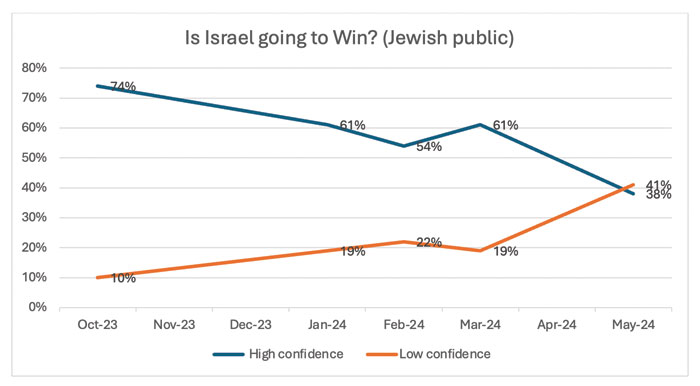
In October 2023, half a year ago, a vast majority of Jewish Israelis had high confidence that Israel would win the war. As the war dragged on, a slow decline was to be expected. From more than 70% confidence, to more than 60%, to more than 50%. In May, for the first time, more Israelis have low confidence that the country could win, than those who still retain their high confidence. Their level of pessimism rises; their approval of Israel’s government drops.
Something must change. But choosing the exact “thing” that must change, and make it change, is complicated to do. On Sunday, Hamas provoked Israel by launching a shell attack from Rafah, in the south part of the Gaza strip, killing soldiers, and taking immediate ownership of the attack. As if telling Israel: As you hesitate to get in, we are going to give you a reason to get in. On Monday, Israel rained pamphlets on some neighborhoods near Rafah, demanding evacuation of the civilian population. No – this is not yet “it.” It was not yet the big move into the last ditch of Hamas resistance. It was a message: get your act together, take the deal, or else.
Israel’s Jewish public (but not the Arabs) supports a Rafah operation. But there’s a third of it willing to give up on the military attack in exchange for getting the hostages back. In the last three weeks of negotiations, debate between those who prioritize an attack and those who prioritize a hostage deal became ugly. The Rafah camp is charged by its opponents with not caring about human life, being willing to abandon the hostages because of political considerations. The hostages camp is blamed by its opponents for no longer being determined to win, that once more it is prioritizing a temporary respite over a strategic necessity.
Both camps have supposed proof against their opposite camps: the PM is under pressure from his coalition partners to forgo the deal and send the IDF into Rafah. And by pressure, I mean threat. Either you do this, or your coalition is gone. Had Benjamin Netanyahu been a PM that the people trust, they’d assume that he will make the decision based on Israeli interest, not on short-term coalition-preservation interests. Alas, Netanyahu is a PM a vast majority of the public does not trust. More than 70% want him gone, either now or when the war is over. Hence, suspicion spreads. What if the PM is deliberately sabotaging the hostage deal – not because he thinks it’s bad but rather to keep his coalition together?
The Rafah camp also has proof with which to hammer the hostage camp. It consists of two main arguments. One – that the leaders of the hostage camp strive to topple the coalition. Minister Benny Gantz already announced that a September election is what Israel should aim to have, so maybe (the Rafah camp suspect) he is willing to sacrifice the prospect of victory to have his political triumph. Two – the Rafah camp blames the hostage camp that what it offers Israel is the same old status quo strategy of past wars. You begin with a bang and end with a whimper. The “generals” – such as Gantz, his party member Gadi Eisenkot, Defense Minister Galant, Chief of the IDF Halevi – are all victims of groupthink. They forgot how to win wars. You need proof of that? Oct. 7 was proof of that!
So, an ugly smear campaign is ongoing, painting a serious debate – about what to do next – in unserious colors. In fact, there is good reason to argue for a Rafah operation. The war is not over. Hamas is not yet on its knees. Its operatives just demonstrated that they can still launch deadly attacks on targets inside Israel. In such situation, the residents of the ‘Otef’ – the Israeli villages and towns around Gaza – cannot safely go back to their homes.
It’s not at all clear that going into Gaza will provide Israel with the victorious end it strives to have. In fact, more than a few military men warn of possible operational complications if or when Israel goes into Rafah.
There are also good reasons to argue for a hostage deal – assuming Hamas accepts a deal, which, at the time of writing, is far from being certain. First, because Israel does not have international support for a Rafah operation. Second, because to save the hostages we need a deal now, and attacking Rafah could be done later. Third, because it’s not at all clear that going into Gaza will provide Israel with the victorious end it strives to have. In fact, more than a few military men (yes, more “generals”) warn of possible operational complications if or when Israel goes into Rafah.
And yet, something must be done. As the public loses its confidence that the war can be won, the government must either double down – as it declares it is about to do – or find an exit so Israel can turn to the vast task of rebuilding and rehabilitating Israel’s south and north. Both options are costly, both options have pros and cons. Let us hope that Israel chooses the right one. Let us hope the choice is made for the right reasons.
Something I wrote in Hebrew
Here’s what I proposed to Israelis who watch with (justified) amazement the events at college campuses across the U.S.:
Since the students do not understand us, they should tell us how to solve our problems. Since we do not understand them, we should tell them how to solve their problems. In other words: American students do not have the ability to express an informed opinion about the Israeli-Palestinian conflict, its causes and results. Israeli officials have no ability to express an informed opinion on the state of American academia, its causes and results. We rightly ask that they not educate us. It is advisable to remember that we also do not have the training to educate them.
A week’s numbers
Losing confidence, in numbers (from JPPI’s monthly Israel survey).
A reader’s response:
Erwin Goldberg: “Do you expect American Jews to make Aliyah because of what happens in America?” Answer: I’m always in favor of Jews who come to live in Israel, but right now one must admit that Israel doesn’t see like the tempting destination that we all want it to be.
Shmuel Rosner is senior political editor. For more analysis of Israeli and international politics, visit Rosner’s Domain at jewishjournal.com/rosnersdomain.
First he lived biblically, now he’s living like it’s 1787.
AJ Jacobs, the prolific stunt-author of “The Year of Living Biblically,” in which he decided to read the Hebrew Bible and keep God’s commandments, chapter and verse; “Thanks a Thousand,” which documents his gratitude for the hundreds whose work went into producing his morning cup of joe; and “The Puzzler,” recounting his attempts to solve the world’s toughest mazes, crosswords and riddles, is back — proudly sporting a tricorne hat and armed with a musket.
In “The Year of Living Constitutionally: One Man’s Humble Quest to Follow the Constitution’s Original Meaning,” Jacobs sets out, in characteristically wise and witty style, to understand America’s founding charter and see what lessons we might learn from it amidst today’s virulently polarized pre-presidential election times.
Tipping his cap, and the new book’s subtitle — which echoes that of its biblical predecessor, “One Man’s Humble Quest to Follow the Bible as Literally as Possible” — Jacobs, a Reform Jew who lives in Manhattan’s Upper West Side, notes how struck he was by the parallel projects. “I followed the Ten Commandments, but I also followed the hundreds of more obscure rules,” he reminds his readers. “I grew some alarmingly sprawling facial hair (Leviticus says you should not shave the corners of your beard) and tossed out my poly-cotton sweaters (Leviticus says you cannot wear clothes made of two kinds of fabric) … The project was absurd at times but also enlightening and inspiring.” Ultimately, in wrestling with a fundamentalist interpretation of a millennia-old document, he concluded:
“I found that some aspects of living biblically changed my life for the better (the emphasis on gratitude, for instance). I also learned the dangers of taking the Bible too literally (I don’t recommend stoning an adulterer in Central Park, even if those stones are pebble-sized, as mine were). And I learned how challenging it is to figure out what we should replace literalism with.”
Now Jacobs covers the Constitution, not quite yet two-and-a-half centuries young.
Scholars, he notes, have long described the Constitution as the sacred text of America’s civic religion. Jefferson called the delegates of the Constitutional Convention “demigods.” And, as in biblical interpretation, there is an endless debate between those who proclaim a fealty to the text’s ancient messages and others who argue its meaning evolves with the times.
Jacobs, adorned in garb that would make George Washington proud, balances a close reading of sections of the Constitution with his humorous, light touch.
Jacobs, adorned in garb that would make George Washington proud, balances a close reading of sections of the Constitution with his humorous, light touch. Take, for example, his comments on the opening 52 words:
“We the People of the United States, in Order to form a more perfect Union, establish Justice, insure domestic Tranquility, provide for the common defence, promote the general Welfare, and secure the Blessings of Liberty to ourselves and our Posterity, do ordain and establish this Constitution for the United States of America.”
Here’s Jacobs’ reaction:
“I love how it builds tension, comma by comma by comma, till we get to the majestic and self-referential phrase ‘this Constitution.’ I also like the mention of the ‘general Welfare.’ We could all use more attention to the “general Welfare” nowadays as a balance to America’s focus on individual rights. I’m also a fan of the mention of ‘Posterity’ — that’s us they’re talking about. We’re the posterity. I’m a part of this American experiment.”
Following a quip about the “promiscuous” use of capital letters by the Founders, Jacobs admits that the subsequent rules for setting up Congress are “technical and lawyerly … like the instructions to a complicated board game — like ‘Settlers of Catan,’ but the players are the branches of government.” While the typical citizen probably doesn’t have strong feelings on the instructions that “the Votes of both Houses shall be determined by yeas and Nays” and “No Person shall be a Senator who shall not have attained to the Age of thirty Years, and been nine Years a Citizen of the United States,” the Constitution does remain a national Rorschach test, with everyone, including, admittedly, Jacobs himself, seeing what values they want in it.
“Does the Constitution support laissez-faire gun rights, or does it support strict gun regulation? Does it prohibit school prayer or not? Depends on whom you ask. And it’s not just the issues we’re divided on — it’s the Constitution itself. Is the Constitution a document of liberation, as I was taught in high school? Or is it, as some critics argue, a document of oppression? Should we venerate this brilliant road map that has arguably guided American prosperity and expanded freedom for 230-plus years? Or should we be skeptical of this set of rules written by wealthy racists who thought tobacco-smoke enemas were cutting-edge medicine?”
On his quest to gain a better understanding of the Constitution’s intent and impact, Jacobs commits to “walk the walk and talk the talk and eat the mutton and read the Cicero,” just as they did in Franklin, Adams, and Jefferson’s day. He drafts the book with a goose quill, votes in a local election by voice, and hands out then-traditional eighteenth-century “election cakes” near a voting booth — an offer met by one curious onlooker with that most modern of queries, “Is it gluten-free?”
With his bemused family begrudgingly shlepping along for the endeavor, Jacobs participates in a reenactment of the 1776 Battle of Ft. Lee. He traces the history of women’s rights and the quest to abolish slavery. Free speech and federalism are analyzed and argued over. He even voluntarily quarters (i.e. houses) a soldier in his home. Hilariously, Jacobs and his son attempt to pay for a dinner with gold and silver due to the Founders’ distaste for paper money. The meal is for liberals and conservatives to debate originalism vs. living constitutionalism, naturally.
Jacobs hardly leaves a constitutionally-relevant topic unexamined. All the while he consults with legal experts and laypeople alike for their insights and perspectives, framing the debates that still rankle our republic.
Jacobs ultimately emerges having gained an appreciation for the Constitution’s, and its authors’, emphasis on the common good, deliberate thinking and having an experimental mindset, and the early Americans’ dislike for aristocracy. And he expresses profound awe at the gift that is being able to cast a vote in an election.
“The Year of Living Constitutionally” concludes by alluding to the story of Benjamin Franklin’s reaction to noticing the image of the sun, cut in half by the horizon, that adorned the wooden chair that Washington sat on as the Constitution was drafted. Franklin opined, at the end of the convention, that the sun, and America, was rising. Jacobs offers his own take:
“My year of immersing myself in the founding of this country has inspired me to fight as hard as I can to protect it … I’m not certain of much, but I’m sure of one thing: Whether the sun sets or rises on democracy, that’s up to us, we the people.”
Rabbi Dr. Stuart Halpern is Senior Adviser to the Provost of Yeshiva University and Deputy Director of Y.U.’s Straus Center for Torah and Western Thought. His books include “The Promise of Liberty: A Passover Haggada,” which examines the Exodus story’s impact on the United States, “Esther in America,” “Gleanings: Reflections on Ruth” and “Proclaim Liberty Throughout the Land: The Hebrew Bible in the United States.”
Antisemitism is not simply a Jewish problem. In fact, in many ways it has very little to do with the Jews and very much to do with the antisemites. Moreover, its aim is not solely the Jew, but the host civilization that is the carrier of this age-old virus.
One need not look far to apprehend this. Look at our universities and see how the virus of antisemitism has entirely disarmed institutions whose mandates are to educate and conduct research. “They’ve decided to close the university today,” a professor from Portland State University writes on Facebook. “They are canceling all classes as the anti-Israel protesters have broken into the university library and occupied it, trashing and vandalizing what is visible of the library through barricaded windows.”
At Columbia University, patient zero of the most recent spread of antisemitism on college campuses, pro-Hamas protesters broke into Hamilton Hall and unfurled a banner reading “INTIFADA.” At Harvard Square, students draped a Palestinian flag on John Harvard; at George Washington University, a keffiyeh was wrapped around the neck of a George Washington statue, and a Palestinian flag placed in his hand. At the University of Southern California, graduation has been canceled at the demands, allegedly, of pro-Hamas student groups.
Why are these things happening? Because society did not heed the warnings of the canary — Jews. Leaders did not listen to Jews who begged them to understand that chanting “From the River to the Sea, Palestine Will be Free” is a call to annihilate the only Jewish country, Israel. Because they ignored Jews who reported being excluded from communities for supporting Israel and Zionism. Because when Jews implored them to reconsider dividing the world between oppressor and oppressed, they blamed them for “making it about the Jews.”
Like a virus, antisemitism travels along the surface of civilizational pillars until it enters the receptors of institutions, where the virus and the pillars fuse, allowing the virus to infect and completely take over the civilization.
Indeed, like a virus, antisemitism travels along the surface of civilizational pillars until it enters the receptors of institutions, where the virus and the pillars fuse, allowing the virus to infect and completely take over the civilization. This latest variant, anti-Zionism, has been tenaciously traveling through our most important institutions, schools, universities and media, infecting hearts and minds.
If antisemitism is not just a Jewish problem, then treating it as such is ineffective. In-deed, as antisemites have captured univer-sities across America, our remedy has been to go out with massive pro-Israel rallies. I doubt, however, that this will work.
If antisemitism is not just a Jewish problem, then treating it as such is ineffective. Indeed, as antisemites have captured universities across America, our remedy has been to go out with massive pro-Israel rallies and fliers replete with “Never again is now,” “Stand up against antisemitism,” and “United against antisemitism” slogans. I doubt, however, that this will work. Moreover, I doubt that the recent efforts at UCLA to play raw footage of the Oct. 7 massacre on a massive screen facing the Hamas encampments will work.
The body has been infected. The receptor cells can no longer detect and disarm the hostile ideology. When you have raised an entire generation to look at the world through a binary lens of oppressor and oppressed, the oppressed can, quite literally, get away with murder — if the murder is of someone deemed an “oppressor.”
Remember the above poster, which emerged on Nov. 15, just one month after the Oct. 7 massacre of Jews in Israel?
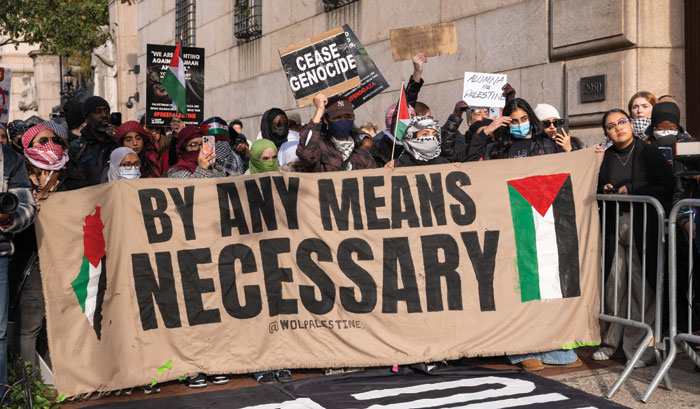
A student recently asked me, “But doesn’t the U.N. realize that if the Palestinians get their own state, it will be run by Hamas, and women will be mistreated and what about all the minorities …?” To this I say “By any means necessary” will provide any Palestinian state an imprimatur to conduct their state however they want. Moreover, the professors, students, and international bodies ostensibly fighting for human rights will applaud this future state, for it will have been created by dismantling the oppressor.
The disease has spread outside of universities. About 800 miles northwest of Columbia University, in Chicago, a roomful of masked, keffiyeh-clad activists enthusiastically repeated “Marg bar Israel” at the prompting of Shabbir Rizvi, a Chicago-based “activist” who frequently appears on Iran’s state-run Press TV. When one of the participants finally asked what it meant, Rivzi explained that in Farsi, “It can either mean ‘death to,’ or ‘down with.’” The crowd cheered, then started chanting “Marg bar America”: Death to America.
The “Free Palestine” movement has hypnotized an entire generation of students, academics, social workers, psychologists, teachers, administrators, doctors and nurses to want to destroy America and the West.
But there is hope. If the Jew is the proverbial canary in the coal mine who signals danger, this canary can also save the miner. We can save the miner by understanding that because antisemitism does not just victimize the Jews, we must confront the jihadists not just as a pro-Israel movement, but as a pro-peace, pro-truth, pro-freedom, and pro-life movement. Because that is who we are.
Naya Lekht received her Ph.D. in Russian Literature and wrote her dissertation on Holocaust literature in the Soviet Union. Naya is currently the Education Editor for White Rose Magazine and a Research Fellow for the Institute for Institute for the Study of Global Antisemitism and Policy.
Rabbi Natan Halevy, leader of the Sephardic congregation Kahal Joseph, grew up all over the map. His parents were born in Iraq, separately made aliyah before they were married, later moved to Australia — where baby Natan was born — and from there to America, the most jolting change of all. “My parents were very hard workers,” Halevy said.
The multiple moves were socially and culturally challenging. “In Iraq, families were very tight-knit, not just the immediate family but cousins, uncles and grandparents. However, all of that all changed when they left Israel after the Six-Day War [1967]. They moved to Australia, where I was born, and then to L.A. in the ‘80s.”
As the youngest by six years of the four Halevy children (Sharon Gomperts, one half of the Journal’s Sephardic Spice Girls, is his older sister), he grew into a voracious reader.
When he was 10, Halevyremembered thinking “I had an Australian passport and I had a green card, which said ‘Resident Alien.’ That felt strange to me. Weird. I started thinking: My parents are from Iraq, they went to Israel, they went to Australia, they came here. I was brought up here, but I am not officially American. I don’t feel like I am Australian. I don’t feel I am Israeli, I sure don’t feel Iraqi — when you’re a kid, you don’t understand that. I realized above all I was a Jew.”
The question of identity was complicated when he started going to school. It was the ‘80s when “a lot of Persians came here,” the rabbi said. “They lumped us all together. They looked down on us. I felt it as a kid. It stung. It wasn’t good for me,” he said. It took a long time until he got over that – feeling that I was not as smart. At Hillel [Hebrew Academy], we had a smart class and dumb class. I was a good reader.” Even though he was ordained at 24, it wasn’t until his 30s for Halevy to realize he was not “dumb.”
It took therapy and self-work until he realized his self-worth and managed to shed these negative thoughts. “Being of service was helpful too,” he said. “If you’re a rabbi, if you are reading the Torah and giving speeches, you can’t be that dumb.” Ultimately, overcoming mental burdens is about realizing your self-worth, the young man realized. The rabbi also reflected on Jewish law. “It says ‘You have to love your fellow like yourself.’ If you don’t love others, how can you love yourself? Loving yourself is important.”
Halevy occasionally alluded to how his parents were dedicated to raising their children traditionally, but adjusting to so-called societal norms was a pesky, persistent presence. He grew up Modern Orthodox. But when he became more religious, he was drawn to Chabad. “That definitely helped me,” the rabbi said, “because I loved reading, and I had learned Hebrew from my parents. Being able to read a lot and knowing Hebrew –that was great with Torah. Perfect.”
But Iraqis, “especially the men, my dad – are very soft-spoken people,” Halevy said. “They are not disciplinary at all.” Itwas hard for his parents to adjust to sharp social differences in America which were so removed from the way they were raised.“I don’t think they knew what to do when they came to Australia and America,” says their youngest child. “The nature of life in Western civilization is that you are not always by each other. My parents didn’t know what to do with that. They did not realize that in America – especially in the ‘80s – you better be on top of your kids more.”
Rabbi Halevy recalled a crucial school days’ scene. “When I was in the eighth grade, I said to my parents, ‘Jewish school is a waste of time and money. You might as well just send me to Beverly [Hills High Schoo] and save your money.’
“I felt badly for them,” he reflected.“How religious are you going to stay at Beverly? My parents had no idea about that. You are around non-kosher food and kids breaking Shabbat. When I tried to wear a kippah to school, Jewish kids laughed at me. That shamed me even more. So embarrassing.”
“I am Jewish.That defines me. I am a very proud Jew. Even at times when I was off the derech a little, I knew I was Jewish. It was a very strong part of my identity.”
There was one thing his parents made sure he never forgot: “I am Jewish.That defines me. I am a very proud Jew. Even at times when I was off the derech a little, I knew I was Jewish. It was a very strong part of my identity.” He made this point multiple times. “I want to emphasize,” he said, “this is part of my ethos. The Lubavitcher Rebbe called it ‘the greatness and the pride of Jacob.’ Every Jew should feel the greatness and the pride of being a Jew.” I think that is the reason we are in this situation in Israel. We lack Jewish pride.”
After graduating from Beverly, Halevy spent a year abroad in Israel. Returning to America, he enrolled in a Brooklyn yeshiva, weighing careers and whether to go to college. “I asked my father,” said Rabbi Halevy. “He said ‘Stay in yeshiva. Learn to be a rabbi.’ I said ‘I am going to honor my father.’ I was 19.”
He is rare. “A lot of Iraqis are businessmen, doctors, lawyers. There are few Iraqi rabbis.”
Fast Takes with Rabbi Halevy
Jewish Journal: The most important lesson you are teaching your children?
Rabbi Halevy: How important it is that they should love each other because they are a unit. Love your fellow Jews – and everyone, including non-Jews.
J.J.: What do you do in your spare time?
RH: When I can, I like swimming in the ocean and hiking.
J.J.Your favorite activity as a family?
RH: We like going to parks, going out to nature. When we can get away, it is awesome.