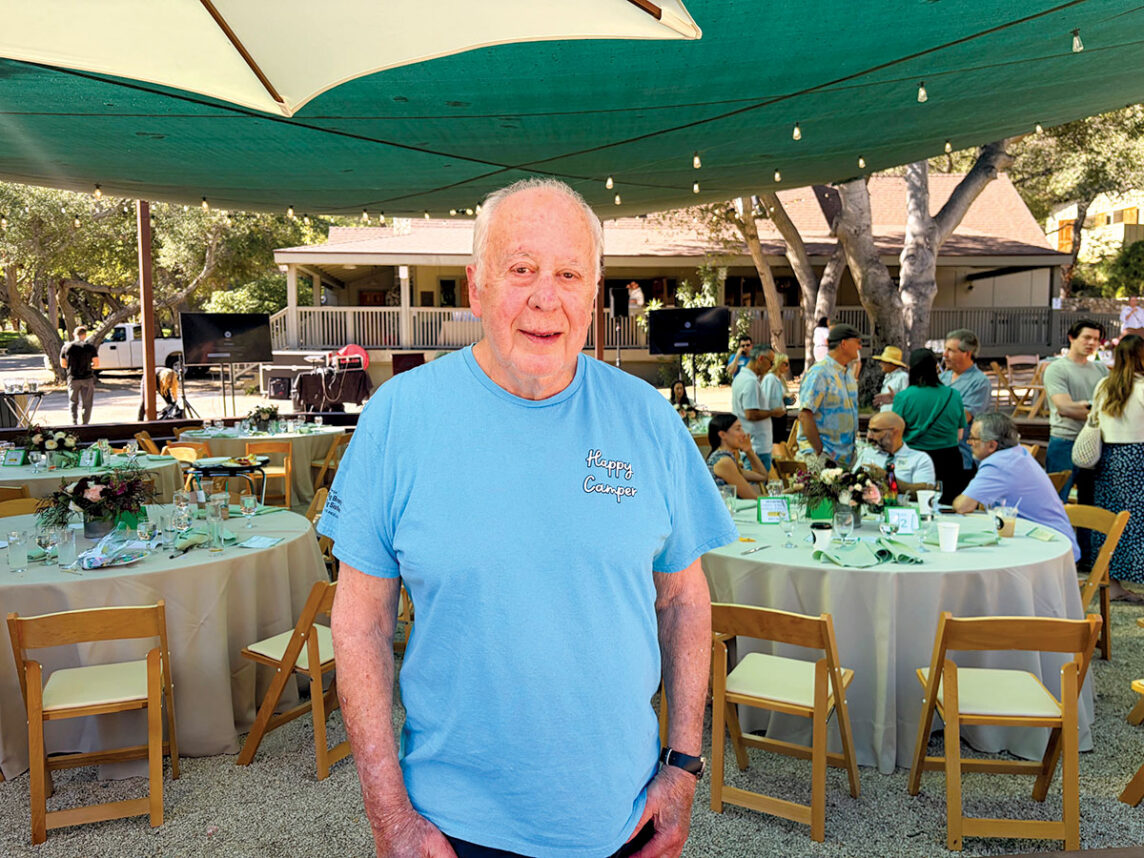
As a boy in Tel Aviv, Gady Levy &’9;lived in a purely secular household. He rode his bike on Yom Kippur and had absolutely no interest in Jewish tradition. Then, when he was 16, his family moved to San Diego. His mother, realizing that her son felt isolated from American teen culture, signed him up as a counselor-in-training at Camp Ramah. Levy protested, “I’m never going to spend my summer with a bunch of Jews!” But somehow — probably because his mother bribed him with the promise of a new stereo — he was persuaded to give camp a try.
At Ramah, in the summer of 1986, something remarkable happened. Levy still remembers “getting out of the bus and finding a community.” It has become a family joke: “I left on the bus and I never came back.” Part of what Levy discovered at Ramah was a passion for Jewish education that transformed him. In his new job as director of the University of Judaism’s (UJ) department of continuing education he hopes to find “the opportunity to touch people’s lives the way I was touched.”
Following his first Ramah summer, Levy continued to work with Jewish children. While earning a bachelor’s degree in marketing from California State University Northridge (CSUN), he served as a youth advisor and taught religious school. Along the way, he acknowledged that his knowledge of Judaism was far from complete. He followed his master’s in education from CSUN with a second master’s in Jewish education from UJ. Now he’s taking courses at Pepperdine University, working toward a doctorate of education with a focus on organizational leadership. Not bad for a boy who was known among his Ramah friends as a clown, not a budding scholar.
Levy came to his current post in late 1999, after spending seven years as youth leader and then director of education at Adat Ari El. He loved introducing children and teens to the joys of Jewish communal life, and it was hard to move on. But Levy could not resist the challenge of rising to the next level, saying, “What I was able to do with kids, I hope I can do with adults.” At UJ he’s busy revamping adult education offerings and planning other activities for the 10,000 people who participate yearly in UJ programs. But Yesod (see article on page 18) remains his favorite project. It so absorbs him that “I sleep on it at night and wake up in the morning to write notes.” Still in his head is the concept of some future Yesod-Plus, in which graduates of the two-year course can continue their studies by meeting in private homes.
Levy believes that communal life is the glory of Judaism, “regardless of how religious you are.” He fluctuates in his own observance, holding Shabbat dinners for his friends but not always following Jewish law to the letter. One of his closest pals from Pepperdine is a Catholic nun, for whom he hosted a traditional Passover seder last spring. He knows he’s lucky to have enjoyed his career every step of the way. For the future he makes a solemn pledge: “I will never take a job I don’t feel passionate about.”