
Judaism plays a significant role in the play “The Lehman Trilogy.” As the characters’ success in business reaches astronomic levels, the degree in which they practice Judaism goes from strictly observant at the beginning of Act I (taking place in 1844), to barely practicing at the end of Act III (taking place in 2008).
To ensure the Jewish authenticity in every scene, Tony Award-winning director Sam Mendes, who is Jewish, brought in Rabbi Daniel Epstein, then a rabbi at the Cockfosters & North Southgate Synagogue in London. The rabbi did a deep dive with the actors in understanding the Judaism their characters were to embody.
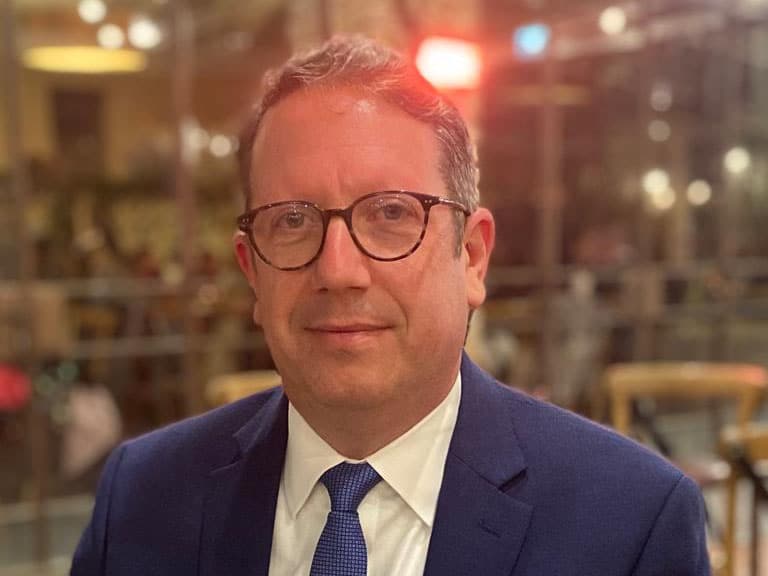
As the highly-revered play begins its residency at the Ahmanson Theatre through April 10, Epstein spoke with the Journal about how he was tasked with making sure there would not be any semblance of a caricature of the Jews depicted in it.
“I was telling [the actors] that in the first generation, there would’ve been tallit over your head and there would’ve been a lot of this shokeling,” Epstein said. “And then after the second generation, they’d still be putting on a kippah—they light the candles at one point for example. [The actors] wanted to know how to light them.”
There were discussions between Epstein and the actors on whether they should put on a kippah for the scenes with the second generation of Lehmans. They decided to do without the kippah, partly because it was complicated to pull it out of their pocket every single night and make sure they wore it securely.Their focus was on the language, so they made a slight wardrobe sacrifice to lessen the risk of derailing the flow of the dialogue.
When asked about what inspired his coaching, Epstein recalled how he felt when he watched Sylvester Stallone in “Rocky III” say a prayer at the Jewish funeral of his trainer Mickey Goldmill.
When asked about what inspired his coaching, Epstein recalled how he felt when he watched Sylvester Stallone in “Rocky III” say a prayer at the Jewish funeral of his trainer Mickey Goldmill.
“Somebody did a good job of making him pronounce the words just right,” Epstein said. “The mood was correct, and the solemn aspect of it, you were taken by it. It was good. Had [Stallone] just been saying [the kaddish] all wrong or in the wrong tone, it would’ve stood out.”
Epstein also coached the actors on the pronunciation of transliterated Hebrew prayers in the script.. With his deep knowledge of Hebrew and history, Epstein was able to deduce just how the Lehmans,would have pronounced the prayers.
In Act I, the original Lehman Brothers, Henry, Emmanuel and Mayer, engage in several ritualistic Jewish moments— praying on a daily basis and sitting shiva properly. They observe all 30 days of sheloshim. By the turn of the 21st century, the Lehman descendants observed only three minutes of mourning.
““Three minutes was asclinical as it was detached from their tradition,” Epstein said. “And it’s a very powerful statement about where they’re moving, from prophet P-H to profit F.”
Epstein also led discussions with the actors on mitigating being massively successful while still retaining Jewish values.
“Are the two mutually exclusive? Do you have to shed one to enable the other?” Epstein said. “I was trying to make the case that you don’t. You can find ways around. There’s no reason why you can’t stay Orthodox and be wildly successful in business.”
In each of the three Acts, which features three actors, each character plays a Lehman descendant from the next generation. The characters come from a Jewish family, but in the 164th year of the company’s existence, the family name became synonymous with the collapse of the subprime mortgage market.
The characters come from a Jewish family, but in the 164th year of the company’s existence, the family name became synonymous with the collapse of the subprime mortgage market.
“[The actors] were trying to get their heads around the very delicate eggshell walk of ‘At what point does it become an antisemitic trope that we’re talking about excessive amounts of money and Judaism and philanthropy?’” said Epstein. “[The actors] were just fascinated to almost ask the questions in a safe space. I was happy to encourage them to talk about it, but I don’t believe the play contains any antisemitic tropes.“”
The antagonist in “The Lehman Trilogy,” in Epstein’s view, is the temptation to be greedy Greed, according to the rabbi, is only tempered by an anchoring in a faith or tradition.
He said, “I think that’s the cautionary tale of this whole thing.”
“The Lehman Trilogy” is playing at the Ahmanson Theatre. through April 10.