“Trayf” is an award-winning play that is kosher for those with a taste for Jewish-themed theater and anyone who has ever pondered “What makes a Jewish soul?” The play will also entertain those who loved making mixtape cassettes of their favorite music back in the 1990s.
The play is currently having its maiden West Coast run at the Audrey Skirball Kenis Theater at the Geffen Playhouse in Westwood. During a sold-out matinee, the four-person cast brought laughs, gasps and tears to a captivated audience.
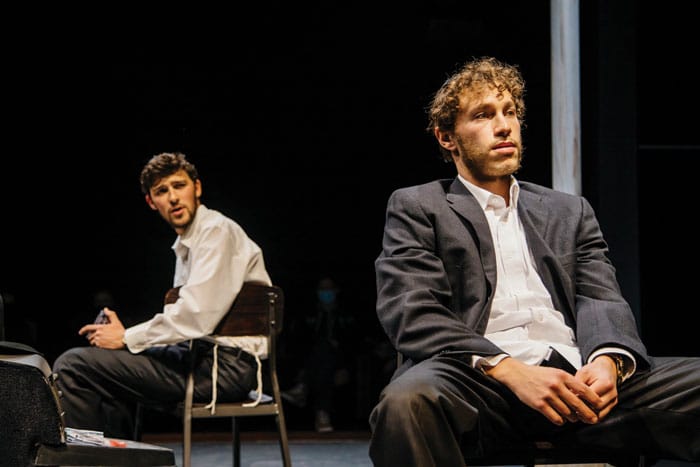
The 80-minute one-act play is about Judaism and the friendship between its main characters, Zalmy (Ilan Eskenazi) and Shmuel (Ben Hirschhorn), 18-year-old Orthodox men who are life-long friends and drive a Mitzvah Tank together around New York City in 1991. They step onto street corners to educate, spread awareness of Judaism and to offer charity to passersby.
One day, Zalmy and Shmuel come across Jonathan (Garrett Young), a man who was raised Catholic and is feeling sad and lost, having just found out that his recently deceased father was a Holocaust survivor. Jonathan’s girlfriend, Leah (Louisa Jacobson), is a strong-willed non-observant Jewish woman.
As their conversations continue, Jonathan and Zalmy seem to bond. Zalmy confesses his enthusiasm for his secret interests — popular music, roller-skating and dating women — and Jonathan is happy to indulge.
Shmuel is not as enthralled with Jonathan. His mother isn’t Jewish (and in Shmuel’s view, he is not really a Jew) and his secular lifestyle seems to be bringing an unwelcome respite to Zalmy from the traditional life they had been raised in together. Shmuel starts to see Jonathan as a threat to his friendship with Zalmy and as a glaring example of the scourges of secular society.
Director Maggie Burrows leads the ‘Trayf’ cast through their characters’ harrowing struggles, filled with both inspiring conversations exploring what it means to be Jewish and heartbreaking moments of friendships on the rocks.
Director Maggie Burrows leads the “Trayf” cast through their characters’ harrowing struggles, filled with both inspiring conversations exploring what it means to be Jewish and heartbreaking moments of friendships on the rocks. The talented cast embodies each of their roles with a palpable mix of grit and charm.
The theater’s set brings a gritty New York City charm, with a lone hulking streetlight looming over each scene amidst a satisfyingly moody lighting setup. Most strikingly, though, is the boombox tape player that sits in the middle of the set. It’s a symbol of the noise, distractions and lure of temptations to all of the characters finding their place amongst each other and in a turbulent world.
Hit songs from the turn of the 1990s are in the play, including “Where Is My Mind?” by the Pixies, “Come As You Are” by Nirvana, “Evenflow” by Pearl Jam and “It’s the End of the World As We Know It (And I Feel Fine)” by R.E.M. The lyrics (and for that matter, the song titles) reflect the internal struggles of the four characters.
“The play begins and ends with a tape,” playwright Lindsay Joelle told The Journal. “In the movie ‘High Fidelity,’ the main character says, ‘The making of a good compilation tape is a very subtle art… First of all, you’re using someone else’s poetry to express how you feel. This is a delicate thing.’”
Joelle then compared that quote with a quote from the founder of Chabad, Rabbi Shneur Zalman of Liadi: “If words are a pen of the heart, then a song is the pen of the soul.” One of the main questions of “Trayf,” Joelle said, is the question of what makes a Jewish soul.
“It’s also about the journey of two friends who at first don’t have the ability to speak to each other openly about the truths hidden in their souls,” Joelle said. “Without giving anything away about the plot, at the end of the play, the exchange of a mixtape — the making of it for one character and the willingness to hear it from the other — is the true expression of the strength of their friendship and the core values they share despite their differences in ideology.”
“Trayf” is at the Geffen Playhouse through April 10. geffenplayhouse.org/shows/Trayf/