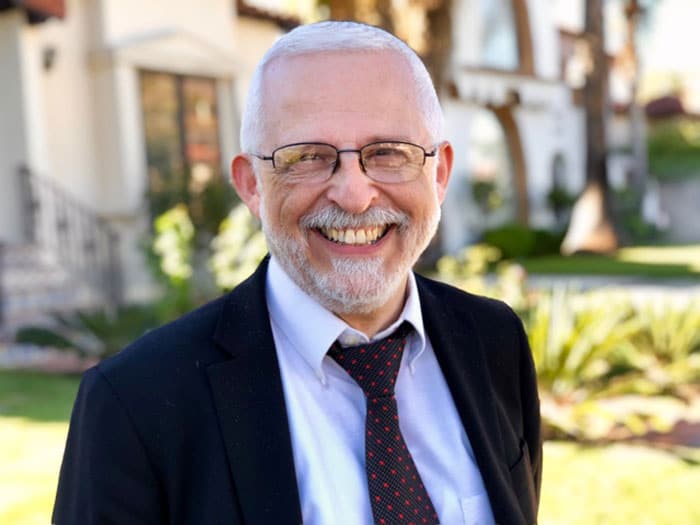
Growing up in Belfast, Northern Ireland, Rabbi Moshe Cohen only went to shul twice a year: on Rosh Hashanah and Yom Kippur.
“My upbringing wasn’t very Jewish,” he said. “There was a one-size-fits-all synagogue, which was Orthodox in name, Conservative in practice and Reform in outlook. It was a real mish-mash of everything.”
He became a lawyer, then ended up studying Torah in Israel. During his time there, he met Rabbi Noach Weinberg, of blessed memory, founder of Aish HaTorah.
“He was a fascinating person,” Cohen said. “He was very charismatic and he just spoke to me in a way that was very engaging.”
Cohen got hooked on Torah. He spent so much time studying in Israel – 10 years – that he needed something to show for it. That’s when he became ordained.
“I didn’t decide to be a rabbi,” he said. “I was there in Israel and I was studying for so long. My parents kept saying, ‘How long does this course last?’ and ‘Will you come home with a degree?’ Eventually, I decided I’d take ordination. I did it because that’s what my parents expected, like when you go to college and get a degree.”
Cohen moved to Los Angeles more than 30 years ago, and today, he is the rabbi of The Community Shul in Pico-Robertson. The shul, he said, is made up of ba’alei teshuvah, or Jews who did not grow up religious but became religious later on in life—just like he did.
“They didn’t have a background in Judaism, and there are a lot of gaps that need to be filled in,” he said.
To help fill those gaps, Cohen teaches individual and group classes where he connects Torah to the hot topics of today. He gave a series of classes on issues such as capital punishment and using marijuana and the Torah perspective on them.
“I really have a unique ability to get people connected to their Judaism and to give them a real, authentic way of feeling Jewish and making it very relevant to their lives,” he said.
Since Cohen is a ba’al teshuva, he has experienced both a secular and a religious life, and he uses that experience in his work. “I come with a breadth that most rabbis don’t have,” he said. “There’s a Joni Mitchell song where she sings, ‘I’ve looked at clouds from both sides now.’ I’ve seen what the secular world is and I’ve seen what the religious world is. I can give them a better perspective than what they would otherwise get.”
However, what really attracts Jews to Judaism is interacting with religious families.
“No class is going to be as effective as seeing a happy family on Shabbat. That’s it. That’s the cake, the icing and the cherry on top.”– Moshe Cohen
“No class is going to be as effective as seeing a happy family on Shabbat,” Cohen said. “That’s it. That’s the cake, the icing and the cherry on top.”
When Cohen isn’t teaching, he studies Torah and Talmud and also serves as a rabbi for a virtual community in Mission Hills. He writes a regular newsletter called “Torah in the Desert” for them and goes out there once a month to hold events.
“I have a broad enough background that I can speak to them about many different things,” he said. “I like to read self-growth books, like books by Malcolm Gladwell.”
While Cohen said that the ba’alei teshuvah movement crescendoed after the Six-Day War, now it has plateaued a bit. However, that doesn’t stop him from continuing the work that is most meaningful to him.
“Now, it’s very difficult because there is so much else out there vying for people’s attention,” he said. “It’s very difficult to get them interested. But they are interested. You just have to know how to speak to them.”
Fast Takes With Moshe Cohen
Jewish Journal: What do you do for fun?
Moshe Cohen: I’m a chess player. I’m up until 2 a.m. most nights, and most of the time I’m studying. But sometimes, I take a moment to play a game of chess.
JJ: What’s your perfect Shabbat look like?
MC: One where I’m home with my family and friends.
JJ: You ran a marathon a few years ago. Where in LA did you practice running?
MC: I ran into Beverly Hills and Melrose all the way down to La Brea and back again. I did it between 12 a.m. and 2 a.m. I really enjoyed it because of the challenge and I had time alone to think.
JJ: What’s your favorite Jewish food?
MC: Anything my wife cooks.
JJ: How about your favorite Irish food?
MC: Either fish and chips or bangers and mash. I’ve never met a potato I didn’t like.
Things never are so bad that they cannot get worse
has sadly been quite true about Venezuela,
but staleness is something that you can reverse,
preventing bread by toasting from becoming staler.
Although this bread-rule’s true, it hardly is to leaders
like President Vladimir Putin now applicable;
egregious aggression and his grandiose greed is
unlikely to transform him to toast, though despicable,
which means unlike burned toast he never will be crumbled,
consumed by his consumers he wants to digest.
It’s rare for bad leaders to fall or be tumbled,
overthrown by the people whom they have oppressed.
We see this not only in Russia but in
contemporary countries ruled by autocrats,
who are contemptible, like Iran, China, Hebrew: Sin,
the country’s cover story of covidious bats,
which caused a bad disease that isn’t getting better,
and even may get, I’m afraid to think, much worse.
On the healing process it is wrong to be a better,
and far more sensible to bet on the reverse.
After the Ten Plagues God drowned all Pharaoh’s host
in the Reed Sea and Moses sang a famous song,
but Putin won’t be turned by the Ukrainians to toast
unless this poem’s title and first line are wrong.
The title and first line of this poem were inspired by Things are Never So Bad that They Can’t Get Worse: Inside the Collapse of Venezuela by William Neuman.
Gershon Hepner is a poet who has written over 25,000 poems on subjects ranging from music to literature, politics to Torah. He grew up in England and moved to Los Angeles in 1976. Using his varied interests and experiences, he has authored dozens of papers in medical and academic journals, and authored “Legal Friction: Law, Narrative, and Identity Politics in Biblical Israel.” He can be reached at gershonhepner@gmail.com.
Editor’s Note: Hyperlinks were carefully added throughout the piece as both silly Easter eggs and points of clarification. You don’t need to click on them, but you’ll certainly have more fun if you do.
449 days. I went 449 days without seeing a movie in the theater. The last time I went this long was easily, without question, not a doubt in my mind, from birth until I was taken to my first movie. And to be totally honest, it’s possible that my mom brought me to a theater as a baby. I’ve never asked her, and if she did, it’s likely I’ve never gone that many days without going to the movies – horrifying! To conceptualize this another way, it’s 1 year, 2 months and 23 days. It’s 64 weeks and a day. If a year is a long time, this was 123.01% of a year, an unforgivably high percentage! It’s 10,776 hours, give or take the time of day each movie was watched. That’s over 5 thousand movies I could have seen in that time, which was wasted at home, in the hospital with patients, and in parks with my family. I mean, priorities, people, AmIRite?!
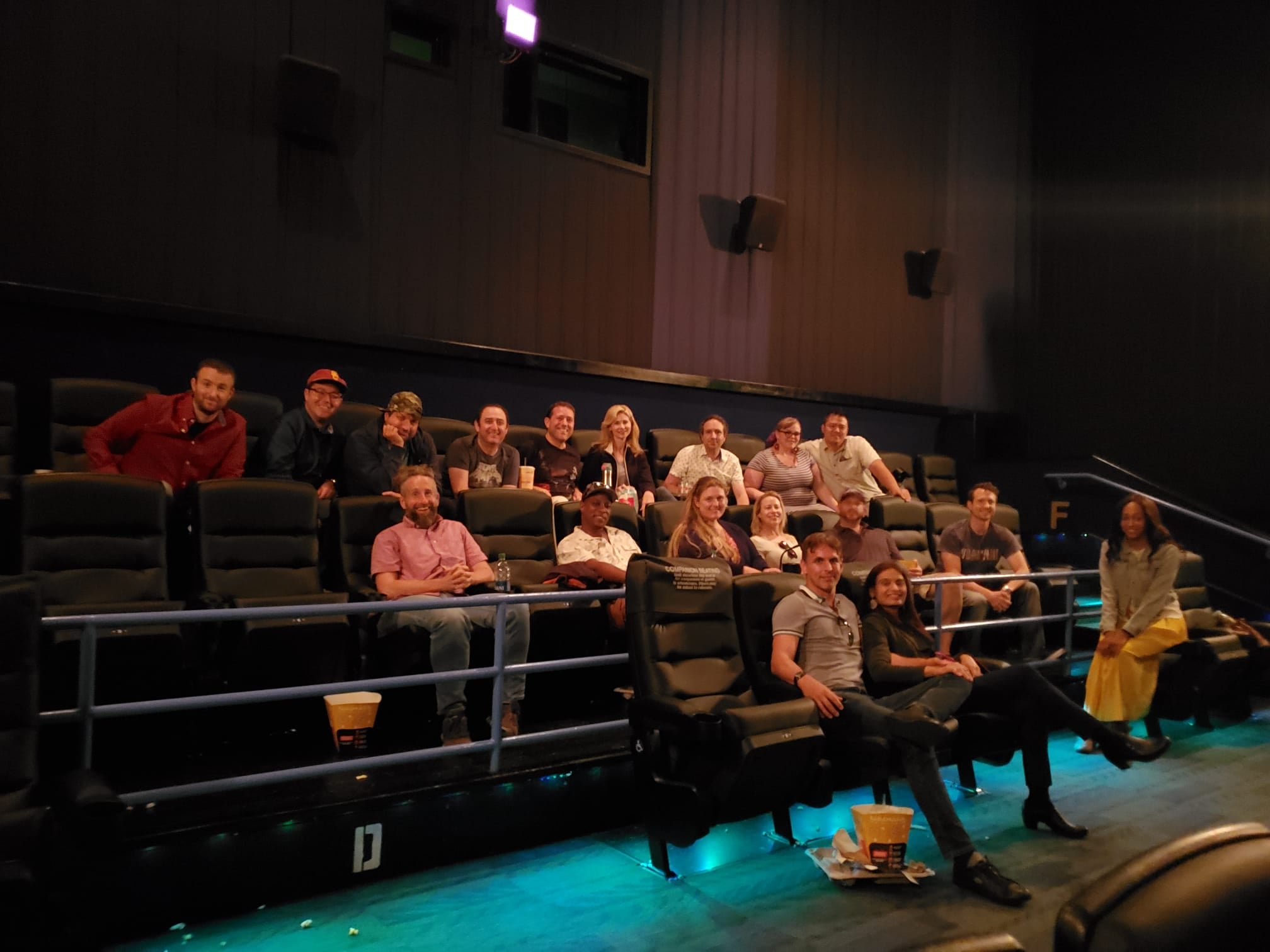
The last movie I had seen was the cartoonish and okay version of The Call of the Wild, on March 14, 2020. My first movie after all that time needed to be special. I wanted to be surrounded by friends, I wanted to have my mask off and eat snacks, so we made it exceptional. On June 6, 2021, we rented out a private screening at the Cinemark Baldwin Hills theater, and 19 of us watched the really great A Quiet Place Part II. I’m going to be honest, a crappy movie would have been great after 449 days, especially surrounded by friends; but this one happens to also be a really good sequel to a really exciting movie. Just the right amount of good acting, taut suspense, great sound effects that craft excellence out of a silly B-movie premise. This was us on that happy day.
Just before the private screening, from left to right: Back row – Aaron, Josh, Yoni, Chad, Boaz, Julia, Abe, Amanda, Ray. Middle row – Patrick, Nate, Leah, Lindsie, Noah, Harwin. Front row – Keith, Emily, Char. Behind the camera – AdiJust after the movie at the Baldwin Hills Cinemark. From left to right: Lindsie, Amanda, Ray, Yoni, Leah, Keith, Emily, Josh, Aaron, Char, Noah, Adi, Boaz, Julia, Patrick & Chad (Missing from photo: Harwin, Nate & Abe)
Rather than reiterate the entire, crazy, family-related medical drama, and the start of the pandemic, just recap it yourself by reading the 2020 tally linked here. Caught up? Okay great, let’s move on and discuss 2021.
We started off 2021 by celebrating New Year’s in Tucson, Arizona. It involved tons of cactus-filled beauty, visits to their wonderful desert museum, and we stayed at a beautiful Airbnb ranch filled with animals. But the one photo I’ll include is what you beautiful American consumers will most care about – the gas prices.
To be fair, even Arizona is probably closer to 6 dollars a gallon as of writing this post
A few weeks later I started the beginning of a valuable relationship with Dr. David Agus, when I interviewed him about COVID vaccines as they were newly released, a piece that was shared all over the country and by USC itself! It still holds up.
March 24th was eventful, it was the day we met a little rescue puppy named Gianna, adopted her, and instantly changed her name to Zero, because when we looked at her we just didn’t think she had “mob-girlfriend” vibes. That plus our awesome daughter instantly looked at her and said, “She’s Zero, from The Nightmare Before Christmas“! There wasn’t even a discussion to be had after that.
Zero the day we brought her home from the rescue, while Natalia did insane gymnastics in bed, just because she’s Natalia.
In April, we went on another lovely road trip, this time to Atascadero – a place that my movie-buff friend Mike loves to deliberately mispronounce like he’s a wiseguy straight out of My Cousin Vinny. I could show you photos of the lovely gardens and zoos we visited, or the famous, smelly elephant seals of San Simeon. But this is about movies, so I’ll instead include the pic from when we watched the Oscars from our Airbnb.
Me presenting Regina King as she opened the most boring Oscars I’ve ever watched
I’m aware my good friend Zach Ralston, who writes phenomenal movie reviews, found a way to love this Steven Soderbergh orchestrated ceremony. But apologies to him (and Matt Damon), it was not the awards show I look forward to each year; it was an absolute snoozefest. I recognize that it required a smaller audience during the pandemic, but there was virtually no humor. No sketches. Presenters came, explained the award category, and gave the award. The reason we watch has never merely been to find out the winner. We can Google the results for that. For those of us who don’t watch sports, it is our Super Bowl. A fan does not just look up scores, he or she watches the game when they can, for the experience of getting to that final result. The only memorable thing about this show for me was the stylish, cinematic walk of Regina Hall into Union Station ceremony. And admittedly, as an native Angeleno, and a cinephile, the setting of Union Station was quite cool, given the variety of the movies filmed within its walls over the decades.
Time passed, I worked, I wrote articles, I spent time with my wife and daughter, I binge watched international seasons of Survivorwith my friend Jared (the Australian version is arguably even better than ours), but like a kid waiting for recess, I just stared at the clock as I awaited June 6th. That would be the day I would gather some close friends to celebrate my 42nd birthday, and end my wretched streak of missing the movies at 449 days! I told you about A Quiet Place Part II, so let’s dig in and see how the second half of my year went…
I was finally ready to enjoy my favorite pastime again, but it seemed the landscape wasn’t quite the same:
1. Some theaters had closed, including the Arclight and Pacific theaters. Some managed to open back up under new management, including the now-AMC theater at the Grove and Americana malls.
2. We restarted our AMC A-List membership, giving us a subscription to see any 3 movies of our choosing each week, but noticed that (for the most part), there were no longer morning showtimes in that theater chain. A day of movies used to start around 10am, but now would have to start closer to 2pm, making an insane 4 or 5 Boaz-movie day a thing of the past.
3. For some reason, Nicole Kidman now harassed us at the start of each movie, telling us that “heartbreak feels good in a place like this”; a commercial that initially got an eyeroll from us, continues to make Adi groan, but I hope that before long entire theaters will be cheering and heckling as it comes on the screen – a preshow Rocky Horror experience as it were.
4. There were also fewer movies being released each week. Many were getting exclusive releases on streaming devices, or small partial windows in the theater. Even jumping ahead to 2022, Disney continues to make the bizarre and highly questionable choice to exclusively release its Pixar movies on Disney Plus, in spite of the many who would pay to watch it on IMAX if given the option.
5. We were also not ready to have our masks off with strangers (a personal choice I’m aware), which meant no more “sneaking our lunches and dinners into the movies with us”, yet another challenge to the classic multi-movie feast.
Nonetheless, even with masks on, and all of the other changes, it continued to be something Adi would really enjoy, and I would actually crave. To her credit, on our anniversary when we hit a delay of traffic, it was my amazing wife who suggested we go see a movie at the Camarillo outlet malls, where we enjoyed the lovely, intimate, and now-Oscar nominated Belfast.
We also managed to find some clothes to buy at the outlet mall, before running to see the highly acclaimed Belfast.
Movie Tally
Too much exposition? Just hungry for the sexy numbers? So was I as a kid, so let’s give the people what they want. As always, I remind you that I catch movies at home only when for one reason or another it’s not possible for me to catch it on the big screen. I’m aware it’s often free on my subscription with: Netflix/Amazon/Hulu/Disney/Apple/Peacock/Paramount/HBO and more…
Well gee, that’s nice, and I get that the rest of the universe sees streaming as the better option as a result; but I’m still a sucker who’s in love with the entire big screen/sound/theatrical experience, and I’ll be damned if I won’t keep choosing that over the years – if given the option. Making it financially more palatable is my aforementioned subscription to AMC theaters; so in truth when I watch the movie that’s “free” at home with my plan, it’s just as “free” at the theater. Either way, it’s a sunk cost.
That being said, I do not count movies that I caught on my television in these write-ups, so here we go…
Movie Tally
My own movie tally for 2021, which didn’t get a start until June 6th? 25. That’s right. A record low for me. The next smallest was obviously 2020 which only gave me the first almost 3 months to watch movies, and even that was 34. Why did I see even fewer with seemingly twice as many months in 2021? Because at least in 2020 life was normal, movies were plentiful, and all of the slew of reasons I gave earlier how things aren’t what they were. But within the 6 plus months I got back to the movies last year, there were months within surges when I again stayed away, or times one of us might be coughing and thus stay away. For all of these reasons, the count was low. But you can assume and count on it that I fully expect to raise the number this year, and so far the main impediment to my journey is my own medical health as I write this while between two major back surgeries. But mark my words, next year will exceed the past 2 abysmal years.
And now to find out who I saw them with, I must warn you that this year will also be a bastardized version of that usual fun.
Adi “my wife” Hepner – 23 movies. Previous year 21. Amazingly, she only missed 2 of the movies I saw in the theater, that means she was with me 91% of the time. Geez, talk about needing my personal space! No, I’m kidding, if it were up to me, she would never miss a single one I catch. So this is pretty amazing all things considered.
Patrick “my friend” Vukovich – 2 movies. Previous year 4. Are you sensing why this is sad? My #2 movie-watching companion only saw 2 with me. This is why on Passover when the children are asking, “Why is this year different from all other years?”, you should answer them, “Because most years Boaz sees multiple movies with dozens of friends, but on this year Boaz saw multiple movies with only his wife and Patrick”. If you don’t get that joke, you are so far removed from Judaism that you’ve never even watched a Woody Allen film. But thank you to Patrick for not only joining my group birthday movie, but also being my type of crazy, and seeing Red Notice with me, a Netflix movie that only we would still go to see on the big screen; and we enjoyed every dumb second of it. (I mean, is it even possible to not enjoy a Ryan Reynolds movie at this point in his preening career? Even his commercials are gold.)
Yeah, maybe you weren’t paying attention, but there’s no #3 because nobody else saw multiple.
Patrick and Boaz, enjoying being the only ones in the Cinemark Howard Hughes theater, until a handful of others arrived late.
Honorable mentions – I’ve never done this before, but let’s mention the few who saw ONE with me, other than the awesome group who are photographed at my birthday movie.
Arnon Shorr joined us while visiting from Massachusetts, and we saw Dune together, a worthy big screen experience. Of note, Arnon has not only created an award-winning live action short called the The Pirate Captain Toledano, available to watch on Amazon; but fun fact: Adi and I are generously listed as producers in the credits, thanks to his Kickstarter campaign years ago. Second fun fact: it has been adapted into a graphic novel for kids, on presale for May 1, but thanks to my plan to review it for the Jewish Journal, I’m enjoying an advanced paperback.
(In yet more publishing news, my very own mother has spent her life teaching, painting, and now spinning stories for her grandchildren. In October she published an incredible children’s book, The Adventures of Goldilocks and Baby Bear: What Happened Next, and shameless plug, it’s damn good and please buy a copy!)
My nephew Darius and his friend were visiting in town, and although he’s not much of a movie person, he wanted to see Nobody. What’s that? Seeing nobody could quickly turn into an old fashioned comedy routine? Quick tangent, but did you ever see this updated rendition on that with Billy Crystal and Jerry Seinfeld among others? It’s pretty great. Anyway, people seemed surprised by Bob Odenirk doing drama for this movie, but if you’ve watched Better Call Saul, there’s really no reason to be caught off guard by this. I still don’t expect him to turn into the next middle aged Liam Neeson action hero, but it was a very fun take on that “what I do have are a very particular set of skills” trope. Also, it remains the only movie I’ve caught during the pandemic with zero other people in attendance.
Our dear friends Margy & Jeremy love movies. But they didn’t see a single one with us last year. Why do I even mention them? Because their son Nathan has many cool interests, and among them is a love for Pixar movies. So when Adi and I found one of the few showings of Luca at the one-week El Capitan release, we jumped on it and brought him with. A beautiful movie, as are most Pixar instant-classics, and certainly far, far better experienced on the big screen. My personal favorite continues to be the original Toy Story, but I recognize that part of that is a bias of it being the first of the many magical experiences. But I’ve watched it even recently and must say that the dialogue and magic still hold up.
My twin nieces Eve & Ada came up for a nice weekend with us, something we missed and needed to get in before they would spend a year studying in Israel. They were 17, and I’m the guy who spent my childhood watching Rated R movies (as recently discussed), so naturally, the movie we took them to was their first theatrical Rated R movie! We saw the instant classic, The Hitman’s Wife’s Bodyguard, a sequel to a movie they hadn’t even seen (something I’d never endorse doing), but we all had a fun time watching the stupid/fun flick. (Didn’t I already make it clear that you’ll have a hard time not cracking a smile during a modern Ryan Reynolds movie? Now you add Samuel L Jackson dropping F-bombs to the mix, and you think it’s not entertaining?!)
We always enjoy the recliner seats of AMC Prime. From left to right: Adi, Ada, Eve & Boaz
My least favorite movie of the year? Apologies again to my friend Zach who loved this, but it was The Green Knight. We get that it was artistic but we were both overwhelmingly…bored.
My favorite? Well removing my obvious bias for A Quiet Place Part II for being the first to see in ages, I think it might be West Side Story. I wanted to sing out loud throughout the joyous experience, and just about any filmmaker has been blown away by this being the first musical ever directed by Spielberg, considering the intricate perfection of his choreographed dancing and cinematography. It was sublime. But I had the greatest time also watching, in no particular order, Free Guy, No Time To Die, Last Night In Soho, and Suicide Squad 2, among others.
As this goes to press, I’m trying to catch the last few Oscar nominated movies before Sunday’s ceremony, sadly these last ones will have to be caught on my television set. Isn’t it ironic, that the nominations and awards are most commonly determined based on screeners sent to people to watch on their TV or computer screen? If you think about it, the people who are making the decisions about the best films of the year, may not even usually be watching them to way they were created to be watched. But let’s leave that essay for another day. Everyone enjoy your 2022, and if you haven’t already, let’s get back to the movies!
Los Angeles is a place where you can very easily feel like you’re always trying to keep up with the Joneses. People here have nice cars and nicer homes. They wear designer clothes and Rolexes and belong to Equinox. They go on beautiful vacations, which they display in perfect family portraits on Instagram. With all this pressure to be equal to our wealthy peers, coupled with the high costs of housing, gas and food, it may feel like you can never get ahead.
Here in the Jewish community, we aren’t immune to expensive lifestyles. In fact, it’s worse for us. We send our kids to Jewish schools, which cost anywhere from $15,000 to $50,000 per year. “There are scholarships available,” is what you hear if you can’t afford tuition. Even with scholarships, it’s too much. Not to mention, the scholarship kids might feel out of place when their classmates are rolling up to school in Teslas, and their parents drive a 2012 Honda Civic.
Kosher food is pricier than non-kosher food, and housing in a Jewish neighborhood costs much more than in other parts of LA. A friend recently asked why we pay such high rent when we could buy in the Valley. I said, “The Valley? It’s still a million for a home. You got a down payment for me?”
I always jokingly say that I have the answer. I know how to suddenly be able to buy a home and afford kosher food and Jewish school and be able to go on vacations. Wanna hear it?
Have rich parents.
All facetiousness aside, I do have a solution. It’s one that has helped me immensely. Wanna hear it?
Focus on your blessings.
I used to go to people’s houses in Beverlywood and think, “I wish I could buy a gorgeous home of my own.” I’d hear about fancy Pesach vacations people took and get jealous of them. I wanted to be able to eat at Pat’s more than once or twice a year.
Then, one day, I decided I couldn’t worry about other people anymore. It was exhausting. I focused on what I had instead of what I didn’t. Focusing on your blessings is fulfilling and makes you grateful for what you have. Focusing on what you don’t have is an endless black hole that wouldn’t be filled even if you had all the riches in the world.
Whenever I want to feel blessed, I look back at my past. Ten years ago, I lived in a small railroad apartment in Brooklyn next to a violent, crack-addicted neighbor and I rarely had more than $100 in my bank account. I was constantly worried about how I’d pay for my next meal.
Today, thank God, I don’t have that problem, because I’ve worked hard and am endlessly grateful. I can pay for all my basic expenses and then some. In one word, I am blessed.
When you’re surrounded by exorbitant wealth – and rich people are celebrated simply for being rich in our society, and even in our community – it can get you down. But fixating on this is not going to uplift you; it’ll just make you feel worse. Trust me, because I’ve been there.
I am grateful for what I have, from the air I breathe to the 2012 Honda Civic in my driveway, to the one time of year on my birthday when I get to go to Pat’s and order my favorite burger in town.
I don’t feel like I’m behind anymore or that I have less than others, or that I am less than others. By focusing on my blessings, I have everything in the world I could ever need.
Kylie Ora Lobell is the Community and Arts Editor of the Jewish Journal.
A common critique of religion is that it exists only to blunt our fear of death through the deployment of comforting fairytales, replacing life’s great and unsettling unknowns with visions of an afterlife which are — if not less unsettling — at least less unknown.
Such a mindset, however, is foreign to the Torah, which accepts with equanimity that death is a part of life.
Take for example, this unassuming yet breathtaking verse from the opening of the book of Exodus—the second book of the Torah:
“Joseph died, and all his brothers, and all that generation” (Exodus 1:6).
With this, all of those individuals whose lives, joys, troubles, downfalls, and triumphs constituted the near-singular focus of the book of Genesis have been written out of the text—their time in the spotlight revealed to have been nothing more than a passing trick of the light.
This, however, is the perspective of the narrator. What about the people of the Torah themselves? Well, they may fret about dying without leaving an heir, or perhaps about being buried in alien soil, but death itself—the extinction of individual consciousness and the non-eternality of the human self—does not seem to be a preoccupation of the Biblical consciousness.
Perhaps, as Thomas Mann suggests in his novel “Joseph and His Brothers,” this was because the Biblical man had a more expansive sense of self than we do. When Joseph’s teacher Eliezer would speak, Mann recounts, he related stories from his own past and also from the well of collective memory, never deviating from the use of the first person. His utterance of the word “I” was not “solidly encompassed but, as it were, stood open to the rear, overflowed into earlier times, into areas beyond his own individuality.”
In our own times, the “I” has been sealed. To speak of other lives in the first person is, if not unthinkable, a sign of delusion or deceit. We locate ourselves precisely in this body and lifetime, surrounded on all sides by the oblivion of non-being. It is no wonder that we are afraid.
Moses is the Biblical figure most deeply associated with the fear of death. It is Moses, after all, who is forced by life’s circumstances to be a sealed “I,” cut off from historical continuity by being separated from his people at a young age, cut off from his followers by the need to lead, and cut off from ordinary humanity by his unprecedented closeness with God.
When Moses dies, it is written:
Moses was a hundred and twenty years old when he died; his eyes were undimmed and his vigor unabated. And the Israelites bewailed Moses in the steppes of Moab for thirty days. The period of wailing and mourning for Moses came to an end … Never again did there arise in Israel a prophet like Moses — whom the LORD singled out, face to face, for the various signs and portents that the LORD sent him to display in the land of Egypt, against Pharaoh and all his courtiers and his whole country, and for all the great might and awesome power that Moses displayed before all Israel.(Deuteronomy 34:7-12).
How different a tone is struck in these verses than in Exodus 1:6, when “Joseph died, and all his brothers, and all that generation.”
In the Exodus verse, life ends as a new story begins, giving a sense that death and life comprise one ebb and flow. In Deuteronomy, death is announced at the very conclusion of the entire Torah, giving the sense that death marks an absolute ending.
In Exodus, death is treated with narrative detachment. In Deuteronomy, Moses’ death is treated with sentimentality.
In Exodus, the individual is not separate from the whole — Joseph’s death shares space with the death of his brothers and the whole generation. In Deuteronomy, Moses dies alone.
Moses’ unique relationship with death and identity is also attested to by the words of Psalm 90, the only psalm attributed to Moses himself:
The span of our life is seventy years,
or, given the strength, eighty years;
but the best of them are trouble and sorrow.
They pass by speedily, and we are in darkness. (Psalms 90:10)
In our own day and age, our view of death corresponds more with Deuteronomy and Psalm 90 than with Exodus. We see death as an ending—the sudden cessation of the self, of being. How can we not be terrified?
In our own day and age, our view of death corresponds more with Deuteronomy and Psalm 90 than with Exodus. We see death as an ending—the sudden cessation of the self, of being. How can we not be terrified?
Perhaps we grasp for hope—for a belief in an afterlife, or for some achievement that will be remembered by the world after we have left it. Such things, I fear, are what King Solomon called “hevel,” a puff of wind — vanity.
So long as the “I” is closed — closed to our ancestors and our descendants; closed to the soil and the sky; closed to the Creator and the creation; the world and the void — we will remain afraid. The Torah offers an alternative.
So long as the “I” is closed — closed to our ancestors and our descendants; closed to the soil and the sky; closed to the Creator and the creation; the world and the void — we will remain afraid.
The Torah offers an alternative.
As it is written later in Psalm 90, “Teach us to count our days rightly, that we may obtain a wise heart” (90:12). In other words, let our confrontation with death enlighten us. May learning to “count our days” be that which brings wisdom—the opening of the “I.”
Our liturgy helps us in this pursuit, having us recall our mortality each morning. Whether we are ordinary, mighty, brilliant, or wicked, our deeds and our lives are but “fleeting breath” before God.
The prayer book offers no comforting platitudes to blunt the impact of this statement. Instead, it offers something else: “We are fortunate that we rise early and stay late — morning and evening — and twice daily say: “Hear Israel, the LORD is our God, the LORD is One.”
An acknowledgement of our limitations — our mortality — is paired with a recitation of the Shema, Judaism’s affirmation of the oneness of God, the oneness of all creation, the oneness of all that is.
This, then, is Judaism’s doctrine of life eternal: it is not a place in the clouds but rather the opening of the “I,” the understanding that, in the words of Vietnamese monk Thich Nhat Hanh in his book “No Death, No Fear”: “nothing has a separate self, and nothing exists by itself,” and therefore, “there is no birth, there is no death; there is no coming, there is no going; there is no being, there is no non-being; there is no same, there is no different.”
Matthew Schultz is the author of the essay collection “What Came Before” (2020). He is a rabbinical student at Hebrew College in Newton, Massachusetts.
The Middle East Studies Association (MESA) overwhelmingly voted in favor of a resolution on March 22 to endorse the Boycott, Divestment and Sanctions (BDS) movement.
The resolution, which MESA members had been voting on from January 31-March 22, received 768 votes in favor and 167 against. The resolution accused Israeli universities of being “imbricated” in “systemic violations” against the Palestinians, which they said included “restricting freedom of movement for Palestinians; isolating, undermining, or otherwise attacking Palestinian educational institutions; harassing Palestinian professors, teachers, and students; harassing Israeli professors and students criticizing Israeli policies; destroying, confiscating, or otherwise rendering Palestinian archival material inaccessible; and maintaining inequality in educational resources between Palestinians and Israelis.” The Israeli universities, the resolution charged, provide “direct assistance to the Israeli military and intelligence establishments” and the United States government protects “successive Israeli governments from being held accountable for such violations and facilitated them through unprecedented diplomatic, military, and economic support.”
“Our members have cast a clear vote to answer the call for solidarity from Palestinian scholars and students experiencing violations of their right to education and other human rights,” MESA President Eve Troutt Powell said in a statement. “MESA’s Board will work to honor the will of its members and ensure that the call for an academic boycott is upheld without undermining our commitment to the free exchange of ideas and scholarship.” She added that MESA members have long had “various forums for conversations and debates regarding participation in an academic boycott of Israeli institutions and other ways of standing in solidarity with Palestinian scholars at risk under Israel’s longstanding military occupation. We affirm our commitment to academic freedom for Palestinians, and for all scholars in all countries throughout the region.”
AMCHA Initiative Director Tammi Rossman-Benjamin criticized the MESA vote as being “morally reprehensible and incredibly dangerous.” “Although the academic boycott that MESA members voted to endorse seemingly targets only Israeli institutions and scholars, the biggest victims of academic BDS are students and faculty on U.S. campuses,” she said in a statement. “Academic BDS’s rejection of the normalization of Israel in the academy not only calls on its faculty endorsers to work towards boycotting educational programs and research opportunities in or about Israel and canceling or shutting down pro-Israel events and activities on campus, it also urges the censuring, denigration, protest and exclusion of pro-Israel individuals.”
Rossman-Benjamin added that MESA’s “3,000 members are the primary purveyors of Israel-related courses and departmentally-sponsored events about Israel on campus. Their embrace of an academic boycott means campus antisemitism is likely to grow exponentially worse for Jewish students. Universities must immediately withdraw their membership from MESA and prevent their own faculty from using their university positions and departmental affiliations to promote politically motivated advocacy and activism.”
Asaf Romirowsky, who heads Scholars for Peace in the Middle East (SPME) and the Association for the Study of the Middle East and North Africa (ASMEA) as an alternative to MESA, said in a statement to the Journal, “MESA’s passing of this resolution to blacklist and boycott Israeli institutions highlights how MESA has abandoned any pretext of being an academic association in favor of propaganda with the goal of delegitimizing Israel. MESA’s abandonment of the basic principles of academic integrity, namely the free expression of ideas, is deeply rooted in prejudice and, above all, the Palestinianization of academia.”
Jewish Family Service LA (JFS LA) was awarded $18.7 million from the Conference on Jewish Material Claims Against Germany (Claims Conference) as part of a $720 million allocation to more than 300 social welfare organizations globally.
The funds are earmarked to support care and provide services for frail and vulnerable Holocaust survivors, the Claims Conference announced in a statement.
The organization also announced it is allocating nearly $47 million in social welfare services in Ukraine to support Holocaust survivors in the face the country’s war with Russia.
“We are proud to announce this significant allocation at a time when these funds are critical, due to the age, poverty and increasing disability of our waning survivor population; and as they also continue to face the ongoing uncertainty and threat of COVID-19,” Gideon Taylor, president of the Claims Conference, said. “We know these funds [will] provide vital support during these difficult times.”
The allocations are distributed to social welfare organizations in regions where significant numbers of survivors live to ensure vital services, such as homecare, medical care, emergency assistance and food are available. According to the Claims Conference, funds for these vital services provide a critical lifeline to frail, elderly Holocaust survivors in need around the world, enabling them to live out their remaining days in dignity that were stolen from them in their youth.
“Jewish Family Service LA’s partnership with the Claims Conference makes it possible to provide robust services to nearly 900 survivors in LA,” JFS LA CEO and President Eli Veitzer said. “Their support funds over 500,000 hours of homecare annually, emergency assistance for everything from dental care and medication to help with utility bills and a team of social workers providing comprehensive care management.”
The Claims Conference said that these funds constitute one of the largest allocations from any grant-making organization globally in one year, and the largest amount ever allocated by the Claims Conference in a single year. It estimates that the funds will reach approximately 120,000 survivors.
“Funds negotiated by the Claims Conference are used to finance life-sustaining social services for needy survivors of the Shoah around the globe,” Marian Turski, an Auschwitz survivor and member of the Negotiations Delegation said in a statement. “In my home country of Poland, for example, I was able to see for myself the lasting impact these services had for survivors during the past two years, especially under the conditions of the rampant pandemic,” he added.
As a result of negotiations with the Claims Conference since 1952, the German government has paid more than $90 billion in indemnification to individuals for suffering and losses resulting from persecution by the Nazis.
Founded in 1951 by representatives of 23 major international Jewish organizations, the Claims Conference negotiates for and disburses funds to individuals and organizations and seeks the return of Jewish property stolen during the Holocaust. As a result of negotiations with the Claims Conference since 1952, the German government has paid more than $90 billion in indemnification to individuals for suffering and losses resulting from persecution by the Nazis.
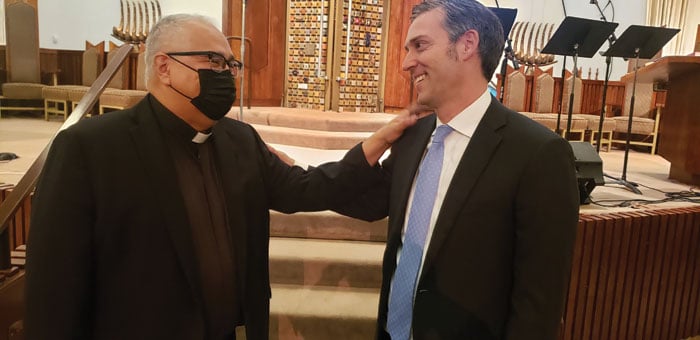
On March 15, Sinai Temple hosted an interfaith prayer service with over 20 different faith communities, including Ukrainian churches, participating. Speakers included the host, Rabbi Erez Sherman, as well as Senior Rabbi of Sinai Temple David Wolpe and Rabbi Noah Farkas, CEO and president of the Jewish Federation of Greater Los Angeles, who livestreamed from the Polish-Ukrainian border.
The event was organized quickly, Sherman told the Journal. “My friend, Father Gil Martinez of St. Paul the Apostle Catholic Church, called me a week ago. He said, ‘Is the Jewish community doing anything to pray for Ukraine? If so, we would love to join. I said, ‘We should be doing something.’ So we started calling our friends. One led to another, until we had 20 faith organizations, mostly synagogues and churches coming together.”
Some of the participants included Saint Vladimir Ukrainian Orthodox Cathedral, Saint Andrew Ukrainian Orthodox Church of Los Angeles, Nativity of the Blessed Virgin Mary, Ukrainian Catholic Church, Adat Shalom, Temple Beth Am, HIAS, Temple Emanuel of Beverly Hills, Temple Isaiah and Wilshire Boulevard Temple.
Attendees brought emergency medical kits to send to Ukraine, and three people appeared via livestream: Farkas, along with Ariel Keren, a medical clown from Israel, who also was on the border cheering up people as they fled their homes, and Rabbi Reuven Stamov, a Conservative Ukrainian rabbi who was a classmate of Sherman’s in the rabbinic seminary. Stamov’s family had just made aliyah, and he was going back to Ukraine to help his community.
“The pandemic for the last couple of years has kept us apart physically,” Sherman told the audience. “We literally haven’t been in our own communities but in our own homes. In essence, we have been prisoners [of] ourselves. Yet one blessing that has come from these two years has been a deep faith that has bound us from community to community.”
The Sinai clergy “have been deeply grateful to all of our faith neighbors who have allowed us to worship, sometimes in their spaces,” Sherman continued.
After announcing he had received a $25,000 check to aid Ukrainians from a member that day, Wolpe capped the occasion by talking about experiencing anger during this time.
“Everybody here has prayed for peace, but that does not mean you are not allowed to be angry. There is good cause to be angry. Anger is not hate. Anger is indignation at the wanton destruction of life.”
– Senior Rabbi David Wolpe
“Everybody here has prayed for peace, but that does not mean you are not allowed to be angry,” he said. “There is good cause to be angry. Anger is not hate. Anger is indignation at the wanton destruction of life, at the creation of refugees, men, women and children, at the obliteration of buildings and monuments that took years and lives to build.”
Wolpe drove directly at Vladimir Putin and Russian attackers.
“This was an act of enormous cynicism and cruelty,” he said. “As somebody who is not Ukrainian, I feel free to be able to say how angry we should feel on behalf of the Ukrainian people over the wreckage that has been loosed on their country. Had my great-grandparents not decided to come to America, I would have been Ukrainian, if I had been lucky enough to be alive.”
Sherman, bringing in Torah to inspire the audience, alluded to the prophet Zechariah, “who teaches us people are prisoners,” he said. “We are prisoners of hope. That is why we are here tonight, to be prisoners of hope. Hope is not how we see the world, but hope is the faith that we wish this world could be.”
For hopeful Israeli tech founders, Fusion Labs provides the ideal opportunity to see what’s possible.
“I’ve been a business English teacher throughout my entire career and never got to acquire the necessary skill set or the network that’s required to build a tech startup,” Noa Cohen, a member of Fusion’s latest accelerator program, told the Journal.
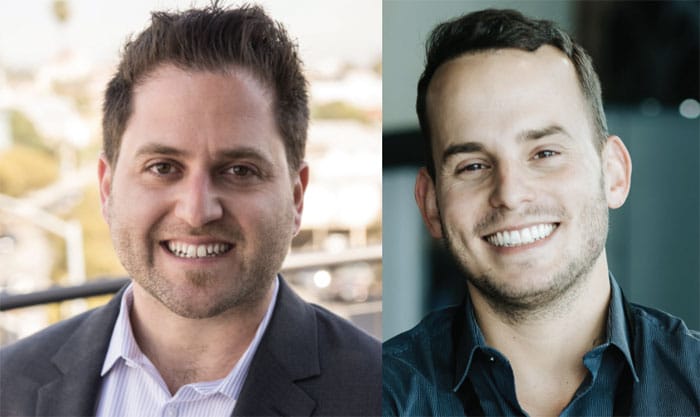
On February 16, Fusion, with founders Yair Vardi in Santa Monica and Guy Katsovich in Tel Aviv, hosted a virtual pitch fest for their ninth batch of startups.
Israel’s top early-stage accelerator, Fusion works with early-stage founders to provide institutional capital and a support system to scale their company in the United States. Pre-COVID, the Israeli founders moved to Los Angeles for this accelerator program. In March 2020, when Shelter in Place orders a into effect, Fusion flew their CEOs back to Israel.
“We doubled down on Israeli startups in the past two years and invested in over 30 teams.” – Yair Vardi
“We haven’t slowed down over COVID, but rather adjusted,” Vardi told the Journal. “We doubled down on Israeli startups in the past two years and invested in over 30 teams.”
Founded in 2017, Fusion helps with first hires, product development, customers and fundraising. Sixty-five companies have gone through the Fusion Accelerator, and have collectively gone on to raise more than $200 million; they have a combined market cap of more than $600 million.
Over the last two years, founders participated in a nine-week hybrid program: remote bootcamps in Tel Aviv (also in-person between COVID waves) and remote meetings with mentors and investors in the United States for office hours and feedback sessions.
“What led me to Fusion was the desire to surround myself with like-minded individuals with similar ambitions to mine, and a cohort of brilliant investors who will be there to support me on my entrepreneurial journey,” said Cohen, who created Claire, a subscription-based, on-demand translation and localization platform. It combines human and tech capabilities, and offers real-time support for people who regularly work and communicate in English.
Although Cohen, 29, lives in Tel Aviv, she lived in Agoura Hills during her teenage years.
“I think that even though there’s a large Israeli community in Los Angeles, the LA-Israel connection could be strengthened,” she said. “It’s important that we bridge the cultural gaps between Israel and the United States to allow Israeli startups to gain a foothold in the American market.”
For nearly five years, Fusion has been doing just that.
Fusion’s most recent cohort started in October 2021 and included 10 teams of founders. The program culminated in a rapid-fire virtual pitch fest – Fusion’s third showcase online – with 400 RSVPs and more than 200 real-time attendees from LA, New York, Israel and more. Pre-COVID, the founders would pitch at receptions in Santa Monica and Silicon Valley.
“To address the issue of ‘Zoom fatigue’ among investors, we decided to film all of our founders professionally for short two-minute videos,” said Vardi.
After their video showcases, founders took questions from the virtual audience, who were directed to each company’s landing page for more information.
“Pitching my product in front of 200 stakeholders was nerve-wracking and exhilarating at the same time,” Cohen said.
After the event, attendees reached out to Cohen and the other founders, many of whom were seeking investors and partners, as well as to spread the word about their businesses.
Female founders led 50% of the latest batch of companies, which are in industries like vertical SaaS (Software as a Service), wellness and ecommerce. According to Vardi, some of the companies, such as WorkKit, Sexence, Happy Things, LaylaElectric, Buzzer and Followear, already have clients and users from LA.
The WorkKit platform is a fast and efficient solution for on-demand hiring, Sexence is a sexual-wellness digital health company and Happy Things is a mobile app that turns science into happiness with bite-sized daily activities. LaylaElectric is a smart SaaS platform for property managers, Buzzer uses digital signal processing and artificial intelligence to match leads to salespeople and Followear is a social shopping platform.
“We are excited to share that we’re planning to go back and produce an in-person roadshow for our companies in the United States this spring after Passover,” Vardi said. “Our goal is to host a series of events in LA, Silicon Valley and New York City for batch number 10 of Fusion, marking five years since we founded Fusion.”
For more information on the program or these companies, go to Fusion-VC.com.
“There’s no room on the table for the wine,” my father complained one Friday night in March 1992, when we were about to begin Shabbat dinner.
“Put it next to the fish bowl,” replied my mother.
“There’s also no room for the bread.”
“That goes next to the bowl of wheat sprouts,” my mother said.
“Goldfish, sprouts, garlic, coins — there’s no room on the table anymore,” grumbled my father, “I’m putting the chicken and rice in that little corner where I sit.”
“Make room for the hyacinths,” declared my mother as she entered the dining room with a giant vase of the fragrant purple flower and almost hit my father in the back of the head.
As I look back at this annual struggle, I realize it was the ultimate nod to our double identity as Persian Jews.
Every March, my mother laid out an incredible Nowruz (“New Day,” also known as Persian New Year) arrangement, called a Sofreh Haft-Sin, on the dining room table, with specific items symbolizing spring and rebirth. And every Shabbat in March, my father complained that he had no room for wine, bread, Shabbat dinner and his newspaper. As I look back at this annual struggle, I realize it was the ultimate nod to our double identity as Persian Jews.
Americans don’t generally know about Nowruz, and even the ones who live among tens of thousands of Iranian Americans, such as those in Los Angeles, often view it as a holiday celebrated by a small minority. But Nowruz is a huge deal, celebrated by over 300 million, from Parsi populations in India to Kurds in Iraq and Uighurs in China to Persian Jews in L.A. In Iran, Nowruz is marked by two weeks of festive celebrations. Diverse communities in areas ranging from Central Asia to the Middle East have celebrated Nowruz for over 3,000 years (it’s called a slightly different name in each country). When I was a little girl in Iran, every day of Nowruz celebrations felt like my birthday.
Children all over Iran paint eggs and place them on the Haft-Sin table as a sign of fertility and hope. During our first spring in America, I was delighted to see that some kids here painted eggs as well, though no one in my family could explain why those children also seemed obsessed with pastels and bunnies. “Rabbit and egg pictures everywhere,” my mother observed after an outing to the 99 Cents store one spring afternoon. “Maybe this is the time of year Americans try to get pregnant.” Soon thereafter, we learned the meaning of Easter.
On Nowruz, we greet one another by saying, “Eid-e-shoma Mobarak!” (“Happy Holiday” or “Happy New Year”). Some say, “Nowruz Piruz!” (“May your Nowruz be victorious”). My father’s preferred saying? “Get these goldfish off the table before I fry them up with turmeric and pepper!”
There’s so much meaning behind the seven (“haft”) symbolic items that are placed on the Haft-Sin table. All of them begin with the ‘s’ sound:
Seeb (apple): a symbol of health and vitality.
Sabzeh (wheatgrass grown in a shallow dish): a symbol of nature’s imminent renewal.
Sekeh: (coins): a symbol of prosperity.
Serkeh (vinegar): a symbol of the virtues of patience and getting better as we age.
Seer (whole heads of garlic): another symbol of health.
Samanu (sweet wheat germ pudding): a symbol of life’s sweet offerings, including fertility.
Sonbol (hyacinth): the ultimate spring blooms.
Other items include somaq (sumac) — a reminder to seize each new day and enjoy the metaphoric spices of life; senjed (the dried fruit of the lotus tree) — a symbol of love; goldfish in a bowl (they represent the importance of constantly moving forward in life and knowing when to turn and pivot); colored eggs (prosperity); an ornate hand-mirror (a reminder about the imperative for self-reflection), and candles. No Haft-Sin is complete without various pastries, including Persian chickpea flour cookies called Nokhodchi.
My favorite part of the Haft-Sin spread is a “book of wisdom” that’s placed alongside all of the other items. Muslims use a Quran, Zoroastrians display the Avesta, and more secular Iranians place the exquisite works of ancient Persian poets, including Ferdowsi’s “Shahnameh” or the “Divan” of Hafez. For their part, Persian Jews often put a Jewish prayer book (Siddur) or even a Torah in printed and bound form.
Of all our Haft-Sin items, the tiny goldfish were the most exciting for us children. A few years ago, I randomly asked a Petco employee in West L.A. if the store sold many goldfish in March. “Don’t ask,” he said. “The Persians all buy them. But they only want the bright orange goldfish. The ones who come too late get the gray ones and they never want ‘em.”
Unlike the Gregorian New Year, Nowruz doesn’t start at midnight. And unlike Rosh Hashanah, it doesn’t start at sundown. In fact, Nowruz starts at a different time each year, and is dictated by the exact moment of the spring equinox. That probably explains why one Nowruz back in college, my mother called me after midnight to wish me a happy new year, though something tells me she was really calling to make sure I was in my dorm room and not at a fraternity party.
This year, Persian New Year officially began at 8:33 a.m. on Sunday, March 20. I implored my mother not to call me that early — not because I’d be asleep, but because I’d be chasing my kids down the hallway, begging them to eat breakfast.
Though I have many fond memories of Nowruz from my own childhood, I’ve never put together a Haft-Sin table for my own American-born young children. Perhaps I worry that adding Persian New Year to the already crowded mix of Rosh Hashanah and January First will be too confusing. Perhaps I’m still suppressing some of my Persian identity because it proved such a liability when I was growing up amid shiny, beautiful blond kids in America who wondered how I’d managed to grow such a healthy mustache at the age of nine.
Here’s the truth: I’m afraid that my kids will like Nowruz, with its painted eggs, charming goldfish and sweet pastries, more than Rosh Hashanah, and my husband and I want our children to identify as Jewish first and foremost.
But here’s the truth: I’m afraid that my kids will like Nowruz, with its painted eggs, charming goldfish and sweet pastries, more than Rosh Hashanah, and my husband and I want our children to identify as Jewish first and foremost.
Perhaps introducing them to wonderful Nowruz traditions will broaden their perspectives, uplift their self-identities and help them categorize which holidays are most meaningful for themselves. During our first years in the United States, I thought my family and I would never be anything but Persian and Jewish. And then, one Shabbat dinner during the 13 days of Nowruz festivities, we quickly said the prayer over wine (kiddush), grabbed our dinner plates full of Persian stews and rice, and ran over to the TV to watch “Full House” and “Family Matters” on ABC’s “TGIF” Friday night lineup. That was the moment we became true Americans.
Tabby Refael is a Los Angeles-based writer, speaker and civic action advocate. Follow her on Twitter @RefaelTabby