fbpx

March 25, 2022

The Rabbi Who Coached Actors for “The Lehman Trilogy”

Judaism plays a significant role in the play “The Lehman Trilogy.” As the characters’ success in business reaches astronomic levels, the degree in which they practice Judaism goes from strictly observant at the beginning of Act I (taking place in 1844), to barely practicing at the end of Act III (taking place in 2008).

To ensure the Jewish authenticity in every scene, Tony Award-winning director Sam Mendes, who is Jewish, brought in Rabbi Daniel Epstein, then a rabbi at the Cockfosters & North Southgate Synagogue in London. The rabbi did a deep dive with the actors in understanding the Judaism their characters were to embody.

Rabbi Daniel Epstein. Photo credit: Joshua Farkowitz

As the highly-revered play begins its residency at the Ahmanson Theatre through April 10, Epstein spoke with the Journal about how he was tasked with making sure there would not be any semblance of a caricature of the Jews depicted in it.

“I was telling [the actors] that in the first generation, there would’ve been tallit over your head and there would’ve been a lot of this shokeling,” Epstein said. “And then after the second generation, they’d still be putting on a kippah—they light the candles at one point for example. [The actors] wanted to know how to light them.”

There were discussions between Epstein and the actors on whether they should put on a kippah for the scenes with the second generation of Lehmans. They decided to do without the kippah, partly because it was complicated to pull it out of their pocket every single night and make sure they wore it securely.Their focus was on the language, so they made a slight wardrobe sacrifice to lessen the risk of derailing the flow of the dialogue.

When asked about what inspired his coaching, Epstein recalled how he felt when he watched Sylvester Stallone in “Rocky III” say a prayer at the Jewish funeral of his trainer Mickey Goldmill.

When asked about what inspired his coaching, Epstein recalled how he felt when he watched Sylvester Stallone in “Rocky III” say a prayer at the Jewish funeral of his trainer Mickey Goldmill.

“Somebody did a good job of making him pronounce the words just right,” Epstein said. “The mood was correct, and the solemn aspect of it, you were taken by it. It was good. Had [Stallone] just been saying [the kaddish] all wrong or in the wrong tone, it would’ve stood out.”

Epstein also coached the actors on the pronunciation of transliterated Hebrew prayers in the script.. With his deep knowledge of Hebrew and history, Epstein was able to deduce just how the Lehmans,would have pronounced the prayers.

In Act I, the original Lehman Brothers, Henry, Emmanuel and Mayer, engage in several ritualistic Jewish moments— praying on a daily basis and sitting shiva properly. They observe all 30 days of sheloshim. By the turn of the 21st century, the Lehman descendants observed only three minutes of mourning.

““Three minutes was asclinical as it was detached from their tradition,” Epstein said. “And it’s a very powerful statement about where they’re moving, from prophet P-H to profit F.”

Epstein also led discussions with the actors on mitigating being massively successful while still retaining Jewish values.

“Are the two mutually exclusive? Do you have to shed one to enable the other?” Epstein said. “I was trying to make the case that you don’t. You can find ways around. There’s no reason why you can’t stay Orthodox and be wildly successful in business.”

In each of the three Acts, which features three actors, each character plays a Lehman descendant from the next generation. The characters come from a Jewish family, but in the 164th year of the company’s existence, the family name became synonymous with the collapse of the subprime mortgage market.

The characters come from a Jewish family, but in the 164th year of the company’s existence, the family name became synonymous with the collapse of the subprime mortgage market.

“[The actors] were trying to get their heads around the very delicate eggshell walk of ‘At what point does it become an antisemitic trope that we’re talking about excessive amounts of money and Judaism and philanthropy?’” said Epstein. “[The actors] were just fascinated to almost ask the questions in a safe space. I was happy to encourage them to talk about it, but I don’t believe the play contains any antisemitic tropes.“”

The antagonist in “The Lehman Trilogy,” in Epstein’s view, is the temptation to be greedy Greed, according to the rabbi, is only tempered by an anchoring in a faith or tradition.

He said, “I think that’s the cautionary tale of this whole thing.”

“The Lehman Trilogy” is playing at the Ahmanson Theatre. through April 10.

The Rabbi Who Coached Actors for “The Lehman Trilogy” Read More »

Aaron ‘s Silence – Comments on Torah Portion Shemini

Aaron’s Silence

Comments on Torah Portion Shemini 2022

Two young men meet a sudden, tragic death in our Torah portion. The scene is described tersely:

Now Aaron’s sons Nadav and Avihu each took his fire pan, put fire in it, and laid incense on it, and they offered before Adonai alien fire, which God had not commanded them.

And fire came forth from Adonai and consumed them; thus they died in the presence of Adonai.

Commentators for ages have asked, “Why did Nadav and Avihu concoct a ‘strange fire’?” and, “Was this enough of a reason for their being immolated by God?”

Most modern commentators draw a lesson in leadership. Nadav and Avihu, as sons of the High Priest, had an obligation to fulfill their tasks precisely as they were taught.  They ought not be role models of “leaders can do anything they want,” but rather “leaders follow the rules.”

Most of you readers know that I avoid moralizing at a first pass when it comes to our holy texts, contrary to the modern focus on ethics as an interpretive tool. I start with reminding myself that this text from Leviticus 10 is literature, not journalism. The text is not an eyewitness report of what happened, but a literary creation by an author in a specific place and time, with a specific audience, with a specific concern. Literary authors are trying to tell us something about the world and ourselves.

I also remind myself to read the Bible as philosophic anthropology and not as theology. The Bible, in my mind, is far less concerned about what God does and is far more concerned with what humans do, especially as they provoke the God-character of the Bible. The biblical authors, I remind myself, often evince an uncanny psychological brilliance, asking us to seek the motivations for what people do in terse narratives such as this one. The Bible is also mythological and archetypal, discussing not what happened then, but what happens all the time. The Bible presents patterns of existence.

The Bible does not tell us the motivations of Nadav and Avihu in bringing their strange fire. For a moment, I want to avoid that question and the inevitable moralizing answers. Let’s leave it at this: minimally, they made a mistake. They got the ingredients or the measurements wrong.

Maximally, the young men did it on purpose, but did not live long enough to tell us why.

The text indicates to us that they did something wrong. But the text refuses to tell us why it was so wrong.

I will assume they did not predict what would happen next – that a fire would come from God and burn them alive. Maybe this is a special case, like veering ever so slightly across the double yellow lines and instead of correcting your course, you hit oncoming traffic. You break a traffic law that would usually just get you a ticket or a fine.

But sometimes if you cross the double yellow lines, you can get killed or kill someone else. When does driving badly become negligent homicide?

The slightest moment of inattention, an error that you might think of as insignificant, can have catastrophic consequences. We don’t know why these two young men did what they did, anywhere from inattention to being scofflaws. Whatever their mistake or intention was, it got them killed.

We readers are brought into the scene. What happens next?

Then Moses said to Aaron, “This is what Adonai meant when He said: ‘Through those near to Me I show Myself holy, and gain glory before all the people.’” And Aaron was silent.

What does that even mean? Moses is telling Aaron that God showed us God’s holiness just now?  And gained glory before all the people?

If holiness here means “wholly Other” – then yes. An Other-ness far removed from the human condition of errors and sins. A holiness that is awesome but can also be awful.

“Gaining glory?” Does this mean we readers, through the narrative of Nadav and Avihu, have run, obliviously, into a core boundary of the glory of God?  Are we being told that when we transgress certain things that God has not even told us about we could get killed?

Build a Molten Calf? Repentance is possible.

Bring unauthorized incense – okay now you hit the get-burnt-alive tripwire.

Whatever else this story is about, it is about painful mysteries, very upsetting ones.

What did these boys do and why did they do it?  What was it about “strange fire” that brought this reaction from God?  What did Moses mean by that statement? I don’t know and for a moment I don’t want to come up with an answer. I can’t think of any moral summation adequate for the story.

The only clear thing to me is “va-yidom Aharon” – “and Aaron was silent.”  Two of his children were killed before his eyes. Aaron perhaps believed he was going to bestow an incredible legacy upon his children, two of whom now lie smoldering.

I’ll venture this: Aaron did not know why this happened, and what his brother just said over the bodies was worse than meaningless. If Moses has a low point in the Bible, this is it.

I believe this little piece of literature is here to upset us. As we have seen many times before, the God of the Bible is dangerous and unpredictable. I think we should avoid for a moment the temptation to explain or moralize. We should allow ourselves to be shocked and dismayed, and then, for a moment, not to figure out what these boys did wrong or why God reacted as God did, but rather to think empathetically about Aaron’s broken heart.

Va-yidom” is a dark play on words. It means “and he was silent” and it can also mean “and he bled.” Bleeding silence.

A man just saw two of his sons suddenly die, right in front of his eyes. He does not want to hear us moralizing about what they did. Aaron is stuck – it is way too late to turn down the job of High Priest, even with this new information about what that job entailed.

Moses orders Aaron not to mourn – the incense oil is still upon him. Aaron is still in his role. His persona right now is bigger than the bitter, bleeding heartbreak within. Every public person has been there – unspeakable suffering within that must stay silent – there is the role, and all the world is a stage.

Like any good literature, this narrative does not end with the clarity of one of Aesop’s fables. Whatever lessons there are to be learned about leadership are, in my mind, shadowed by the utter shock, Aaron’s unpermitted need to break down and cry, his aching realization of what things are like, what this job means, shadowed by Aaron’s guilt that his two sons maybe were not really fit for the job, but he got them the job anyway and it killed them.

I think that all the moralizing that goes on about Nadav and Avihu might be attempts not to face Aaron, not to allow him to finally cry, to break down in our arms.  If we felt his bleeding silence, we might feel ours.


Aaron ‘s Silence – Comments on Torah Portion Shemini Read More »

Movers & Shakers: Bat Mitzvah at 92, Federation in Ukraine, Pre-Purim Tree Planting and Daniel Lobell at PJC

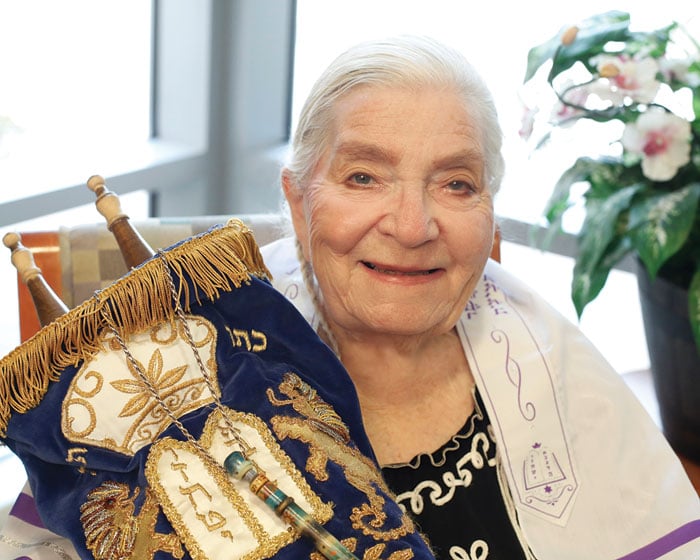
Los Angeles Jewish Home resident Frieda Thompson celebrated her Bat Mitzvah as well as her 92nd birthday, on March 18. 

The date also marked the 100th anniversary of when Judith Kaplan, at age twelve, became the first American girl to celebrate a bat mitzvah on March 18, 1922.

“When I was young, women couldn’t do it, but now I think it’s a wonderful thing,” Thompson previously told the Los Angeles Jewish Home.

Thompson, a Holocaust survivor, lost both of her parents during the World War II. She recalled one of her mother’s final actions was ensuring her brother became a bar mitzvah.  She began studying and preparing for her bat mitzvah a few years ago, but COVID-19 prevented the community from gathering until recently. 

During a kabbalat Shabbat service at the Jewish Home, Thompson was called to the Torah while her loving family as well as the center’s staff and residents looked on. 

Los Angeles Jewish Home Director of Spiritual Life Rabbi Karen Bender highlighted the significance of the occasion.

“As a small child, Frieda was forced to raise her hand and call out ‘Heil Hitler,’” Bender said. “Today her voice rings out as a cherished leader among her peers.”


Jewish Federation of Greater Los Angeles leadership, including President and CEO Rabbi Noah Farkas, recently took part in a humanitarian relief trip at the Ukrainian-Poland border.

The leadership of the Jewish Federation of Greater Los Angeles recently led a humanitarian trip to the Poland and Ukrainian border, responding to the needs of the estimated 200,000 Jews living in Ukraine. 

Los Angeles Federation President and CEO Rabbi Noah Farkas and Federation Campaign Chair Lynn Bider visited the region from March 13-16, helping support relief efforts for the refugees pouring into Poland from Ukraine and displaced by Russia’s invasion. The majority of refugees are women, children and the elderly. 

“The Federation is deeply committed to being a part of the global Jewish response to this crisis,” Farkas said. “It’s imperative that we see what is happening in person on the ground so we can provide emotional and spiritual support and ensure the money we are raising is properly supporting our brothers and sisters in Ukraine. We are guided by the wisdom in our Talmud, ‘Whoever saves a single life, is considered to have saved the whole world.’”

The Federation is working with global partners American Jewish Joint Distribution Committee (JDC) and Jewish Agency for Israel on helping settle Ukrainian refugee families in Israel. Along with aiding with their documentation and travel logistics, Jewish organizations are providing refugees with much-needed medical and nutritional resources.

According to the JDC, more than two million Ukrainians have fled their country since Russian began its invasion last month.


From left: Vine Cerundolo, BCC treasurer Jim Potter and BCC Executive Vice President Jessica Donath plant a tree outside the Breed Street Shul. Photo by Stephen Sass

A pre-Purim tree planting was held on March 13 at the Breed Street Shul in Boyle Heights. 

Approximately 150 people turned out to plant 50 trees in front of the historic synagogue and on neighboring streets and to adopt 100 fruit and shade trees. The day of climate action and community celebration marked the holiday of Purim; the 50th anniversary of Beth Chayim Chadashim (BCC), the world’s first LGBT synagogue; and the complete preservation and transformation of Breed Street Shul over the next several years.

Breed Street Shul Project Founding President Stephen Sass and David Silvas of Boyle Heights Neighborhood Council emceed the event. 

“As we begin slowly to emerge from the most recent COVID surge, and as our hearts are heavy with concern for our brothers and sisters in Ukraine, and for our world, it can feel challenging to feel happy,” Sass said. “But this morning we can—indeed we must—hold both emotions at the same time, for Purim is synonymous with joy and hope and resilience.”

Speakers included L.A. City Councilmember and mayoral candidate Kevin de Leon; Consul General of Israel in Los Angeles Hillel Newman; BCC Rabbi Jillian Cameron and Cantor Juval Porat; and Rabbis Jason Rosner and Daniel Chorny of Temple Beth Israel of Highland Park and Eagle Rock.


Comedian Daniel Lobell (far left) performed at the Shul on the Beach on Purim. Lobell is pictured with his daughter Sophia, Rabbi Shalom Rubanowitz (center) and the Leo Chelyapov Trio

Synagogues across the community held parties, megillah-readings, and spiels to celebrate the holiday of Purim on the evening of March 16.

At Beth Jacob Congregation in Beverly Hills, people of all ages turned out to the modern Orthodox congregation on Wednesday night to hear the reading of the megillah and wave their graggers whenever they heard Haman’s name. Later that night, young professionals dressed as Jedi Knights, Indiana Jones, Waldo of “Where’s Waldo” and countless other characters closed out the merry evening at Founders Ale House in Pico-Robertson. Young adult members of progressive community IKAR were also in attendance at the bar during a program dubbed “Purim on Pico.”

Members of dozens of other congregations, including Pacific Jewish Center, also known as Shul on the Beach; Sinai Temple; Kehillat Ma’arav and Stephen Wise Temple, gathered for the holiday.

Movers & Shakers: Bat Mitzvah at 92, Federation in Ukraine, Pre-Purim Tree Planting and Daniel Lobell at PJC Read More »

Jews, Romans, and Pigs: An Impossible History

When the vegan meat manufacturer Impossible Foods requested kosher certification for its new line of “Impossible Pork,” the OU balked. Although the actual product is made of kosher ingredients, the OU found that certifying Impossible Pork as kosher was….simply impossible. For years, there have been many “faux unkosher” products, such as imitation shrimp, dairy-free cheeseburgers, and even imitation bacon, but the OU felt that pork is different. Chanie Apfelbaum, a New York kosher food blogger and cookbook author, explained to the Wall Street Journal that she had no problem eating Impossible Cheeseburgers, but that she has “a hard time getting past the idea of eating something that’s called ‘pork’ and is meant to taste like pork.”

This resistance to pork seems strange from a halakhic perspective. Other prohibited foods, such as chametz on Pesach or the fat of the hindquarters are more severe than pork. Yet despite this, the metaphor for something unquestionably non-kosher is “chazer treif,” as un-Kosher as pork. Clearly, Jews have a particular problem with pork.

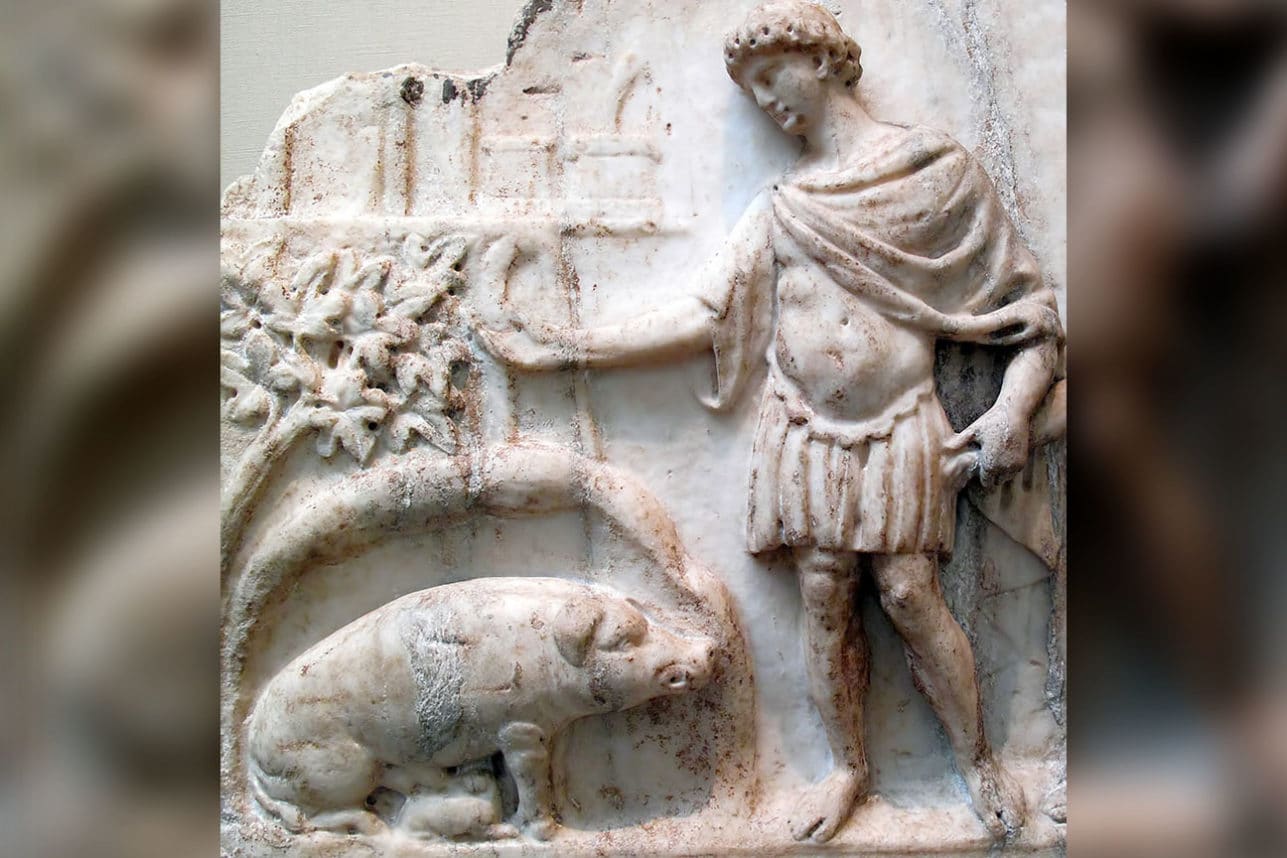
Jews have had negative feelings about pigs for over 2,000 years, and in many ways, the antagonism was created by anti-Jewish polemics. The Greco-Roman world saw the Jewish refusal to eat pork as extremely strange; along with monotheism, circumcision, and Shabbat, it was a Jewish practice that perplexed outsiders. Pork was a staple of the Roman diet, and both Greeks and Romans used pigs for animal sacrifices. Outsiders mocked the Jewish refusal to eat pork. In the year 40, a violent battle raged between Greeks and Jews in Alexandria. Philo Judaeus, a leader of the Jewish community, led a delegation to Rome to meet with the Emperor Caligula. As both parties to the dispute stood before him, Caligula asked Philo: “Why is it that you abstain from eating pig’s flesh?” The Greeks burst out in laughter, certain that Caligula meant this as an insult.

Many in the ancient world saw the Jewish refusal to eat pig meat as misanthropic, part of a larger Jewish refusal to engage with the rest of the world; the desire to remain “a nation that dwells alone” irritated many in the ancient world. It is for this reason, when persecuting the Jews, their tormentors forced them to eat pork. The Book of Maccabees, which relates the history behind the Chanukah story, tells of martyrs who refused to eat pork and gave up their lives instead. Included among them were a mother and her seven sons, all of whom refused to eat pork and were all killed. Diodorus, a 1st century BCE Greek historian, explains that Antiochus, the villain of the Chanukah story, sprinkled pig’s blood on the Temple’s altar, poured pig gravy on the Temple’s Torah scrolls, and forced the High Priest to eat pork. Diodorus explains that Antiochus assumed if he could break Jewish habits regarding pork, he could break Judaism.

Many in the ancient world saw the Jewish refusal to eat pig meat as misanthropic, part of a larger Jewish refusal to engage with the rest of the world; the desire to remain “a nation that dwells alone” irritated many in the ancient world.

In the Roman era, there was a change in rhetoric; the Jewish refusal to eat pig was not seen as an expression of hostility to pigs (and those who eat them), but rather an expression of affinity for pigs. Juvenal, the first century poet and satirist wrote that among the Jews, ‘‘a long- established clemency suffers pigs to attain old age.” Another satirist commented regarding Herod, who killed several of his own children, that he would “rather be Herod’s pig than Herod’s son.” Petronius referred to the Jews as worshipers of a ‘‘pig-god.” The Jews’ refusal to eat pork was twisted into evidence of a Jewish fondness for pigs.

This theme continues into the medieval era. Irven M. Resnick writes: “The pleasure-loving pig, then, became a familiar image in medieval Christian anti-Jewish polemics. Moreover, the pig will be understood to have been forbidden to Jews precisely because the two share the same natural qualities or characteristics. That is, Jews will be viewed as “pig-like” while, conversely, pigs will be viewed as “Jew-like.”” In other words, Christians can eat pork because they have a superior disposition; but Jews, who are ravenous gluttons, are prohibited from doing so, because it will reinforce their already pig-like disposition. Popular culture in medieval Europe was far more malevolent; the Judensau, “the Jews’ pig,” which depicts Jews in close contact with a pig, became popular in the 13th century. It was disseminated on woodcuts, paintings, and sculptures, and a frieze of the Judensau was found on multiple churches and cathedrals. (Images of the Judensau remain on nearly two dozen churches in Europe to this day.) Martin Luther reports approvingly about the Judensau at his local church:

“Here on our church in Wittenberg a sow is sculpted in stone. Young pigs and Jews lie suckling under her. Behind the sow a rabbi is bent over the sow, lifting her right leg, holding her tail high and looking intensely under her tail and into her Talmud, as though he were reading something acute or extraordinary…”

This nauseating antisemitic image is the culmination of centuries of anti-Jewish and antisemitic polemic, all focused on Jews and pigs. One simple kosher law became the focus of profound hatred, all because Jews wouldn’t eat pork.

In rabbinic literature, one sees a mirror image of these polemics; the laws regarding the pig are read as a reference to the Roman Empire. To the rabbis, the negative attributes of the pig symbolize the excesses of Rome, which like the pig, is destructive and self-centered. This polemic has a fascinating nuance. One well-known Midrash regarding the pig/Rome analogy focuses on how the pig is in a sense “half-kosher,” because the pig has one of two signs of the kosher animal; it has split hooves but does not chew its cud. But this isn’t seen as a reason for praise; instead, being “half-kosher” emphasizes the hypocrisy of the Romans. The Midrash says: “Why is he (Rome) compared to a pig? Just as the pig, when it lays down, it puts out its hooves and says, ‘‘I am kosher,’’ so too does the kingdom of Rome (Edom) arrogantly commit robbery and violence, while making believe they are smoothing out a tablecloth on the table (and acting very civilized and hospitable).” It then continues to tell a story about a Roman magistrate who was sentencing thieves, adulterers, and sorcerers to death, and afterwards remarked, “I did all three of these last night.” The Roman Empire had achieved a great deal; it had abundant public works, and a fully functioning legal system. But the rabbis saw through the hypocrisy of a leadership class that satisfied their own rapacious desires without limits; they saw up close the inhumanity of a so-called “civilized” empire that used violence indiscriminately to achieve its goals.

Jews associated the pig with the Roman empire, and the pig was the food of the enemy. This is why pig is “chazer treif,” and pork is the most “anti-Jewish” of non-kosher foods, because pork carries with it a legacy of centuries of antisemitism and antagonism.

Jews associated the pig with the Roman empire, and the pig was the food of the enemy.

There is one final twist to the impossible history of Jews, Romans, and pigs. There is a tradition, attributed to the Midrash but first recorded in the 13th century, that in messianic times, the pig will return to the Jews and become kosher; this insight is based on the similarity between the Hebrew word for pig, “hachazir,” and the word for return, “l’hachzir.” This unusual tradition creates a lot of debate; some, like Rabbi Baruch Epstein, reject the Midrash as a forgery, while others reinterpret it. However, many accept this tradition; Rav Chaim ben Attar, the author of the Ohr HaChaim, says that when the Messiah arrives, pigs will begin to chew their cud and become kosher. The Lubavitcher Rebbe, Rav Menachem Mendel Schneerson, was an advocate of this Midrash, although he took the view that in messianic times, pigs would not chew their cud, but rather our perspective will shift, and will reveal the goodness within the half-kosher pig.

Undoubtedly, this change in the kosher status of pigs carries a larger lesson about the Roman Empire and its successors; when the Messiah comes, the descendants of Esau and Jacob will join hands together in peace. The good works of the Roman Empire will now be united with a higher morality and spiritual purpose. The age-old divisions of antisemitism and animosity will dissolve, and brothers will be brothers once again.

I have a particular affinity for this tradition because it is rooted in the unending optimism of the Jewish people. Even the pig, a symbol of Roman oppression and ages of antisemitism, is still able to become kosher and return to the Jewish people. There is always potential for change, always a possibility for rapprochement.

We are already part of the way there. Rabbi Herman Adler, the Chief Rabbi of England at the turn of the 20th century, once met a Catholic colleague, Cardinal Herbert Vaughan, at a luncheon. The Cardinal asked him, “Now, Dr. Adler, when may I have the pleasure of helping you to some ham?” Without missing a beat, Adler responded: “At Your Eminence’s wedding.”

This comic exchange would have been impossible in the 3rd century, or the 13th century. But the good humor and camaraderie between the Chief Rabbi and the Cardinal in the 20th century offer a glimpse into a different world, where the impossible is possible, and Rome and Jews can be reunited.


Rabbi Chaim Steinmetz is the Senior Rabbi of Congregation Kehilath Jeshurun in New York.

Jews, Romans, and Pigs: An Impossible History Read More »