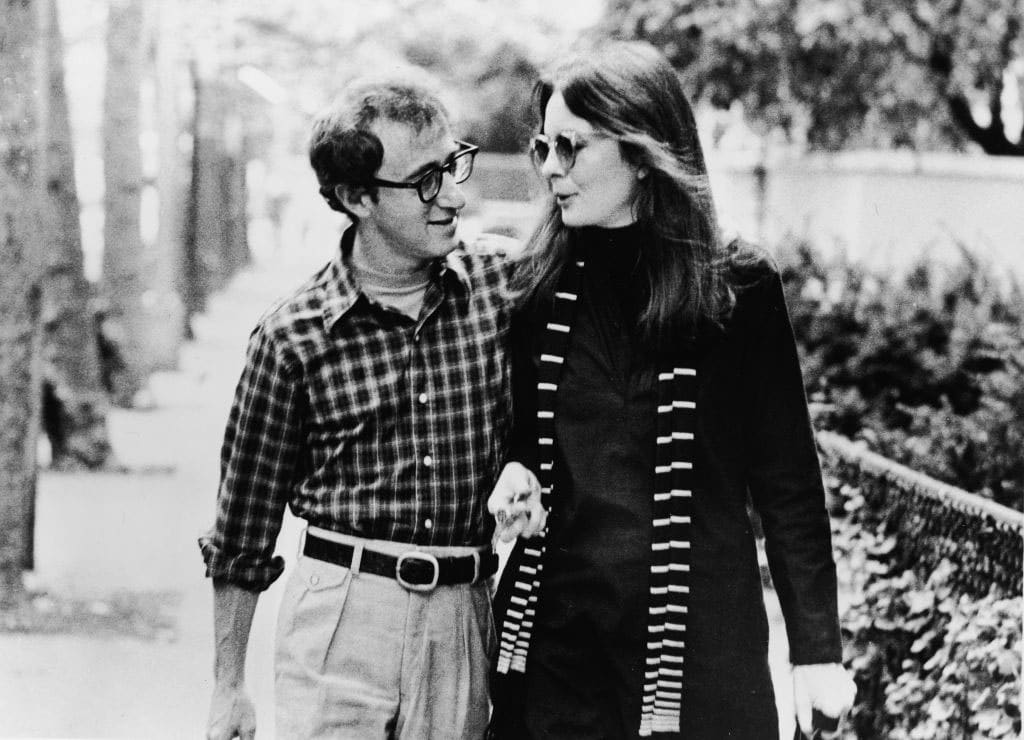
Remember when antisemitism was funny in Woody Allen’s classic comedy, “Annie Hall” (1977)? On reflection, the current eruption of virulent antisemitism in America and throughout the world has darkened the humor, but perhaps the same horrific events have made the power of humor and laughter even more vital to regaining our shared humanity and our understanding of the human condition.
Allen portrays antisemitism in “Annie Hall” as real but relatively harmless. Antisemitism in the film becomes funny because it appears as something probably outside the daily lived experience of both Jewish and non-Jewish members of Allen’s typical audiences at the time the film was made. Then, instances and incidents of antisemitism were generally isolated occurrences on the margins of society. Such antisemitism ordinarily posed little felt or immediate threat to Allen’s fans, so it was easy to laugh at antisemitism in “Annie Hall.” With Allen’s film, audiences could take comfort in a false sense of security that came from being part of a modern liberal democratic culture that appeared immunized against the prejudices and hatreds of the past. Such feelings helped moviegoers to enjoy the film’s comedy.
Yet, in the mind of Alvy Singer, the film’s paranoid protagonist played by Allen as a kind of doppelgänger for Allen the director, antisemitism occurs with such force that the depth of his dread inevitably must resonate with the facts of historical memory. Alvy’s terror and anguish at some level touches the common experience and awareness of viewers, adding a kind of existential pungency to the humor. Antisemitism becomes both scary and funny as in old-fashioned horror movies, the kind of films Allen celebrates and once made.
While public scandal has inevitably influenced Allen’s reputation, an example of his standing genius as a director can be found in his humorous use of antisemitism as a source of character development and cultural and historical insight in “Annie Hall.”
Famously obsessed and conversant with Freudianism throughout his body of work, Allen presents antisemitism in a way that dramatizes the workings of Alvy’s inner mind. Allen’s cinematic art form parallels his focus on Alvy as driven by latent forces. In an important early scene in the film that exploits antisemitism for humor, we hear but do not see Alvy in conversation with his friend Rob (Tony Roberts) as they walk on a street in Manhattan. Distancing the characters to the point of invisibility at the beginning of the scene can suggest latent drives and meaning for Allen in this film. Seen through the lens of psychoanalysis, Alvy’s language articulates the hidden and the ambiguous as the two men come into view. Alvy says, “I distinctly heard it. He muttered under his breath, ‘Jew.’” Interestingly, Rob calls Alvy “crazy” and “a total paranoid.” Alvy in turn says, “Wh-How am I a paran—? Well, I pick up on those kind o’ things. You know I was having lunch with some guys from NBC so I said … uh, ‘Did you eat or what? and Tom Christie said, ‘No, didchoo?’ Not, did you, didchoo eat? Jew? No, not did you eat, but jew eat? Jew. You get it? Jew eat?”
A touch of reality lends credibility and significance to Alvy’s existential psychology of antisemitism. Diane Keaton in a self-proclaimed career-making performance as Alvy’s girlfriend, Annie Hall, says to Alvy that her grandmother, Grammy Hall, would consider Alvy “a real Jew.” The innocence of Annie’s description of her grandmother’s antisemitism indicates its reality but also its seeming lack of seriousness as a threat. Annie says, “She hates Jews. She thinks that they just make money, but let me tell yuh, I mean, she’s the one—yeah, is she ever, I’m tellin’ yuh.”
When Alvy actually meets Grammy Hall at a hysterically funny dinner of clashing cultural and ethnic perspectives, he sees her as “a classic Jew hater.” In the scene, Allen creates one of his truly-telling and provocative images of Alvy’s projection of how he thinks Grammy sees him as an orthodox Jew immured in his alien world behind a beard and mustache and dressed in traditional black coat and hat.
Clearly, with all of Alvy’s paranoia and craziness, Allen’s film highlights something many did not want to see as real or potentially endangering, preferring instead to understand antisemitism as a perilous threat from another time and place. It seems Allen like Philip Roth saw better than many.
Allen and Roth also saw the indispensable importance of humor in facing the worst that life offers. Although the humor of “Annie Hall” must resonate differently today in light of current events, the prescience of Allen’s treatment of antisemitism in the film also suggests that losing the ability to laugh becomes a form of disarmament against evil and horror.
Allen and Roth also saw the indispensable importance of humor in facing the worst that life offers.
Thus, in the midst of all the violence and hatred of October 7 and its aftermath, an emotional John Podhoretz, editor of Commentary, related on “Morning Joe” on MSNBC (November 1, 2023) that his Bar Mitzvahed son’s name of Isaac means laughter, literally directing “Why, even now, we are commanded to laugh.”
Podhoretz’s touching story echoes Amos Oz’s memory in “A Tale of Love and Darkness” of what his Jewish grandmother used to say: “If you have no more tears left to weep, then don’t weep. Laugh.”
Sam B. Girgus is a retired professor of English and American studies who has taught at Vanderbilt University and the Universities of New Mexico, Alabama and Oregon. A recipient of a Rockefeller Humanities Fellowship, he has written and published more than ten books on film, modernism and American literature, thought and culture.