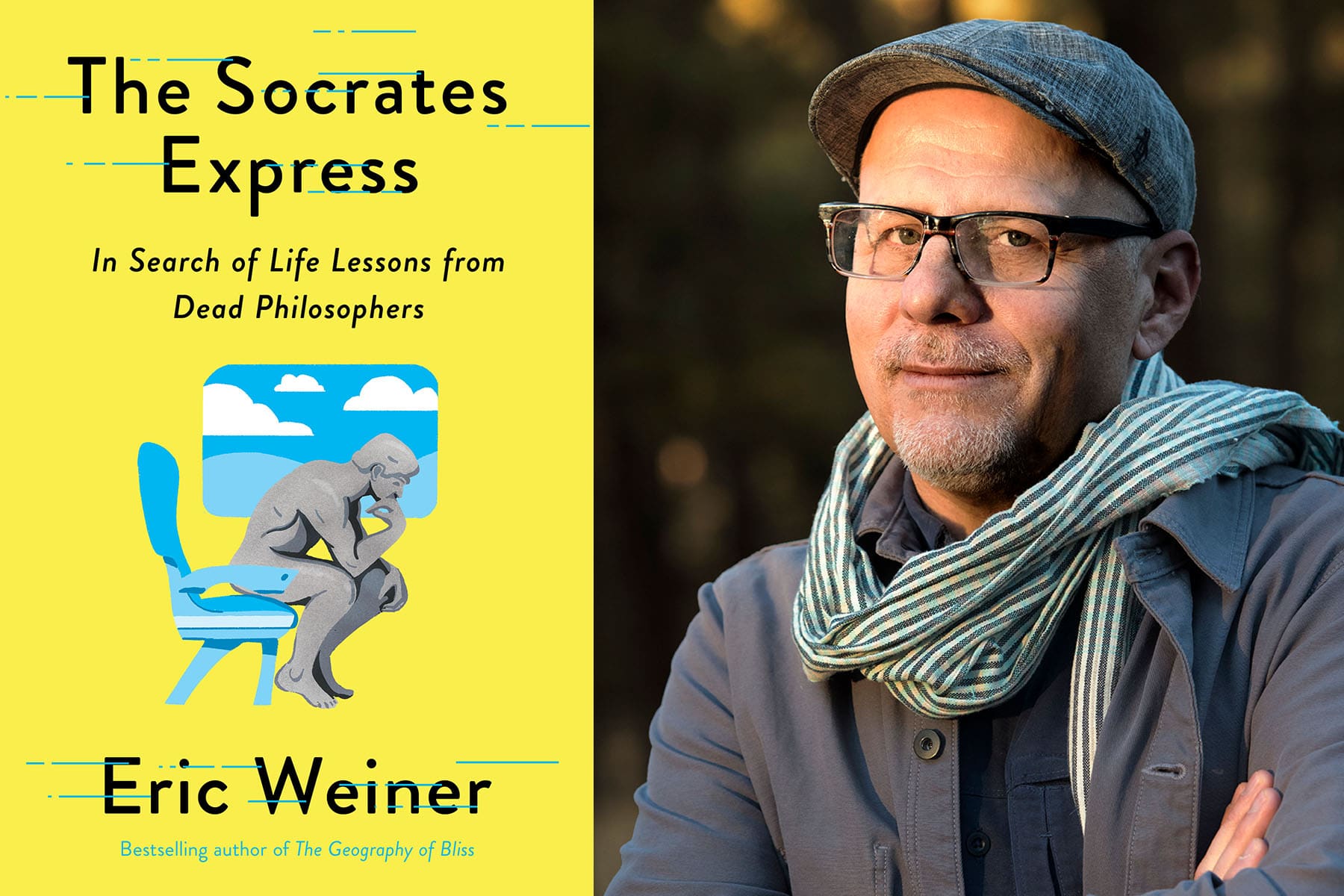
When Eric Weiner chronicled his latest hunt for wisdom, the adventure had lasting impact. Despite his previous titles, The Geography of Bliss, The Geography of Genius, and the spiritual memoir Man Seeks God, the bestselling author discovered a surprising truth.
“Before, I was racing through life, trying to accomplish as much as humanly, or super-humanly, possible,” Weiner says. “Rarely did I stop and ask ‘why? To what end?’ I now question assumptions, especially my own, on a regular basis. This makes life trickier in some ways, but also richer and, in the end, more meaningful.”
The importance of slowing down is one of many maxims in his latest book, The Socrates Express: In Search of Life Lessons from Dead Philosophers. The book, published by Avid Reader Press, an imprint of Simon & Schuster, recently entered its third printing. NPR named it one of the best books of 2020. To wisen up a bit, the Jewish Journal probed Weiner for highlights of his book, released with timing perfect for a pandemic.
JEWISH JOURNAL: What inspired this book?
ERIC WEINER: In a word: wisdom. I was hungry for it, and wasn’t finding it in the usual places. “Why not philosophy,” I thought? The word “philosophy” comes from the ancient Greek philosophia—literally “the love of wisdom.” These days, the field gets a bad rap. It’s seen as an arcane, impractical subject. Nothing could be further from the truth. Philosophy was once the most practical subject you could study. It was therapeutic. Medicine for the soul. I hope my book, in some small way, helps restore it to its proper place.
JJ: How are trains a part of this story?
EW: I love them! I can think on a train. I cannot think on a plane or a bus. Not even a little. So, in researching this book, I took trains everywhere I could, from Athens to India, Brooklyn to Frankfurt.
JJ: Which teaching do you find most valuable during this pandemic?
EW: All are helpful but perhaps none more so than Stoicism. The Stoic ethos is “change what you can, accept what you cannot.” This past year has taught us—reminded us, really—that external events are largely beyond our control. But we can control our internal world, our reactions to events. It’s a powerful insight.
JJ: Why did you structure the book in three sections, from “Dawn” to “Noon” to “Dusk”?
EW: I set out to structure the book not around big metaphysical questions but, rather, straightforward “how to” ones. How to get out of bed, how to enjoy, how to cope, etcetera. These are the sort of questions that keep most of us up at night. I also wanted the narrative structure to mirror the arc of a day, and of a life. The “how to” questions that matter to us when we’re 20 years old aren’t the same ones that matter most when we’re 70.
JJ: One of those questions is “What gets you out of bed?”
EW: The same thing that got Marcus Aurelius, the Roman Emperor and Stoic philosopher, out of bed: other people. That sense that there is more to life than our own petty desires. Nothing rouses you from bed more efficiently than the knowledge that you are needed.
JJ: Why these thinkers?
EW: I chose philosophers who spoke to me. Relatable ones. That’s probably why all of them were “feral” philosophers, working on their own rather than attached to a university. I also wanted a cross-section of thinkers–not only dead white men but women, too, as well as Asian thinkers… They loved wisdom deeply, and that love is contagious.
JJ: How did you end up addressing them directly, by their first names?
EW: That was by design. I wanted to bring these greats down from their pedestals and engage with them more personally, seeing them for what they were: fully human. Brilliant in some ways, yes, but deeply flawed in others. Just like all of us.
JJ: What is Jewish about this book?
EW: Jews are naturally philosophical. We are a questioning people, and asking questions—good questions—lies at the heart of all philosophy. Beginning with Socrates, philosophers have repeated this refrain: always question assumptions, especially your own. As I said, very Jewish.
“Jews are naturally philosophical. We are a questioning people, and asking questions—good questions—lies at the heart of all philosophy.”
JJ: What is the best advice you received while writing this book?
EW: The best advice I received actually came in the form of a question. I’m a tremendous kvetcher, world class. One day, I was kvetching with my friend Jennifer about success. I felt I didn’t have enough.
“What does success look like?” she asked.
I just sat there, stunned, realizing I had no idea. A good question does that. It grabs hold of you and won’t let go. A good question reframes the problem so that you see it in an entirely new light. That is the essence of philosophy, I think.
JJ: What is your philosophy of travel?
EW: My philosophy of travel is that of the American writer Henry Miller. “One’s destination is never a place,” he said, “but a new way of looking at things.” Come to think of it, that’s a pretty good definition of philosophy, too.
JJ: Which of the book’s revelations are the most disheartening?
EW: Schopenhauer is a bummer, a grumpy misanthrope, but even he had his bright side. He loved the arts—music, in particular—and thought they provided a respite from this, the “worst of all possible worlds.” So, even in the darkest of philosophies, I found rays of light.
JJ: Which teaching do you find the most meaningful?
EW: I’d have to say it’s Nietzsche’s ‘Theory of Eternal Recurrence.’ In a nutshell, Nietzsche posited a giant “what if” question: what if the universe, and your life, repeated itself forever and ever? What would be the implications for how you live your life? If Eternal Recurrence, as he called his theory, is true then there is no such thing as a trivial moment, since you’d have to relive that moment countless times. I find it to be an extremely powerful thought experiment, that simple question, what is worthy of eternity? I suggest you try it, too.
Lisa Klug is a freelance journalist and the author of “Cool Jew” and “Hot Mamalah: The Ultimate Guide for Every Woman of the Tribe.”