
Let’s do the math together.
No more than seven days after election results are officially confirmed, Israel’s president must choose a candidate, a Member of Knesset, and let him try to form a new government. The candidate has 28 days.
If he fails, the president can extend the time and add 14 more days.
If that doesn’t work, the president has three days to choose someone else.
Twenty-eight days. If that also fails, a majority can request an attempt by a third candidate. Fourteen days.
Are you still with me?
In 2022, P.M. Netanyahu negotiated for 58 days. In 2020, it took 76 days. In 2021: Eighty-two days.
Now reconsider where we are on Israel’s political calendar. Yes – earlier this week we crossed the 30-day line, and today we are about four weeks from Election Day. Alas, in Israel, Election Day doesn’t end a process, it is a prelude to a process. On Election Day we lay the playground on which Israeli politicians must then play for another month, or two, or almost three. You think: In a few weeks this is over and done with. Not true! Our political process isn’t concluding on October 27. More likely, at the end of 2026, or even the beginning of 2027.
And concluding it could mean one of two things. It could mean that we have a new government. It could also mean that we have a new date for another election, if no candidate is able to form a government (90 days later – namely, in March or April 2027).
We need this silly mathematical exercise for a simple reason: right now, according to most polls (including the polls I manage for Ch13 News), forming a government will not be easy. Again, we need some math: the current coalition is expected to get between 50 and 55 seats. That is, if we count the addition of a party named Amcha that vowed to support a Netanyahu candidacy. The opposition is expected to get the same number of seats. That is, when we exclude the two Arab parties that would likely get in with 12 to 15 seats. The heads of three opposition parties have committed to excluding the Arab parties from the next coalition, and such a clear commitment would not be easy to simply forgo.
So, we find ourselves in the following situation. If most polls are wrong, and one of the two blocs will get 61 seats or more, you’ve just wasted five minutes reading an article that has zero value. If most polls get it about right, we must brace for a rocky political ride. The opposition could try to form a minority government, with Arab support from the outside (the coalition is going to cry: “You lied when you vowed not to rely on the Arab parties!”). The opposition could try to lure in one of the coalition’s parties – possibly Amcha (a new party with pariah tendencies), or maybe Shas (this will have a real price in Haredi draft legislation). The opposition could invite Likud to join in, if Netanyahu is ready not to be the P.M., or – that’s the hope of many Israelis – ready to finally retire. Of course, Netanyahu could extend the same offer to opposition parties. Come under my wing and get a big prize (defense minister, or any other position the leader in question might covet except for the P.M.).
After Election Day, we can expect immediate action: if the opposition including the Arabs has the numbers – as it is likely to have – the Speaker of the Knesset, Likud’s Amir Ohana, will be promptly dethroned and replaced. Taking control of parliament would send a signal that times have changed. This could be followed by prompt legislation to establish a formal Commission of Inquiry for the October 7 calamity. Behind the scenes, President Herzog will renew, perhaps sweeten, his proposed pardon of Netanyahu. If the P.M. realizes that his chances of an early comeback are small, he might be tempted to take the deal and move on with the remainder of his life.
Or he might not. He might decide to wait out the 28 days, then the 14, another 28, another 14, another 90. He might bet on a new election. One of Israel’s most troubling political novelties of the last decade is the normalization of the idea of repeated election cycles. As if forming a government is just one option out of two possible outcomes of an election. As if another election is not a remedy that ought to be saved for the most extreme and rare situations, but rather a tolerable routine.
It is intolerable. It is also a real possibility. And whether it is the likeliest possibility we might know on October 28. Or might not. Israelis are an impatient bunch, but their political processes can drag on and on – and on.
Something I wrote in Hebrew
What are the implications for Israel if the Democratic Party takes over the Senate:
The INSS offers a reassuring interpretation: “Despite the attention paid to the achievements of the progressive Left in the current election cycle, the camp is expected to grow by, at most, two Senate seats and four to ten House seats.” The most extreme elements will not set the tone. “In relative terms, this camp is set to grow by only a few percentage points within the overall ranks of Democratic lawmakers.” This is undoubtedly true, yet it also undoubtedly falls into the trap – or the forced reality – of low expectations. Since “a rapid return to the near-total support for Israel that existed among Democratic lawmakers prior to the war is impossible,” we will have to settle for less. It is a matter of coming to terms with reality and finding solace in the knowledge that El-Sayed is an outlier. In other words, most Democratic lawmakers will not seek to turn Israel into a pariah apartheid state but will instead settle for a lower level of confrontation.
A week’s numbers
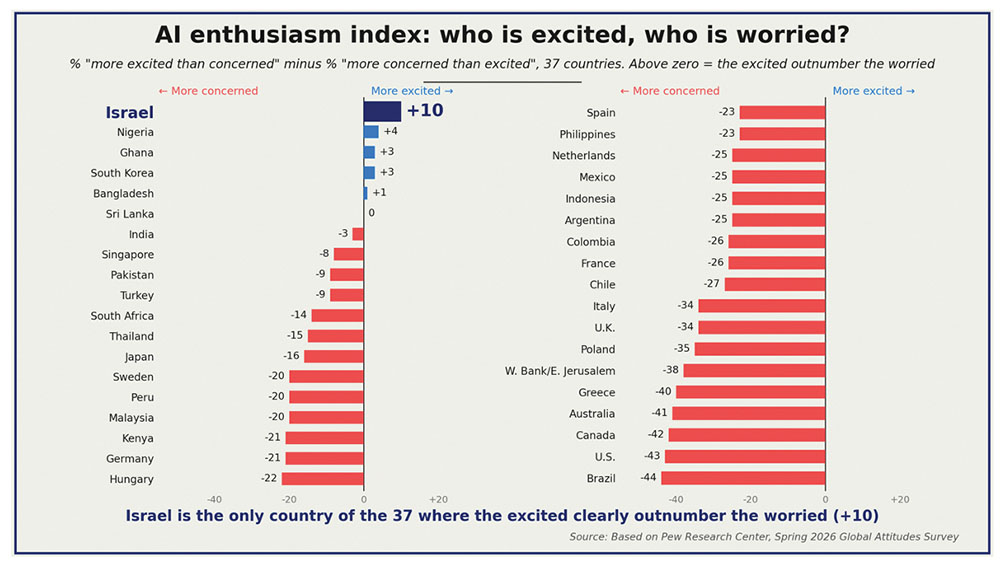
Americans are worried about AI. In many countries people are worried about AI. In Israel – more excited than worried. More excited than any other country.
A reader’s response
John G. writes: “Don’t you guys have some term limits for Prime Ministers?” My response: No, we don’t. It’s not simple to have such a thing in a parliamentary system, but many Israelis believe we must find a way to add it to ours.
Shmuel Rosner is senior political editor. For more analysis of Israeli and international politics, visit Rosner’s Domain at jewishjournal.com/rosnersdomain.