When I first encountered the plans to build hundreds of apartments above a massive Costco in South Los Angeles, I was struck not simply by the architectural novelty of the project, but by its implications for demography, migration, and community survival. As a scholar of demographic change and migration patterns, I have spent considerable time thinking about why populations move, what forces cause communities to disperse, and what is lost when people can no longer afford to live near one another. The Costco model suggested a compelling possibility: perhaps the physical assets already embedded within our communities could be used to resist displacement and restore the relationships that geographic separation has weakened.
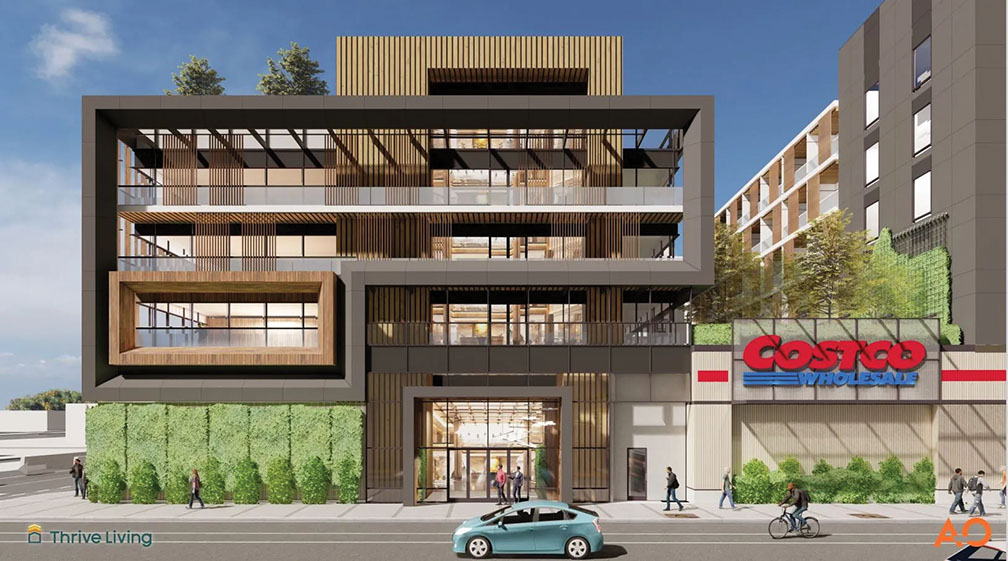
At 5035 Coliseum Street, developer Thrive Living is constructing a Costco at street level with 800 apartments above it, including 184 homes reserved for low-income households. The project broke ground in September 2024 and has been described by Los Angeles officials as a first-of-its-kind development for the city. It combines housing with food access, employment, pharmacy services and other everyday necessities on a single site. What captured my attention was the principle beneath the project: a large institution does not have to remain a single-purpose island. Its land, air rights, infrastructure, and steady flow of people can support an entire residential ecosystem. A place people ordinarily visit to purchase necessities can become the foundation for a mixed-income neighborhood.
That insight has profound implications for the Jewish community of Los Angeles.
Unaffordable housing is quietly eroding the geographic foundations of Jewish communal life. Young adults who grew up in established Jewish neighborhoods often cannot afford to remain there. Families move farther from parents, synagogues, schools, and community centers in search of affordable rents or home prices. Older adults may find themselves living alone in homes they can no longer maintain, yet unable to locate an affordable and accessible alternative within the community they know. These individual moves accumulate into a larger demographic transformation. The result is not merely residential dispersion. It is the weakening of cross-generational interaction and interdependence. Grandparents who live across the city cannot easily help with childcare. Young adults cannot casually check on an older neighbor. Children encounter elders mainly at occasional services or holiday programs rather than as a natural part of daily life. Congregants may drive long distances to attend scheduled events but no longer share the informal encounters from which trust, mutual responsibility and enduring community grow. Los Angeles amplifies these effects. Distance, traffic and limited transportation options can turn a move of only several miles into a major social separation. A family may technically remain connected to the same synagogue or Jewish community center while becoming functionally detached from its daily life. Jewish belonging becomes another appointment on the calendar rather than an environment in which one lives.
What if Jewish community centers responded by adopting the underlying logic of the Costco model? Many JCCs already bring together recreation, early-childhood education, culture, social services, fitness and communal gathering. Where land, zoning, financing and neighborhood conditions permit, these institutions could add mixed-income, intergenerational housing above or alongside their existing facilities. Such housing could serve people at the stages of life when they are often most vulnerable: young adults establishing independent lives, families raising children, and older adults confronting reduced income, declining mobility, bereavement, or isolation. A JCC-centered development could provide affordable apartments for young residents, family-sized homes, accessible units for older adults and supportive housing for those who need additional care. Shared spaces and thoughtfully organized programs could turn proximity into reciprocal relationships.
This is more than a proposal to construct apartments. It is an invitation to reconsider what a Jewish institution can be. In other words, instead of functioning primarily as a destination, a JCC could become the physical heart of a community where generations live, learn, celebrate, age and care for one another. In a city where housing costs are pulling Jewish life apart, the intentional combination of housing and communal infrastructure could help bring it back together. A Jewish community should be more than a collection of buildings that people visit. It should be a place in which people can enter as children, grow into responsibility, receive support in times of need, offer their gifts to others and age without surrendering their belonging. If we build such places, l’dor vador will cease to be only a phrase recited in prayer. It will become a landscape we inhabit and a covenant made visible in homes, courtyards, classrooms, shared tables and lives carried together from cradle to grave.
Lisa Ansell is Assoc. Director of the USC Casden Institute and Lecturer of Hebrew Language at Hebrew Union College-Jewish Institute of Religion Los Angeles.