
On October 14, 1663, the famous 17th-century diarist Samuel Pepys visited London’s Creechurch Lane Synagogue. After four centuries of banishment, Oliver Cromwell had allowed the Jews to return in 1656 and the small Sephardic congregation was a curiosity in Restoration London.
Pepys was expecting a solemn and quiet prayer service, but he and his wife happened to attend on Simchat Torah, the most exuberantly happy holiday in the Jewish calendar.
Shocked and bewildered by the singing and dancing, he famously recorded in his diary that he could not imagine that “there had been any religion in the whole world so absurdly performed as this.”
Simchat Torah, the joyful celebration of the completion and restarting of the Torah reading cycle, has always been one of my favorite holidays. It is the feel-good holiday, from my earliest memories at the Sephardi Synagogue of Sydney where I stood with my grandmother Nana Aziza in the women’s balcony watching the men dance and where they gave each child a huge bar of Cadbury chocolate, to my single days in the party atmosphere of Lincoln Square Synagogue on the Upper West Side of Manhattan, to shul-hopping with my husband Alan and good friends along Pico Boulevard, walking from synagogue to shul to shteebel, greeting other friends and enjoying a drink or two along the way.
Of course, no Jewish holiday is complete without its customary foods. The popular culinary tradition for the Sukkot and Simchat Torah holiday is to eat stuffed vegetables, like cabbage, peppers, zucchini and onions.
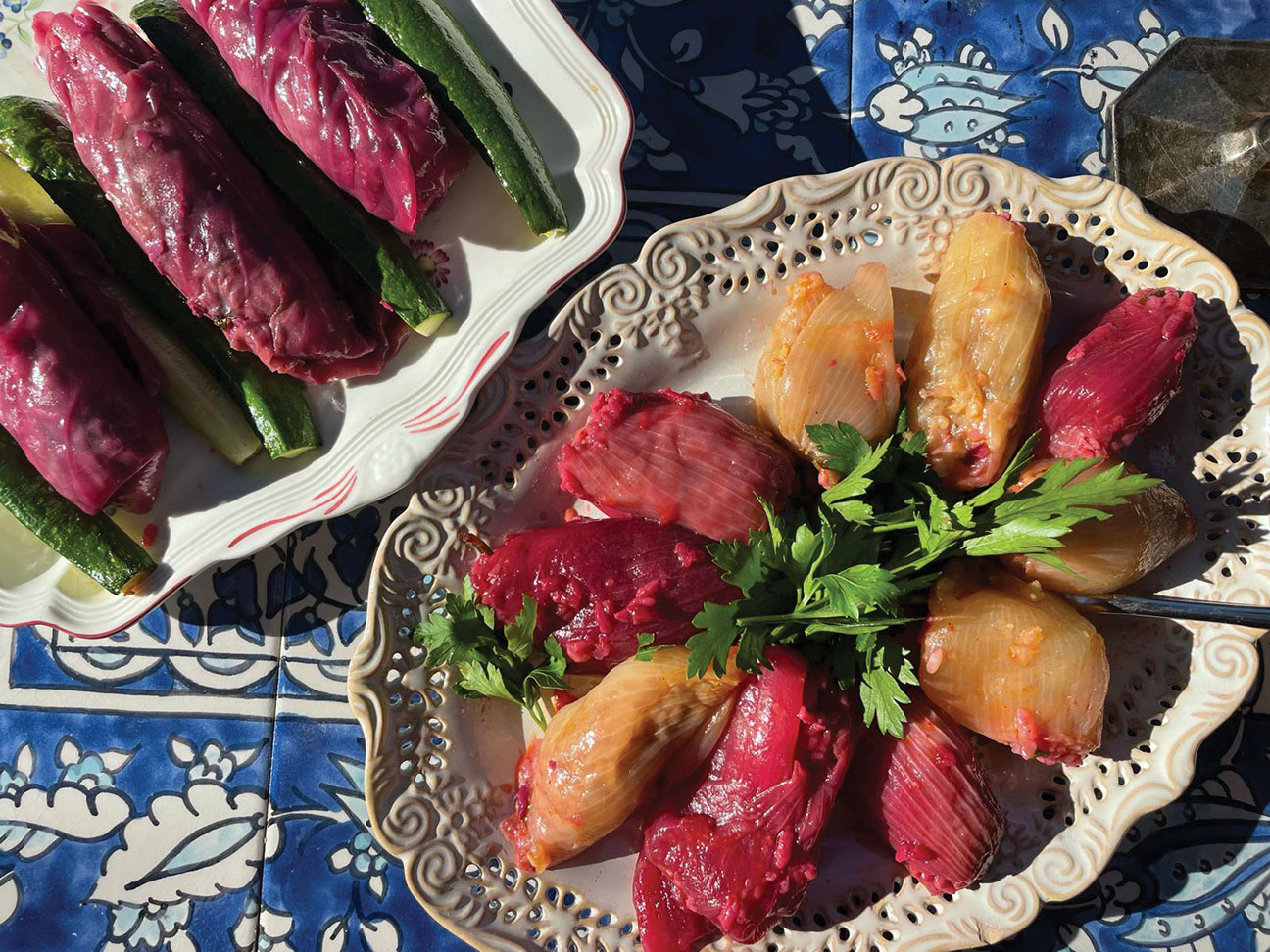
My grandmother Nana Aziza always made a stunning jewel-toned platter of m’hasha, sweet and sour stuffed vegetables. I loved watching my grandmother’s hands as she stuffed the tender cabbage leaves, translucent onion and hollowed out zucchini with the delicate, aromatic filling of ground beef and rice, mint and parsley, tomatoes and pinenuts, lemon and silan.
The stuffed veggies would slowly simmer in a rich, savory sauce of olive oil, diced tomatoes, tomato paste, and sweet paprika, By the time we gathered around the table, they were completely caramelized, meltingly tender and infused with sweet and savory flavors.
—Sharon
The custom of eating stuffed vegetables on Simchat Torah is to symbolize the scrolls of the Torah filled with the wisdom of the holy text. I love that each community has its own unique name and recipe for their stuffed vegetables. Ashkenazi Jews make holishkes, a sweet and sour stuffed cabbage dish. Syrian and Egyptian Jews call their dish mehshi, from the Arabic word for stuffed. In Ladino, stuffed vegetables can be called reyenadas. And in the former Ottoman Empire they are called dolma.
The vegetables change from kitchen to kitchen. Zucchini, eggplant, peppers, tomatoes, onions, grape leaves and other seasonal vegetables can all be hollowed out and filled with rice, meat, herbs, spices and sometimes nuts or dried fruit.
Stuffed vegetables make perfect sense because we are celebrating the harvest and these dishes are all about abundance and blessing.
There is something very Sephardic about a dish of choice vegetables filled with a generous mixture and slowly cooked until tender. The ingredients may be simple, but the preparation takes time and love. The result is food made to be shared by friends and family. And that is exactly what I want on my table, at this joyous time and always.
—Rachel
M’hasha Stuffed Veggies
Tomato Broth
1 cup boiling water
1/2 cup tomato paste
1 tbsp consommé powder
1 tbsp sugar
1 tsp salt
1/2 cup lemon juice
In a large measuring cup, dissolve the tomato paste, consommé, sugar and salt in the boiling water. Add the lemon juice and stir to combine well. Set aside.
1 cup basmati rice
1 large white onion, peeled
1 large purple onion, peeled
1 medium purple cabbage
1/2 lb ground beef
1 cup chopped tomato
1/2 cup finely chopped Italian parsley
1/2 cup mint, finely chopped
1/2 cup pinenuts
1/2 lemon, peeled and chopped
1/4 cup tomato paste
2 garlic cloves, minced
2 tbsp organic Silan
1/2 cup extra-virgin olive oil, divided
1 tsp kosher salt
1/2 tsp black pepper
1 tsp ground cinnamon
1 tsp sweet paprika
Soak rice in cold water for 30 minutes, then drain and set aside.
Use a sharp knife to cut a lengthwise slit that reaches the core of the onion. Use a sharp knife to cut a slit in the core of the cabbage. Place the white onion in a small pot filled with cold, salted water and the purple onion and cabbage in a large pot filled with cold, salted water. Bring both pots to a boil over high heat. Cover the pot, reduce heat and cook for 10 minutes. Drain the water and set aside.
Preheat oven to 300°F.
In a large bowl, combine the ground beef, rice, tomatoes, parsley, mint, pinenuts, lemon, tomato paste, garlic, Silan, 1/4 cup olive oil, salt and pepper, cinnamon and paprika.
Pour remaining olive oil into a large baking dish.
Peel a layer of the cabbage and stuff with 3 tablespoons of the ground beef mixture. Place in the middle of the baking dish and continue stuffing.
Peel a layer of the onion shell and stuff with 1 tablespoon of the ground beef mixture. Roll the onion shut and place in the baking dish.
Continue stuffing the onion shells and place in a circular pattern around the cabbage. Pour the tomato broth over the stuffed cabbage and onions.
Cover with a layer of parchment paper and a lid or a layer of heavy duty aluminum foil.
Roast in the oven for 60 to 90 minutes, until meat is cooked.
Sharon Gomperts and Rachel Emquies Sheff have been friends since high school. Their cooking and storytelling project has grown into a devoted following on Instagram @sephardicspicegirls and on Facebook at Sephardic Spice SEC Food. sephardicspicegirls.com/full-recipes.