Well, they came because of something nice. That’s my Leo moon, trying to look on the bright side.
The nice thing being that our recording of the country-classic “Blue Kentucky Girl” got picked up by Bluegrass Today.
Because of this nice thing, the Cossacks came in a count-down of 3-2-1.
“Perhaps she should stick to Hava Nagilah.”
I blinked at my screen, and breathed. The commenter’s user name was Missouri Red.
“This will show her!” I imagined him thinking, “Get it? Hava Nagilah? THAT will put her in her place. Jews will not replace us!”
His comment was liked by another guy. Hailing from someplace in Missouri. The other America. (Never read the comments.)
I know trolls are a sign of visibility.
He wanted to make me feel I do not belong in that musical world.
But the thing is, this music belongs to me as much as him.
I will not lie.
I will not say it did not hurt.
But I breathed some more and thought of what Dolly Parton or Willie Nelson or Johnny Cash would say.
I tried to remember that 1.) trolls are the price of visibility and they’ll latch on to literally anything 2.) there is an 80 percent chance this is a sad guy in his mom’s basement, red-hot mad that the Good Lord made him two inches tall and who has literally never met a Jewish person in their lives.
And I remembered that this is likely something my black singer colleagues deal with in the opera world a lot. This whole you-don’t-belong-here vibe.
And it’s incredible that this needs saying and I’m going to say it anyway.
Everyone belongs everywhere they bring integrity, talent, and heart.
“It matters not what someone is born but what they grow to be,” said JK Rowling. Gitel Chana Fox was born SOOO good and SOOO happy and as she grew, she made others better and happier.
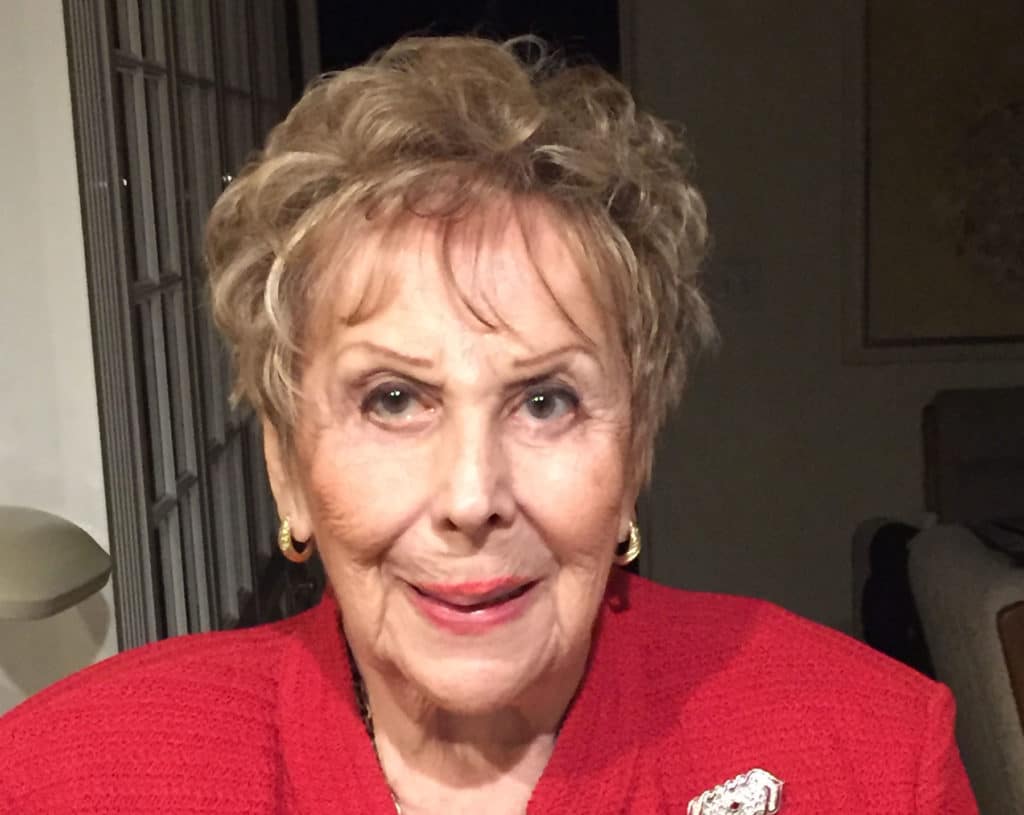
Gertrude Ann Fox, my wonderful mother, was born in Poland and grew up in Milwaukee, WI. She attended the University of Wisconsin and went on to be a teacher and an auditor. She moved to Los Angeles in the mid-1940s and married my father to whom she was married for 72.5 years. A Fox married a Fox. She was the youngest child of Rav Itzik Fox and Chana Fox and she is survived by her husband Gerson, three children (of her four) and two brothers.
Ben Franklin once wrote, “Well done is better than well said.” So true, as no matter what I say, it will not encapsulate how well done my mother’s life was.
She was a kind, modest and decent person, lovely and elegant, patient and powerful, inside and out. She was a sagacious counselor, trusted confidante and an active listener. She had a keen intuition and an eidetic sense of what everyone needed in the moment. She lived with passion, she had integrity and she was extremely loyal. She instilled a sense of confidence when she was around–it would all work out fine.
She was the first female to be Vice-President of an Orthodox shul. Rabbi Feinstein had to psak that so long as she didn’t want to sit on the bimah or get aliyahs, it was permissible; She was a delegate to the World Zionist Congress, and she was a national Vice-President of AMIT. She was always involved in sisterhood, PTA, Jewish education and philanthropy. She was all about “others.”
She was a wonderful spouse, mother, friend and community member. She taught by example as she led with her deeds. She had an infectious joy that went viral. Her good deeds were bounteous.
Amongst her compendium of aphorisms: “Failing to prepare is preparing to fail”; “Be the change you want the world to be”; “Repetition is the mother of success; “You can be anything you want to be, believe it and make it happen”; “It’s not if but when.” She loved pithy observations and she was supremely inspirational.
I never thought I would say these words but my wonderful mother, Gertrude Ann Fox has passed…I always took for granted that she would live forever with her magical spirit, energy, vim and vigor. She was pure magic; she knew how to make good of everything and make the bad vanish. Everyone with whom she interacted, felt special. She had that “gift.” Gertrude taught us how to be kind, how to live and how to advance. Everyone thought she was their best friend, that was her special brand of magic.
Jeremiah 29,11: “‘For I know the plans I have for you,’ declares the Lord, ‘plans to prosper you and not to harm you, plans to give you hope and a future.”
My mother provided me and my siblings a wonderful future. She was everyone’s biggest cheerleader. She told us that “imagine” was the most powerful word in the English language. She implored all of us to imagine what we could be and to believe it. Then she told us to imagine doing it even better and making the world a better place upon exit than entrance. She certainly accomplished that.
JRR Tolkien wrote, “All we have to decide is what to do with the time that is given us.”
We traveled around the world together, we went to sporting events, theater, concerts, parades…parties and dinners. We spent lots of time watching movies and discussing them in detail. What did they mean, what was really going on…? We went to book clubs and museums; we listened to music and we wrote poetry.
We, as a family, raised money for important causes…We were always learning and living, donating our time and resources as that is what she did. Gertrude said the most interesting people are interested people. Our family discussions around the dining room table were electric. Gertrude was determined to make every moment of her time count and insisted we do the same. She always said that the most important decisions we make are how we spend our time and with whom.
People like to say, “this too shall pass” but it’s hard to imagine that being true, as my mother was everything to me.
Talk is cheap because supply exceeds demand. Gertrude knew success comes before work only in the dictionary. Moreover, she loved life and her journey resonated with purpose. During good times, during rough times, she remained positive and optimistic and “did” much more than she “said.”
I am fortunate to be her son and it’s an honor to call her my mother. I love her more than words can capture. It would take a lifetime to describe all of the special memories I shared with her.
Hopefully in time, what now makes me sad will soon make me smile as I’m reminded of the most precious gift that I ever received, the time I spent with my amazing mother, Gertrude Ann Fox. May G-d elevate her soul.
A proposed, state-wide, mandatory Ethnic Studies Model Curriculum in California is open for public comment only until Thursday, January 21. The current draft of the curriculum celebrates figures who have promoted anti-Semitism (including leaders of the Third World Liberation Front and the anti-Jewish leaders they admire); it uses racial distinctions to divide people into those who are considered white (and therefore privileged) and those who are non-white (and therefore oppressed); and in the case of Jews, it combines the two, pitting “Jews of color” against Jews who are tarred with “conditional whiteness” and its attendant “racial privilege.”
“White supremacists continue to racialize Jews as non-white,” the curriculum’s “Fact Sheet on Jewish American Diversity” acknowledges. But “many Jews with light skin identify with the idea of white-presenting,” it reads. “Light-skinned Jews…experience white privilege,” while “Jews of color like all communities of color face systemic racism.” In other words, the same kind of Jews who, in living memory, were forced into ovens for being non-white, are now identified as white –– or at a minimum, as having “conditional whiteness.” This disqualifies most Jews from the solidarity offered to other minority groups.
Nazi curricula taught that in order to usurp white privilege, Jews pretended to be white, hiding in plain sight. “Just as it is often hard to tell a toadstool from an edible mushroom,” read a Nazi children’s book, “so too it is often very hard to recognize the Jew…” Depicting Jews as imposters and appropriators of privilege — people who pose as something to which they have no legitimate claim — has been a frequent anti-Semitic theme throughout history. A recent large scale analysis of modern anti-Semitic disinformation from the Network Contagion Research Institute (NCRI) suggests that this same conspiracy theory is endorsed by twenty-first-century anti-Semites of all kinds.
But surely, a modern-day ethnic studies curriculum wouldn’t perpetuate the same idea?
“Starting with immigrants, and common with actors” (actors?), the proposed California curriculum’s section on Jews teaches, American Jews have historically hidden their Jewishness by changing their names. Authors of this curriculum want to make sure California’s schoolchildren know that “this practice of name-changing continues to the present day.” Putting an even finer point on it, passing as white (what would have been called “posing” as white in an earlier era) means that Jews “[change] their position on the racial hierarchy… gaining racial privilege” (Emphasis added).
Jews are the only group in California’s proposed curriculum for whom the term “privilege” is used. Let that sink in. Jews are the only group in California’s proposed curriculum for whom the term “privilege” is used. (Do your own word search in the curriculum for the word “privilege” if you’d like to see for yourself.) The word appears elsewhere, but not attached to any other ethnic group.
Jews are the only group in California’s proposed curriculum for whom the term “privilege” is used.
There ought to be no discussion about Jews and privilege that doesn’t begin by talking about the historically enacted and repeated genocidal ideology that revolves around Jews and privilege. For an ethnic studies curriculum to go traipsing through that discourse without a single mention of its ugly and bloody history is not a lesson about anti-Semitism. It is a repetition of it. By itself, that should effectuate a vote of no confidence in the entire franchise.
In the midst of the largest recorded surge in anti-Semitic propaganda and attacks against Jewish people across the globe, a new framework for racial theory again counts Jews as members of the evil class. Jews, who represent roughly 0.2% of the world’s population and roughly 2% of the U.S. population, are again targeted for their “privilege.” Yet, when concerns are raised about the ways in which critical ethnic studies programs promote this type of hatred, the authors of Rethinking Ethnic Studieswrite, “such strong feelings are part of students’ sense-making and development.”
Indeed.
Critical race theory is not the historical equivalent of Nazism, but it doesn’t have to be: the question is whether an American education will help students widen their sense of “us,” or once again, teach students to harden their sense of “them.”
The deadline for public comment on the proposed California Ethnic Studies Model Curriculum is Thursday, January 21. Public comments should be directed to ethnicstudies@cde.ca.gov
Pamela Paresky, Ph.D., @PamelaParesky is a Visiting Senior Research Associate at the University of Chicago’s Stevanovich Institute on the Formation of Knowledge (SIFK). She serves as Senior Scholar at the Network Contagion Research Institute (NCRI).
Joel Finkelstein, Ph.D., is Director and Co-Founder of The Network Contagion Research Institute (NCRI) and Fellow at the Miller Institute for Secure Communities at Rutgers University.
If you’ve ever had the privilege of tasting Rachel’s Olive Chicken, you already know that it is lemony fresh and truly flavorful. Olive Chicken is a traditional Moroccan dish that is slowly simmered in a ceramic tagine. But since most of us don’t have tagines, Rachel has adapted the recipe with cooking techniques for the modern kitchen. Her recipe retains the bright flavor of the preserved lemons, the salty brine of the olives, and the sharp tang of the Dijon mustard, all melding together with the sweet earthiness of the saffron to make the most delectable chicken.
This recipe retains the bright flavor of the preserved lemons, the salty brine of the olives, and the sharp tang of the Dijon mustard.
I, of course, have had the privilege of eating Rachel’s Olive Chicken at many a Friday night dinner, as well as other Moroccan dishes that feature cooked olives. I’ve often wondered why my Iraqi family never cooked with olives. Don’t get me wrong, we love olives. My grandmother brined her own olives, my mother is constantly making olive tapenade, my mother always has those huge metal vats of olive oil in her kitchen and we always have a bowl of olives on the table for our Shabbat meals. But we don’t cook with olives.
This past Friday night, the mystery was solved.
My girls were noshing on olives.
I admonished them: “Stop eating olives! You won’t have room left for dinner!”
My father piped up. “Let me tell you a story about my father.”
There aren’t a lot of stories about my paternal grandfather, Rafi. I know that he was a very kind and generous man, who ran a very successful wholesale food business in Baghdad. My grandmother Rosa was intelligent, tall, blue-eyed and beautiful and they were happily married. They had nine children, with my father smack in the middle of the siblings.
Their eldest son, my uncle Moshe, studied accounting in University and was a member of the T’nuah, the Zionist movement, which was punishable by death. He brought my young father into the group, which caused my grandmother great distress.
My uncles Moshe and Shlomo and my aunt Victoria (Toya) illegally left Iraq and made Aliyah to Israel. My father and his younger brother Naim and a group of youth from the T’nuah, also escaped Iraq over the border with Iran, where they were housed in tents in a Jewish cemetery until they had enough escapees to fill a plane. The family was reunited in Israel through Operation Ezra and Nechemiah in 1951. My grandfather passed away too young, before my parents were married.
My father continued: “One day, my father decided to take the bus to Jerusalem. When he got off the bus, he saw an Arab youth selling fruit. He bought a bag thinking it must be like dates and carried on his business. On the bus ride back to Tel Aviv, he remembered the fruit. He took one bite, then quickly spat it out. He had bought olives freshly picked from the tree!”
That is how I discovered that olives don’t grow in Baghdad and most of Iraq and that is why olives don’t feature in the Babylonian kitchen.
Olives grow in the Mediterranean region—Spain, Italy, Greece, Turkey, Morocco, Israel and the Levant.
The canned pitted green olives from Israel are perfect for this recipe. Preserved lemons add umami saltiness and a real depth of flavor to the dish, but fresh lemons can work too. Don’t be intimidated by the idea of preserving your own lemons—they are very simple to make and they last a long time in the refrigerator. You can find Rachel’s recipe on our Instagram page @sephardicspicegirls and on our Facebook page, Sephardic Spice SEC Food. Cilantro, onions and garlic make this dish even healthier. And we promise that your chicken will be moist, tender and delicious. Mmmmmmmmmm!
Lemon Olive Chicken
1 small red onion
½ preserved lemon, flesh and skin
1 bunch cilantro, cleaned and stems cut off
2 tablespoons Dijon mustard
½ cup extra virgin olive oil
1 cup saffron water
½ tsp salt
½ tsp pepper
1 3-4 pound chicken, cut in pieces
10 whole garlic cloves
1 cup pitted green olives
Preheat oven to 350°F.
In a blender or food processor, mix the onion, preserved lemon, cilantro, mustard, olive oil, saffron water, salt and pepper until the mixture resembles a dressing.
Place chicken pieces in an oven pan.
Place garlic cloves between the chicken pieces.
Place olives on top and around the chicken.
Spoon dressing over the chicken.
Cover the pan and bake at 350 for 45 minutes.
Turn up heat to 425°F.
Remove the cover from chicken and bake another 20-30 minutes, until golden.
Rachel Sheff and Sharon Gomperts have been friends since high school. They love cooking and sharing recipes. They have collaborated on Sephardic Educational Center projects and community cooking classes. Follow them on Instagram @sephardicspicegirls and on Facebook at Sephardic Spice SEC Food.
American Jews have become enamored with and distracted by the political scene. We attribute almost biblical powers to our politicians, and some of us have turned our political party of choice into a quasi-religion. Their platforms have become our 10 Commandments, and canceling our opponents is like some sort of mitzvah — so much so that anyone who disagrees with us is an infidel, to be harassed for their beliefs.
Whether it’s the 2016 or the 2020 presidential election, some fear that America is failing; others feel we’re saved. Either way, when 50% of the country thinks you’re crazy, American Jews are in need of a wakeup call.
The biblical plagues that visited the Egyptians demonstrated there was one power: God. The Egyptians worshipped the Nile, so God literally turned it into a blood bath. Every plague took away another aspect of the Egyptian weltanschauung(worldview), stripping society of its power illusions.
And the greatest illusion of today? The presumption of Western infallibility. Decades ago, Louis Rene Beres, now Professor Emeritus at Purdue University, stated that before the Messiah comes, the West must fall. The glory of Western society — technology, wealth, entertainment — is dominant, successful and full of promise. Okay, so things aren’t perfect. But we’re too distracted to long for Zion and redemption.
The book of Proverbs (21:1) says that the hearts of kings are in God’s hand. Leaders drive current events, which is God’s communication to Man sans prophecy. The last year has been like no other in recent memory. God is talking, saying, “Return, O Jews in Exile. You are majoring in minors. Your priorities need rearranging.”
It’s not about politics. It’s about people!
For a single person to manipulate U.S. politics is beyond anyone, as Donald Trump has learned. As much as the late billionaire Sheldon Adelson influenced American politics, he will be remembered for moving the needle in the Jewish world. This is our opportunity as well. We must look inward to our Jewish people, who are the greatest change agent and highest-leveraged asset with the best ROI in human history.
Politics is not a lifestyle, nor a goal in and of itself. Taken to an extreme, politics had British Jews and German Jews in bloody trench warfare shooting at each other during World War I. Some think that the game we’re playing is Democracy, and the scoreboard counts votes to determine the winner. For American Jews, that’s playing the wrong sport, in the wrong arena, wearing the wrong uniform.
Politics is not a lifestyle nor a goal in and of itself.
So what’s the solution?
God is looking into our hearts to see how much we love our fellow Jews. This is measured by how much we are willing to sit down and listen to the other side. To accept the idea that in some very important issues of our time, intelligent, thoughtful people have come to different conclusions. The Talmud says that the law generally sides with Beit Hillel because they were always careful to consider — and articulate — the other side. Invariably, it’s a win-win, as the result is a more inclusive and deeper perspective.
History teaches that unity is in our best interest. We must find a way to come together, to overlook differences and to celebrate commonalities. Allow the Talmud, which contains every concept known to Man, to be our guide. It is the greatest example of free speech (which is why several attempts have been made to censor it over the millennium). It contains heated debate, where every idea has its day in court. For two millennia it has allowed any and every voice to be heard. No one is silenced.
We believe, as our mentor Rabbi Noah Weinberg (z”l) said, that people of good will can reason together and reach a common conclusion. For truth fears no one.
Around the corner is Purim, marking the anniversary of COVID-19 forcing its way into our lives. It was on Purim that we believed a Jewish queen in the castle would save us. But she couldn’t — not without us realizing our total reliance on God. We had to come together for unified prayers, fasting and repentance.
Let us take a page from history and understand that no political victory or loss brings us closer to redemption if we are a fractured people. We must start talking instead of unfriending each other. Tikkum Olam and polarization cannot coexist.
Tikkum Olam and polarization cannot coexist.
The story of Joseph is not about how to solve the global famine at the time — a catastrophe on a greater scale than what we are experiencing today. God sent the famine so 12 brothers could resolve their differences and form the foundations of Jewish destiny. It’s not the headlines that matter. Jews are the news.
The Jewish contribution to the founding of America is astonishing, with the early Pilgrims viewing the New World as a reenactment of the Jewish Exodus from Egypt, and the Hebrew language playing a central role in the first Ivy League universities.
Nobody knows the future, though we have a gnawing sense of society unraveling before our eyes, where some even fear civil war. Grand forces of history are at play.
For the next great Jewish contribution to American society, our response must be to create a Jewish dialogue, to strengthen Jewish values without being political. For this, we need two sides to the conversation.
That’s why we’re creating Jewish Unity 2021, a place of dialogue where we, as a Jewish family, can meet beyond labels or politics, to learn, listen and discuss how to better love and respect one another. A place where we imagine, together, a life neither red nor blue but guided by profound Torah wisdom.
Let’s be a role model for how it’s done. Let’s shine that light — for our country, and for the American Jewish future.
Rabbi Aryeh Markman is the Executive Director of Aish LA. Rabbi Shraga Simmons is the co-founder of Aish.com and HonestReporting.com. They can be reached at jewishunity2021@gmail.com
When Eric Weiner chronicled his latest hunt for wisdom, the adventure had lasting impact. Despite his previous titles, The Geography of Bliss, The Geography of Genius, and the spiritual memoir Man Seeks God, the bestselling author discovered a surprising truth.
“Before, I was racing through life, trying to accomplish as much as humanly, or super-humanly, possible,” Weiner says. “Rarely did I stop and ask ‘why? To what end?’ I now question assumptions, especially my own, on a regular basis. This makes life trickier in some ways, but also richer and, in the end, more meaningful.”
The importance of slowing down is one of many maxims in his latest book, The Socrates Express: In Search of Life Lessons from Dead Philosophers. The book, published by Avid Reader Press, an imprint of Simon & Schuster, recently entered its third printing. NPR named it one of the best books of 2020. To wisen up a bit, the Jewish Journal probed Weiner for highlights of his book, released with timing perfect for a pandemic.
JEWISH JOURNAL: What inspired this book?
ERIC WEINER: In a word: wisdom. I was hungry for it, and wasn’t finding it in the usual places. “Why not philosophy,” I thought? The word “philosophy” comes from the ancient Greek philosophia—literally “the love of wisdom.” These days, the field gets a bad rap. It’s seen as an arcane, impractical subject. Nothing could be further from the truth. Philosophy was once the most practical subject you could study. It was therapeutic. Medicine for the soul. I hope my book, in some small way, helps restore it to its proper place.
JJ: How are trains a part of this story?
EW: I love them! I can think on a train. I cannot think on a plane or a bus. Not even a little. So, in researching this book, I took trains everywhere I could, from Athens to India, Brooklyn to Frankfurt.
JJ: Which teaching do you find most valuable during this pandemic?
EW: All are helpful but perhaps none more so than Stoicism. The Stoic ethos is “change what you can, accept what you cannot.” This past year has taught us—reminded us, really—that external events are largely beyond our control. But we can control our internal world, our reactions to events. It’s a powerful insight.
JJ: Why did you structure the book in three sections, from “Dawn” to “Noon” to “Dusk”?
EW: I set out to structure the book not around big metaphysical questions but, rather, straightforward “how to” ones. How to get out of bed, how to enjoy, how to cope, etcetera. These are the sort of questions that keep most of us up at night. I also wanted the narrative structure to mirror the arc of a day, and of a life. The “how to” questions that matter to us when we’re 20 years old aren’t the same ones that matter most when we’re 70.
JJ: One of those questions is “What gets you out of bed?”
EW: The same thing that got Marcus Aurelius, the Roman Emperor and Stoic philosopher, out of bed: other people. That sense that there is more to life than our own petty desires. Nothing rouses you from bed more efficiently than the knowledge that you are needed.
JJ: Why these thinkers?
EW: I chose philosophers who spoke to me. Relatable ones. That’s probably why all of them were “feral” philosophers, working on their own rather than attached to a university. I also wanted a cross-section of thinkers–not only dead white men but women, too, as well as Asian thinkers… They loved wisdom deeply, and that love is contagious.
JJ: How did you end up addressing them directly, by their first names?
EW: That was by design. I wanted to bring these greats down from their pedestals and engage with them more personally, seeing them for what they were: fully human. Brilliant in some ways, yes, but deeply flawed in others. Just like all of us.
JJ: What is Jewish about this book?
EW: Jews are naturally philosophical. We are a questioning people, and asking questions—good questions—lies at the heart of all philosophy. Beginning with Socrates, philosophers have repeated this refrain: always question assumptions, especially your own. As I said, very Jewish.
“Jews are naturally philosophical. We are a questioning people, and asking questions—good questions—lies at the heart of all philosophy.”
JJ: What is the best advice you received while writing this book?
EW: The best advice I received actually came in the form of a question. I’m a tremendous kvetcher, world class. One day, I was kvetching with my friend Jennifer about success. I felt I didn’t have enough.
“What does success look like?” she asked.
I just sat there, stunned, realizing I had no idea. A good question does that. It grabs hold of you and won’t let go. A good question reframes the problem so that you see it in an entirely new light. That is the essence of philosophy, I think.
JJ: What is your philosophy of travel?
EW: My philosophy of travel is that of the American writer Henry Miller. “One’s destination is never a place,” he said, “but a new way of looking at things.” Come to think of it, that’s a pretty good definition of philosophy, too.
JJ: Which of the book’s revelations are the most disheartening?
EW: Schopenhauer is a bummer, a grumpy misanthrope, but even he had his bright side. He loved the arts—music, in particular—and thought they provided a respite from this, the “worst of all possible worlds.” So, even in the darkest of philosophies, I found rays of light.
JJ: Which teaching do you find the most meaningful?
EW: I’d have to say it’s Nietzsche’s ‘Theory of Eternal Recurrence.’ In a nutshell, Nietzsche posited a giant “what if” question: what if the universe, and your life, repeated itself forever and ever? What would be the implications for how you live your life? If Eternal Recurrence, as he called his theory, is true then there is no such thing as a trivial moment, since you’d have to relive that moment countless times. I find it to be an extremely powerful thought experiment, that simple question, what is worthy of eternity? I suggest you try it, too.
Lisa Klug is a freelance journalist and the author of “Cool Jew” and “Hot Mamalah: The Ultimate Guide for Every Woman of the Tribe.”
When I was a little girl, I briefly got to take horse-back riding lessons.
We lived in North Carolina back then. And I lived for those lessons.
Once a week my mother would pick me up outside of Estes Hills Elementary School, hand me a brown paper bag with string cheese and a box juice, and we’d drive the 15-20 minutes out of Chapel Hill to the stable. I’d kick my legs in the front seat, barely containing my excitement.
The presence of these huge creatures soothed and thrilled me.
But also I loved getting dusty; loved the warm air that comes from the velvety part of the horses nostrils, the soft sound they make with their lips when they breath out into your hand. I loved the scent of hay and barn and leather and sweat. I loved the country music radio station blasting from the little transister radio propped up sideways on a stack of blankets in the tack room. I loved my college-student riding teacher with her blonde ponytail, calling out commands in her Carolina drawl.
To be clear, I was never very good and it also wasn’t about that.
I loved it in an uncomplicated way. Without ambition. That was it.
When we moved back to Venice and were again surrounded by the whine of sirens, drunk tourists, surfers, and a lot of people experiencing homelessness, I stopped riding. I suppose I could have found a barn out in Malibu or Topanga but someone would have needed to drive me and it just never happened. I missed it a lot. Not because I was in the process of becoming an accomplished horse person, just because how the animals made me feel. Safe, and quiet in my mind.
Then one day, a family friend with a horse in L.A. invited me to ride her new stallion. He was jet-black and beautiful.
“But are you sure you are experienced enough to ride a baby?” she asked.
“OH YES” I remember saying, fraudulently.
It was 100 percent wishful thinking, childhood hubris at its worst.
The friend said OK, well let’s get you up.
The stallion bucked me off in 10 seconds flat.
I flew up into the air, twirled in terrifying slow-motion, and crash-landed on the hard white picket fence. Big purple bruises bloomed on my chest and back. Got the wind knocked out of me pretty good too.
I did not get back up on the horse.
That one thing you are always, always supposed to do? I did not do it.
A lifetime went by and other loves came.
Music and theater eclipsed most the other loves. I put on blinders and devoted myself fully to singing.
Over the years I’d see horses, and look at them, longingly, but never really got back up.
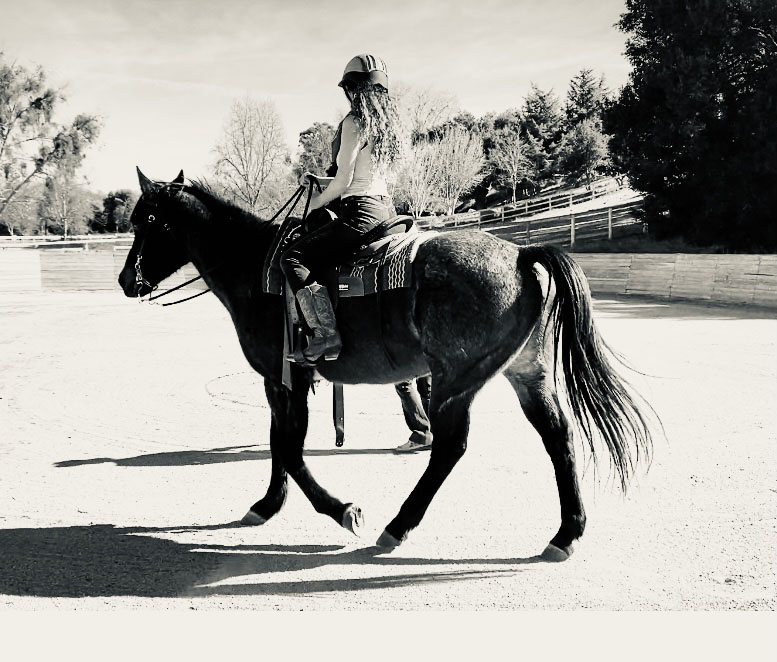
Yesterday, January 16th, 2021, for the first time, I got back up.
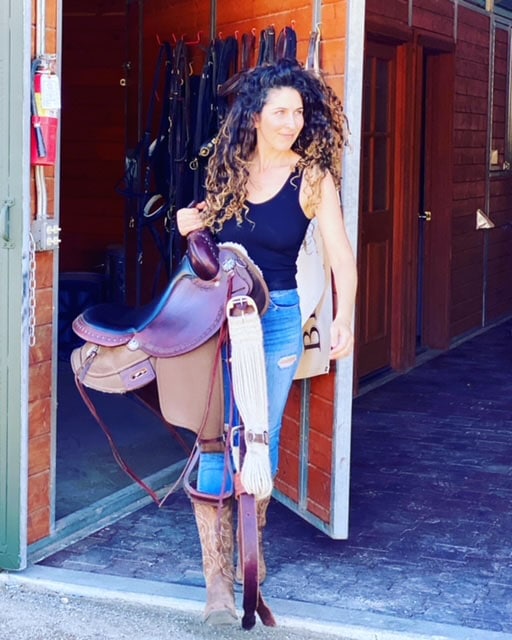
Because of my partner, Max Hoetzel, a devoted horse person, I got back up.
And because of him I got to take a lesson.
As synchronicity would have it, my wonderful teacher Courtney, right here in CA, hails from North Carolina, too.
At first, when I got up on Romeo, the very gentle sweet horse, I held on for dear life to the little knob on the saddle.
“Breath!” called out Courtney.
“I am breathi—“ I called back, and realized in that exact minute that indeed, I was not.
“He needs to feel your breath because it will make him feel relaxed. Right now he feels your tension and stress. The horse is a mirror for whatever is going on in you. You need to be the leader.”
So I started conciously breathing. My back and shoulders released. My breath dropped way down into my lower body. My core was engaged, but not tense. It reminded me….well, it reminded me a lot of singing.
Romeo started yawning, blowing air out his nose.
“This is great!” called Courtney. “This means he is relaxing. Because you are. Y’all are starting to have a relationship.
And we were.
After all these years, yesterday a horse helped an opera singer remember how to breathe.
Representative Rashida Tlaib (D-Mich.) argued in a January 19 interview on Democracy Now! that Israel is excluding Palestinians from the COVID-19 vaccine because Israel is a racist and apartheid state.
The host, Amy Goodman, asked Tlaib for her thoughts on Israel vaccinating 20% of its citizenry while Palestinians have not been vaccinated. Representative Tlaib replied, “Israel is a racist state, and that they would deny Palestinians like my grandmother access to a vaccine, that they don’t believe that she is an equal human being who deserves to live, deserves to be able to be protected by this global pandemic.”
Tlaib added, “it’s really hard to watch as this apartheid state continues to deny their own neighbors, the people that breathe the same air they breathe, that live in the same communities — you can put a settlement whereever you want, but on the other side of that wall is a farm community, a village where my grandmother lives. And many of our various family members and others that I know are trying to live a good life, a free life, free from these racist policies that deny them access to public health.”
She proceeded to accuse the United States of enabling Israel’s “inhumane” treatment of Palestinians. “I hope our colleagues, I hope our country sees what the Palestinians have been trying to tell us for a very long time, that Israel has no intention of ever being caring or allow equality or freedom for them as their neighbors, and you can see it with the distribution of the vaccine,” Tlaib said.
Rep. @RashidaTlaib on Israel not vaccinating Palestinians:
“It’s really important to understand that Israel is a racist state, in that they would deny Palestinians like my grandmother access to a vaccine, that they don’t believe she’s an equal human being who deserves to live." pic.twitter.com/vPCeXjdqrZ
“.@RashidaTlaib, you are entitled to your own opinions, not your own facts. Israel is giving the vaccine to all its citizens, Jewish and Arab alike,” the American Jewish Committee tweeted.
“The PA [Palestinian Authority], responsible for Palestinian healthcare, has rejected Israel’s help and ordered its own vaccines.”
.@RashidaTlaib, you are entitled to your own opinions, not your own facts.
Israel is giving the vaccine to all its citizens, Jewish and Arab alike.
The PA, responsible for Palestinian healthcare, has rejected Israel's help and ordered its own vaccines. pic.twitter.com/zbPaOvynsQ
The Stop Antisemitism.org watchdog similarly tweeted that under the Oslo Accords, the Palestinians are responsible for their own health care, including vaccinations.
“P.S. – how many Jews live in Gaza? ZERO,” they added.
A sitting Congresswoman (Palestinian) is clueless about the Oslo Accords
Let us help:
Article 17 Health 1. Powers and responsibilities in the sphere of Health in the West Bank and the Gaza Strip will be transferred to the Palestinian side, including the health insurance system. https://t.co/Mdxt2o1IJs
2. The Palestinian side shall continue to apply the present standards of vaccinations of Palestinians and shall improve them according to the internationally accepted standards in the field, taking into account WHO recommendations.
The Jerusalem Post’s Lahav Harkov has previously noted that Israel has already started vaccinating Palestinians in East Jerusalem and plans to vaccinate Palestinians in Israeli prisons. The PA is expected to receive thousands of doses of vaccines from Russia by the end of the week.
The Media Line — Political uncertainty is nothing new in Israel these days. The country is headed for its fourth election in less than two years and, for the first time, experts say Prime Minister Binyamin Netanyahu is facing a viable challenge to his lengthy reign.
What has changed this time around is the additional level of uncertainty in dealing with a new U.S. government.
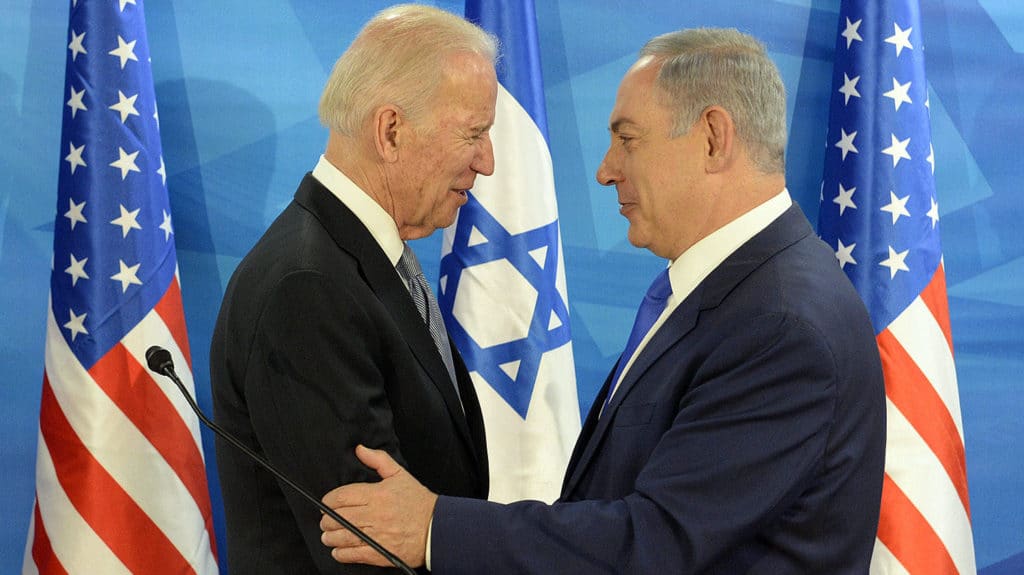
Joe Biden will enter the White House on Wednesday. His relationship with Israel and Netanyahu goes back decades – for better or for worse. This time, though, the unpredictability of Israel’s internal political situation may leave the country at a huge disadvantage as Netanyahu and company try to lobby the Biden administration on issues such as Iran, arms sales to allies and settlement building. Conversely, it could also give Biden a ready excuse to push back against his left wing and delay implementation of any policy vis-à-vis Israel by claiming he wants to wait and check the posture of its new government, whenever that may be in place.
“To some extent, that’s not such a bad thing considering Biden and his people have so many other things to deal with,” Michael Koplow, policy director of the Washington-based Israel Policy Forum, told The Media Line.
“It’s definitely more challenging for the Biden administration to figure out the complexion of the Israeli government and where it will stand for the next five years. I don’t think it will prevent behind-the-scenes contact, though, especially in dealing with the Iranian nuclear program and, to a lesser extent, on the Palestinian issue,” said Koplow.
Biden will have his hands full putting out fires at home as America looks to recover from the coronavirus pandemic and a cratered economy, not to mention the consequences of the recent insurrection at the US Capitol.
“I think the first point to understand is that the Middle East is not likely to be a priority issue for the incoming Biden administration,” veteran diplomat Dennis Ross told The Media Line. Ross served as the US State Department’s director of policy planning and special Middle East coordinator, and later served as a special adviser for the Persian Gulf and southwest Asia, including Iran, to Secretary of State Hillary Clinton.
“Between the pandemic, the economic fall-out from it, and the need to re-establish the U.S. as a global actor, the Middle East will not be at the top of the Biden Administration’s preoccupations. That said, the Middle East has a way of forcing itself onto the agenda. An Israeli election, by definition, means that policies for dealing with many bilateral issues would be put on hold unless, of course, they relate to Israeli security,” said Ross.
In fact, with a right-wing Israeli government – with or without Netanyahu at the helm – still the likeliest outcome of the March elections, Biden and his state department may take the stance that they’ll probably be dealing with the same Israeli policies, even if the leader changes.
“I don’t think the election is going to hold up any type of talks or cooperation with the US and Israel over American policy toward Iran because a) it will be near the top of Biden’s foreign policy list and Netanyahu is prime minister until at least the end of March, and b) even if there is a different prime minister, Israeli politics is pretty united in its view of Iran as a pressing threat,” Dov Waxman, a professor and The Rosalinde and Arthur Gilbert Foundation Chair in Israel Studies at UCLA, and director of the UCLA Y&S Nazarian Center for Israel Studies, told The Media Line.
“Netanyahu, because of his very close alliance with Trump, wound up alienating Democrats and other segments of the population. He doesn’t have quite the same stature in America anymore.”
But, even if the Americans know the Israelis’ across-the-political-spectrum stance on Iran, might it help to have a different messenger in place, even for the short-term?
“Yes, absolutely,” according to Koplow. “Netanyahu, because of his very close alliance with Trump, wound up alienating Democrats and other segments of the population. He doesn’t have quite the same stature in America anymore,” he said.
“He’s dealing with a weaker set of cards than a few years ago. Still, the Biden Administration can’t afford to ignore him. But, somebody other than Bibi should be messenger because he’s burned so many bridges, particularly in Congress, that there is a danger he made himself the face of the opposition,” said Koplow, using the prime minister’s nickname.
To that end, a recent report in Axios claimed that Netanyahu was giving thought to appointing a special envoy to America for Iran nuclear talks. With Netanyahu’s confidante, Ron Dermer, wrapping up his tenure as Israeli ambassador to the US on Wednesday, and the incoming ambassador, Gilad Erdan, a virtual unknown in Washington, Netanyahu is looking to push his Iran agenda, even as several proponents of the Iranian nuclear accord begin to populate the upper ranks of the State Department again.
“Normally, those talks would take place directly with the prime minister or ambassador. It’s more of a signal that Netanyahu doesn’t have enormous faith in Erdan to oversee the Iran issue,” said Waxman.
“I’m not sure it benefits anyone,” Waxman told The Media Line. “So, let’s say Biden recommits to the traditional two-state outcome. That’s something he can do irrespective of who the prime minister is. If Biden resumes humanitarian funding to the Palestinians, it doesn’t depend on the Israelis. On more specific policies, like settlements and Area C treatment of the Palestinians, for example, everyone will want to have clarity on the path forward.”
“The Israeli-Palestinian conflict will be affected, and there will be a reset that would require coordination with a permanent government, with the possibility of another election in 2021 not out of the question. So, any kind of long-term planning becomes really difficult,” he added.
And while Donald Trump handed Netanyahu diplomatic gift after diplomatic gift in the run-up to each of the last three elections, Netanyahu won’t be counting on anything from Biden. The best he can hope for is that the new state department doesn’t broadside him as a way of saying that the business of the last four years is over.
“On Iran, I fully expect that there will be quiet consultations with Israel to hear Israeli assessments of Iranian developments on the nuclear issue and in the region; to elicit Israeli concerns; and to explain US objectives and steps that might be taken in the pursuit of those objectives.”
“There is a long-standing instinct here, and it would almost certainly apply in the Biden Administration, not to take sides in the Israeli election,” said Ross.
“Obviously, Iran – with its enrichment to 20%, seizure of the South Korean tanker, efforts now to produce uranium metal – is trying to force itself onto the American agenda. And, this is an issue that affects Israel. On Iran, I fully expect that there will be quiet consultations with Israel to hear Israeli assessments of Iranian developments on the nuclear issue and in the region; to elicit Israeli concerns; and to explain US objectives and steps that might be taken in the pursuit of those objectives,” Ross said.
Ross said that, despite the current Israeli care-taker government and the tension between Netanyahu and Defense Minister Benny Gantz, “it will still be necessary for there to be a mechanism for the necessary consultations. Keeping that mechanism as professional as possible and as discreet as possible will be a challenge in the heat of an election campaign, but I expect that the Biden Administration will strive for that.”
While intuition says Biden’s team would like to wash its hands of Netanyahu, in the bigger picture it might want to be careful what it wishes for.
“Someone like Yair Lapid has a very good relationship with the Democrats and would be much more amenable to working with Biden’s people. But, he doesn’t have more than a theoretical path to form a government yet,” said Koplow, of the leader of the center-left opposition Yesh Atid party.
“Netanyahu’s rivals on the right, though, like Gideon Saar and Naftali Bennett, are less pragmatic and more ideological than Netanyahu,” said Koplow.
Essentially, it seems that the Biden administration holds the cards now, and it’s just a matter of how aggressively, and how quickly, it chooses to play them.
December, 2092.At age 110, I’m invited to speak to a class of seventh graders at Garcetti Middle School and Correctional Facility about the long trajectory of my life.
TEACHER: Class, this is Miss Tabby. She’s here to speak with you about her life. Please be sure to state your name and to speak loudly so she can hear your questions.
ME: Hello, children. My name is Miss Tabby and I was born in the eighties. Not the 2080s, but the 1980s!
(the children’s mouths drop open)
ME: Does anyone have a question they’d like to ask me?
(silence)
ME: Don’t be shy! How about you, little girl?
KID #1: I’m a boy.
ME: Sorry. I’m 110, and my good eye stopped working when I was 108.
KID #1: [stands up] My name is Jadanite. Um, what was your childhood like?
ME: Nearly one hundred years ago, in 1995, I was having the time of my life. I had a popular group of girlfriends, I earned top grades in school, and I was a strict disciple of Tupac Shakur.
(silence)
ME: I was born in Iran, if anyone finds that interesting.
KID #2: My name is Dulcolax. Which half of Iran?
ME: Good question. The whole half! Back in the 1980s, Iran was still a whole state. It wasn’t until 2030 that the regime accidentally blew up the southern half of the country in a series of nuclear tests gone wrong. The southern half, as you’ve probably heard, is still no man’s land.
KID #3: My name is Ulcer. We haven’t learned about the Middle East yet. We’re still learning American history.
ME: I can tell you about American history! I was alive in 2020!
(bewildered gasp)
KID #4: What was that like? Oh, and my name is Zoloft.
ME: Children, 2020 was a difficult year. It all started with toilet paper. One day, it was on the shelves and the next day, it was all gone. And then, the flour was gone. And then, pasta. It was an anxious, terrible time. A lot of people perished. We didn’t see family members for over a year. Weddings were postponed. Children spent their birthdays practically alone. Those who could still leave the house drove to the supermarket and shopped for groceries in person.
(collective gasp)
KID #5: People drove themselves in cars?!
ME: Yes! And they did their own shopping!
(everyone laughs)
ME: It’s true! We didn’t have drones everywhere, leaving groceries at our doorstep. It took some of those drones 10 years to learn how to properly set down a grocery bag containing eggs by my door!
Image by diyun Zhu/Getty Images
(I shift nervously in my chair and look toward the classroom door.)
KID #3: If you were alive in 2020, then you lived when Donald Trump was president?
ME: Yes! It was a painful, divisive time. Before the pandemic—
KID #5: Which pandemic?
TEACHER: Introduce yourself!
KID #5: Sorry. I’m Magma. Which pandemic?
ME: COVID-19. We didn’t get COVIDs 20, 21 and 22 until a few years down the line. Anyway, before the pandemic, the economy was doing pretty well. A burger, fries and a soda cost around $7.
(thunderous laughter)
ME: Hmm, how much does that cost today?
KID #1: $75
ME: Psh, we could have bought two small packs of kosher meat at the market with $75 back then. As I was saying, the economy was great before the pandemic, but the divisiveness was something awful. President Trump was deeply hated by half the country, and the other half seemed to enjoy some sort of infatuation with him. There were some who loathed his policies but were grateful that he ushered peace between Israel and a whole bunch of Muslim countries—
KID #7: Which Israel?
TEACHER: I’m sorry for all the interruptions. By the way, it was Dowel who asked that question.
ME: That’s alright. It means they’re engaged.
(I turn toward Dowel)
ME: It was Israel Echad. Back then, there was still room for almost everyone to be crammed together in the original Israel. Israel Shtayim wasn’t created yet. None of us could have imagined they [the Israeli leaders] would have chosen a part of Saudi Arabia as the location for a second Jewish state. But the Saudis were desperate to sell some land after they completely ran out of oil in 2040. Now, back to 2020: As you’ve probably learned, President Trump lost reelection to Vice President Biden.
KID #2: Was he the vice president who made a reality show in the White House?
ME: No, that was Vice President Clooney. And he turned out to be one of the best VPs in American history.
KID #8: Hi, I’m Nyquil. What happened to President Trump after he lost?
ME: Oh, he worked in the private sector for a while before becoming a televangelist and marrying his fourth wife, Kellyanne. We’re going to have an inauguration next month, aren’t we?
(class nods in agreement)
KID #1: It’ll be President-elect George Bush V.
ME: Well, since we’re close to another inauguration, do you want to hear about the inauguration of President Biden back in 2021?
KID #4: I have to go to the bathroom.
ME: Me too. My bladder’s the size of a prune. I’ll go with you after a few more questions.
TEACHER: Miss Tabby, please tell us about the inauguration of President Biden.
ME: I watched it all live on television. Back then, TVs were really, really big. Ours was about 45 inches.
(thunderous laughter)
TEACHER: If we want to watch TV today, we hold a small box and plug a USB into the back of our necks, don’t we, class?
KID #3: I have two USB neck portals because my mother says I’m a handful!
ME (muttering quietly): Lousy robots.
(I look at the doorway again and gasp.)
ANDRZEJ WOJCICKI/SCIENCE PHOTO LIBRARY/Getty Images
ME: Never mind! What I meant to say is that this is such an exciting time to be alive! Do you want to hear about the watermelons at President Biden’s inauguration? That year, a handful of vengeful supporters of President Trump chartered a small plane and flew over the inauguration, hurling watermelons at whoever was on stage. It was a shame that security forces found no other solution but to shoot down the plane. People said watermelon seeds could be found as far away as Maryland.
(stunned silence)
ME: Yes, sir. It was quite a low point for the country. I can’t recall a more tense inauguration, except for when President Kardashian was sworn into office, of course. But we all knew where she was headed once she started law school.
TEACHER: We have time for just one more question.
KID #9: My name’s Daniel.
(laughter and taunting)
KID #7: You have a stupid name, Daniel!
TEACHER: Dowel! Cut that out! Daniel, please continue.
KID #9: Uh, I’m Daniel. I just wanted to ask if there’s a secret to living a long life, like you?
ME: What a thoughtful question. Thank you. To tell you the truth, I barely exercised and ate boxed macaroni and cheese nearly every day. But I never, ever got dragged into a fight with anyone on social media. Maybe that explains it. I always found too much technology to be a life-sucking force of —
TEACHER (nervously interrupts): That’s all the time we have! Everyone, please say, “Thank you, Miss Tabby.”
(I again look nervously toward the doorway. Security forces from our robot overlords escort me out of the building and back into the driverless taxi. They don’t look amused and program the taxi to drive me straight to the Zuckerberg Intelligence and Lobotomy Center for questioning.)
Tabby Refael is a Los Angeles-based writer, speaker and activist.