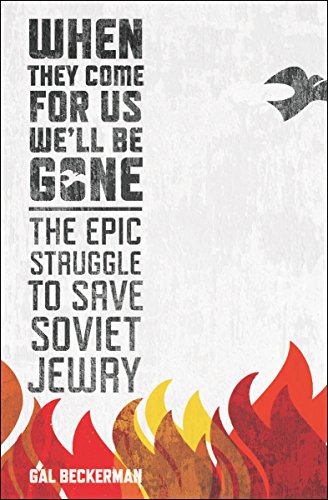
In this Passover season, we are reminded of the more recent “Let My People Go” in Jewish history — that of the rallying cry of the Zionist activists who defeated the Soviet superpower in the 20th century. Gal Beckerman’s 2010 history of the battle waged in the former U.S.S.R. and in the U.S. to rescue Russian Jews is titled “When They Come for Us, We’ll Be Gone: the Epic Struggle to Save Soviet Jewry.” It received much attention when released 10 years ago and still stands as the most successful book to cover the topic.
This is a time of worldwide resurgence of violent anti-Semitism, and this book’s portrayal of how grass-roots Jewish activists and community-based organizers joined to change the landscape of Jewish history is the exact type of inspiration needed right now. All who care about the Jewish future would benefit from re-examining Beckerman’s study.
Beckerman is a journalist, not a historian. In his book, he departs from the sanitized, establishment view of the fight for freedom and sheds light on many corners of the Soviet Jewry movement others purposely would have neglected.
Early in his narrative, Beckerman singles out the groundbreaking work of the Student Struggle for Soviet Jewry/SSSJ and Yaakov Birnbaum as the catalysts for the American side of the campaign. The lesson that Jewish students with little money and no political power can initiate change by working in a disciplined and smart way is a highly instructive one.
A careful reading of the book leaves one with the knowledge that these activists were inspired by the great pre-World War II Zionist leader Ze’ev Jabotinsky, on both sides of the Iron Curtain. More than that, these activists very often were at the forefront of the Soviet Jewry movement in the formative years of the struggle. Unfortunately, Beckerman draws no conclusions from this, and he seems mostly oblivious that adherents of Jabotinsky collectively made a more substantial contribution to the campaign than any other ideological grouping.
The book opens with a look at Yosef Mendelevitch and his fellow Riga-based activists. In this section, Beckerman illustrates it was the older Jabotinsky activists who, in the 1960s, inculcated in the younger Jews (who were Mendelevitch’s age) a new outlook: “By showing a young person a map of Israel, teaching him a few Hebrew songs, and exposing him to Jabotinsky’s essays, they could alter his sense of himself.”
On Mendelevitch himself, Beckerman writes, “The first piece of illegal writing Mendelevitch read, typed and loosely bound with a needle and thread, was a collection of Jabotinsky’s writings.”
In the depiction of the rise of SSSJ, Beckerman notes the central role Jabotinsky adherents played in Birnbaum’s efforts. This Jabotinsky connection repeats itself in America again and again. Later, when the 1965 creation of the first successful adult activist group, the Cleveland Council on Soviet Anti-Semitism, is covered, Beckerman relates “the group found inspiration in … Jabotinsky” — but he fails to make any connection to the Riga activists, who also were inspired by Jabotinsky four chapters earlier.
Later, when the Jewish Defense League’s part in the story is covered, Beckerman notes veterans of the Jabotinsky movement made up many of its early leaders and activists. However, again, he does not point out Jabotinsky was the decisive commonality in all these isolated groups and efforts.
Who was Jabotinsky? Ze’ev Jabotinsky (1880-1940), is a figure too often forgotten. He was a Zionist leader, orator and writer. He founded the Jewish Legion during World War I, as well as the Haganah self-defense units in Jerusalem in 1920. Prime Minister Benjamin Netanyahu’s father, Benzion, served as Jabotinsky’s personal secretary just after the outbreak of World War II.
What were Jabotinsky’s vital contributions? His words, deeds and ideas animated a generation of young Jews to resist the Nazis, rescue fellow Jews from Hitler’s forces, and fight for the freedom of Israel as soldiers in the Irgun and the Stern Group/LEHI. Later, Jabotinsky Zionists led the movement for freedom for Soviet Jewry in the United States and inside the Soviet Union.
Beckerman provides the evidence of the key role Jabotinsky’s devotees played in freeing Soviet Jews but does not present the much-needed closing argument. The book is uniquely inspiring to would-be young Zionist activists — it’s virtually a handbook for them — but the soul in the story is missing. And that is Jabotinsky’s exclusive brand, comprised of a blend of four ingredients: Jewish pride, street activism, devotion to duty and unapologetic Zionism.
Moshe Phillips is national director of Herut North America’s U.S. division. Herut sponsors the Zionist History Book of the Month project. “When They Come for Us, We’ll Be Gone” is the April book of the month. Learn more about Herut here.