Four years ago, Sherman Alexie’s film, “Smoke Signals,” became the first movie written, produced and acted by Native Americans. Today, Alexie’s new film, “The Business of Fancydancing,” might be the first to feature a character who is both Native American and Jewish.
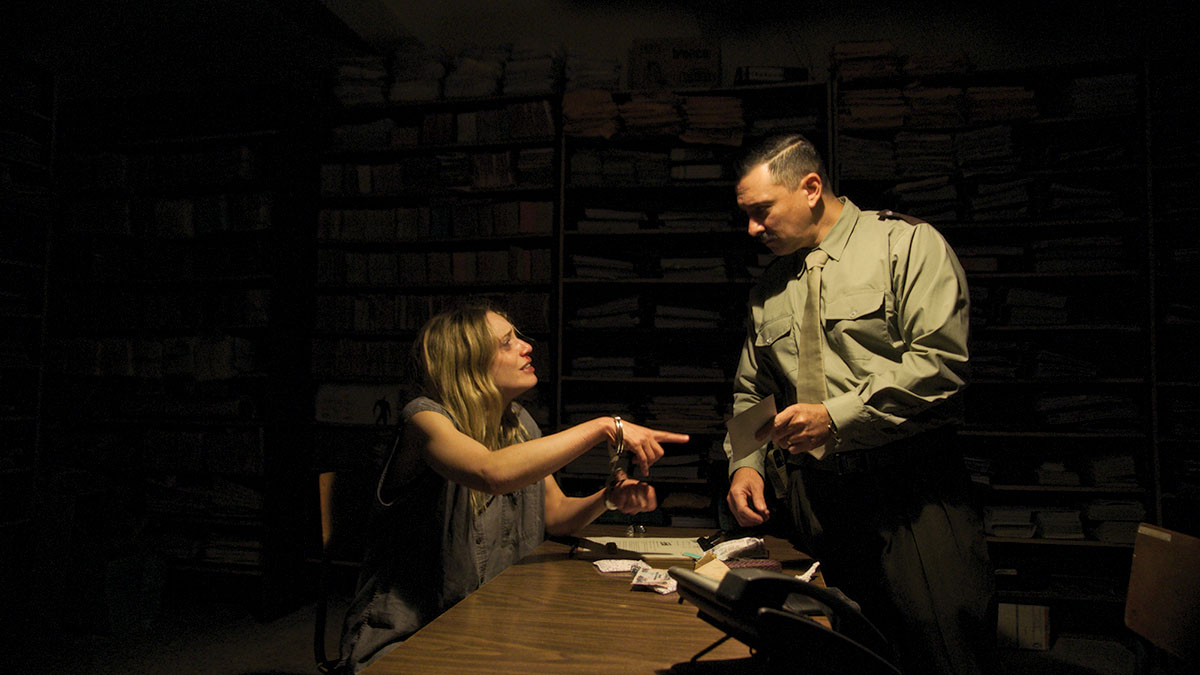
Written and directed by Alexie, the film explores the complexity — even the messiness — of personal identity. The film centers on the fictional Seymour Polatkin, a gay Native American poet who seems to turn his back on his reservation in exchange for artistic success. He moves to Seattle and partners with a Caucasian man, but his poetry remains focused on reservation life. Returning to the reservation for the funeral of his friend, Mouse, Seymour tries to determine where he belongs.
No less complex is the personal identity of Agnes Roth, Seymour’s former lover and the daughter of a second-generation Russian Jew and a Spokane Native American. An early scene is a collision of cultures as Agnes prepares Mouse’s body for his wake. As Native drumming and chanting resonate in the background, Agnes wraps Mouse in Native-design blankets, lights some sage, pauses, then opens a prayer book and recites “Kaddish.” Cut from the film were the more in-depth sequences interplaying images from the Holocaust and Native genocides.
Alexie wrote the part specifically for actress/vocalist Michelle St. John, who, like her character, is the daughter of a white Jewish mother and a Native American Christian father.
“Sherman asked me if I could think of something that would tie in the Jewish Indian thing. I thought, it’s a funeral, how about the ‘Kaddish?'” St. John said. “[My character has] chosen to move back to [the reservation] and assert her identity as a Native woman, but in that time of grief, what does she turn to? The Jewish thing.”
The scene is based on St. John’s memories of her grandfather’s funeral — where Jewish mourning rituals bumped up against Native American ones. “On the Indian side, you start cooking, because people are coming over. On the Jewish side, I was told I can’t come into the kitchen; I couldn’t touch anything,” St. John said. “How do I grieve if I can’t cook? ‘Kaddish’ became important.”
As an adolescent, St. John was aware that she was both Native American and Jewish, and that neither side of her heritage fit into her Canadian suburb. “Word had spread that this brown guy and Jewish girl moved in with a little brown kid,” she said. “We were the freaks of every neighborhood we moved into.”
During her 20s, St. John began to explore her Jewish roots, primarily through a friendship with a young Orthodox woman. But it was prejudice and racism that catalyzed St. John’s Native American identity. “The world was not going to perceive me as a nice Jewish girl from New York,” St. John said. “I came out brown, and that’s what people see first…. I’m a Native women — I’ve never been mistaken for Marla Lieberman.”
Today, St. John is examining her Native American and Jewish identities through a stage play called “The Scrubbing Project.” Written by St. John and two other Native women (one of whom is also Jewish), the play will premiere at Chutzpah Jewish Play Festival in Vancouver in March 2003.
“We all have scrubbing stories — twisted aspects of being a [mixed-blood] kid,” she said, recalling how she tried to scrub off her freckles because full-blooded Native Americans don’t have them. Another actor remembers pouring bleach into her bath water, attempting to look more like her white mother.
“No matter what parents give you to balance [yourself] in the world, a child can still look in the mirror, and say it’s safer to be white.”
Still, St. John says it’s sad how often her mixed identity confuses people. “I get tired of doling out the pedigree when I’m asked what I am,” St. John said. “I’m me.”