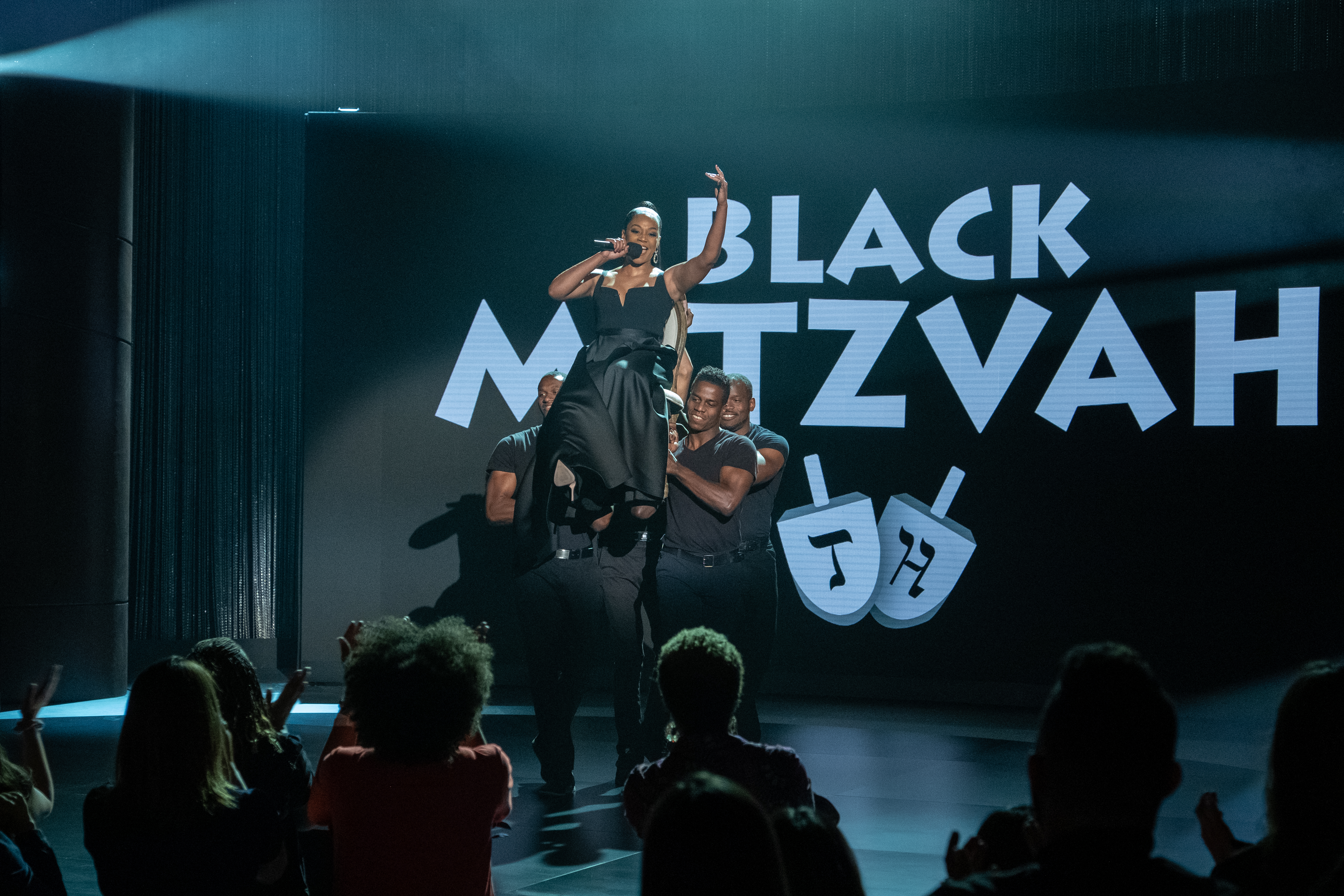
Some may wonder why actress and comedian Tiffany Haddish titled her latest Netflix stand-up comedy special “Black Mitzvah” and opens with a rap to the tune of “Havah Nagilah,” but she comes by the Jewish connections honestly. Although she did not grow up with him, Haddish’s father was an Ethiopian-born Jew and refugee from Eritrea, and she wanted to honor the Jewish heritage that she has come to embrace.
“The point of a bar or bat mitzvah is to be learning and applying the Torah to your life. I wanted to be an example to the world and to honor my father and my ancestors,” Haddish told the Journal. “I thought ‘Black Mitzvah’ would be a good way to say ‘I’m black, I’m Jewish and I’m a grown-up now.’ And maybe encourage others to pay attention to the Torah.”
A Los Angeles native, Haddish first met her father 13 years ago when she was 27, but learned she was Jewish 10 years earlier when she was hired to dance at corporate parties at bar and bat mitzvahs. “I didn’t even know what a bat mitzvah meant,” she said. But her grandmother encouraged her to take the job offer. “She said, ‘You need to get closer to your people. You have Jewish blood.’ So I started to learn and go to synagogue,” she said. “I think I know more about Jewish culture and religion than the average Jew in America.”
In “Black Mitzvah,” Haddish also tells stories about her difficult childhood and relationship with her mother and jokes about a variety of adult topics that may shock fans of her child-friendly ABC show “Kids Say the Darndest Things.” Her longtime fans won’t be surprised, “but the brand-new fans that just got on the bandwagon two years ago may be a little shocked,” she said, referring to those who’ve been fans since “Girls Trip” made her a star in 2017. She acknowledged that both sides are part of her.
“When I’m with my friends, I’m very blatant and honest,” she said. “I think it’s really healthy to speak it how you see it. When I’m with children, I’m letting them talk and giving them an opportunity to express themselves and nurturing their souls,” the one-time activity coordinator at a youth center said. “But there’s a time and place for everything. ‘Black
Mitzvah’ is for adults, not for children. It’s grown-up time.”
“I thought ‘Black Mitzvah’ would be a good way to say, ‘I’m black, I’m Jewish and I’m a grown-up now.’ And maybe encourage others to pay attention to the Torah.” — Tiffany Haddish
Haddish first realized she had a flair for comedy at age 9, when her mother suffered a brain injury in a car accident and couldn’t care for her. “I went into foster care and the girls were going to beat me up so I cracked jokes about myself and they didn’t mess with me. I was able to use comedy to deflect,” she said.
https://www.facebook.com/JewishJournal/videos/2479224819021676/
Her mother had become violent toward her, “and if I could make her laugh and turn her anger into some joy, I was less likely to get beat. Same thing in school: If I could make the kids laugh, they’d help me with my homework and protect me from other bullies. It was like a super defense mechanism — like a gun but way safer,” she said. “I’ve learned how to wield jokes like a weapon. You can destroy somebody’s spirit or you can lift them up and change their whole life. I choose to do the latter.”
Currently, Haddish has four movie comedies and a Netflix miniseries about self-made millionaire Madam C.J. Walker in the works, and she handles everything by scheduling her time, taking care of herself (including exercise) and knowing her limits. She’s grateful that success came later in life, “because I know when to say ‘no’ now. I was not ready in my 20s. I was not mature enough to handle the workload,” she said.
Haddish, who won an Emmy in 2018 for hosting “Saturday Night Live,” is now nominated for a Grammy for the audiobook version of her memoir “The Last Black Unicorn.” Of all her projects so far, she is proudest of “They Ready,” her Netflix comedy showcase that premiered in August. “I was able to give an opportunity to other comedians and it fills my heart with joy because it changed their lives,” she said. “I see them living their dreams now and that makes everything worth it.”
In the future, she’d like to run her own production studio like Lucille Ball and Tyler Perry and play characters like Amelia Bassano, a part-Jewish 16th-century poet and member of the British royal court. “Just like the Torah tells stories that are passed down from generation to generation, I’d love to create movies that tell stories from all over the world. I don’t necessarily need to star in everything. I’d like to give other people opportunities to be stars.”
Coinciding with “Black Mitzvah’s” debut on her 40th birthday on Dec. 3, Haddish planned a bat mitzvah ceremony and party to celebrate. “Sarah Silverman’s sister is my rabbi. She’s flying in from Israel,” she said. She’s also looking forward to celebrating Hanukkah with friends. She loves to cook for them and she celebrates their success as much as her own.
“When I see my friends winning, it makes me really happy,” she said. “I’m usually happy when I wake up in the morning. I’m always super grateful because I know that every day is a gift.”
“Black Mitzvah” is now streaming on on Netflix.