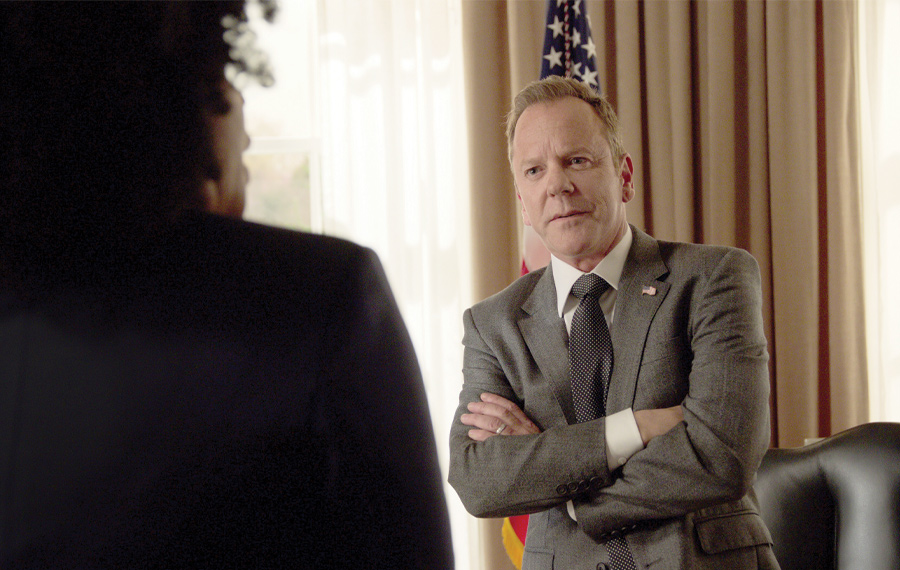
When “Designated Survivor” premiered on television in 2016, it began with a bang — literally. A terrorist bombing at the Capitol made low-level Cabinet member Tom Kirkman (Kiefer Sutherland) president by default, and the first two seasons on ABC followed his struggles on the job. Moving to Netflix for its 10-episode third season, the drama follows Kirkman’s campaign to remain in the Oval Office while dealing with foreign, domestic and personal crises.
“[Kirkman] is running for president, so he must swim in the muddy stream of politics,” Neal Baer, the series’ new showrunner, told the Journal. “Can he, as a man of honor and dignity, integrity and valor, maintain his beliefs and his ideals and not get dirty? These elements are profoundly in conflict in our fictional world and in the world we’re living in now. Can we have politics that are honest? Can we have civility in the way that we address one another in the political realm? That is the through line for this season, and we see him getting challenged more and more. He’s very conflicted throughout
the season.”
Season 3 also introduces several new characters. Anthony Edwards (“ER”) plays new White House Chief of Staff Mars Harper; Lauren Holly is his opioid-addicted wife, Lynn; and Julie White, a Tony Award nominee for “Gary: A Sequel to Titus Andronicus,” plays Kirkman’s campaign manager, Lorraine Zimmer. There is at least one major, shocking death.
Baer and his writing team have raised the intensity level with compelling stories about bio-terrorism, the opioid epidemic, LGBTQ issues, euthanasia, privacy issues in DNA testing, HIV, access to and the high cost of health care, and pharmaceutical companies profiting from painkillers. “Every character has his or her own story that is very personal and has a political element,” Baer said. “What I love about telling these stories is it allows us to at least put them into the public consciousness.”
The preponderance of medical topics explored is not coincidental. A graduate of Harvard Medical School, Baer completed an internship in pediatrics at Children’s Hospital Los Angeles before becoming a producer on “ER” and “Law & Order: SVU.” Coming from broadcast TV, he calls the freedom of a streaming service “like utopia.”
“On Netflix, episodes don’t have to adhere to specific lengths, there’s no need for cliff-hanger act breaks for commercials and no censors,” Baer said. “It is amazing to hear Tony Edwards say the F-word.”
Adding real-world verisimilitude, Baer hired documentary filmmakers Patrick Creadon and Christine O’Malley to interview people on issues the characters are dealing with “to illustrate these stories in a fresh way.”
For Baer, being a storyteller is both a conduit for his curiosity about the world and his interest in issues that matter to him. As a man who was married, had a son and came out as gay just six years ago, he brings that perspective to the writers’ room. There are plotlines involving Kirkman’s sister-in-law, a transgender character, and two gay African American males, one of whom is HIV-positive but
not infectious.
Born into a “secular and very liberal” Ashkenazic family in Denver, Baer grew up in a gentile neighborhood and felt like a double minority. He attended Hebrew school and became a bar mitzvah, but only to please his parents. “I knew I was gay when I was 4 years old, but I didn’t want to be gay. To say, ‘Today I am a man’ meant I’d have to accept some things that I just didn’t want to accept about myself,” he said.
“I [now] embrace what Judaism stands for,” he added. “There are two LGBTQ shuls in L.A. I’ve been to both. I’ve never been to Israel, but I’m thinking about going
this summer.”
Always interested in science, Baer gravitated toward medicine as a way to spend time with his surgeon father, joining him on hospital rounds. “I wanted to please him and wanted him to accept me,” Baer said. “I decided that the best way to do that would be to go to the best medical school.”
His transition into showbiz came courtesy of producer-director John Wells, an elementary school friend who gave him a job on “ER.” He considers being part of that influential show and “SVU” his proudest accomplishments to date other than his son, Caleb, a photographer and recent college graduate with plans to go to law school.
Baer, who is writing a play, also remains passionate about medicine and education. “I have an academic appointment at UCLA in the field of public health and I’m teaching for a week at Harvard in the fall,” he said.
Whether there will be a fourth season of “Designated Survivor” isn’t known, but the new season’s final episode positions it perfectly. “The show has twists and turns that people enjoy, the characters’ struggles will captivate them and it’s all against a background that is very relatable to today’s issues,” Baer said. “I think what they’ll come away with is some surprising stories that they knew nothing about. If I had one thing to hope for, it’s that the show encourages more empathy and more discussion about these very difficult topics that we’re facing.”
“Designated Survivor” begins streaming June 7 on Netflix.