

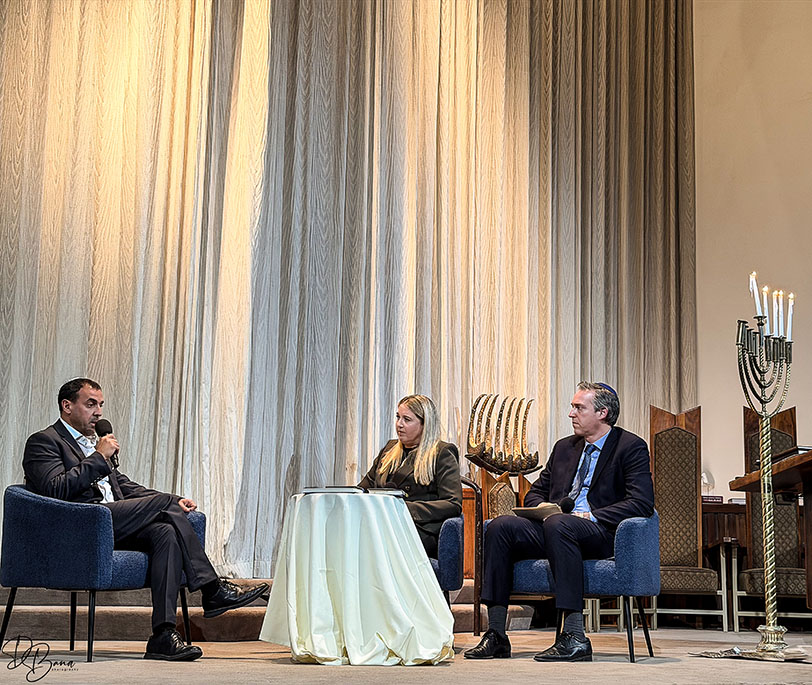
Eli Sharabi, a 52-year-old former hostage who spent 491 days in Hamas captivity in Gaza, shared his story with a packed Sinai Temple audience on Dec. 18. It was part of a book tour Sharabi is doing for his new book, “Hostage” (HarperCollins), which just became a New York Times bestseller.
For almost an hour, Sharabi recounted vivid, haunting moments in the hours following the initial terrorist attacks at Kibbutz Be’eri, beginning at 6:29 a.m. on Oct. 7, 2023. Sharabi shared some of the most horrifying details from the moment he was abducted into Gaza.
“After about half an hour of a slow drive, we arrived at our first stop — in a mosque,” Sharabi told the crowd, many breaking their stunned silence with groans. From day one in captivity, Sharabi and his fellow hostages were shackled together, iron chains on their legs. He would remain shackled for the next 485 days. They’d go months at a time without the privilege of brushing their teeth or bathing (only a bucket of cold water and soap). The Hamas terrorists demanded that they shave all of their body hair. They were fed a diet of rice and half a pita at most once a day. They faced a looming threat of beatings every time they had to use the toilet.
Sharabi also talked about the rotating cellmates, and how he could speak Arabic with the captors. He would take on a father-figure role with his fellow captives.
“The first day we arrived at the town I was 51 years old then, and the six other hostages were between 10 and 27,” Sharabi said. “They’re all half of my age. So I understood the role I’m going to take there almost immediately.”
Rabbis Erez Sherman and Nicole Guzik of Sinai took turns asking Sharabi questions. The husband-wife duo have held joint discussions and sermons during their three years as co-senior Rabbis, but never an interview together.
“Eli asked us before we went out to begin the conversation, ‘are you excited?’” Guzik told The Journal. “And [Sherman and I] looked at each other and we thought, ‘no, we’re not excited to do this, we are honored and we think it’s incredibly important to the witnesses to his story and to the other stories of the freed human beings, the freed Jews, the freed of hostages who are willing to share their stories.’”
The couple read Sharabi’s book and came up with questions separately. They were astounded at how similar their respective lists of questions were: “describe relationships with specific captors,” “what was the role of prayer and ritual during captivity,” “tell us about normal life in Kibbutz Be’eri.”
The one time Sharabi had tears well up in his eyes was when he talked about when he thought about his wife, daughters and brother during the 491 days.
“To see him tear up, while we know that he tells these stories day after day after day,” Sherman told The Journal. “He was also tearing up from the emotions that were coming from the audience, from the people that were around him. Afterwards he said to us, ‘so how are you?’ How am I? Imagine what he was like, all alone with those kids in the tunnels.”
For the duration of the 16 months in captivity, Sharabi didn’t know who from his family and kibbutz was even alive.
One of the 2,000 attendees at Sinai that night, Lauren Rosenthal, came all the way from Irvine to see Sharabi. Since Oct. 7, 2023 Rosenthal and her friends had been “in a constant state of anxiety” for the return of the hostages, all the way through the release of the last living hostages on Oct. 13, 2025. On the night of Sharabi’s release, Feb. 8, 2025, Rosenthal and her friends stayed up all night awaiting to see which hostages would be returning. They were shocked at Sharabi’s condition, and heartbroken about how he would soon find out his loved ones’ fate.
“I remember he walked into the hospital wrapped in an Israeli flag, but then only in seeing him there with his mom and his sister,” Rosenthal told The Journal. “Of course he had his mom and his sister, but us watching this live on TV, we knew everyone else that had died that Eli thought would be there waiting for him.”

There was a collective amazement among the attendees, that Sharabi, the emaciated man who upon his release was only 94 lbs. (down from 154 lbs. when abducted by Hamas), but is now suited up, a New York Times Bestselling author and speaking to a congregation on Wilshire Boulevard in Los Angeles.
Another sentiment felt at the event was that Sharabi’s miracle survival story was being shared on night four of Hanukkah. Before speaking, Sharabi lit the fourth candle on the five-foot tall menorah on the bimah.
“Eli Sharabi is an inspiration and a light whose presence elevates the world around him,” fine art photographer and photojournalist Debbie Banafsheha told The Journal. “To have met Eli on Hanukkah, a celebration of light and miracles, feels profoundly meaningful, truly a moment I will never forget.”
The event was also a fundraiser for Ma’agalim, an Israel-based nonprofit that offers mentorship and support for at-risk and disadvantaged Israeli youth.
“Eli is here as an ambassador of the Jewish people to the world,” Ma’agalim founder and CEO Assaf Weiss told The Journal. “Hamas didn’t take Eli from his house because he was Eli Sharabi, the person, they took him because he was a Jewish man.”
Since Oct. 7, the need for supporting traumatized and unstable youth around Israel “has only deepened,” Samuel Franco, executive director of American Friends of Ma’agalim said in his remarks before introducing Sharabi. “All of Israel has been affected, but this population has been affected even more. We have a long waiting list of schools across Israel waiting for us to hire and train more mentors, waiting for us to reach teens, crying out for the stability and guidance they need.”
Ma’agalim’s mission reassured the crowd that their efforts from afar matter so much to individual Israelis who are struggling. Sharabi concluded the night commending Diaspora support for hostages coming home and showing solidarity with the people of Israel.
“To see their solidarity with the Israeli state and with Israelis, it’s very moving. You almost can’t understand that people hold your photos thousands of miles away from Israel and are praying for you and for your release. It’s amazing. So I’m grateful. I’m grateful for you people.” – Eli Sharabi
“So many people stopped their lives to support my family,” Sharabi said. “Then I found about the hundreds of thousands of Israelis that went out to the streets — marching and praying for us — people that you never knew and they cared for me and supported my family. It was amazing to understand all this. Then I started to go abroad to speak to prime ministers and parliament members and presidents and dozens of Jewish communities, loads and loads of Jewish people. To see their solidarity with the Israeli state and with Israelis, it’s very moving. You almost can’t understand that people hold your photos thousands of miles away from Israel and are praying for you and for your release. It’s amazing. So I’m grateful. I’m grateful for you people. Because of that, I’m waking up every morning and choosing life because I don’t have the privilege to stay in bed and cry all day — because of this love.”


































