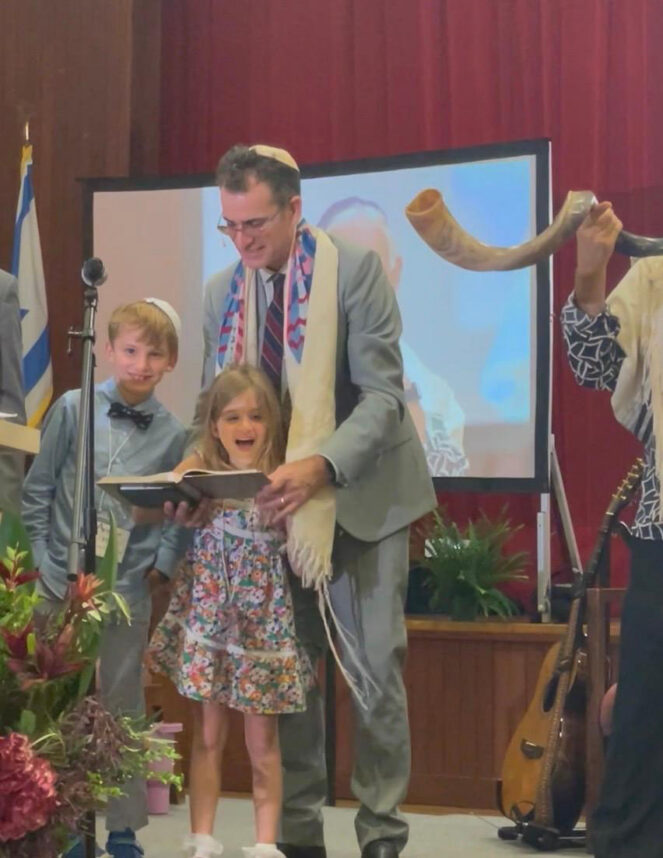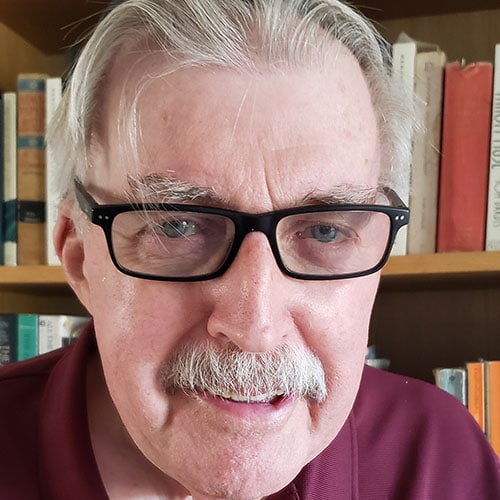

When Rabbi Refael Cohen first saw Sephardic Temple Tifereth Israel, he felt a kinship with the over 100-year-old congregation. “Wow,” he thought, “this could be the place for me!”
That’s quite a statement, especially since he’s traveled to “almost all of the Sephardic communities around the world.” So after 25 years of circling the globe, the 51-year-old Cohen, his wife, Michal and their four children settled in last June at the sprawling temple at the intersection of Wilshire Boulevard and Warner in Westwood.
This is not his first American congregation. In addition to serving communities in Tucuman and Córdoba, Argentina and in Cali, Colombia, he also spent a year in Cherry Hill, NJ. There have been numerous working trips to Israel.
Cohen’s parents are from Iran, and he grew up in the religious community of B’nai B’rak. “I am an Israeli,” he says proudly. In Israel, he studied law and was a leader at Jerusalem’s prestigious Shehebar Sephardic Center in the Old City, where he served as executive director, training rabbis and placing them around the world. “I had a fabulous, fabulous experience,” he enthusiastically noted, pointing out the importance of working with (Shehebar’s founding) Rabbi Kassim and having the chance to “travel and be in contact with Sephardic communities all over the world.” He was sent to Bogota, Columbia, where he opened a kollel where none of his students were religious. But, he said with a smile, “they loved being there, and they loved to study.”
“I am very much focused on growing the Sephardic Temple. My slogan is Make the Sephardic Temple Greater Again.”
But now, he says, “my habitat is between Manning and Warner. I am not interested in the inner workings of other communities. I am very much focused on growing the Sephardic Temple. My slogan is Make the Sephardic Temple Greater Again.”
Before Cohen arrived, he said, “the Sephardic Temple was an unbelievable community, and then they suffered a decrease of members. Original members disappeared.”
He does not know exactly why this happened. “I asked everyone – Turks, Greeks, Persians —where are their children? They disappeared. No one could give me accurate information.”
His assessment of the Persian community was equally frank. “They are “not making enough effort. There is a core group coming that is supportive, giving and doing, but it is not enough.”
Did Cohen have specific targets when he landed in Westwood? “Yes, I am very goal-oriented. My goal is to increase the number of people who want to be part of the Sephardic Temple, an active part. Another goal is to infuse more concepts of Torah and Judaism to the people.”
How will he know if he is succeeding? The rabbi rejected the notion that a head-count is an appropriate yardstick. “Forget numbers,” he said. “This is not just to help members. We are not a football club.”
What counts as success is “to transmit teaching.”
He pulled out his phone and found a What’s App link for an example.
“Dear Rabbi Cohen, I don’t know how to thank you. I don’t have the words. You have done so much for me and my family. We are so blessed. Beyond words. I never have been so lucky in my life to go to a rabbi with a problem, and he made a miracle. You entered our congregation with an open heart, and you have shown us what a true rabbi is.”
He scrolled to another What’s App note: “Thank you for my miracle.”
After the notes were read aloud, Rabbi Cohen responded, “I felt my way to be is for the people.”
To get an idea of Rabbi Cohen’s commitment to his congregation, earlier this year, he was scheduled to return to Israel to be with his family, and expected to stay until after Yom Ha’atzmaut.
However, he also is a mohel, and Rabbi Cohen had promised a friend that he would be present for his grandson’s brit milah.
The rabbi did not keep track of the date. When his friend contacted him to say the brit milah would be the day before Yom Ha’atzamaut, the Rabbi asked how he knew. Because the mother-to-be would have a C-section, he was told.
Instantly, the rabbi spun into action. “Took me two hours to cancel all programs in Israel and to be back here on time,” he said with a smile.
“For me, the friendship, the appreciation of people in the community, is huge.”
Fast Takes with Rabbi Cohen
Jewish Journal: What is your favorite Jewish food?
Rabbi Cohen: “It’s Persian: Eggplant with sauce and rice.”
JJ: What is your favorite music?
Rabbi Cohen: “Classical – I like Bach.”
JJ: What is your favorite time of year?
Rabbi Cohen: “Springtime.”