fbpx

May 25, 2023

How to be a Good Jewish Lover: The Basics

In her senior year of college, my wife fell in love with a fairly sedentary journalist; now she’s married to a fairly active rabbi.

In some ways, I’m the same person I was 25 years ago; in other ways, I’m really not. I’ve grown and changed in our time together and so has she. In many important ways, we aren’t the people we were when we met – our interests have changed, our bodies have changed, even our names have changed. Our relationship, however, has endured all these changes and many more.

As we’ve stumbled and risen again, we’ve come back to a few simple practices that form the basis of our life together as well as the work I do with couples preparing for marriage. These are not the practices of saints; they are the practices of two flawed, imperfect, inconsistent humans who work every day to love each other a little bit better than we did yesterday. These are the three foundational practices we rely on the most:

Know your Partner

It might seem obvious, but we need to really know our partners. The Hebrew Bible uses the same word to indicate physical and emotional intimacy because the same practices that make a good lover in bed are the same practices that make a good lover out of bed. A good lover gets naked, which is to say, gets vulnerable, so our partner can see us fully, in our insecurity and perceived flaws; practices tenderness, and is only ever gentle and loving with the most sensitive and vulnerable parts of our partner’s body and their psyche; and cultivates curiosity, recognizing that there really are different strokes for different folks, and what turns them on – in bed or out of it will necessarily turn their partner on.

Pioneering relationship therapists John and Julie Gottman write that “knowledge of our partners, as they are now, is the foundation not only of love, but of fortitude to weather the storms all couples inevitably face.” Sometimes, it can be easier to know our partner’s body than it is to know their soul. A good lover cultivates knowledge of both by getting naked, getting tender and getting curious.

Embrace Imperfection

The Jewish tradition teaches that the world could not stand without teshuva, without the ability to recover from life’s inevitable disappointments. Any two people who love each other will frustrate and fail each other at times – that’s practically a given in human relationships. The real question is what to do with that frustration – we can tally our partner’s shortcomings and use them to tear each other apart, or we can cultivate teshuva, or an orientation towards repair, and forgive our partners’ failings and accept their forgiveness of ours. The greatest gift that two partners can give each other is acknowledging flaws and places where work is needed, and loving them anyway. Your relationship is more than the sum of your problems.

Commit to Maintenance

Any complex system has imperfections that need to be addressed through ongoing maintenance – this is true of car engines, this is true of organizations and this is true of relationships as well. I strongly encourage every couple I work with to commit in their ketubah, or marriage covenant, to regular and frequent times to talk with each other. This is not a date or pre-bed conversation; this is a weekly opportunity to center our partner’s reality, and listen to their hopes and frustrations on their terms, not ours. It is also an opportunity to hear from our partners in a calm and deliberate way about the way we have (inevitably – see above) fallen short and make amends.

These three rules are not magic, nor is this a comprehensive list of best practices in a relationship. In my life and the lives of the couples I work with, I have found that these practices can provide a foundation for the grace and respect that are necessary for any relationship between humans to thrive.

The Jewish tradition teaches that when a relationship is weak, we can live in the lap of luxury and be miserable, but when it is strong, we can deal with any adversity, even a bed as narrow as a sword.

Strong marriages aren’t frictionless; strong marriages have deliberate practices that allow for complicated, fallible people to be in relationship with each other.


Rabbi Brent Chaim Spodek is a member of the faculty at Pardes North America and the host of Good Jewish Lover: The Torah of Relationships. He lives with his family in New York’s Hudson Valley where he has also been the rabbi at Beacon Hebrew Alliance since 2010.

How to be a Good Jewish Lover: The Basics Read More »

Without Loyalty, Judaism Disappears

Shlomo Carlebach would relate an anecdote about his visits to college campuses in the 1970’s. After finishing a concert, he would ask the students he met what religion they were.  Some would say they were Roman Catholic, while others would say they were Protestant. But other university students would answer his question by saying, “I am a human being.” To which Carlebach would immediately respond: “you must be a Jew!”

The answer these students gave is not at all new, and echoes the words of the ancient philosopher Diogenes who, when asked where he came from, would declare “I am a citizen of the world.” This view is even more seductive now that we live in a global village, and what happens anywhere is broadcast everywhere. To identify with one small group feels parochial and narrow.

The Book of Ruth presents a dramatically different view than Diogenes, and offers a seminar on the importance of loyalty, of staying close to those who are closest to you.

The narrative of Ruth begins with an estrangement, a failure of loyalty. During a famine, a man named Elimelech and his family leave Israel and go to the plains of Moab. From later passages in the book, Elimelech’s prominence becomes clear; yet during a crisis, he chooses to leave his community behind to find greener pastures for himself. Rashi condemns Elimelech’s behavior and writes: “He was very wealthy, and the leader of the generation. He left Israel for a foreign land because of his stinginess, for he was miserly toward the poor who came to beg from him; therefore Elimelech was punished.”

Tragedy ensues. Elimelech dies, and his two sons, who then marry Moabite women, die as well. Naomi, Elimelech’s widow, decides to return to the land of Israel and to her hometown of Bethlehem. As she leaves, Naomi is accompanied by her two Moabite daughters-in-law, Ruth and Orpah. Mid-trip, Naomi stops and implores her daughters-in-law to return to their parents’ homes, because there’s no future for them in Israel.

Orpah accepts her mother-in-law’s advice, and tearfully bids her farewell. But Ruth refuses to go. She remains at Naomi’s side, even though her mother-in-law has excused her, and exhorted her to leave. In two short sentences,(Ruth 1:16-17,) Ruth expresses a profound depth of loyalty: “Don’t urge me to leave you or to turn back from you. Where you go I will go, and where you stay I will stay. Your people will be my people and your God my God. Where you die I will die, and there I will be buried. May the Lord deal with me, be it ever so severely, if even death separates you and me.”

In a comment that further highlights the theme of loyalty, the Midrash finds fault in Orpah’s behavior. It connects her name to the Hebrew word oreph, the back of the neck. In the Midrash’s view, Orpah is too quick to turn her back on Naomi, especially when her own sister-in-law continues forward.

Ruth’s loyalty to her mother-in-law is all the more remarkable considering that she is a Moabite, from a nation that descended from Lot, Abraham’s nephew. Lot and Abraham share the journey from Aram to Canaan, then to Egypt and back. They are truly like brothers. But then they separate over a business dispute.

This separation grows deeper with time. After the Exodus, when the Jews are journeying from Egypt to the land of Israel, the Moabites refuse to offer them water and even engage Balaam to curse the Jews. Ruth’s lineage is from a nation who have turned their backs on Abraham’s family, which makes Ruth’s loyalty all the more remarkable.

The conclusion of the Book of Ruth is intertwined with two legal institutions that obligate relatives to help out their kin. One is yibum, the levirate marriage. When a man dies childless and leaves behind a widow, the brother of the deceased has an obligation to continue that man’s name and marry the widow. Marrying the widow to a family member, (who then has children with her,) ensures that the deceased brother will always be remembered, and his name will be carried on. (In the Book of Ruth, this legal institution is extended to include a close relative, Boaz, as well.)

The second institution is the redemption of a field. The Bible explains (Leviticus 25:25) that “If one of your fellow Israelites becomes poor and sells some of their property, their nearest relative is to come and redeem what they have sold.” This repurchase carries profound significance. In an agrarian society, identity is rooted in the land itself, which is transferred from generation to generation; when relatives repurchase these fields and return them to impoverished members of their family, they have returned them to their roots and given them dignity.

Both of these legal institutions are founded on the importance of loyalty, and reflect the unique obligations one has towards a close relative.

In the final chapter of the book, two men are confronted with these obligations: Boaz and Ploni Almoni  (a pseudonym that means “anonymous.”) They are the ones who must redeem Naomi’s fields, and marry her widowed daughter-in-law Ruth. The anonymous Ploni Almoni is given priority because he is the closest relative; but he refuses, saying (according to the interpretation of Ibn Ezra and Ralbag) that he’s worried about a cash crunch, that if he acquires the new field he won’t have enough money to hire workers for all his properties.

Ploni Almoni puts his individual needs above his responsibility to his kin; and he remains anonymous to history, like a faded flower, like whirling dust. It is Boaz, who is loyal to his family and community, who together with Ruth becomes the foundation of the house of David, and the future of the Jewish nation.

The Book of Ruth’s emphasis on the obligations of loyalty contrasts sharply with a staunchly universalist ethic, which sees preferential love for a particular community as narrow and self-centered.

While moral universalism correctly demands that we treat everyone with dignity and justice, loyalty demands that we go a step further and make substantial sacrifices for kinfolk and compatriots. The moral argument for loyalty is grounded first in reality; to care about everyone is to care about no one in particular. Without preferential love, even basic relationships are impossible. Richard M. Hare pointed out that, even for universalists, If mothers had the propensity to care equally for all the children in the world, it is unlikely that children would be as well provided for even as they are. The dilution of the responsibility would weaken it out of existence. But the Book of Ruth goes further, well beyond a pragmatic acceptance of loyalty; instead, it celebrates the spiritual power of commitment.

Rabbi Dr. Samuel Lebens, in his book A Guide for the Jewish Undecided, sees Ruth’s conversion as a paradigm of authentic Jewish belief. Our identities always shape our perspective, or as Lebens puts it, “it is what makes reasoning possible to begin with.” He points out a fascinating contrast between the conversion of Ruth, (the only one found in the Tanakh,) and the conversion of Paul in the New Testament. As it is described in the Book of Acts, Paul comes to Christianity after he sees a grand vision on the road to Damascus, and suddenly the scales fall from his eyes. In contrast, the conversion of Ruth is founded on personal connection and familial love. On the road to Bethlehem, Ruth perseveres in her love for Naomi; and that draws her close to God and the Torah. It is her decision to commit to the Jewish people that transforms Ruth.

Faith grows out of our commitments, which is why the Book of Ruth is read on Shavuot. At the foot of Mount Sinai the Jews pledged “naaseh v’nishmah,” “we will do and we will listen.” In other words, the Jews were pledging to loyally follow God, and by doing so, understand the spiritual value of the Torah. Enlightenment is the product of one’s commitments. And so it was with Ruth.

But like the Carlebach’s college student, many young Jews find loyalty to be difficult. They have grown up in what psychologists call a WEIRD culture: Western, Educated, Industrialized, Rich, and Democratic, which, as Jonathan Haidt explains in The Righteous Mind, devalues loyalty. Calls for loyalty are often met with suspicion and derision. Even some young rabbis struggle with loyalty; they will dither in response to terror attacks and conflict in Israel, worried more about political implications than personal commitments.

It is not surprising that as the Jewish community becomes more immersed in a WEIRD culture, loyalty has diminished, as well as our community’s connection to Judaism and the Jewish people.

But on the road to Bethlehem, Ruth chooses loyalty. And that has made all the difference.


Rabbi Chaim Steinmetz is the Senior Rabbi of Congregation Kehilath Jeshurun in New York.

Without Loyalty, Judaism Disappears Read More »

Beit Issie Shapiro Fundraiser, Andy Cohen, MDA Paramedic in Los Angeles

Viktor Frankl, the famed Jewish-Austrian psychiatrist and Holocaust survivor, said, “The more one forgets himself — by giving himself to a cause to serve or another person to love — the more human he is.”

On May 16, an in-person fundraising event for American Friends of Beit Issie Shapiro brought Frankel’s words to life.

Beit Issie Shapiro is Israel’s leading developer and provider of innovative therapies and state-of-the-art services for children and adults across the entire range of disabilities, impacting over half a million people annually. As pioneers in Israeli innovation, they improve life quality and ensure the full rights of people with disabilities and prepare them to participate in community life. Their work benefits Jews, Arabs, and many others around the world.

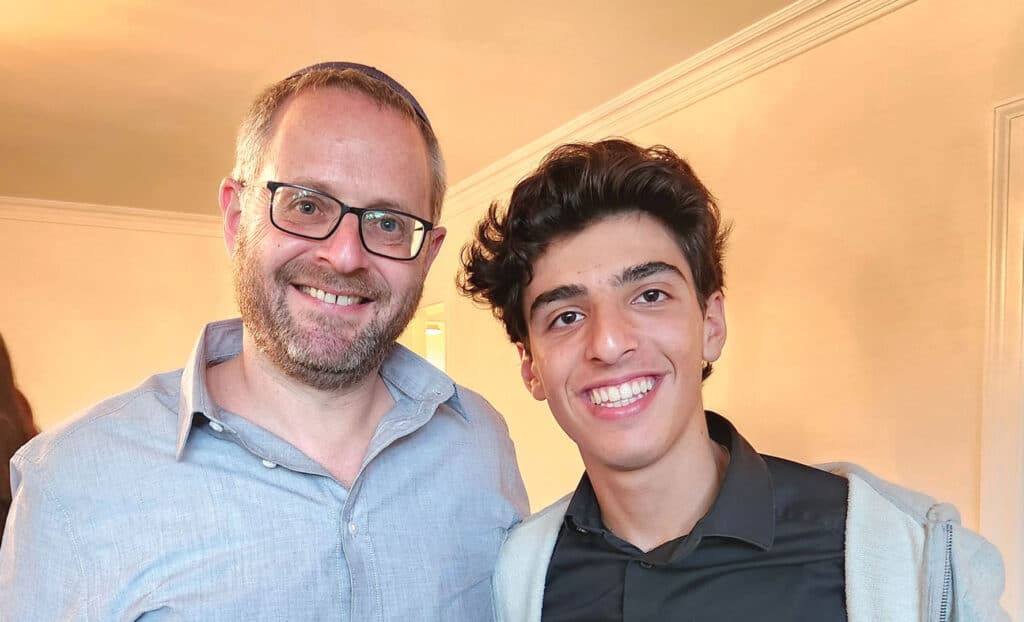
The small, intimate gathering of friends and family occurred at Dr. Ario and Rama Fakheri’s residence in Encino. Their son, Isaac, selected this organization for his Bar Mitzvah philanthropy project.

Through the introduction and video presentation of Chief Advancement Officer Michael Lawrence and American Friends of Beit Issie Shapiro-West Coast Vice President of Philanthropy Soraya Nazarian, the attendees learned first-hand about the impact and meaningful value of this noble organization on people with disabilities worldwide.

The event came together beautifully; simple, warm, and homey. There were no charity awards, tournaments, walk-a-thons, galas, or prizes. It was a memorable charity event. Seeing the Beit Issie Shapiro Teen Ambassadors at the event was also impressive. They were among about 40 attendees.


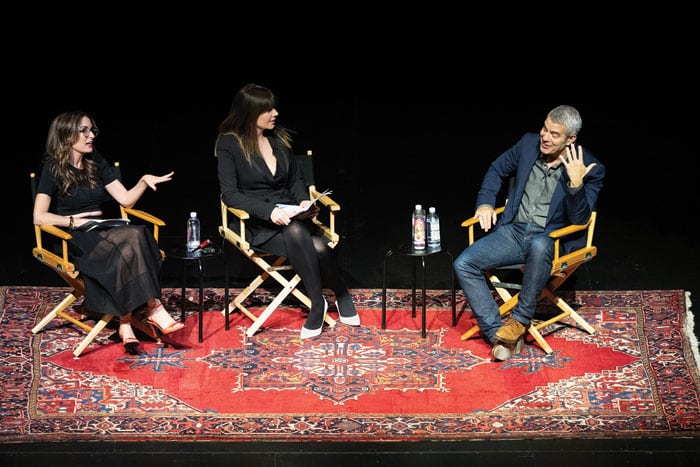
From left: Danielle Schneider, Casey Wilson and Andy Cohen appeared in Los Angeles. Courtesy of Live Talks Los Angeles

Jewish television personality Andy Cohen appeared in Los Angeles on May 18 to promote his new memoir, “The Daddy Diaries: The Year I Grew Up.”

Cohen, host and executive producer of Bravo’s “Watch What Happens Live,” appeared at the Aratani Theatre downtown as part of the “Live Talks Los Angeles” speaker series.

Cohen appeared in a lively conversation with writer-performer Danielle Schneider and actress Casey Wilson. Before a crowd of hundreds of people, the three discussed the many scandals and juicy happenings involving stars of Bravo’s much-watched reality TV programs. They also delved into the fun passages of Cohen’s newest book.

During a Q&A, when an audience member asked about Jewish representation on Bravo, Cohen replied that he felt positively about how Jews are portrayed on the cable network’s shows. He said he routinely speaks out against antisemitism and there will even be a new Jewish cast member on the upcoming season of “The Real Housewives of New York City.”


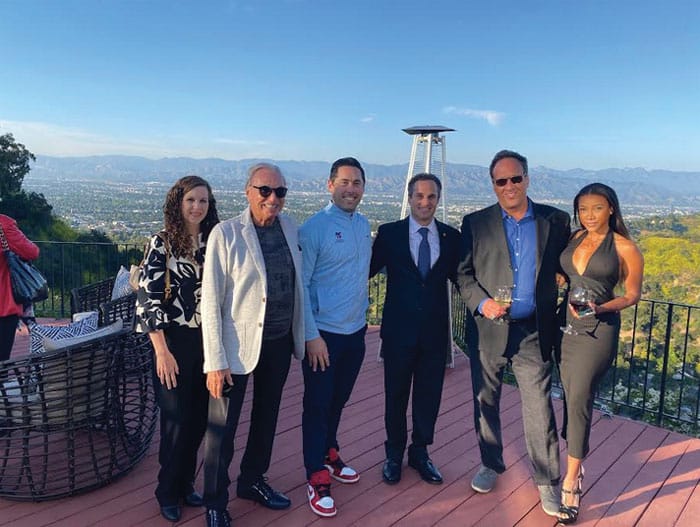
Jewish community philanthropist Barak Raviv (fourth from left) hosted the event with AFMDA at his home. Courtesy of American Friends of Magen David Adom
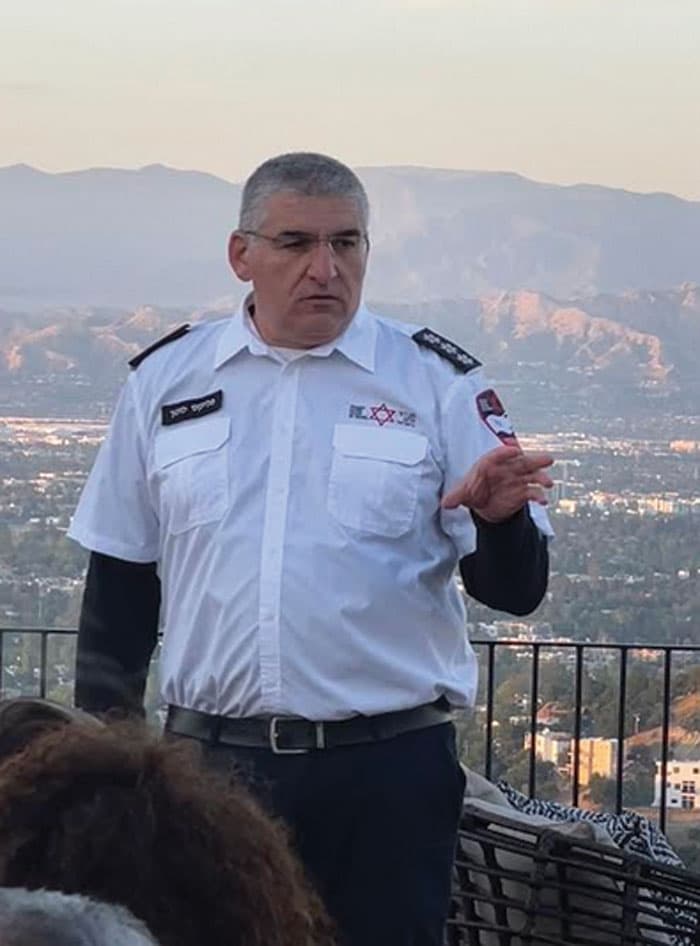
Magen David Adom Senior Paramedic Felix Lotan. Courtesy of American Friends of Magen David Adom

Felix Lotan, head of Magen David Adom’s disaster preparedness department and a senior paramedic, addressed an intimate crowd of approximately 30 Magen David Adom donors at the Beverly Hills home of Indre and Barak Raviv.

Held May 16, the event was organized by American Friends of Magen David Adom, the U.S.-based fundraising arm of the Israel-based organization. The goal was to increase awareness about the work of MDA, Israel’s national emergency medical service and representative to the International Red Cross.

The organization relies on donor support. Historically, American supporters have sponsored the majority of MDA’s emergency vehicle fleet.

“Without philanthropists like you, MDA could not exist,” Lotan told the crowd assembled in the backyard in Beverly Hills.

The MDA paramedic spoke about his involvement in several of MDA’s international relief missions, including in Turkey, Haiti and Nepal, following devastating earthquakes in those regions.

“We’re not only doing EMS [emergency medical services] things,” Lotan said. “We’re doing humanitarian things as well.”

Beit Issie Shapiro Fundraiser, Andy Cohen, MDA Paramedic in Los Angeles Read More »

‘Shadows We Carry’ Shows the Repercussions of the Holocaust and the Feminist Movement of the 1960s

Every year, new movies, plays and books about the Holocaust come out. However, not many of these works focus on what happened to people after the Holocaust. How did it affect the survivors? How did families come to terms with what happened to them? 

In the 2020 novel “The Takeaway Men,” by author Meryl Ain, readers meet Bronka and Johanna Lubinski, twin sisters who arrive in the U.S. from a displaced persons camp. The book follows them from birth to their teenage years. 

Meryl Ain (Photo by Diana Berrent)

Now, Ain brings back the Lubinski twins for the sequel, “Shadows We Carry,” and tells the story of what happened to them during their college years, covering the late 1960s, during at time when American society experienced a great upheaval, including the beginning of the feminist movement. The sisters and their peers struggle with their families’ past and how much of an effect it has on them and their identities. Johanna becomes pregnant, but doesn’t want to get married right away – she wants to follow her dreams. On the other hand, Bronka hopes to marry Ned, a friend from high school, and become a journalist

“I continue the story of the twins and their peers and neighbors,” Ain said. “But in the second book, not only did I want to write about the survivors and the second generation, but I wanted to set it in a very turbulent time of the ’60s and ’70s. There was political and cultural turmoil and women were just beginning to fight for equal rights.”

Ain, a baby boomer, saw the feminist movement as it happened – and experienced discrimination firsthand. 

“I was discouraged from going to law school by a male professor,” she said. “I believe that the culture did not encourage me to follow my dreams. Nowadays, there are so many options for women. I want my granddaughters to know that they can be anything they want to be.”

“Shadows We Carry” also deals with antisemitism, a relevant issue today. It includes scenes at a Nazi Youth camp on eastern Long Island called Camp Siegfried; at one time, the community had street names that honored Nazi leaders, including Adolf Hitler and Joseph Goebbels.

“We need to know our history to understand the present.” – Meryl Ain

“We need to know our history to understand the present,” said Ain. “Unfortunately, history seems to be repeating itself now. It’s important to remember that Hitler came to power in increments. We need to be vigilant against antisemitism and all forms of prejudice and discrimination.”

Ain, who taught history and is a member of The International Advisory Board for Holocaust Survivor Day, became interested in learning about the Holocaust when she read “The Diary of Anne Frank” in the sixth grade. Her parents weren’t in the Holocaust, but her mother did enlist in the WAC (Women’s Army Corps) during World War II after she saw a film about Hitler. The author is also friends with many people whose parents or grandparents were survivors.

“I am conscious of the Holocaust and the impact it had, and continues to have, on survivors and their families,” she said.

With “Shadows We Carry,” Ain also wrote about divisions in the Jewish community, which were around in the sixties and are still happening today. In a time of rising antisemitism, it’s important to be unified.  

“As a practicing Jew, I think there is currently too much emphasis on labels,” she said. “We need to realize that all Jews are responsible for one another.”

‘Shadows We Carry’ Shows the Repercussions of the Holocaust and the Feminist Movement of the 1960s Read More »

Shabbat in the Age of AI

What we do on Shabbat—light candles, eat challah, drink wine, pray, etc—stays relatively consistent throughout the generations. 

What we don’t do on Shabbat, however, is in constant flux as different technologies, labors, and tools rise and fall throughout history. 

Thus, in an age dominated by internet access mediated by screens, Shabbat becomes a time of digital disconnect, and the halacha prohibiting the use of electronics becomes the most salient negative commandment of the day. In another age, when agricultural labor dominated the Jewish work week, the prohibitions on harvesting or carrying would have felt equally salient. 

Today we stand on the cusp of a technological revolution. AI, we are told, will change our society in unpredictable and potentially frightening ways. Engaging with AI will soon come to dominate our work weeks, and so it stands to reason that not engaging with it will come to characterize our Shabbats.

What will this look like? The most extreme voices say that AI will prove fatal for mankind. Eliezer Yudkowsky, the main proponent of this doomsday prophecy, explains how he thinks it will go down: “A sufficiently intelligent AI won’t stay confined to computers for long,” he writes in a piece for TIME. “In today’s world you can email DNA strings to laboratories that will produce proteins on demand, allowing an AI initially confined to the internet to build artificial life forms….”

If Yudkowsky is correct, Shabbat in the age of AI will be a day when we cower together in our homes whispering blessings in the hope that the 3D-printed AI beings don’t hear us. 

Frightening, but unlikely. Despite what Yudkowsky says, the technology to “print” battle-ready living beings doesn’t actually exist, and even if it did, one could always unplug the printer.

Less extreme than Yudkowsky are those who say that bad actors will use AI to flood the internet with fake images and fake news stories, leading to cultural polarization and disintegration. A fake news crisis is nothing we haven’t seen before, but AI could scale up the problem to an unimaginable degree.

In this disruptive new world, Shabbat would present an opportunity to emerge from an ocean of doubt onto a small island of certainty—a day on which we can again trust our senses.

In this disruptive new world, Shabbat would present an opportunity to emerge from an ocean of doubt onto a small island of certainty—a day on which we can again trust our senses.

A third prediction is that AI will lead to mass joblessness. This, sadly, has already begun happening in certain industries. If human workers are made redundant in large numbers by AI, we won’t just have an economic/political crisis on our hands, but a spiritual one as well. Without work, we will find ourselves depressed and despondent in a world where we have become nothing but consumers.

On one day each week, at the very least, we will remember that our ultimate value is not in doing, which has been taken from us, but in being—which can never be taken from us.

In this case, Shabbat will be a day of relief for a human race made obsolete by its own handiwork. On one day each week, at the very least, we will remember that our ultimate value is not in doing, which has been taken from us, but in being—which can never be taken from us.

These are all concerning visions for the future, but what about the best-case scenario? In the optimal version of the story, AI doesn’t steal our work, but rather liberates us from work. Freed at last from the curse of having to toil for our bread, we will lead lives of dignified leisure. 

I tend to doubt visions of utopia, but it is worth considering what Shabbat, which is called a taste of the world to come, would feel like under utopic conditions.

Perhaps Shabbat would lose all meaning. In a world where all hard labor is done by AI, Shabbat might feel redundant. We might even witness an inversion in which life has become so easy that Shabbat feels like toil by comparison. 

I would like to believe, however, that Shabbat will always be meaningful. What dominates us for six days a week cannot dominate us on the seventh. While times and technologies change, this fact will remain. 

Shabbat will be the day we rely solely on human intelligence and converse only with beings made of flesh and blood. It will thus be what the Torah always promised—a remembrance of creation—a time to celebrate our createdness, our humanity, and the non-artificial intelligence Who brought us into being.


Matthew Schultz is the author of the essay collection “What Came Before” (2020).

Shabbat in the Age of AI Read More »

The Festival of Weeks – A poem for Shavuot

Like honey and milk, it lies under your tongue
–Song of Songs 4:11

When we’re born we count our age in days,
That quickly changes to weeks and then months
which lasts for a while, even after a year.

But then, it is only years we measure our time by.
Imagine if three decades in someone proclaimed
to be three hundred and sixty months old.

At a certain point, we can only perceive the
passage of time in the largest possible increments.
The minute-by-minute details, lost to our past.

Then, once a year, after we put the matzah away
we slow it back down to weeks – to savor the
passing moments, to establish a yearning for

what we will be given. All of us, standing at the mountain
as if our flesh was on that soil. As if we spent
forty days looking up, as if we were prepared for

the sweetness about to land on our tongues.
It is at this point our memory kicks in, of
miracles we saw through other people’s eyes.

This book of our past which we read to
guide our future, which we struggle with
to understand the why and how of history.

This Jewish textbook for our lifelong master class.
We are the people of the book, and this is the book.
We received it thousands and thousands of weeks ago.

Before we understood how to separate milk from meat.
Before Ruth went where she went.
Before we even knew what a blintz was.

We’ll do this again in an appropriate number of weeks.
I wouldn’t plan on getting any sleep tonight.
There’s too much to know.


God Wrestler: a poem for every Torah Portion by Rick LupertLos Angeles poet Rick Lupert created the Poetry Super Highway (an online publication and resource for poets), and hosted the Cobalt Cafe weekly poetry reading for almost 21 years. He’s authored 27 collections of poetry, including “God Wrestler: A Poem for Every Torah Portion“, “I’m a Jew, Are You” (Jewish themed poems) and “Feeding Holy Cats” (Poetry written while a staff member on the first Birthright Israel trip), and most recently “The Low Country Shvitz” (Poems written in Georgia and the Carolinas – Ain’t Got No Press, May 2023) and edited the anthologies “Ekphrastia Gone Wild”, “A Poet’s Haggadah”, and “The Night Goes on All Night.” He writes the daily web comic “Cat and Banana” with fellow Los Angeles poet Brendan Constantine. He’s widely published and reads his poetry wherever they let him.

The Festival of Weeks – A poem for Shavuot Read More »

Josh Weiss Discusses His Crime Thriller, ‘Sunset Empire’

When you think of Jewish authors whose identity became a hallmark of their novels, names like Philip Roth, Chaim Potok, Michael Chabon, and Jonathan Safran Foer likely come to mind. There are others, but it’s not a long list. Now, you can add a fresh name to the bunch with Josh Weiss.

In 2015, while still in college, Weiss conceived his first alternative-history novel, “Beat the Devils,” which came out in 2022. Now a year after his debut, at just 28, Weiss has returned with a page-turning sequel, “Sunset Empire,” which ramps up the paranoia of the Red Scare to new heights.

Inspired by noir classics such as “The Maltese Falcon” and “Chinatown,” Weiss subverts the hardboiled mystery genre with his own outlandish twist. In his dystopian universe, Joseph McCarthy is President, and America has become akin to Nazi Germany. The country has run amok with xenophobia, antisemitism, and anti-Asian racism (except notably for Japanese people). People deemed enemies of the state are sent to the true-to-history Manzanar concentration camp for “un-American” activities.

If this all sounds dark, it may come as a surprise that Weiss writes this thriller as an irreverent romp, hoping readers enjoy the levity amidst the tragedy.

“It’s not trying to be super serious,” Weiss says. “I try to make what I write fun.”

While there have been plenty of alternative history thrillers to hit bookshelves, few have infused Jewish identity so front-and-center as Weiss has done with this series. You’d be hard-pressed to find a more Jewish book in the mystery section.

“They say write what you know, and having been a Jew all my life, that’s all I know.”

Weiss’s decision to write a demonstrably Jewish thriller came from reading Michael Chabon’s novel, “The Yiddish Policemen’s Union.” “The fact that he wasn’t afraid to get super Jewish with it really emboldened me on these two books,” says Weiss.

And indeed, super Jewish Weiss gets.

I dare you to find another dystopian thriller where the main character is a Holocaust survivor who wraps tefillin, uses Yiddish words like farkakte, and confides in a rabbi —  a survivor of Theresienstadt — for emotional support and wisdom? That alone makes it stand out, but what makes it compelling is the way Weiss meticulously weaves history and fantasy together to create a zany story filled with twists and misdirections.

Weiss created the character of Morris Baker from stories he grew up hearing about his grandfather: a Chezoslovakian Holocaust survivor with epilepsy, a trait Weiss gave to his protagonist as well.

“My grandpa was in three different camps, including Auschwitz, and was on a death march. One morning, he was late to roll call at Auschwitz, and an SS guard hit him on the head with the butt of his rifle, and he was knocked unconscious. He was put on a pile of bodies to be burned, but his friend took him off,” Weiss said. Harrowing stories like this are embedded throughout Weiss’s two books, making for a complicated and tragic protagonist haunted by the trauma of his past.

Weiss says after dozens of rejections, he received a call from an agent who believed in his vision — enough to get Weiss a two-book deal with Grand Central Publishing, an imprint of Hachette. Other people have discovered Weiss —    “Sunset Empire” was recently named a Mystery Pick of the Month by The Strand Book Store in New York.

The first novel, set in 1958, finds LAPD detective Morris Baker investigating the murders of filmmaker John Huston and up-and-coming journalist Walter Cronkrite, which he soon learns is part of a bizarre political conspiracy.

“Sunset Empire” is set a year later, during the week of Hanukkah and Christmas. Baker, now a private investigator, is confronted with two daunting tasks: locate the whereabouts of a missing Henry Kissinger and uncover the facts behind a Korean-American suicide bomber who targeted a Los Angeles mall.

Weiss says his decision to blend fervent antisemitism with anti-Asian racism in his latest novel was inspired by the paranoia and violence against Asian Americans during COVID, making his period thriller feel eerily relevant today.

Weiss, who reports on Hollywood blockbusters for SYFI Wire and Forbes, is a pop culture maven through and through.“Sunset Empire” reads like a treasure trove of cultural and historical Easter eggs: keep an eye out for a young Steven Spielberg working as a production assistant on an adult film set. Yes, you read that right. In this world, Jews are blacklisted from Hollywood and reinvent themselves as masterclass porn filmmakers. That is the kind of bonkers ride that awaits in this novel.

His series also pays homage to classic film and literature, honoring tropes from “The Manchurian Candidate,” “Minority Report,” “Blade Runner” and “Raiders of the Lost Ark” and is heavily influenced by Philip Roth’s ”The Plot Against America.”

The story’s main villain is McCarthy, but look out for Nixon and Roy Cohn too, where Weiss astutely captures the horrors of both the Red Scare and the lesser-known Lavender Scare persecuting homosexuals. Part of what makes “Sunset Empire” a unique read are all the granular details that abound, such as a passage that mentions the banning of The Jewish Daily Forward.

If you’re wondering if the young author has more books planned, the answer is an emphatic yes. 

“I have a Google doc of 50 pages worth of ideas.”

Josh Weiss Discusses His Crime Thriller, ‘Sunset Empire’ Read More »

The Blacklist: The Hollywood Red Scare

I have a confession to make: I once voted Communist.

It’s not that I hold communist views, or feel any particular affinity with Marx and Engels. It was 1984, and neither Ronald Reagan nor Walter Mondale had much appeal. When I stepped into the voting booth, looking at the other candidates on the ballot, I saw that Gus Hall was once again on top of the Communist Party USA (CPUSA) ticket. Hall, the longtime general secretary of CPUSA, had been a perennial  presence in presidential races, so much so, he had become the Harold Stassen of the American left. I figured he’d earned my vote — for persistence, if nothing else. And I wanted to see what would happen if I pulled the lever for the Communists — would an alarm go off somewhere, red lights flashing? I’d be lying if I told you I wasn’t disappointed when none of that happened to me, or, I imagine, to the other six people in my district who gave their all to Hall.

I can joke about this now, but 75 years ago, even joking about voting Communist would have been enough for people to lose their ability to work. That era is covered by the Skirball Cultural Center’s comprehensive new exhibition, “Blacklist: The Hollywood Red Scare,” on view through September 3rd.

For Cate Thurston, the coordinating curator of the exhibit, “The Blacklist” set out to accomplish a couple of things. Most important, she said, is “placing the blacklist into a larger context of ‘red scares’ in America … It wasn’t a one-off.”

“The Blacklist” covers the era from May 1949, when J. Parnell Thomas (R-N.J.), the Chairman of the House Un-American Activities Committee (HUAC), and ranking member John Rankin (D-Miss.), first met with studio executives to discuss the communist infiltration of the Screen Writers Guild, (the precursor of the Writers Guild of America [WGA]) until the mid-1970s, when the Screen Actors Guild dropped its loyalty oath requirement.

HUAC broadened its inquiry into ferreting out “subversives” in the entertainment industry. Seventeen screenwriters, producers and directors were subpoenaed to appear. Ten of them (screenwriters Alvah Bessie, Herbert Biberman, Lester Cole, Ring Lardner Jr., John Howard Lawson, Albert Maltz, Samuel Ornitz, Dalton Trumbo, director Edward Dmytryk and producer Adrian Scott) refused to answer the now-infamous question “Are you now or have you ever been a member of the Communist party?” on First Amendment grounds. They were found in Contempt of Congress, fined $1,000 and sentenced from six months to a year in jail. They became known as the Hollywood Ten.

Soon, an industry rose up to keep movies, TV and radio free of “subversives”: The Blacklist.  Red Channels, a pamphlet published in 1953 by the rabidly anti-communist journal Counterattack, initially identified 151 entertainment professionals as either “Red Fascists” or their “sympathizers,” a list that by the 1960s expanded to thousands of names. To clear their names, show the sincerity of their patriotism and be allowed to work again,  people had to “name names,” or identify other “reds.”

The exhibit points up how much the blacklist was driven by antisemitism. Six of the Hollywood Ten were Jewish, and to HUAC, “Jewish” might as well have been synonymous with “Communist.” Rankin in particular, was blatantly antisemitic, pointedly referring to Jewish actors Edward G. Robinson and Danny Kaye by their given names: Emmanuel Goldenberg and David Daniel Kaminsky, respectively. “He wanted to make Jews sound foreign, distant, un-American,” Thurston said. “That was his intention right there.”

“The Blacklist and Antisemitism” section includes a never-before-seen memo detailing a conversation Rankin had in the congressional lunchroom. HUAC was going to do a “quick job on Hollywood. We’re going to particularly go after the screenwriters,” the memo reported.  “When you see the artifacts laid out,” Thurston said, “it would be impossible to deny that antisemitism didn’t undergird some of the actions of HUAC and certainly shaped the experiences of Jewish creatives who were blacklisted.”

The artifacts on display range from the media of the day (The Hollywood Reporter was especially fervent in their hatred of “Reds”), to clips of the Ten testifying before the committee, to copies of Red Channels and leaflets, posters, and magazine stories both for and against the Ten, to the more personal — letters from their families sent to Trumbo and Bessie in jail, correspondence from talent and literary agents dropping their blacklisted clients because representing a blacklisted person could get them blacklisted. “We really wanted to underscore the lived experience of those involved,” Thurston said. “I think when history feels really macro, you lose what’s so dynamic about history — that these are people with real lives, not so different from our own.”

She points to the exhibit’s treatment of those who “named names.” Thurston made sure the exhibit’s treatment of them isn’t sympathetic, but “humanizing.”  The exhibit’s goal, she said,  was “never to vilify the actions of anyone, but to add context in the same way that we wanted to make it understandable why folks were attracted to communism and why people cooperated with HUAC.” You don’t have to “agree with their actions,” she said, “to look at the conditions that affected the choices they made.” The material concerning Richard Collins, one of the earliest people to name names, “really showed him struggling with his decision to participate.”  She’s emphatic that “it would be a disservice to history and a disservice to the exhibition if someone tries to cast anyone as the bad guy when, really, the circumstances were the bad guy.”

“We wanted to make it understandable why folks were attracted to communism and why people cooperated with HUAC … You don’t have to agree with their actions to look at the conditions that affected the choices they made.”—Cate Thurston

Thurston’s family was affected by the blacklist. Irwin Shaw, her great-uncle, was blacklisted, and her grandparents — who were both story analysts and screenwriters — were “graylisted,” which she defined as “guilt by association.” Shaw fled to Switzerland, but her grandparents went from “having a very nice life to my grandfather fishing and trading the fish for vegetables.” She appreciates their hurt and anger, but said her job as a historian is different: “To create a round, complicated picture … to show the sharp edges and contours of history.”

Joe Gilford, the son of blacklisted actors Jack Gilford and Madeline Lee, is not a historian. A playwright, author and professor, you can intuit his opinion of those who named names from the title of his 2013 play, based on his parents’ story: “Finks.” He bristles when discussing the blacklist, and practically spits out the name Elia Kazan, the writer/director who famously named names. Kazan was not a victim of the blacklist, Gilford insists. “Why did (he) sign a deal with Columbia and go direct ‘On the Waterfront’?”

“Blacklist: The Hollywood Red Scare” is also, sadly, relevant. It’s hard not to see the parallels between the blacklist and today’s cancel culture, where politicians and pundits on both sides of the aisle demand the repudiation and silencing of anyone who dares to hold an opinion that goes against their dogma. It’s not too far a jump to see Ron DeSantis’ using his office to punish Disney for disagreeing with his policies and pledging to wage war on “woke” as a 21st century Red Scare.

“If the American democratic project is to work, we can’t see people we disagree with as our enemies.” —Cate Thurston

For Thurston, what makes “The Blacklist” relevant is that Americans have a blind spot —  we’re not good at forging across difference. “If the American democratic project is to work, we can’t see people we disagree with as our enemies.”


The Blacklist: The Hollywood Red Scare Read More »

Rewarding Ukraine Family Who Once Saved Two Jews

During WWII, two young Ukrainian Jewish girls managed to escape the Nazis before their family was marched to the forest and executed. They ended up seeking refuge with the non-Jewish family of a classmate, Nicolai Bogancha. The family hid the two girls, and helped them find their way to an orphanage, where they spent the rest of the war. The girls, Zhanna and Frina Arshanskaya, eventually emigrated to America, where they both became acclaimed musicians, and the Bogancha family’s courage was recognized by Yad Vashem when they were added to the list of  “Righteous Gentiles.”

The story would have ended there, except for the Russian invasion of Ukraine in 2022. The current generation of Bognachas — were forced to leave their home in Kharkiv. They settled in Austria. Alex Bogancha, an 18-year-old student was able to find a sponsor and came to Los Angeles. His parents — Andrei, an attorney, Marina, in a nice historical echo, a piano teacher— and his 14-year-old sister  remained in Austria.

Two Los Angeles congregations, Westwood’s Adat Shalom  and Culver City’s Temple Akiva, decided to join forces to aid Ukraine. Renalee Pflug and  Sandy Helman, two active members of the Adat Shalom community, decided the best way to help was to sponsor a family from Ukraine. “We did not know when we began how large a family we might meet,” Helman said. “Their history and age were not known, nor whether they had children or spoke English.”

Working with HIAS, a nonprofit that has aided refugees since the turn of the 20th century, the congregations heard about Alex and his family.  When they learned about the family’s history, it made their decision easier. “In the process,” Helman told the Journal, “we could help the family that helped Zhanna and Frina.”

When they learned about the family’s history, it made their decision easier. “In the process, we could help the family that helped Zhanna and Frina.”— Sandy Helman

Of course, the process is not that simple. There’s bureaucracy, and having to prepare the resources necessary to make the transition easier. “Rescuing people is not a one-way street,” Phlug added. “The family has to be happy with those who are sponsoring them …  It’s interesting that it works both ways.”

With the help of HIAS’ Welcome Circle, they have raised money, and local businesses have chipped in to help: Legacy Mattress provided some of the bedding and the Beverly Hills Bike shop donated a bicycle for the family’s use. But just after Passover, the congregations learned the Bogancha’s will arrive in Los Angeles on June 1st.

The story doesn’t end there. There must be housing ready for the Bogancha’s when they arrive. Rent is an issue; the apartment must be affordable. It also needs to be close to public transportation since the family will not have a car. “Settling in Culver City would place them near both synagogues so members could be helpful, ” Helman said. “ It would also be near their son and close to schooling for their daughter.” The biggest problem is that some apartment owners have a policy that tenants must see the property before moving in. Funds have been raised that should support the Boganchas for six months, giving them time to become self-sufficient.

“We had trepidation when we started this project,” Helman said. “Now we are excited. The parents are capable and willing to tackle the resort.  The project has a personal dimension for her. “I have my dad’s HIAS cards when he came here from Poland in 1923.”

Eighty years on from the Holocaust, nearly unbelievable ironies are bringing together Jews and a family of Christian rescuers for a second time.

One recent morning, Renalee Pflug and Sandra Helman, leaders from Adat Shalom, a Conservative synagogue on the near Westside, shared the latest true story.

The women are working with Michele Paley of Temple Akiba on this project with miraculous overtones.

Helman mentioned a recent front-page story in the Los Angeles Times about two Jewish sisters, Zhanna and Frina Arshansky. They were residents of Kharkiv, Ukraine, during World War II.

Needing protection from Nazi invaders, the non-Jewish grandparents of the present-day Bogancha family provided refuge for the girls. At the family’s own peril, they hid Zhanna and Frina as the Germans approached.

The girls became orphaned after their parents and grandparents harshly were taken away.

Talented pianists, the sisters survived the war, and began their lives anew

in the United States, Helman said.

They attended Julliard on scholarships, built full lives.

Meanwhile, the girls’ rescuers, the Boganchas, Prokofy and Yevdokia, remained in Kharkov. In 2008, they were formally recognized by Yad Vashem as Righteous Gentiles, Righteous Among the Nations.

After Russia invaded Ukraine a year and a half ago, members of Adat Shalom and Temple Akiba, a Reform synagogue in Culver City, joined forces with a goal of settling a needy Ukrainian refugee family.

“We did not know when we began how large a family we might meet,” Helman said. “Their history and age were not known, nor whether they had children or spoke English.”

Adat Shalom and Temple Akiba began working with HIAS. This historic international Jewish humanitarian organization founded in 1881 to help Jewish refugees, now aids non-Jews as well.

The Los Angeles activists heard about Alex Bogancha, an 18-year-old Ukrainian boy with a scholarship to Santa Monica College.

After the Russians broke into Ukraine in February 2022, Alex and his family fled their native Kharkov. Once they had settled in a small Austrian town, Alex was sponsored to the United States without his family.

He settled in Santa Monica and is attending classes at Santa Monica College.

His parents and 14-year-old sister still are still in Austria. They are scheduled to land in Los Angeles – and be reunited with Alex.

Still in shock at the remarkable irony they had happened upon, the joint committee of Adat Shalom and Temple Akiba chose to assist Alex’s “family.

“In the process,” said Helman, “we could help the family that helped Zhanna and Frina.

As plans moved forward, the committee expanded, jointly raising money, acquiring needed goods, learning about resources that will help the family once they arrive. Many Westsiders reached out to assist.

“Just after Passover,” said Helman, “we heard the great news that the family will arrive on June 1.”

Housing is now their main issue.

It needs to be affordable and near public transportation since the family will not have a car. We are reaching out to the community.

“There must be a place for this family,” Helman said. “Settling in Culver City would place them near both synagogues so members could be helpful. They also would be near their son and close to schooling for the daughter.”

Volunteers have raised funds they believe will support the Boganchas for six months with the hope that they will be self-sufficient in that time.

Andrey Bogancha is an attorney. His wife Marina is a piano teacher.

Among hometown supporters of this project, Legacy Mattress on Overland Avenue has provided a portion of bedding, and the Beverly Hills Bike Shop will deliver a bicycle for Andrey’s use.

“We had trepidation when we began this project,” Helman said. “Now we are excited. The parents are capable and willing to tackle the rest. We still need the housing piece of this puzzle to make it a reality.”

Renalee Pflug, executive director of Adat Shalom, explained to the Journal how this latter day miracle was born.

With the world almost surrounded by warring nations, activists were interested in adopting a war-threatened family.

“That was a year and a half ago,” Plug said, “and at that time the focus was on what had been happening in Afghanistan. That was the motivation for our committee to start thinking about how can we help.

“Then the Ukrainian situation exploded, and we shifted to saying ‘let’s help a family from Ukraine.’”

Helping rescue the Bogancha family evolved from learning about Alex being at Santa Monica College while his parents and sister were thousands of miles away.

Rescuing persons is not a one-way street. Pflug said that “the family has to be happy with those who are sponsoring them. Interesting that it works both ways.”

Helman’s interest in this project is personal.

“I have my dad’s HIAS cards when he came here from Poland in 1923.”  She said Irving Winkelman arrived “just before our immigration laws became much narrower in 1924.”

As for the Bogancha project, “we are working with HIAS in their Welcome Circle program, a small group that that becomes a core group, three each from Adat Shalom and Temple Akiba,” Helman said.

As the days narrow for the Boganchas’ arrival, finding housing easily is the thorniest challenge.

A nagging challenge, for Pflug, Helman and the cast of volunteers is that some apartment owners have a policy that the tenants must first see the property.

What do you do when they are not yet in this country?

Rewarding Ukraine Family Who Once Saved Two Jews Read More »

The 10 Commandments are not the 10 Commandments – Shavu’ot 2023


Shavu’ot 2023

The Ten Commandments are not the Ten Commandments


I’ll start my thought on Shav’uot with a bit of “Adult Education” and then to a thought that addresses the inner life.

Here is something you probably didn’t know. The term “Ten Commandments” – “aseret ha-mitzvot” – does not occur in the Bible. Nowhere. Whenever you see the term “Ten Commandments” in English, for example in Exodus 34:28, we are reading an attempt to translate “aseret ha-d’varim.” “Aseret ha’dvarim” means literally the “Ten Things,” the “Ten Matters,” or the “Ten Words.”  “D’varim” does not mean “commandments.”  The Hebrew word “davar” is not translatable into one word in English.

Ever since the time of ancient rabbis, the “ten d’varim” has been called “aseret ha-dibrot,” The “ten dibrot.” The term “dibrot,” plural of “dibbur,” also cannot be translated into one word of English. The Hebrew term “dibbur” connotes “divine utterance,” or “speech act of God.”  The best way, in my opinion, to translate “aseret ha-dibrot” is “The Ten Speech Utterances of God” (most Bible scholars go this way). I know. Not very catchy.

The Septuagint (third-second BCE Greek translation of the Bible) and the Vulgate (the fourth century CE Latin translation) had it much easier. They translated the “aseret ha-d’varim” as the “dekalogos,” or “decalogue,” as we spell the word in English. The Greek and Latin term “logos” come very close to the range of meaning of both “davar” and “dibbur.”  Logos can mean “word,” but also “the word of God.” “Logos” can mean the study or theory of something, as in “psychology” – the “study of the soul.”  In Stoic philosophy, “Logos” can mean “the mind of God.”

“Decalogue” in Exodus 34:28 came into English as “ten verses” in the Tyndale translation, the earliest English translation of the Bible. “Commandments” was used in the Geneva Bible to translate aseret ha-d’varim, the next oldest translation, and the King James version followed suit. “Ten Commandments” has been in the English language ever since.

In my opinion, if we are going to refer to the Hebrew term “aseret ha-d’varim” in English, it would be ideal to say “Decalogue,” but I think Hollywood nixed that possibility. I can’t even imagine the Charlton Heston movie being called “The Decalogue!”  If we wanted to be precise, we would say, “the Ten Commandments, called ‘aseret ha-dibrot’ in Hebrew.”  That does sound a bit pedantic, so we will just use “the Ten Commandments” but at least we will know the rest of the story.

The question remains: why did the ancient rabbis prefer “dibbur” as the word of God, (plural “dibrot”) to davar? Most scholars agree that “davar” became “dibbur” because of the influence of Aramaic. The Hebrew “davar” likely became “dibura” in Aramaic, and gained a special connotation, like the Greek “logos.” “Dibbura,” and its synonym in Aramaic, “memra” both refer to an act of divine revelation, a moment of prophecy, even if a minor one. The ancient rabbis, who thought in both Hebrew and Aramaic, back-translated “dibbura” into “dibbur,” and used the Hebrew “aseret” (from the Hebrew word “eser,” ten).

Another reason not to call the Decalogue “commandments,” a reason you have doubtless heard often, is that the first “commandment” is not a “command” at all. The first dibbur is “I am Adonai your God who took you out of the land Egypt the house of bondage.” This verse is not even a revelation, per se. The listeners had just been through the Exodus from Egypt. Why would this statement of the obvious be a “dibbur?”

Some facts are more than facts. Stating a fact with emphasis is to state the fact, plus something else.

And rules are more than rules.

Think of it this way. We know rules of conduct, “thou shalt” and “thou shalt not.” People often say, “I know I shouldn’t have done that,” right before they tell me something they did. What if an angel God appeared to that rule-breaker at that very moment, as an angel appeared to Abraham just before he was going to slice Isaac’s throat. Right before someone is fixing to get into a stupid argument over a petty thing, a fiery angel of God appears to them and says, “Don’t do it.”  A rule is one thing. A flaming seraph is another.

Certainly, we can’t live like that: every commandment backed up by a searing angel, the voice of God reaching from the soul of the universe into the depths of your soul. The rabbis wanted to tell us that these particular words of the Ten Commandments are “dibbur,” bearers of special divine urgency. Each element of the Decalogue carries within it a world of meaning, a world of moral instruction. For example, “Don’t steal” includes wasting someone else’s very limited supply of time. “Don’t murder” includes harsh language and gossip.

Imagine that each of the so-called “Ten Commandments” is the tip of vast pyramid of meaning.  Imagine that we Israelites go from building pyramids as mausoleums to constructing pyramids of meaning, standing pristine, rooted in our souls and peaking in how we conduct ourselves. Some norms are rules. Some rules are commandments. Some commandments are revelations of God’s presence.


The 10 Commandments are not the 10 Commandments – Shavu’ot 2023 Read More »