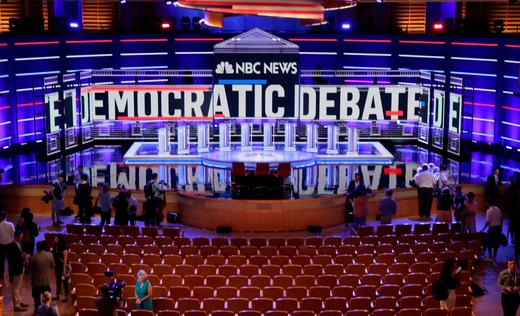
Addressing Jewish Democrats, U.S. Rep. Debbie Wasserman Schultz (D-Fla.) praised the performances of Sens. Kamala Harris and Elizabeth Warren in the first Democratic presidential debates, held on June 26 and 27.
“They both had an opportunity to shine and they took advantage of it,” Wasserman Schultz, the former chair of the Democratic National Committee (DNC), said of Harris of California, and Warren of Massachusetts during a June 28 phone call convened by the Jewish Democratic Council of America (JDCA). “They spoke with passion, with empathy and … moral authority and brought ideas to the table.”
Wasserman Schultz said Warren, who participated in the first debate on June 26, has emerged as one of the more progressive nominees in the Democratic field because of her positions on “Medicare for All” and support for the Green New Deal. As such, Wasserman Schultz said Americans heard from a candidate who is electable.
“She was measured, practical and earnest. I think she was specific and substantive and did it in a way that you didn’t come away feeling like she was promising the moon and proposing things out of reach,” Wasserman Schultz added. “She was ambitious and aspirational, certainly, but as a legislator for 25 years now, the things she talked about and way she spoke about them, I could see a pathway.”
Regarding Harris, Wasserman Schultz said that the former California attorney general performed well during the second debate, largely due to her taking on former Vice President Joe Biden’s previous remarks on working with segregationists and busing in U.S. public schools.
“I think Kamala Harris did a fantastic job demonstrating she is ready for prime time,” Wasserman Schultz said.
“[Warren and Harris] spoke with passion, with empathy and … moral authority and brought ideas to the table.” — Debbie Wasserman Schultz
During the hourlong call with JDCA leaders, including JDCA Executive Director Halie Soifer and JDCA Board Chair Ron Klein, Wasserman Schultz said she thought that the debate format worked against Biden because “holding Joe Biden to 30 seconds [to respond] never will give him the opportunity to shine. He has such vast experience and the breadth to which he is able to communicate is limited in that type of format.” Wasserman Schultz added, “It’s important for [DNC Chair] Tom Perez and the DNC to mix up the formats as they mix up these debates.”
Wasserman Schultz has served in Congress since 2005 and currently represents Florida’s 23rd District, which, she noted during the call, has a large Venezuelan population. She said she was disappointed that neither of the debates addressed the foreign policy crisis in the Latin American country. Likewise, she said the omission of any discussion about Israel was regrettable.
“I don’t know how you have debates in Florida, [which has] one of the largest Jewish populations, without discussing what is happening in the Middle East around Israel,” Wasserman Schultz said.
The moderators, however, did pose questions to candidates during both debates about one of Israel’s most dangerous enemies — Iran — asking whether candidates, if elected, would reenter the Iranian nuclear agreement President Donald Trump withdrew from in 2018.
During the first debate, most of the candidates, with the exception of Sen. Cory Booker D-N.J.), said they would enter back into the agreement.
Wasserman Schultz said that was the right position. “It was grossly irresponsibly [for Trump to withdraw] and I would think it is incumbent on a new president to make it one of his [or her] first priorities,” Schultz said.
Wasserman Schultz also denounced the president’s continuous trafficking in anti-Semitic tropes, saying anti-Semitism, along with the issue of immigration, presented the candidates in the Democratic Party an opportunity to “contrast the nightmare that is Donald Trump and the light at the end of the tunnel our nominee will represent.”