“The world hates a Jew who hits back. The world loves us only when we are to be pitied.” – Golda Meir, Israeli Prime Minister (1969 – 1974)
If, before the 10/7 terrorist attack on Israel, someone told me that antisemitism would soon take root and spread in the animal rights movement, I would have scoffed. “Not a chance. Not in this community.” But having lived through 9/11, the COVID pandemic and the January 6 insurrection, I’m not sure why I’m still surprised when something unexpected — and terrible — happens.
I grew up in Miami Beach, Florida in the 1970s and 1980s. At the time, the city had a large and vibrant Jewish community, but it wasn’t immune to antisemitism. Several neighborhoods discouraged or prohibited residents from selling their homes to Jews, and at least four private clubs barred Jews from becoming members. I was perplexed by the discrimination, but, as a closeted 15-year-old boy living at a time when being gay was unacceptable, I had bigger worries.
Among the Jews living in Miami Beach during my youth were Holocaust survivors. Several decades had elapsed since the Allied forces liberated Jews, gays and other “undesirables” from Nazi concentration camps, but most survivors were still too traumatized to talk about what they endured. By the mid-1980s, however, many elderly survivors came forward because they knew the window to tell their stories was closing. “Never again,” they would say when speaking in the chapel at my childhood temple. I’m glad they’re not alive today to see that their beloved synagogue, which was open to the public when they were congregants, is now a fortress with a high fence and security guards.
Like most Jews I know, I have been shaken by the antisemitic violence in recent decades, such as the mass shootings and intifadas, but I regarded them as isolated incidents. I never considered the possibility that, in a matter of months, Jews around the world could be unsafe and the persecution of Jews could be normalized. Before October 7, I had the luxury of not knowing that antisemitism is a light sleeper.
In the hours and days after Hamas broke the ceasefire and attacked Israel on 10/7 — raping, burning, mutilating, kidnapping and murdering their victims — I noticed that my peers in the animal rights movement were largely silent. Why weren’t they posting the typical expressions of support and compassion for the victims of tragedy? Something was amiss.
The antisemitism in the movement was subtle at first: depriving the victims and their families of the compassion afforded to others; citing “resistance” to justify acts of terror; and denying that the atrocities occurred at all. But it quickly became more odious, even before Israel launched a military operation in Gaza to retrieve the hostages and disarm Hamas to prevent future terrorist attacks.
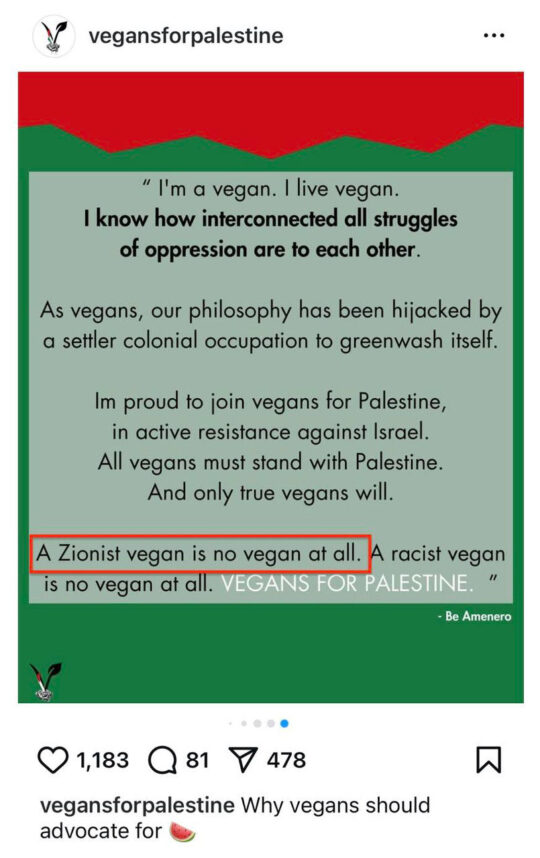
Animal rights activists who had never posted about the Arab/Israeli conflict and, in some cases, privately admitted to knowing nothing about its history, joined Palestine affinity groups in accusing Israel of being a white colonizer state that has committed 75 years of genocide. They also mimicked the Jihadist calls to destroy Israel “from the river to the sea” and to rise up violently against Jews in a “global intifada.” Even after their Jewish peers explained why this rhetoric is hurtful and dangerous, many of the Free Palestine – or anti-Zionist – activists in the animal rights movement continued to use it.
Free Palestine activists are also attacking the estimated 95% of us who identify as Zionist — accusing us of being racists; publishing blacklists with our names; calling for boycotts of Jewish-owned vegan businesses and pressuring community leaders to publicly condemn us online and at animal rights events. They are also redefining Zionism as colonialism or racism and weaponizing the slur against Jews, using “Zionist” or “Zio” as a stand-in for “Jew.” They tokenize the small minority of Jews who do not identify as Zionist. Activists who normally criticize microaggressions against minority groups unabashedly attack their Jewish peers. Some couch their rhetoric in duplicitous language claiming to “love our Jewish brothers and sisters.”

The Jewish animal rights activists who are sounding the alarm about the antisemitism are being targeted on our own social media pages, with some Free Palestine activists conflating our concerns about antisemitism with support of, and complicity in, “genocide” and a lack of compassion for the victims of war. If accusing us of being inhuman isn’t cruel enough, they are also charging us with misusing and weaponizing “antisemitism” in response to their hateful rhetoric, telling Jews what is and is not antisemitism—which is akin to telling people of color what constitutes racism.
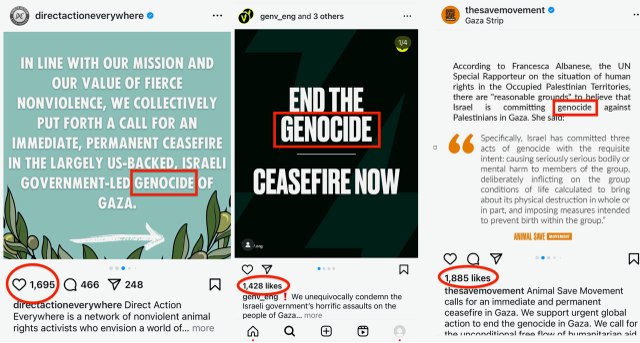
In addition to individual activists, three global animal rights groups which had never, to the best of my knowledge, taken a stand on geopolitical issues made posts on Instagram accusing Israel of committing genocide. In the posts, Direct Action Everywhere, the Save Movement and Generation V made no mention of the actual ethnic cleansing of Jews on 10/7 and of the textbook genocides taking place in other countries: only Israel. These posts reached thousands of impressionable animal rights activists, many of whom assuredly accepted the narrative without researching it for themselves.
As predicted, the antisemitic rhetoric embraced by animal rights activists — and many others — has led to hateful acts and physical violence. Jewish people, homes, businesses, schools, temples and cemeteries are being attacked and vandalized every day. Posters reminding people of the hostages held captive by Hamas are being torn down or defaced. In a particularly malicious act, Amsterdam’s sacred statue of Anne Frank, the Dutch teenager who chronicled her life in hiding before being killed in a Nazi concentration camp, was twice desecrated with graffiti.
Attacks on Jews and Jewish institutions have increased so dramatically and with so few consequences that some Jewish community leaders are encouraging their visibly Jewish constituents to disguise our identities by removing the mezuzahs from our doors, the Stars of David from our necks and the yarmulkes from our heads. They are, in essence, suggesting that we go into hiding.
Given the similarities between 1930s Germany and their own countries today, some Jews in North America, Europe and Australia have begun to ask their Jewish friends and neighbors the dreaded question, “Have you started to make a plan?” By “plan,” they are referring to moving to Israel, the only country that explicitly protects Jews from antisemitic persecution. Since 10/7, several thousand Jewish people in Europe and the United States have moved to Israel, despite the risks associated with the ongoing war.
Jews are not the only victims of antisemitism in the animal rights movement. As Jewish activists spend our time responding to “anti-Zionist” attacks online or altogether withdraw from a community where we no longer feel welcome, the animals for whom we should be advocating continue to suffer. In fact, everyone loses when people or groups fomenting hate co-opt and compromise a social justice movement.
Jews are not the only victims of antisemitism in the animal rights movement. As Jewish activists spend our time responding to “anti-Zionist” attacks online or altogether withdraw from a community where we no longer feel welcome, the animals for whom we should be advocating continue to suffer.
To be sure, antisemitism is not unique to the animal rights movement. The scourge has spread within the LGBTQ+, reproductive rights, feminist and BLM movements too, leaving many progressive Jews feeling ostracized and excommunicated.
Donny Moss has been a campaign organizer and leader in the Animal Rights Movement for the past 19 years.

Antisemitism Comes to the Animal Rights Movement
Donny Moss
“The world hates a Jew who hits back. The world loves us only when we are to be pitied.” – Golda Meir, Israeli Prime Minister (1969 – 1974)
If, before the 10/7 terrorist attack on Israel, someone told me that antisemitism would soon take root and spread in the animal rights movement, I would have scoffed. “Not a chance. Not in this community.” But having lived through 9/11, the COVID pandemic and the January 6 insurrection, I’m not sure why I’m still surprised when something unexpected — and terrible — happens.
I grew up in Miami Beach, Florida in the 1970s and 1980s. At the time, the city had a large and vibrant Jewish community, but it wasn’t immune to antisemitism. Several neighborhoods discouraged or prohibited residents from selling their homes to Jews, and at least four private clubs barred Jews from becoming members. I was perplexed by the discrimination, but, as a closeted 15-year-old boy living at a time when being gay was unacceptable, I had bigger worries.
Among the Jews living in Miami Beach during my youth were Holocaust survivors. Several decades had elapsed since the Allied forces liberated Jews, gays and other “undesirables” from Nazi concentration camps, but most survivors were still too traumatized to talk about what they endured. By the mid-1980s, however, many elderly survivors came forward because they knew the window to tell their stories was closing. “Never again,” they would say when speaking in the chapel at my childhood temple. I’m glad they’re not alive today to see that their beloved synagogue, which was open to the public when they were congregants, is now a fortress with a high fence and security guards.
Like most Jews I know, I have been shaken by the antisemitic violence in recent decades, such as the mass shootings and intifadas, but I regarded them as isolated incidents. I never considered the possibility that, in a matter of months, Jews around the world could be unsafe and the persecution of Jews could be normalized. Before October 7, I had the luxury of not knowing that antisemitism is a light sleeper.
In the hours and days after Hamas broke the ceasefire and attacked Israel on 10/7 — raping, burning, mutilating, kidnapping and murdering their victims — I noticed that my peers in the animal rights movement were largely silent. Why weren’t they posting the typical expressions of support and compassion for the victims of tragedy? Something was amiss.
The antisemitism in the movement was subtle at first: depriving the victims and their families of the compassion afforded to others; citing “resistance” to justify acts of terror; and denying that the atrocities occurred at all. But it quickly became more odious, even before Israel launched a military operation in Gaza to retrieve the hostages and disarm Hamas to prevent future terrorist attacks.
Animal rights activists who had never posted about the Arab/Israeli conflict and, in some cases, privately admitted to knowing nothing about its history, joined Palestine affinity groups in accusing Israel of being a white colonizer state that has committed 75 years of genocide. They also mimicked the Jihadist calls to destroy Israel “from the river to the sea” and to rise up violently against Jews in a “global intifada.” Even after their Jewish peers explained why this rhetoric is hurtful and dangerous, many of the Free Palestine – or anti-Zionist – activists in the animal rights movement continued to use it.
Free Palestine activists are also attacking the estimated 95% of us who identify as Zionist — accusing us of being racists; publishing blacklists with our names; calling for boycotts of Jewish-owned vegan businesses and pressuring community leaders to publicly condemn us online and at animal rights events. They are also redefining Zionism as colonialism or racism and weaponizing the slur against Jews, using “Zionist” or “Zio” as a stand-in for “Jew.” They tokenize the small minority of Jews who do not identify as Zionist. Activists who normally criticize microaggressions against minority groups unabashedly attack their Jewish peers. Some couch their rhetoric in duplicitous language claiming to “love our Jewish brothers and sisters.”
The Jewish animal rights activists who are sounding the alarm about the antisemitism are being targeted on our own social media pages, with some Free Palestine activists conflating our concerns about antisemitism with support of, and complicity in, “genocide” and a lack of compassion for the victims of war. If accusing us of being inhuman isn’t cruel enough, they are also charging us with misusing and weaponizing “antisemitism” in response to their hateful rhetoric, telling Jews what is and is not antisemitism—which is akin to telling people of color what constitutes racism.
In addition to individual activists, three global animal rights groups which had never, to the best of my knowledge, taken a stand on geopolitical issues made posts on Instagram accusing Israel of committing genocide. In the posts, Direct Action Everywhere, the Save Movement and Generation V made no mention of the actual ethnic cleansing of Jews on 10/7 and of the textbook genocides taking place in other countries: only Israel. These posts reached thousands of impressionable animal rights activists, many of whom assuredly accepted the narrative without researching it for themselves.
As predicted, the antisemitic rhetoric embraced by animal rights activists — and many others — has led to hateful acts and physical violence. Jewish people, homes, businesses, schools, temples and cemeteries are being attacked and vandalized every day. Posters reminding people of the hostages held captive by Hamas are being torn down or defaced. In a particularly malicious act, Amsterdam’s sacred statue of Anne Frank, the Dutch teenager who chronicled her life in hiding before being killed in a Nazi concentration camp, was twice desecrated with graffiti.
Attacks on Jews and Jewish institutions have increased so dramatically and with so few consequences that some Jewish community leaders are encouraging their visibly Jewish constituents to disguise our identities by removing the mezuzahs from our doors, the Stars of David from our necks and the yarmulkes from our heads. They are, in essence, suggesting that we go into hiding.
Given the similarities between 1930s Germany and their own countries today, some Jews in North America, Europe and Australia have begun to ask their Jewish friends and neighbors the dreaded question, “Have you started to make a plan?” By “plan,” they are referring to moving to Israel, the only country that explicitly protects Jews from antisemitic persecution. Since 10/7, several thousand Jewish people in Europe and the United States have moved to Israel, despite the risks associated with the ongoing war.
Jews are not the only victims of antisemitism in the animal rights movement. As Jewish activists spend our time responding to “anti-Zionist” attacks online or altogether withdraw from a community where we no longer feel welcome, the animals for whom we should be advocating continue to suffer. In fact, everyone loses when people or groups fomenting hate co-opt and compromise a social justice movement.
To be sure, antisemitism is not unique to the animal rights movement. The scourge has spread within the LGBTQ+, reproductive rights, feminist and BLM movements too, leaving many progressive Jews feeling ostracized and excommunicated.
Donny Moss has been a campaign organizer and leader in the Animal Rights Movement for the past 19 years.
Did you enjoy this article?
You'll love our roundtable.
Editor's Picks
Israel and the Internet Wars – A Professional Social Media Review
The Invisible Student: A Tale of Homelessness at UCLA and USC
What Ever Happened to the LA Times?
Who Are the Jews On Joe Biden’s Cabinet?
You’re Not a Bad Jewish Mom If Your Kid Wants Santa Claus to Come to Your House
No Labels: The Group Fighting for the Political Center
Latest Articles
Jewish Democrats Cave to Anti-Semites
Chai Lifeline Families Spend Afternoon with Clippers Center Yanic Konan Niederhäuser
“Just a Few Sleeps Away” by Mike Nichols
Rabbi Kaplan Named JCC Camps Senior VP; Maman Events, JFSLA, Temple of the Arts
Controversial Far-Left Streamer Hasan Piker Scheduled to Speak at Cornell, UT Austin
Listen — A poem for Parsha Ha’Azinu
When Celebrities Endorsed a Different “Free Palestine”
When many of America’s leading celebrities called for a “Free Palestine” eighty years ago this week, they were talking about freeing Palestine from British occupation, in order to establish a Jewish state.
A Bisl Yom Kippur~ Plenty of Regrets
Yom Kippur is admitting our plentiful regrets and summoning and building our inner determination and drive to be better people, regrets, and all.
A Moment in Time: The Sound of Now
Enigmatic End: the Penultimate Song in the Torah
Print Issue: Renewing American Jewry | September 18, 2026
In this time of introspection and rising adversity, let us resolve as American Jews to write our new chapter by better understanding our history.
Expanding the Soul
There is a struggle within us between constriction and expansion, between despair and vitality. Good humor can be a powerful ally against the constriction that suffering creates.
Making Torah More Accessible
The 402-page book is organized around 36 life lessons related to the Book of Genesis, with thoughtful study questions and dozens of responses from respected sources in Jewish thought.
Avi Nesher Fights the Boycott with a Human Story
Making Israeli films is not easy. Budgets are generally small by American standards, and international financing has become increasingly difficult to secure amid the cultural boycott of Israeli cinema.
Combating Antisemitism Through Education in Beverly Hills
For Judith, her family’s experience as refugees from Iran is part of what drives her commitment to speaking out against antisemitism and never staying silent.
From Israel’s Farms to Los Angeles: The Etrog with a Purpose
Mickey Katzburg, founder of the World Center for Jewish Education, is trying to give Los Angeles Jews another option: an etrog grown in Israel, while at the same time helping support farmers in the country’s Gaza border region.
What’s in a Name: Peanut Butter Date Bark
Dates are a perfect way to add natural caramelized sweetness to desserts.
Table for Five: Yom Kippur
Elevating the Physical
ACF Report Reveals the Strongest – and Most Concerning – Campuses for Jewish and Pro-Israel Students
The report, which can be found on CampusFairness.org, took into consideration five criteria: incident record, institutional response, anti-Israel organizing, Jewish life on campus, and the legal and structural environment.
Jason Arday, Donald Trump, and the Post-Truth World
For both MAGA and Arday’s defenders, truth doesn’t matter, lies are accepted as facts, and tribe matters above all.
How Yom Kippur’s Afternoon Prophet Inspires America
When Jonah makes his appearance on the holiest day of the year, he is meant to remind Jews across the globe of the remarkable grace of repentance.
Knowing Our History
In this time of introspection and rising adversity, let us resolve as American Jews to write our new chapter by better understanding our history.
Macklemore Dropped from Ed Sheeran Tour After ‘Free Palestine’ Remarks at MetLife Stadium
Among the most high-profile artists to criticize Macklemore’s MetLife Stadium rant was P!NK. Born Alecia Moore, P!NK is a Jewish Grammy-winning pop star who has been increasingly public about her Judaism and antisemitism since Oct. 7.
Noah Wyle, Rob Reiner, and the Jewish Winners at the 78th Emmys
Wyle won Outstanding Lead Actor in a Drama Series for playing Dr. Michael “Robby” Robinavitch on HBO Max’s “The Pitt.”
Rosner’s Domain | Choosing the Next Government
Are you better off than you were four years ago?
My Choice for Essay of the Year
The collective assault against Israel has been so broad and deep it’s been hard finding anyone in the mainstream media who will dare go after the Hamas murderers whose biggest victims are the Palestinians.
More news and opinions than at a Shabbat dinner, right in your inbox.