In his autobiography “Being Oscar: From Mob Lawyer to Mayor of Las Vegas,” Oscar Goodman recounts his 35 years as famed criminal defense lawyer for Jewish gangsters Meyer Lansky, Benjamin “Bugsy” Siegel and Frank “Lefty” Rosenthal, on whom the character “Ace Rothstein” was based in the movie “Casino.”
Goodman served three elected terms as the popular mayor of “Sin City,” succeeded by his wife Carolyn, a former local Jewish Federation leader whose own third term ends in 2024, capping 25 consecutive years of this couple’s relatively non-partisan mayoral leadership.
Relentlessly promotive of Las Vegas as both a glamorous international tourist destination and an increasingly desirable suburb for California tax refugees, Oscar Goodman advocated the development of the highly regarded Mob Museum (The National Museum of Organized Crime & Law Enforcement), which carefully documents the many stories of the predominantly Jewish and Italian mafias in the United States as well as today’s international criminal gangs engaged in financial cybercrimes, human trafficking, and the global drug and exotic animals trades.
On a recent summer evening, guests of the Mob Museum gathered for a four-story tour of the well-curated exhibits as well as a movie screening and Q&A with the brilliant, Israeli-born director Eytan Rockaway and charismatic actor David Cade of the new biopic “Lansky.”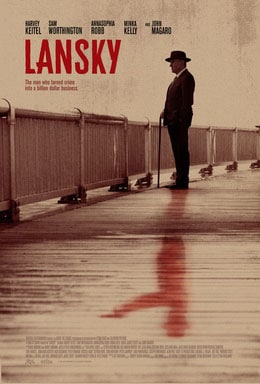
The film is a soulful but lively re-telling of the life and times of the legendary Jewish-American gangster, starring Academy Award nominee Harvey Keitel as a terminally ill Lansky relating his stories and secrets to a writer he commissioned to release his authorized biography upon death.
Aging in Miami, but still under Federal investigation for a suspected $300 Million in undiscovered cash savings (much of his fortune was made in 1950s Cuba but then likely lost when communists destroyed the gambling halls of Havana), the real-life Meyer Lansky did in fact reveal his tales, prior to his natural passing in 1983, to historian Robert Rockaway, a longtime professor at Tel Aviv University and co-writer of the movie with his son Eytan.
Lansky’s notorious life helped inform Robert Rockaway’s insightful study “But He Was Good to His Mother: The Lives and Crimes of Jewish Gangsters,” which details not only disreputable criminal behavior but also lesser known but significant efforts to help their own people.
Prof. Rockaway tells the stories of Arnold Rothstein, the New York based organized crime mastermind known as the key figure behind the infamous 1919 Chicago “Black Sox” World Series baseball scandal; the “Cleveland Four,” including “Moe” Dalitz, Morris Kleinman, Sam Tucker and Louis Rothkopf; Al Capone’s financial adviser Jack “Greasy Thumb” Guzlik; and the “Purple Gang,” the Detroit mob formed by Sammie Cohen and led by the Bernstein brothers.
In his book “Tough Jews: Fathers, Sons, and Gangster Dreams,” author Rich Cohen adds to this catalogue of Jewish criminals the story of Louis “Lepke” Buchalter, the head of the mafia hit squad known as Murder, Inc. and the only mobster ever executed by the state of New York. Born in 1897 to Yiddish-speaking parents, his mother called him “lepkeleh” or “little Louis,” which later became “Lepke.” His three brothers became a dentist, a college professor and rabbi, and a pharmacist, but Louis rose to become a notorious garment industry and bakery trucking racketeer and independent contract murderer for Cosa Nostra mobsters.
Buchalter arranged for the 1935 hit on powerful New York gangster Dutch Schultz on orders of senior mafia officials after kingpin Charles “Lucky” Luciano rejected Schultz’s suggestion that the mob’s top Commission approve his request to assassinate rising “gangbuster” New York District Attorney Thomas Dewey.
Ironically, Dewey later prosecuted Buchalter for the murder of candy store owner Joseph Rosen, who had been driven out of the trucking industry and whom Buchalter (likely wrongly) suspected of cooperation with the law. Eventually sentenced to the death penalty, Buchalter then saw his final appeal for commutation rejected in a widely watched 1944 decision by the now popular New York Governor and two-time U.S. Presidential candidate Dewey.
But it is Meyer Lansky who was the top mobster of his era, as previously featured in David Mamet’s HBO movie “Lansky” (1999) starring Richard Dreyfuss. Among many popular films of this genre, arguably the two best are “The Godfather” trilogy (I and II in particular), which tells the story of an Italian crime family led by Don Corleone (based on both Frank Costello and “Lucky” Luciano, Lansky’s key associate and the most powerful Mafia boss in the U.S.), and “Once Upon a Time in America,” a stunning saga of the rise of young Jewish street gangsters (loosely based on Lansky and Bugsy Siegel) in Brooklyn, N.Y. during the Prohibition Era of 1920-1933.
In this violent but also more philosophical film treatment, writer-director Eytan Rockaway features Lansky’s efforts to lend his power to combat a period of threatening antisemitism and American Nazism in the U.S. as well as to support the fledgling Jewish state of Israel.
Writer-director Eytan Rockaway features Lansky’s efforts to lend his power to combat a period of threatening antisemitism and American Nazism in the U.S. as well as to support the fledgling Jewish state of Israel.
Meyer Lansky was born Meier Suchowlański in Belarus, on July 4, 1902 to a poor Polish family that faced persecution and pogroms. Meyer arrived to the Lower East Side of Manhattan in 1911. A voracious reader, he also quickly exhibited the remarkable math and gambling skills that helped him become “the mob’s accountant” as he rose to increasing influence in the organized crime syndicate.
During the pre-World War II decades, attacks on Jews became rather virulent in parts of the country. Several religious broadcasters in the Midwest openly targeted Jews as undesirable, and the Brown Shirts in New York and the Silver Shirts in Minneapolis attacked Jews in the streets. Though not religiously observant, several Jewish gangsters noted the lack of strong response from organized Jewish leadership and decided to step up to protect Jewish communities.
First, upon the request of New York State Judge Nathan Perlman, Lansky was asked to break up the rallies of the German-American Bund in New York City, provided that Lansky’s “toughs” would not kill anyone. Lansky would have preferred to knock off some American Nazis, but he agreed and further advised he would take no payment, stating “I was a Jew and felt for those Jews in Europe who were suffering. They were my brothers.” Prof. Rockaway notes that “Nazi arms, legs, and ribs were broken and skulls were cracked, but no one died.”
Lansky described breaking up one Brown Shirt rally in Manhattan: “The stage was decorated with a swastika and a picture of Hitler. The speaker started ranting. There were only fifteen of us, but we went into action. We threw some of them out the windows. Most of the Nazis panicked and ran out. We chased them and beat them up. We wanted to show them that the Jews would not always sit back and accept insults.”
Gambling honcho David Berman and his allies similarly broke up rallies of the Silver Shirts in Minneapolis, who sought to replicate Hitler’s Brown Shirts in Germany and Mussolini’s Black Shirts in Italy by attacking “Jewish communists” in America. After three public meetings were violently disrupted, the Silver Shirts halted their campaign to demonize American Jewry.
Next, continuing his anti-Nazi efforts during World War II, Lansky led the efforts to assist the U.S. Office of Naval Intelligence to identity German infiltrators and submarine-borne saboteurs. In exchange for the release of his friend Luciano from prison, Lansky’s men provided security for U.S. warships being built in the docks of New York Harbor. German submarines were sinking allied ships along the eastern seaboard and the mob went to work to infiltrate, identify, and inform on pro-Nazi supporters on the New York waterfront.
Further, both Meyer Lansky and his partner Bugsy Siegel helped the nascent Jewish state of Israel. One reported meeting took place between Bugsy and Reuven Dafne, the emissary of the Haganah, in 1945. Jews were seeking funds and weapons to liberate Palestine from British control. Bugsy said, “You mean to tell me Jews are fighting? You mean fighting as in killing?” When told yes, Siegel advised, “I’m with you.” He quietly provided suitcases full of cash in support.
Bugsy Siegel of course was Meyer Lansky’s boyhood friend who became the most famous of Jewish gangsters. As teenagers, they created the Bugs and Meyer Mob. Lansky served as the brains of the outfit, with Siegel providing the brawn. Siegel was the youngest member of the gang, known as the vilda chaya, yiddish for “wild animal(s),” which engaged in illicit activities like prostitution, gambling, loan sharking, bootlegging, and labor racketeering.
In 1937, Bugsy moved his gambling rackets to California, where he befriended Hollywood moguls and starlets, borrowing money from several celebrities whom he never repaid. He dated actress Virginia Hill, an underworld moll herself who helped Bugsy’s bosses back east keep an eye on him. In 1945, Siegel and Hill came to Las Vegas to build a gambling mecca in the Nevada desert, starting with the Flamingo Hotel and Casino, funded by the eastern crime syndicate with $1.5 million.
Unfortunately, after Bugsy ran up debts of some $6 million through theft and mismanagement, all of Lansky’s defenses of his longtime pal proved insufficient to prevent the mob hit ordered by the syndicate. On June 20, 1947, Siegel was shot four times as he sat on a sofa in Hill’s Beverly Hills home while reading the Los Angeles Times.
The mob accelerated the development of the Las Vegas strip of casino hotels and ruled the town for decades until its replacement by corporate management. Famed mobster turned developer Moe Dalitz was given the key to Las Vegas in 1979. Over recent decades Jewish leadership in building Las Vegas included not only the Mayors Goodman but also Steve Wynn, the visionary casino creator who was financed by the junk bonds created by investment banker and humanitarian Michael Milken, as well as the developers of the world’s largest hotel, Jewish philanthropists Sheldon and Dr. Miriam Adelson.
Lansky’s life was complex and brutal. His victims must be remembered and respected.
His personal life was marked by the ups and downs of family life, including an honorable son Paul who attended the U.S. Military Academy at West Point and then joined the U.S. Air Force and served in Vietnam, and another son Buddy who sadly suffered from cerebral palsy. He also had a daughter, Sandi Lansky Lombardo who grew up with wealth, parties and private schools as described in her own autobiography, “Daughter of the King: Growing Up in Gangland.”
Perhaps the most compelling scene in “Lansky” focuses on his attempted emigration to Israel in the early 1970s where he sought to avoid tax evasion prosecution in the U.S. by appealing for citizenship under “the law of return.” Denied asylum by Golda Meir, who faced pressure from American authorities, Lansky bitterly recounts that his early support of Israel was not reciprocated at his most critical time of need.
Lansky managed to evade U.S. prosecution, however, and live as a free man to age 80. Through his highs and lows, his fortunes and misfortunes, Lansky appears at the end of his life as an intelligent and introspective figure. He never changed perspective, holding firm as a “tough Jew” to his motto, “life is shades of grey, not black and white.”
Smiling as he slowly walks into the sunset along the beach in Miami, with the Feds having quit their chase for his never-found (and always denied) remaining riches, Lansky survived and thrived and lived on his own terms. He left a disturbing legacy of inexcusable violence, but endures as a humanized figure of intense fascination for the American public, and not least for American Jewry whose communal legacy includes several bigtime gangsters with humble Yiddish roots who fought against some of the Jews’ worst enemies.
Larry Greenfield is a Fellow of The Claremont Institute for the Study of Statesmanship & Political Philosophy.

Tough Jews, Las Vegas, and the Legacy of Meyer Lansky
Larry Greenfield
In his autobiography “Being Oscar: From Mob Lawyer to Mayor of Las Vegas,” Oscar Goodman recounts his 35 years as famed criminal defense lawyer for Jewish gangsters Meyer Lansky, Benjamin “Bugsy” Siegel and Frank “Lefty” Rosenthal, on whom the character “Ace Rothstein” was based in the movie “Casino.”
Goodman served three elected terms as the popular mayor of “Sin City,” succeeded by his wife Carolyn, a former local Jewish Federation leader whose own third term ends in 2024, capping 25 consecutive years of this couple’s relatively non-partisan mayoral leadership.
Relentlessly promotive of Las Vegas as both a glamorous international tourist destination and an increasingly desirable suburb for California tax refugees, Oscar Goodman advocated the development of the highly regarded Mob Museum (The National Museum of Organized Crime & Law Enforcement), which carefully documents the many stories of the predominantly Jewish and Italian mafias in the United States as well as today’s international criminal gangs engaged in financial cybercrimes, human trafficking, and the global drug and exotic animals trades.
On a recent summer evening, guests of the Mob Museum gathered for a four-story tour of the well-curated exhibits as well as a movie screening and Q&A with the brilliant, Israeli-born director Eytan Rockaway and charismatic actor David Cade of the new biopic “Lansky.”
The film is a soulful but lively re-telling of the life and times of the legendary Jewish-American gangster, starring Academy Award nominee Harvey Keitel as a terminally ill Lansky relating his stories and secrets to a writer he commissioned to release his authorized biography upon death.
Aging in Miami, but still under Federal investigation for a suspected $300 Million in undiscovered cash savings (much of his fortune was made in 1950s Cuba but then likely lost when communists destroyed the gambling halls of Havana), the real-life Meyer Lansky did in fact reveal his tales, prior to his natural passing in 1983, to historian Robert Rockaway, a longtime professor at Tel Aviv University and co-writer of the movie with his son Eytan.
Lansky’s notorious life helped inform Robert Rockaway’s insightful study “But He Was Good to His Mother: The Lives and Crimes of Jewish Gangsters,” which details not only disreputable criminal behavior but also lesser known but significant efforts to help their own people.
Prof. Rockaway tells the stories of Arnold Rothstein, the New York based organized crime mastermind known as the key figure behind the infamous 1919 Chicago “Black Sox” World Series baseball scandal; the “Cleveland Four,” including “Moe” Dalitz, Morris Kleinman, Sam Tucker and Louis Rothkopf; Al Capone’s financial adviser Jack “Greasy Thumb” Guzlik; and the “Purple Gang,” the Detroit mob formed by Sammie Cohen and led by the Bernstein brothers.
In his book “Tough Jews: Fathers, Sons, and Gangster Dreams,” author Rich Cohen adds to this catalogue of Jewish criminals the story of Louis “Lepke” Buchalter, the head of the mafia hit squad known as Murder, Inc. and the only mobster ever executed by the state of New York. Born in 1897 to Yiddish-speaking parents, his mother called him “lepkeleh” or “little Louis,” which later became “Lepke.” His three brothers became a dentist, a college professor and rabbi, and a pharmacist, but Louis rose to become a notorious garment industry and bakery trucking racketeer and independent contract murderer for Cosa Nostra mobsters.
Buchalter arranged for the 1935 hit on powerful New York gangster Dutch Schultz on orders of senior mafia officials after kingpin Charles “Lucky” Luciano rejected Schultz’s suggestion that the mob’s top Commission approve his request to assassinate rising “gangbuster” New York District Attorney Thomas Dewey.
Ironically, Dewey later prosecuted Buchalter for the murder of candy store owner Joseph Rosen, who had been driven out of the trucking industry and whom Buchalter (likely wrongly) suspected of cooperation with the law. Eventually sentenced to the death penalty, Buchalter then saw his final appeal for commutation rejected in a widely watched 1944 decision by the now popular New York Governor and two-time U.S. Presidential candidate Dewey.
But it is Meyer Lansky who was the top mobster of his era, as previously featured in David Mamet’s HBO movie “Lansky” (1999) starring Richard Dreyfuss. Among many popular films of this genre, arguably the two best are “The Godfather” trilogy (I and II in particular), which tells the story of an Italian crime family led by Don Corleone (based on both Frank Costello and “Lucky” Luciano, Lansky’s key associate and the most powerful Mafia boss in the U.S.), and “Once Upon a Time in America,” a stunning saga of the rise of young Jewish street gangsters (loosely based on Lansky and Bugsy Siegel) in Brooklyn, N.Y. during the Prohibition Era of 1920-1933.
In this violent but also more philosophical film treatment, writer-director Eytan Rockaway features Lansky’s efforts to lend his power to combat a period of threatening antisemitism and American Nazism in the U.S. as well as to support the fledgling Jewish state of Israel.
Meyer Lansky was born Meier Suchowlański in Belarus, on July 4, 1902 to a poor Polish family that faced persecution and pogroms. Meyer arrived to the Lower East Side of Manhattan in 1911. A voracious reader, he also quickly exhibited the remarkable math and gambling skills that helped him become “the mob’s accountant” as he rose to increasing influence in the organized crime syndicate.
During the pre-World War II decades, attacks on Jews became rather virulent in parts of the country. Several religious broadcasters in the Midwest openly targeted Jews as undesirable, and the Brown Shirts in New York and the Silver Shirts in Minneapolis attacked Jews in the streets. Though not religiously observant, several Jewish gangsters noted the lack of strong response from organized Jewish leadership and decided to step up to protect Jewish communities.
First, upon the request of New York State Judge Nathan Perlman, Lansky was asked to break up the rallies of the German-American Bund in New York City, provided that Lansky’s “toughs” would not kill anyone. Lansky would have preferred to knock off some American Nazis, but he agreed and further advised he would take no payment, stating “I was a Jew and felt for those Jews in Europe who were suffering. They were my brothers.” Prof. Rockaway notes that “Nazi arms, legs, and ribs were broken and skulls were cracked, but no one died.”
Lansky described breaking up one Brown Shirt rally in Manhattan: “The stage was decorated with a swastika and a picture of Hitler. The speaker started ranting. There were only fifteen of us, but we went into action. We threw some of them out the windows. Most of the Nazis panicked and ran out. We chased them and beat them up. We wanted to show them that the Jews would not always sit back and accept insults.”
Gambling honcho David Berman and his allies similarly broke up rallies of the Silver Shirts in Minneapolis, who sought to replicate Hitler’s Brown Shirts in Germany and Mussolini’s Black Shirts in Italy by attacking “Jewish communists” in America. After three public meetings were violently disrupted, the Silver Shirts halted their campaign to demonize American Jewry.
Next, continuing his anti-Nazi efforts during World War II, Lansky led the efforts to assist the U.S. Office of Naval Intelligence to identity German infiltrators and submarine-borne saboteurs. In exchange for the release of his friend Luciano from prison, Lansky’s men provided security for U.S. warships being built in the docks of New York Harbor. German submarines were sinking allied ships along the eastern seaboard and the mob went to work to infiltrate, identify, and inform on pro-Nazi supporters on the New York waterfront.
Further, both Meyer Lansky and his partner Bugsy Siegel helped the nascent Jewish state of Israel. One reported meeting took place between Bugsy and Reuven Dafne, the emissary of the Haganah, in 1945. Jews were seeking funds and weapons to liberate Palestine from British control. Bugsy said, “You mean to tell me Jews are fighting? You mean fighting as in killing?” When told yes, Siegel advised, “I’m with you.” He quietly provided suitcases full of cash in support.
Bugsy Siegel of course was Meyer Lansky’s boyhood friend who became the most famous of Jewish gangsters. As teenagers, they created the Bugs and Meyer Mob. Lansky served as the brains of the outfit, with Siegel providing the brawn. Siegel was the youngest member of the gang, known as the vilda chaya, yiddish for “wild animal(s),” which engaged in illicit activities like prostitution, gambling, loan sharking, bootlegging, and labor racketeering.
In 1937, Bugsy moved his gambling rackets to California, where he befriended Hollywood moguls and starlets, borrowing money from several celebrities whom he never repaid. He dated actress Virginia Hill, an underworld moll herself who helped Bugsy’s bosses back east keep an eye on him. In 1945, Siegel and Hill came to Las Vegas to build a gambling mecca in the Nevada desert, starting with the Flamingo Hotel and Casino, funded by the eastern crime syndicate with $1.5 million.
Unfortunately, after Bugsy ran up debts of some $6 million through theft and mismanagement, all of Lansky’s defenses of his longtime pal proved insufficient to prevent the mob hit ordered by the syndicate. On June 20, 1947, Siegel was shot four times as he sat on a sofa in Hill’s Beverly Hills home while reading the Los Angeles Times.
The mob accelerated the development of the Las Vegas strip of casino hotels and ruled the town for decades until its replacement by corporate management. Famed mobster turned developer Moe Dalitz was given the key to Las Vegas in 1979. Over recent decades Jewish leadership in building Las Vegas included not only the Mayors Goodman but also Steve Wynn, the visionary casino creator who was financed by the junk bonds created by investment banker and humanitarian Michael Milken, as well as the developers of the world’s largest hotel, Jewish philanthropists Sheldon and Dr. Miriam Adelson.
Lansky’s life was complex and brutal. His victims must be remembered and respected.
His personal life was marked by the ups and downs of family life, including an honorable son Paul who attended the U.S. Military Academy at West Point and then joined the U.S. Air Force and served in Vietnam, and another son Buddy who sadly suffered from cerebral palsy. He also had a daughter, Sandi Lansky Lombardo who grew up with wealth, parties and private schools as described in her own autobiography, “Daughter of the King: Growing Up in Gangland.”
Perhaps the most compelling scene in “Lansky” focuses on his attempted emigration to Israel in the early 1970s where he sought to avoid tax evasion prosecution in the U.S. by appealing for citizenship under “the law of return.” Denied asylum by Golda Meir, who faced pressure from American authorities, Lansky bitterly recounts that his early support of Israel was not reciprocated at his most critical time of need.
Lansky managed to evade U.S. prosecution, however, and live as a free man to age 80. Through his highs and lows, his fortunes and misfortunes, Lansky appears at the end of his life as an intelligent and introspective figure. He never changed perspective, holding firm as a “tough Jew” to his motto, “life is shades of grey, not black and white.”
Smiling as he slowly walks into the sunset along the beach in Miami, with the Feds having quit their chase for his never-found (and always denied) remaining riches, Lansky survived and thrived and lived on his own terms. He left a disturbing legacy of inexcusable violence, but endures as a humanized figure of intense fascination for the American public, and not least for American Jewry whose communal legacy includes several bigtime gangsters with humble Yiddish roots who fought against some of the Jews’ worst enemies.
Larry Greenfield is a Fellow of The Claremont Institute for the Study of Statesmanship & Political Philosophy.
Did you enjoy this article?
You'll love our roundtable.
Editor's Picks
Israel and the Internet Wars – A Professional Social Media Review
The Invisible Student: A Tale of Homelessness at UCLA and USC
What Ever Happened to the LA Times?
Who Are the Jews On Joe Biden’s Cabinet?
You’re Not a Bad Jewish Mom If Your Kid Wants Santa Claus to Come to Your House
No Labels: The Group Fighting for the Political Center
Latest Articles
The Match That Oct. 7 Struck
Will Sept. 30 Go Down in History Like Oct. 7?
This Just Makes It Worse
Oct. 7 Makes Me Grateful for the Secular Calendar
October 7th and the Secret of Simchat Torah
Rabbis of LA | Rabbi’s Heroic Friend Remembers Oct. 7
EarlyJ Invests More Than $510,000 to Expand Jewish Parenting Centers Across California
Their goal is to ensure Jewish preschools become community hubs for families, starting in the earliest stages of parenthood.
Our Eyes Blink — A poem for Parsha Vezot Hab’rachah
My son turned eighteen yesterday…
AFHU Bel Air Affaire, Los Angeles Jewish Film Fest Screening
Notable people and events in the Jewish LA community.
A Moment in Time: Give a Child a Summer to Remember
A Bisl Torah ~ Fragility Beckons Daily Courage
Sukkot emphasizes that which we intrinsically know. We go outside and show the world that no matter the environment, we will express our Judaism with pride and joy.
October Seventh and the Reversal Caused by Sukkot
The Antisemitism You Won’t Hear About in the News
Liat Cohen-Reeis, director of the Antisemitism Task Force at StandWithUs San Diego, has tried to bring local news media’s attention to antisemitic incidents, but has encountered disinterest.
Print Issue: Crisis of Truth | October 2, 2026
An uproar over an article showing discrimination against Jewish and Israeli writers dramatizes how ideology and politics prevail over truth.
A Free Makeover: A Bath, a Haircut and a Second Chance
At the shelters, the grooming does more than make the dogs look and smell better.
Rochelle Furstenberg, Iconic Writer, Editor, Passes Away in Jerusalem
Furstenberg has been an iconic writer and editor in Israeli and American publications for decades, including for the L.A. Jewish Journal, and her death, even at the age of 90, on the eve of Rosh Hashana, deeply moved Jerusalemites who knew her.
What Kind of Judaism Do We Want After Oct. 7?
Arthur Green, “Can Judaism Be Saved: Its Future After Gaza” (Teaneck, NJ: Ben Yehuda Press, 2025) pp. 139.
Your Organization Doesn’t Need a Chatbot. It Needs Its Hours Back.
The point of all this isn’t to replace the people who keep our institutions running. It’s to give them back the hours they spend being human copy machines, so they can spend those hours on the work only people can do.
The Architecture of L’Dor Vador: How Physical Structures Shape Jewish Values and Intergenerational Life
This is more than a proposal to construct apartments. It is an invitation to reconsider what a Jewish institution can be.
Stuffed with Spice and Simcha
The custom of eating stuffed vegetables on Simchat Torah is to symbolize the scrolls of the Torah filled with the wisdom of the holy text.
Table for Five: Simchat Torah
Exclusive After-Party
Crisis of Truth
An uproar over an article showing discrimination against Jewish and Israeli writers dramatizes how ideology and politics prevail over truth.
Rosner’s Domain | Election Day Will Just Be a Beginning
Israelis are an impatient bunch, but their political processes can drag on and on – and on.
Saudi Arabia Is Encircled. The Way Out May Run through Jerusalem
Saudi Arabia’s growing vulnerability presents Israel – and the United States – with an opportunity to deepen the partnership between two of the region’s most important forces against extremism.
Two Elections, One People
On October 27, Israelis will elect the 26th Knesset. A week later, on November 3, Americans will vote in pivotal midterm elections.
The Return to Biblicalness
Shattering as it’s been, there’s something to be said for this abrupt return to biblicalness. By this awkward word I don’t mean belief in religion, necessarily, but appreciation for values that have fallen into disfavor in our supposedly enlightened age.
More news and opinions than at a Shabbat dinner, right in your inbox.