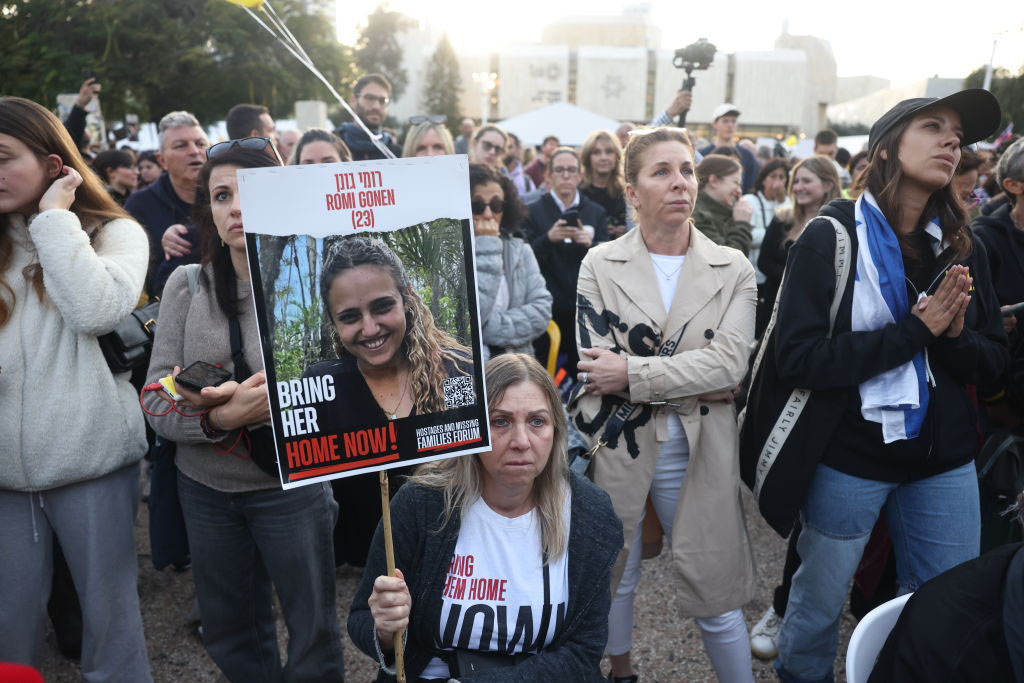
As I watched the heartwarming scenes of Romi Goren, Emily Damari and Doron Steinbrecher returning home after 15 months of Hamas hell, I couldn’t help thinking of other numbers: specifically, the more than 1900 Palestinians who will be released from Israeli jails in return for 33 Israelis as part of phase one of the ceasefire deal.
I wasn’t thinking only of the obvious– that it is horrible to have to release murderers who are sure to murder again. I was thinking also of a moral equation that rarely comes up when we evaluate these exchanges.
For some reason, we automatically assume that Israel must release scores of Palestinians in return for a few Israelis. The height of that imbalance, of course, came in 2011 when Israel released 1027 Palestinian prisoners in return for one Israeli hostage, Gilad Shalit.
That imbalance may be extreme, but it’s not without logic. One side pays what it feels it needs to pay, while the other side charges what it can get away with. The buyer and seller, in other words, agree on what the desired prize (one Israeli) is worth, just as in business.
But by treating human lives with the cold calculus of economics, both sides fall into a moral trap. Israel insults Palestinians by showing how one Israeli life is worth numerous Palestinian lives, while Palestinians are forced to swallow the humiliation of that immoral equation.
I’m not being naive. I get that Palestinians have an interest in getting as many Palestinians released as possible, and that Israel has an interest in doing everything it can to free a captive, one of the highest Jewish values.
That pragmatic approach, however, has forced the parties to publicly display something highly embarrassing: they both see Jewish lives as a lot more valuable than Palestinian lives. After all, if the lives were seen as equally valuable, wouldn’t it be more dignified to trade one for one? For an Arab culture that so values honor, wouldn’t that be the more honorable thing to do?
Indeed, if we’re going to get into the vexing issue of human worth, if anything the imbalance would go in the other direction. Should the life of a terrorist, for example, be worth as much as the life of an innocent hippie who attended a music festival? How would we calculate that equation? Thirty music lovers for one terrorist with blood on their hands? Maybe 50?
But let’s not even go there. Let’s just stay with the religious ideal that we are all created in God’s image, a phrase from the Bible that describes the inherent value of all humans. If we believed in that moral dictum, all human exchanges would be equitable.
How ironic, then, that Hamas follows a charter that claims religious superiority over Jews. Evidently, when the opportunity arises to wheel and deal, they suddenly don’t mind seeing those same Jews as superior.