fbpx

January 19, 2025

Kehillat Israel Resumes Tot Shabbat After the Fires

It is a miracle. Kehillat Israel, a reconstructionist synagogue in the Pacific Palisades, stands after the devasting Palisades fire last week on January 7th. Yet many of their congregation lost their homes. Despite this, the tight-knit community wasted no time in re-establishing as quickly as possible. Through the generosity of the Cayton Children’s Museum in Santa Monica, they came together this morning for one of their favorite rituals, Tot Shabbat.
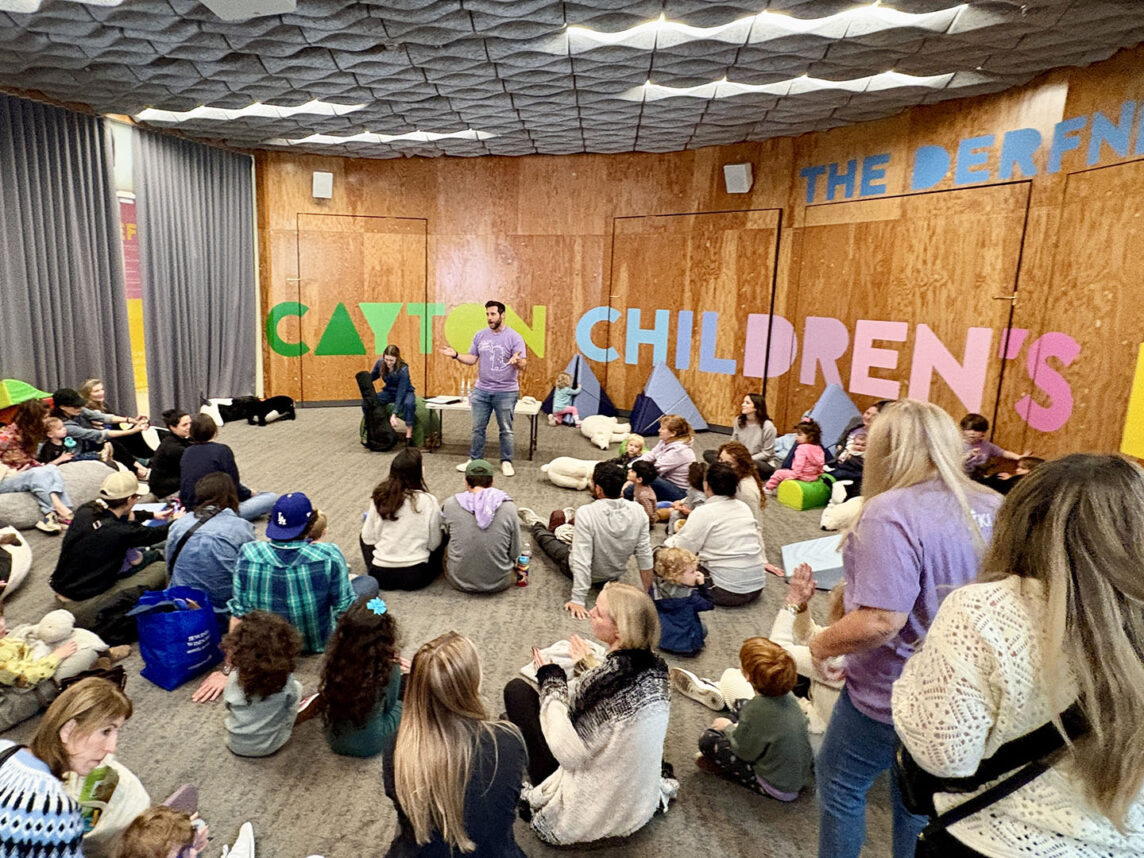
It is in this temporary space that I found myself standing with them earlier today, eyes closed as instructed by the Rabbi just before reciting the Sh’ma. The room quieted somewhat – as befits an open circular gathering space filled with at least 30 young children and their parents and caregivers, as well as the Pre-School teachers and clergy. As Rabbi Sher told me as everyone gathered, “these kids have a superpower – joy – and we are going to harness that.”

In that moment between closing my eyes and the Rabbi beginning to recite the Sh’ma, I had such a powerful flashback that had the wall I was leaning against in the back not been there, I might just have toppled over. Eyes closed, I was suddenly transported back to B’nai Jeshurun Synagogue on the Upper West Side of Manhattan the week after 9/11, where I, five months pregnant with our second child, was at a similar tot shabbat service with our then two year old. And my eyes flew open. I realized as I looked around this gathering of people seated on a floor in the museum, that I felt what I had felt then: enveloped in the warm embrace of the community. And I took a deep breath.

Overcome, I kept looking around this room. Toddlers and babies sat in their parents’ laps or scurried around. Parents hugged each other, wiped away tears. Many had lost everything, and yet here they all were: mothers and fathers and caregivers and teachers and of course, babies and toddlers, gathered to engage in one of our most sacred rituals. They were here to be present and engage in the time-honored ritual of Shabbat. Healing and recovery will take time; fortunately Shabbat gives us all a respite of time.

One of the teachers, Amy Batz, spoke of how nice it felt to just be with the kids this morning, to feel the sense of community. A bit of normalcy. The Rabbi encouraged us all to take a deep breath, and maybe another. To engage just as it had been practiced in the actual Kehillat Israel building – and in so doing, this pre-school community protected the sacredness of their weekly tot shabbat ritual.

Practicing these foundational rituals helps to ground us, to bring back the familiarity. This even extended to all of the children receiving a brand-new Dinosaur t-shirt, something that they wear each week to usher in Shabbat.

KI is deeply rooted in the Palisades community. Many that I spoke to have been longstanding members, even multi-generational members, celebrating all their simchas there. Rob Ellison, a father of three, spoke to me of having been a part of the pre-school for the last 10 years. Their youngest is set to graduate this Spring. His family has deeps roots at the synagogue. That KI is standing, that he is a part of this community, gives him a sense of hope that they are loved and supported and will get through this.

“KI is strong & resilient,” said Lauren Lev, a longtime staff member. It’s not only their internal community that is coming together though. It is also through the community at large that has stepped up. What a joy to come together, to begin the healing process and celebrate tot shabbat in a children’s museum overflowing with the noise and pitter patter of children running around the space where we were.

The prayers were said. The songs were sung. A few tears were shed. As the service came to its’ conclusion, the Rabbi introduced the final song, Oseh Shalom. He spoke of an enduring quality of the Jewish people is to never stop wishing for peace & healing in the world at large, even when we ourselves need healing.

We are Jews in the Diaspora; by definition we come from somewhere else. We have moved often; and will move again. And the community of KI will move too, perhaps in ways in may not be able know today, but given the strength and love that I witnessed this morning in their tot shabbat, they will move forward with grace and grit.

Shabbat shalom.


Dr. Beth Ricanati is a physician, speaker and the author of “Braided: A Journey of a Thousand Challahs,” a finalist for the National Jewish Book Award.

Kehillat Israel Resumes Tot Shabbat After the Fires Read More »
Bibi’s Bind

Donald Trump warned Hamas that unless the hostages were returned by Inauguration Day, “All hell will break loose.”

After 15 months laughing at Joe Biden’s bumbling foreign policy, where Israel had an unqualified right to defend itself so long as it didn’t kill any Gazans, where promised munitions to the Jewish state were delayed and humanitarian aid stolen by Hamas was blamed on Israel, the leaders of Hamas—whoever was still left standing—must have been startled that America had elected someone with the true grit to issue a true threat.

Clearly without Trump’s return to the Oval Office, no Israeli and American hostages would be released this past weekend—or possibly ever. Israel didn’t need 15 months to end this war. It could have been over soon after it began—and with more hostages still alive. All that Israel required was to have its American ally bolt the door on the gathering mob of hectoring antisemites and get out of the way.

Israel didn’t need 15 months to end this war. It could have been over soon after it began—and with more hostages still alive. All that Israel required was to have its American ally bolt the door on the gathering mob of hectoring antisemites and get out of the way.

We are, however, where we are. But make no mistake: this negotiated ceasefire that will unfold in stages will not end well unless Trump, and his entirely revamped American foreign policy team, ensures that all remaining hostages are released, the remains of dead hostages are returned, and all members of Hamas, Islamic Jihad and Palestinian “civilians” who participated in the October 7 massacre pay the ultimate price for their crimes.

Because the resolution to the conflict, as it now stands, positively stinks. In the Middle East version of “Let’s Make a Deal,” I would have preferred skipping over this gambit and going to straight to Door Number 2: the “All hell will break loose” option. I am curious to know what hell would look like for the millions of Palestinians still cheering for Hamas and celebrating the bloodbath that will forever be remembered as October 7.

Almost instantly after these ceasefire negotiations were announced, Gazans took to the streets to bizarrely exult in some psychotic victory. If Gazans are celebrating the death of 44,000 of their own people and the ruination of the entire Strip, then this war is far from over.

Cheering in the streets is a telltale sign that Gazans have not quite had enough, and that Hamas’ promise of several more reenactments of October 7 is something they are all actually counting on.

The world needs to understand what Israelis have long known: Palestinians are notably unlike the Confederate states at Appomattox, the British at Yorktown and Napoleon at Waterloo. They don’t seem to know when they have been defeated. Even complete decimation, in their minds, is construed as a win. Reality never sinks in. Such is the depth of their Jew-hating delusions.

The world needs to understand what Israelis have long known: Palestinians are notably unlike the Confederate states at Appomattox, the British at Yorktown and Napoleon at Waterloo. They don’t seem to know when they have been defeated.

This realization cannot be underestimated. All of Trump’s primary Cabinet secretaries testified this past week that there can be no Hamas in a reconstituted Gaza. But pursuant to the deal, Israel is scheduled to release 730 Palestinian prisoners, many of whom had either murdered Israelis or built weapons that were used for that purpose.

Once returned to Gaza, the West Bank or elsewhere, expect none of them to have found religion—other than the one where they are already devout believers, the very same one that obliges dead Jews as an article of faith. No matter what this negotiated ceasefire expressly states, these newly freed Palestinians will most certainly return to the only actual “occupation” that applies to them: terrorism.

And what does Israel receive in return? Three hostages at the outset, followed by 30 of the 90 believed to still be alive.  Remember, the hostages were innocent civilians—elderly and children—who had been kidnapped and held for ransom and as bargaining chips for extortion. If the unbalanced moral ratio to this exchange sounds absurd, well, . . . it is.

Israelis know this to be dangerously true. But a sizable majority are prepared to accept even a bad deal if it means the eventual return of hostages. Will they all make it back? Are 90 still alive?

All throughout these negotiations, Hamas sought better terms on Palestinian prisoners because it knew what many terrorist aficionados had already suspected: the cards Hamas was holding consisted of far too many dead hostages. That’s not a good look when you are trying to focus the world’s attention on dead Gazans killed by genocidal Israelis.

This legerdemain worked because it was only Israel that was expected to uphold humanitarian standards. The barbarism of Hamas was given a Palestinian pass.

Israeli Prime Minister Benjamin Netanyahu has largely supported this defective deal. He had little choice. He had to trust Trump and not undermine the new president’s Day 1 demand. But didn’t Trump mean all the hostages? Why are we still negotiating with terrorists? Why are we not unloading the Trumpian hellscape on Gaza?

In order to finalize this done deal, Netanyahu had to convince his War Cabinet and governing coalition of its merits. He knew that ultranationalists like Finance Minister Bezalel Smotrich and National Security Minister Itamar Ben Gvir would refuse to release any prisoners and thus add to the population of terrorists. Everyone knows that, as it has always done in the past, Hamas will renege on its commitments. By then, Israel’s wartime pause would have normalized. A decision will then have to be made whether to reset the clock and resume the war or accept the status quo.

Once soldiers return home, a nation naturally loses its will to send them back into battle. Hopefully Israel will at least retain a military presence in the Philadelphi Corridor where Gaza and Egypt share a border. That’s where Hamas doubtlessly smuggled in its arsenal that set this war in motion and allowed it to continue.

Bibi is in a bind. Israel needs to see the return of some hostages: especially the elderly and children. But he also wants to retain his new title as Winston Churchill reincarnate—a far more heroic legacy than being remembered for the national security debacle that was October 7. He was on the precipice of vanquishing Hamas and Islamic Jihad, once and for all.

Obviously, Bibi is betting that Trump will not interfere if after the 42-day ceasefire all hostages are not returned, too many are no longer alive, rockets are still being fired and Hamas appears to be reconstituting with new recruits and old aspirations.

That’s not something Israel can accept, and the world needs to be prepared that this ceasefire could reignite.


Thane Rosenbaum is a novelist, essayist, law professor and Distinguished University Professor at Touro University, where he directs the Forum on Life, Culture & Society. He is the legal analyst for CBS News Radio. His most recent book is titled “Saving Free Speech … From Itself,” and his forthcoming book is titled, “Beyond Proportionality: Is Israel Fighting a Just War in Gaza?”

Bibi’s Bind Read More »

When We Trade 1900 Palestinians for 33 Israelis, Aren’t We Insulting Palestinians?

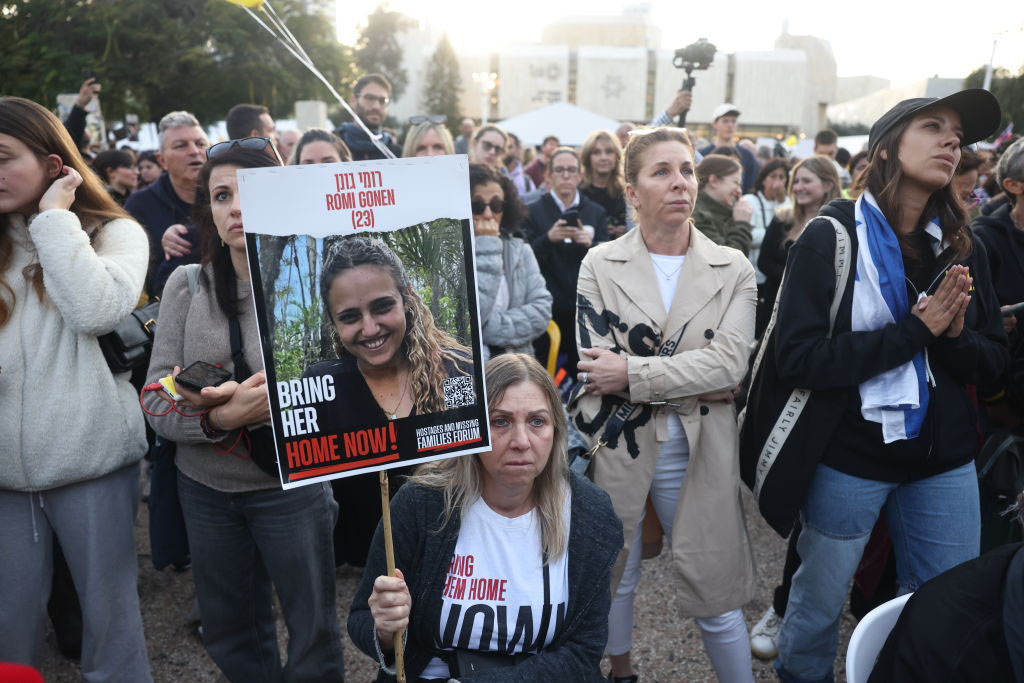
As I watched the heartwarming scenes of Romi Goren, Emily Damari and Doron Steinbrecher returning home after 15 months of Hamas hell, I couldn’t help thinking of other numbers: specifically, the more than 1900 Palestinians who will be released from Israeli jails in return for 33 Israelis as part of phase one of the ceasefire deal.

I wasn’t thinking only of the obvious– that it is horrible to have to release murderers who are sure to murder again. I was thinking also of a moral equation that rarely comes up when we evaluate these exchanges.

For some reason, we automatically assume that Israel must release scores of Palestinians in return for a few Israelis. The height of that imbalance, of course, came in 2011 when Israel released 1027 Palestinian prisoners in return for one Israeli hostage, Gilad Shalit.

That imbalance may be extreme, but it’s not without logic. One side pays what it feels it needs to pay, while the other side charges what it can get away with. The buyer and seller, in other words, agree on what the desired prize (one Israeli) is worth, just as in business.

But by treating human lives with the cold calculus of economics, both sides fall into a moral trap. Israel insults Palestinians by showing how one Israeli life is worth numerous Palestinian lives, while Palestinians are forced to swallow the humiliation of that immoral equation.

I’m not being naive. I get that Palestinians have an interest in getting as many Palestinians released as possible, and that Israel has an interest in doing everything it can to free a captive, one of the highest Jewish values.

That pragmatic approach, however, has forced the parties to publicly display something highly embarrassing: they both see Jewish lives as a lot more valuable than Palestinian lives. After all, if the lives were seen as equally valuable, wouldn’t it be more dignified to trade one for one? For an Arab culture that so values honor, wouldn’t that be the more honorable thing to do?

Indeed, if we’re going to get into the vexing issue of human worth, if anything the imbalance would go in the other direction. Should the life of a terrorist, for example, be worth as much as the life of an innocent hippie who attended a music festival? How would we calculate that equation? Thirty music lovers for one terrorist with blood on their hands? Maybe 50?

But let’s not even go there. Let’s just stay with the religious ideal that we are all created in God’s image, a phrase from the Bible that describes the inherent value of all humans. If we believed in that moral dictum, all human exchanges would be equitable.

How ironic, then, that Hamas follows a charter that claims religious superiority over Jews. Evidently, when the opportunity arises to wheel and deal, they suddenly don’t mind seeing those same Jews as superior.

When We Trade 1900 Palestinians for 33 Israelis, Aren’t We Insulting Palestinians? Read More »