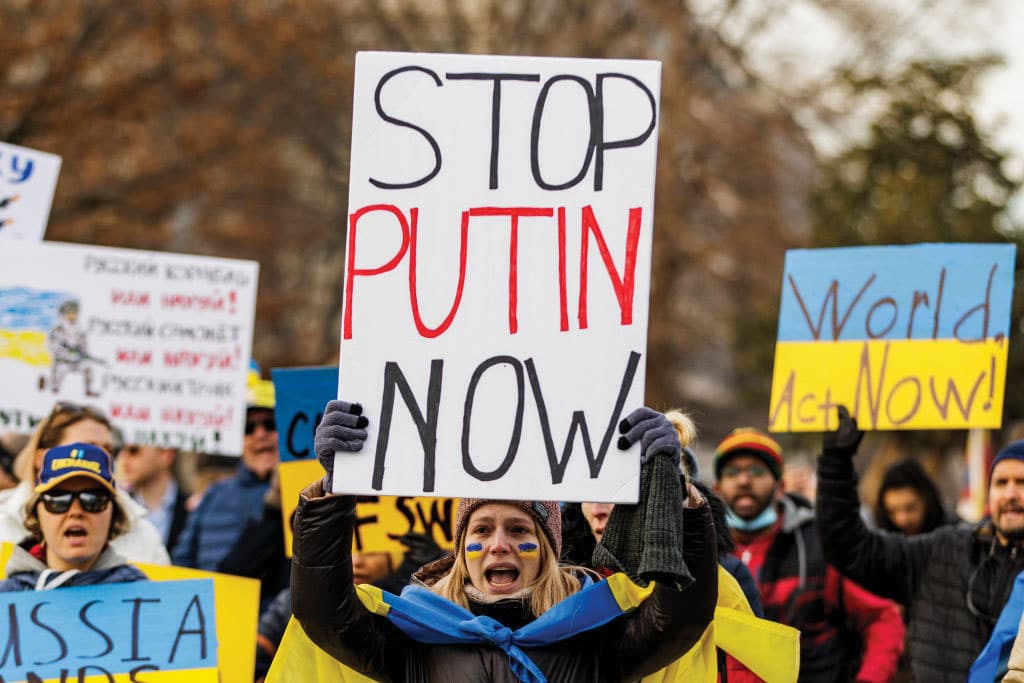
The conventional wisdom is that Vladimir Putin’s naked aggression toward Ukraine is taking us back to more primitive times. Indeed, for most of human history, it was raw power that ruled. If a tyrant wanted something, he just took it by force.
The establishment of international norms and institutions in the wake of World War II was an attempt to regulate and minimize this gratuitous application of power. It didn’t always work, of course, but at least there was a sense that the world was headed in a more civilized direction.
Now we come to a critical juncture: If Putin prevails in his brutal land grab of Ukraine, it clearly will set us back. But if he doesn’t, the outcome may well be a reaffirmation of civilized norms.
Here’s the encouraging news: The reaction to Putin’s aggression has been so severe and brutal he may, in fact, not prevail.
First, in terms of the military campaign, Putin has already been humbled by the ferocious response of the Ukrainian people and its army. If Putin assumed he would march into Ukraine and depose its rulers within a few days, he’s been hijacked by reality. However this invasion ends, he’s already lost some of his winning mystique.
Second, his global isolation is stunning. We’re not hearing about intense debates and disagreements among Western powers on how to respond to Putin’s aggression. The Russian strongman may have assumed he could easily withstand any sanctions, as he has in the past. The problem is that he’s never seen sanctions like these.
As The New York Times reported on Monday about repercussions in Russia, “The ruble cratered, the stock market froze and the public rushed to withdraw cash on Monday as Western sanctions kicked in and Russia awoke to uncertainty and fear over the rapidly spreading repercussions of President Vladimir V. Putin’s invasion of Ukraine.”
These unprecedented sanctions, which represent a kind of financial war against Russia, have given Putin a taste of his own medicine: You like aggression, we’ll give you aggression, only ours will be through banks, not tanks.
These unprecedented sanctions, which represent a kind of financial war against Russia, have given Putin a taste of his own medicine: You like aggression, we’ll give you aggression, only ours will be through banks, not tanks.
He’s been so enraged by this financial aggression that he declared Sunday he was putting his nuclear forces into “special combat readiness” — a heightened alert status that harked back to some of the most dangerous moments of the Cold War.
There’s another reason why this war has not gone swimmingly for Putin: He underestimated the extent of domestic opposition. His people have not bought the propaganda that Ukraine is a violent regime that has aggressed Russia and needs to be “denazified.” No one but his closest cronies believe that, as he told Israeli Prime Minister Naftali Bennett, he had “no choice” but to invade.
His old-school, KGB-era propaganda tactics are no match for the liberating universe of social media. As internal opposition grows, Putin will have no choice but to smother it with brute force, which will further alienate him from a public that never wanted this war against their Ukrainian cousins.
If Ukraine continues to resist and Putin calculates that a decisive victory is no longer realistic, we should watch for any effort by Putin to create an impression of “victory.” He knows he can’t afford to lose face.
If Ukraine continues to resist and Putin calculates that a decisive victory is no longer realistic, we should watch for any effort by Putin to create an impression of “victory.” He knows he can’t afford to lose face.
His problem is that even if he “conquers” Kyiv and deposes Zelensky, he’ll be too hated and isolated to reap the fruits of that battle. Ukrainians will be sufficiently enraged to make any Russian presence in Ukraine living hell for years.
My hunch is that if the financial pain inflicted on Russia keeps increasing, Putin will use the “negotiations” in Belarus as a way to retreat while saving face. That retreat, however, will be hard to camouflage.
It will signify not just a defeat for tyrants everywhere, but a victory for history.