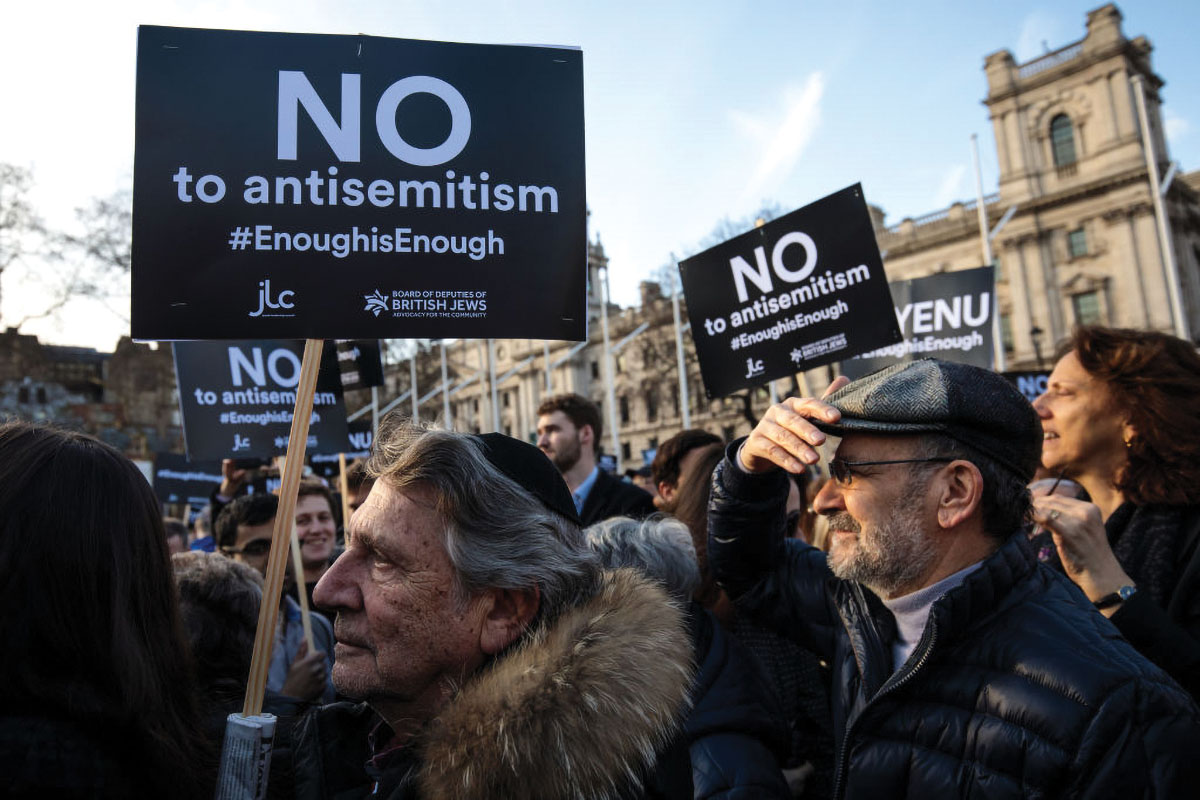

I closed last week’s column by referencing the two-front challenge that the American Jewish community faces in our country’s deeply divided political landscape. The recent controversy over conservative commentator Tucker Carlson’s obsequious interview with notorious Jew-hater Nick Fuentes has roiled the Republican Party. Almost simultaneously, Democratic Socialist Zohran Mamdani was elected mayor of New York City by a sizable margin. Which means that neither of the battles on those two fronts will de-escalate anytime soon.
These twin reminders intensify an already-difficult dilemma for the growing number of American Jews who no longer feel comfortable in either major political party. There was a time in the past when Pat Buchanan’s racially-charged nationalism represented only a tiny sliver of the GOP. More recently, many Democratic leaders dismissed the election of Alexandria Ocasio-Cortez, Ilhan Omar and their fellow Squad members as only four outliers in an otherwise strongly pro-Israel party congressional caucus.
But the extremes continue to ooze inward from the fringes, and the number of Democratic leaders who dutifully endorsed Mamdani’s candidacy and the equally disconcerting number of Republicans who have ignored or minimized the spectacle of a leading conservative commentator’s overt embrace of an avowed anti-Semite, are evidence that both parties now harbor a rapidly increasing number of members who exhibit unbridled animosity toward the Jewish state.
Of equally significant concern are those Jews who tacitly approve such hateful conduct. Very few members of our community have verbally supported these bigots, but their willingness to overlook such prejudices within their own party’s ranks (this impacts both parties, for those of who afflicted with selective outrage) acts to enable such behavior by reassuring party leaders that they can tolerate such behavior in exchange for ideological agreement on other issues.
We are beginning to see an increase in the numbers of those who will attempt to run independent candidates for Congress next year and it is very likely that those candidates, free of the obligation to accept ethnic or religious intolerance among a party’s outliers, will be disproportionately pro-Israel. But it will still be some time before a third party or independent movement attracts a sufficient following to provide additional options to most voters. In the meantime, how does the Jewish community choose between two parties seemingly so comfortable with ani-Zionists and anti-Semites within their ranks?
The answer is that we don’t. It has been twenty-five years since Israel was a vote-determining issue for most Jewish Americans. But these challenges rise to another level and a stronger and bolder response from our community is overdue. As long as either the Republicans or Democrats are willing to harbor the haters, they should no longer be rewarded with knee-jerk loyalty from our community.
According to polling and voter registration, American Jews who regularly vote for Democratic candidates outnumber Republican partisans by roughly a 2-1 margin. That is unlikely to change even if we decide to become more selective in our candidate support. But without fully renouncing either party, our post-Gaza and post-Fuentes community should be willing to cross party lines to reward Israel’s supporters and deny our detractors.
Even as the ranks of anti-Semitic zealots continue to grow, there are still stalwarts who deserve our assistance even across party lines. For the American Jews who vote Republican, I would point you to U.S. Representative Jake Auchincloss (D-MA) who last week bravely became the first Democratic member of Congress to oppose the Senate candidacy of Graham Platner, the Maine oyster farmer who sports a Nazi tattoo. For the majority who are loyal Democrats, take a moment to appreciate the courage of Senator Ted Cruz (R-TX) who has continued to lead the charge demanding Republicans renounce not just Fuentes but Carlson.
If we limit our decisions to whether a candidate has a “D” or an “R” after their name, few among us will cross party lines to congratulate a defender of the Jewish state and the Jewish people. The unhappy result of such close-mindedness is that more and more of us will reside in a party with little use for us. We can do better. We must.
Dan Schnur is the U.S. Politics Editor for the Jewish Journal. He teaches courses in politics, communications, and leadership at UC Berkeley, USC and Pepperdine. He hosts the monthly webinar “The Dan Schnur Political Report” for the Los Angeles World Affairs Council & Town Hall. Follow Dan’s work at www.danschnurpolitics.com.