
I have always believed that Jewish fathers are often an overlooked, but generally wonderful bunch who, for various reasons, can be overshadowed by the colorful heroines known as Jewish mothers. In honor of Father’s Day, I decided to ask several colleagues about their fathers’ legacies, their quirks, and the lesser-known things that have made these Jewish dads deeply loved, and in some cases, deeply missed.
The Creative Genius
In 1950, Jess Oppenheimer pitched an idea for a sitcom to CBS: “Why don’t we do a show,” he offered, “about a middle-class working stiff who works very hard at his job as a bandleader, and likes nothing better than to come home at night and relax with his wife, who doesn’t like staying home and is dying to get into show business herself?” Oppenheimer became the creator and head writer of “I Love Lucy,” and the rest is television history.
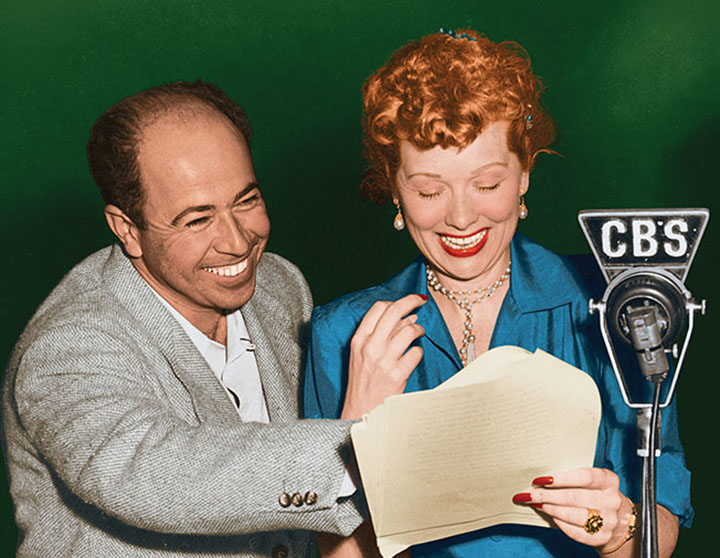
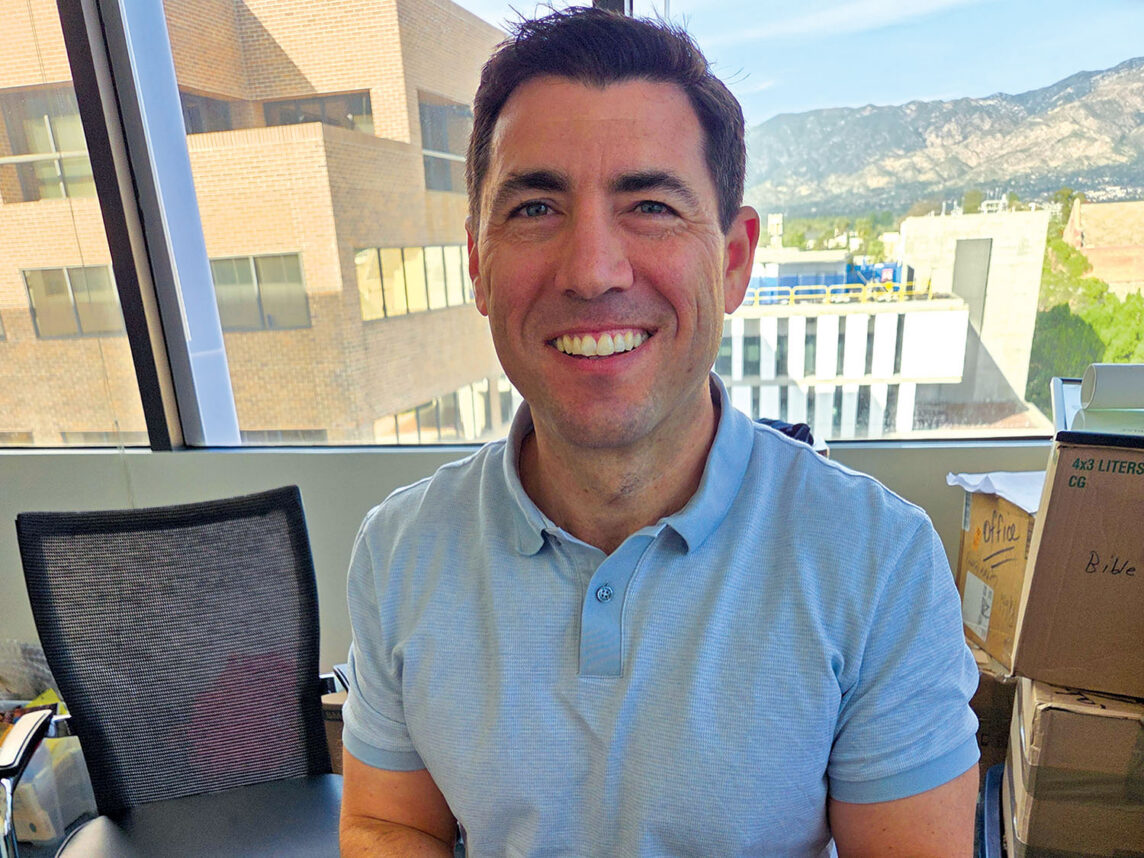
Photo courtesy of Gregg Oppenheimer.
Yes, a Jewish father was responsible for one of the greatest sitcoms on TV. Oppenheimer passed away in 1988, inspiring his son, Gregg, to quit his job as a successful lawyer and complete his dad’s memoir, “Laughs, Luck…and Lucy: How I Came to Create the Most Popular Sitcom of All Time.” I asked Gregg, a Santa Monica-based writer-director, to share more about his hilarious father, who based the episode in which Lucy tries to restore Ricky’s hair on his own futile attempts to slow down his fast-receding hairline.
Jewish Journal: Growing up, did you realize that your father was responsible for the greatest sitcom on television? Did he seem to realize it himself?
Gregg Oppenheimer: My dad and I used to talk about all sorts of things, including his work on “I Love Lucy.” When making the show, they knew they were working on something special, mostly because of Lucy. As Dad put it, “I don’t know enough superlatives to do her justice.” But they weren’t thinking about its place in history. They all were just deliriously knocking themselves out to put the show on the air each week. I was only six years old when the series ended, so at the time I certainly wasn’t thinking of it in historical terms. But I always loved the show, and I was always extremely proud of my dad’s work on it.
JJ: Did your father ever convey advice to you about writing, directing, or producing?
GO: I remember my dad explaining to me that for farce to work, it has to either be about believable people in an unbelievable situation, or unbelievable people in a believable situation. And that as long as you take the audience one step at a time, you can go to the heights of slapstick comedy and outlandish situations. But each and every step has to be logical. Otherwise, you can lose the audience completely.
The other thing he impressed upon me was that to be a success in show business, no matter how talented you are, you need to be incredibly lucky. Talent, even great talent, isn’t enough. In fact, that’s just the price of admission. That’s why I called his memoir, “Laughs, Luck…and Lucy.”
JJ: Is there something that most people did not know or realize about your wonderful, late father?
GO: Dad loved tinkering and building things. He had 18 patents, covering all sorts of inventions. His most successful was the “in-the-lens” teleprompter — the thing that enables news anchors and presidents to read words from a prepared script while looking directly into the camera. The first ever to use it on television were Lucy and Desi, in a commercial. Obviously, Lucy and Desi were more than capable of memorizing the commercial, but they agreed to use it so that Dad could see how well it worked.
The Jewish Sage
For many Iranian Jews, the surname “Shofet” holds a treasured meaning. For much of the twentieth century, the late Chacham (Rabbi) Yedidia Shofet, z”l served as former Chief Rabbi of Iran. After fleeing Iran with his wife, Heshmat, and their children amid the antisemitism and violence of the 1979 Islamic Revolution, Rabbi Shofet and his family picked up where they had left off, establishing Nessah Synagogue and Cultural Center as a space for newly-arrived Iranian Jews, most of whom had found themselves as refugees, to retain their nearly three-millennia connection to their Jewish faith, and to one another.

The community mourned in unison when Rabbi Shofet passed away in LA in 2005. His son, Rabbi David Shofet, who was born in Kashan, Iran, and later moved with his family to Tehran, has lovingly served as a religious leader for the community, and has published countless volumes of books, essays, and pamphlets on Iranian and Sephardic Jewish life. His son, Rabbi Yedidia Shofet, is also well-known in LA and is named after Rabbi David’s father. I asked one of his daughters, Liora Shofet-Refua, to tell me more about her visionary father.
Jewish Journal: Your father is descended from 12 generations of rabbis. To those who know him or who frequent Nessah Synagogue, he is known to be poised, focused, and even serious. But please tell me about his lighter side, the side of him that you loved best while growing up (and perhaps his grandchildren enable him to express today).
Liora Shofet-Refua: My dad’s been seen as a serious individual by the community, but he definitely has his lighter side, whether it’s by sharing a good sarcastic joke (the jokes shared in his native Judeo-Kashi dialect make him laugh the hardest), cooking at home, or more recently, spoiling his grandkids with birthday money or Afikomen presents. I think one incident that stands out to me that encompasses my dad’s lighter side happened many years ago, when we were walking home from Bet Knesset (synagogue) one Shabbat. A congregant driving in his car pulled over and offered us a ride home. My dad replied, “No thanks, it’s not a Shabbat car!” (It was funnier in the original Farsi.)
JJ: As one of the main religious leaders of the Iranian American Jewish community, your father must have heard it all, especially because he is known for his compassionate, yet rational advice and mediation to those who were/are struggling. How has he been able to separate the pains, complaints, and traumas that our community of refugees and immigrants often brought to him from his own well-being and hopefully more peaceful home life?
LSR: I think that’s my dad’s superpower! He definitely has heard and seen it all, but he was always able to compartmentalize it as his role of a community leader, and never, ever brought any of that baggage home to us. I think that it was a skill he inherited from his father, and today, it’s something my brother, as the next generation rabbi, has been able to develop as well.
JJ: What is the one guilty pleasure that the legendary Rabbi David Shofet cannot resist, whether a food, a game, a song/show/film, or anything else?
LSR: Any homemade food made by our family (Persian or otherwise) and following professional football and basketball.
JJ: In one sentence, can you summarize your father’s ultimate approach to Judaism and to strengthening our connection to Hashem?
LSR: Thank Hashem for all that you have, learn Torah, invest in Jewish education, love Eretz Yisrael, and help your fellow Jew.
“Hanukkah Harry”
Elected in 2016, California State Senator Henry Stern represents The Golden State’s 27th Senate District, which spans Los Angeles to Ventura. His father, Daniel Stern, is best known for playing the role of Marv, one of the burglars in the first two “Home Alone” films, as well as serving as the voice of an adult Kevin Arnold in “The Wonder Years.” Today, he lives on a farm in Ventura County, where he lovingly grows citrus and creates beautiful bronze sculptures.
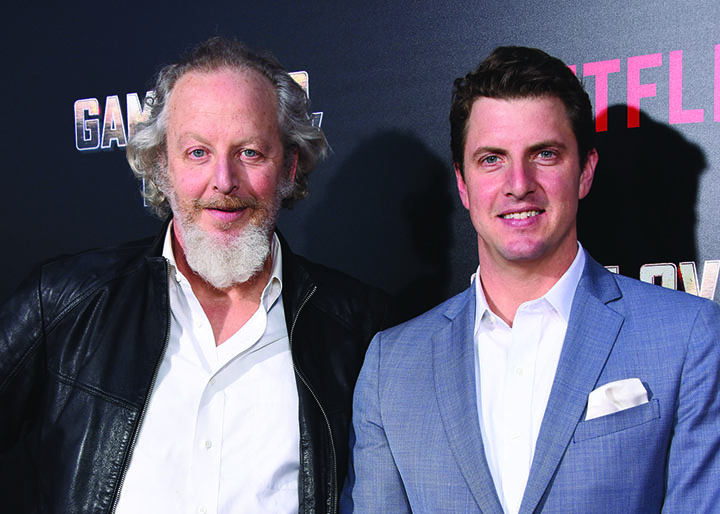
A proud Jewish legislator who is known for championing community and environmental resilience, Senator Stern began our interview by praising his late father-in-law, Joshua Kaufman, whom I also honor in this week’s column (see below). “My dad will be honored he made the cut alongside a giant such as Joshua,” said Stern. “My dad revered Joshua. Whenever ‘Home Alone’ would be on, he [Joshua] would always comment admiringly, as a real-life plumber, about my dad’s plumbing truck in the movie. In fact my dad still has Joshua’s plumbing truck on the farm!”
Jewish Journal: At age 21, you joined your father for a USO tour in Iraq. What did you see, and how did that experience impact your decision to enter politics?
Henry Stern: You might think it’s comedy — but service is really what’s in our blood. His father Leonard Stern (z”l) worked for the Kennedy and Johnson administrations. Lenny rose up the ranks from the son of an immigrant truck driver in Philadelphia from B’nai Brith to the U.S. Army all the way to Kennedy’s Department of Justice. So when my dad and I were protesting the Iraq War when I was in college, it was only natural that we decided while marching around the streets of New York, that we should also put our feet in the shoes of those who serve. And to thank them. Even if that war didn’t make sense. It’s that same spirit that feeds my work in the Senate now, where I represent a huge range of political views — chasing justice, but incessantly looking for common ground where there is seemingly none.
JJ: What has your father’s humanity and low-key lifestyle, one that inspires him to pursue his true passions and live his own way, taught you about what is truly important in life?
HS: Low-key, yes, but diligent. Don’t be fooled by his farm mystique: my dad works his tail off. The man has lists upon lists. He is the most efficient and self-directed person I have ever met. And I’ve met presidents, governors, mayors, and CEOs. So you might think the lesson I learned was to take it easy. And don’t sweat the small stuff. Quite the opposite. Sweat the small stuff. Details matter. Creativity matters.
JJ: Please share a moment of Jewish connection between you and your father that holds special meaning for you.
HS: Hanukkah Harry. This somewhat mythical figure my dad introduced me to as a little kid, would show up at our house every Hanukkah, apparently on a magic carpet pulled by golden retrievers. He would usually leave behind a half-empty bottle of tequila, some words of wisdom in a handwritten letter, and a wild tzedakah project. One year, fruit trees appeared in our backyard that we had to haul to a park nearby. Another year, a wild goose chase eventually led us to turn on a ceiling fan stacked with one dollar bills — with that pile of money we went to the toy store to buy toys for kids who didn’t have any.
JJ: Finally, as a child, were you amused or frightened to have seen your father suffer one blow after another in “Home Alone” films? He was great!
HS: Every kid has those moments of being embarrassed by their dad. But not every kid gets to watch his dad embarrass himself in kids’ living rooms across the world. I will admit though, it still cracks me up watching him fall down the stairs.
The Iron-Willed Survivor
It has been two years since Joshua Kaufman, a beloved community member, speaker, and Holocaust survivor passed away on June 6, 2023. Kaufman survived Auschwitz, lost around 100 extended family members in the Holocaust, served as a slave laborer at Dachau concentration camp, and was liberated at the age of 17. In 2015, a History Channel documentary titled “The Liberators: Why They Fought,” captured his reunion with the American GI who liberated him. During the 2019 State of the Union address, Kaufman was recognized for his life, loss and courage.

Kaufman served in the Israel Defense Forces for 25 years, including during the wars of 1956, 1967, and 1973. In 1975, while a tourist in America, he met a Hungarian survivor named Margaret. On their first date (at Universal Studios), Kaufman declared his life and asked Margaret to marry him.
For years, his iconic plumbing truck was a beloved sight in West LA. I asked Rachel Kaufman, one of his four daughters, to tell me more about her extraordinary late father.
Jewish Journal: Your father, z”l, didn’t fully open up about his experiences during the Holocaust until 2017. What do you think influenced his decision to finally speak with his daughters about his life, and to offer official testimony to the Shoah Foundation?
Rachel Kaufman: My father had a soft spot for children. A [local] bar mitzvah boy asked him to speak at Emek Hebrew Academy. My father had never spoken before to an audience, so I wrote up a short biography and then the students came up with questions. Maybe it was easier for him to speak to other children, but when he raised us, he never wanted to share his story. A few months later, we were invited to Germany by The Dachau Memorial. He was 85 when he returned, accompanied by his four daughters and grandson. It was 69 years after liberation and the first time he said yes to recording his testimony. I think that child opened up a well that my father had blocked off, and from then on, he said yes to speaking engagements.
JJ: Your father passed away roughly four months before October 7, 2023. Had he been here for that terrible day and its shocking aftermath, what messages do you think he would have shared with his Jewish brethren, young and old?
RK: As someone who lost a lot himself in the Holocaust and Israeli wars, he would strongly identify with the pain of the loss and suffering, but nonetheless, he would encourage this generation to focus on the future, to figure out how to move forward, to rebuild. “The more they hate and try to destroy us, the more we have to love one another and rebuild,” he would say. If he was alive, I think he would accept any speaking engagement to strengthen and inspire Am Israel.
JJ: Your father was known to and beloved by many in Los Angeles. Can you share a lovable, but little-known fact about him?
RK: His unconditional love for my mother Margaret z”l. When my father would visit my mother, Margaret, z”l, in the skilled nursing facility and he found her resting, he would sit by her side and wait until she awoke from her slumber. During Covid, he would park his plumbing truck across the street and stand with an Israeli flag, and a nurse would wheel her to the window. He was hard of hearing, and her vocal cords were compromised, but when he was finally able to visit and they were seated six feet apart, he sang and danced to cheer up her spirits, and the love was tangible.
Happy Father’s Day to all of the dads whose love, support, sacrifice, and vision have nurtured us for generations. And to my own father: Anyone who spends a few minutes with you understands that you were put on this Earth to be a father (and grandfather). It is your essence and your purpose. Thank you for everything you have done for me. Most of all, for all of the sacrifices and backbreaking work that I never saw. To 120, Dad.
Tabby Refael is an award-winning writer, speaker and weekly columnist for The Jewish Journal of Greater Los Angeles. Follow her on X and Instagram @TabbyRefael