
Last week the Safra Center in New York City held an event commemorating the 20th anniversary edition of Rabbi Jonathan Sacks’ “A Letter in the Scroll,” and his upcoming fourth yahrzeit. I sat down in the packed synagogue and looked up at a compilation video of Sacks speaking at different events through the years.
I took one look at his face, and my whole body relaxed. For one brief moment, the tsunami of hate, lies, and violence that now fills our lives faded into the background. His face represented everything that’s been missing: A rabbinical figure who is warm, wise, sacred — who fully represents G-d — and can help us put today’s ugly reality into a larger historical perspective.
His face represented everything that’s been missing: A rabbinical figure who is warm, wise, sacred — who fully represents G-d — and can help us put today’s ugly reality into a larger historical perspective.
The video that followed is perhaps his most cherished: “Why I am a Jew,” based on the final chapter of the book. At this point, there were very few dry eyes in the room.
“I am a Jew because, being a child of my people, I have heard the call to add my chapter to its unfinished story. I am a stage on its journey, a connecting link between the generations. The dreams and hopes of my ancestors live on in me, and I am the guardian of their trust, now and for the future.”
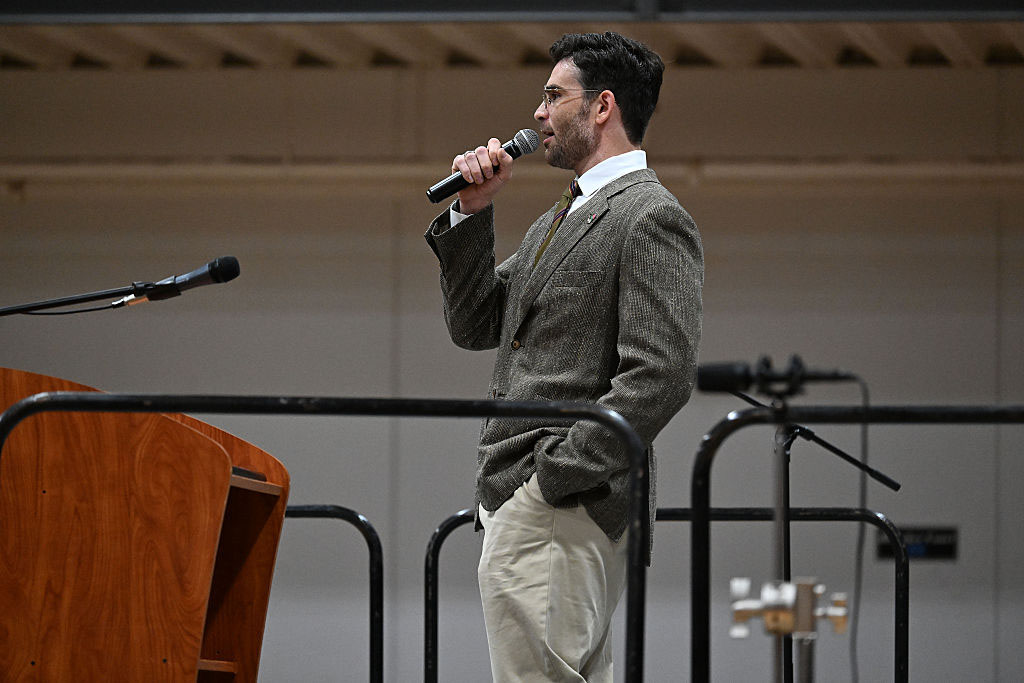
The panelists chosen to discuss Rabbi Sacks’ timeless relevance were well up to the task: Natan Sharansky, who has been appointed the Chair of the Global Advisory Board of the Rabbi Sacks Legacy; Michal Cotler-Wunsh, Israel’s Special Envoy for Combatting Antisemitism; Dan Senor, columnist, podcaster and co-author of “Start-Up Nation”; and Rabbi David A. Ingber, the founding rabbi of Romemu, the largest Renewal synagogue in the United States.
“Rabbi Sacks was a moral lighthouse,” said Sharansky, who wrote the foreword for the new edition of the book. “And his light is needed more than ever in these dark times.”
“This is my people, my heritage, my faith. In our uniqueness lies our universality. Through being what we alone are, we give to humanity what only we can give.”
Michal Cotler-Wunsh said that Rabbi Sacks predicted today’s collapse of morality in his last book, “Morality,” and told the audience, “the outrage of the world was at us for refusing to be slaughtered.” Before Oct. 7, “we were living through an anomaly in Jewish history.” This, she said “is the normal.”
But she also sees this as an “opportunity to strengthen our identity: we are a people. We have to lean into this next chapter.” She said that after Oct. 7 “140% of the people called up, showed up. As volunteers and reservists. And that is the most important notion of “Hineni, here I am, ready to heed Your call.”
“This is on us: We are deployed,” Cotler-Wunsh said. “We are one people with one past and one future. We have to fight.”
“I am a Jew because I cherish the Torah, knowing that God is to be found not just in natural forces but in moral meanings, in words, texts, teachings and commands, and because Jews, though they lacked all else, never ceased to value education as a sacred task, endowing the individual with dignity and depth.”
A couple of nights later, I went to a Shabbat event that can only be described as anti-sacred. Desperate to fit into today’s self-idolatry, it promoted an Instagrammed soullessness. I couldn’t imagine many of them showing up “when challenge calls,” unless they could get a selfie out of it.
I tried to see the evening through the larger historical cycle that the panelists discussed: We got through idolatry; now we need to get through today’s self-idolatry. But how is that going to happen when so many of our nonprofits, with the promotion of “influencers” and the Instagram self-adulation bubble, have become part of the problem?
“Though we have loved humanity, we have never stopped wrestling with it, challenging the idols of every age.”
A couple of days before the Safra event my son, now 15, had exchanged unpleasant words with a rioter holding a “F— Israel” sign. It was not the first time he had stuck up for our people, but I think it was the first time he fully understood the role his generation, Gen Z, is meant to play.
“People do not become leaders because they are great. They become great because they are willing to serve as leaders,” Sacks wrote. “What matters is the willingness, when challenge calls, to say, Hineni, ‘Here I am.’”
“People do not become leaders because they are great. They become great because they are willing to serve as leaders,” Sacks wrote.
In 2016, I had dedicated my “Passage to Israel” book to him, using the quintessential Sacks quote below. I pray that more parents begin to understand — using Rabbi Sacks’ extraordinary texts — that the fight for our children’s future begins with their souls.
“You are a member of an eternal people
A letter in their scroll.
Let their eternity live on in you.”
Karen Lehrman Bloch is editor in chief of White Rose Magazine.