fbpx

September 11, 2024

Intellectual Warrior

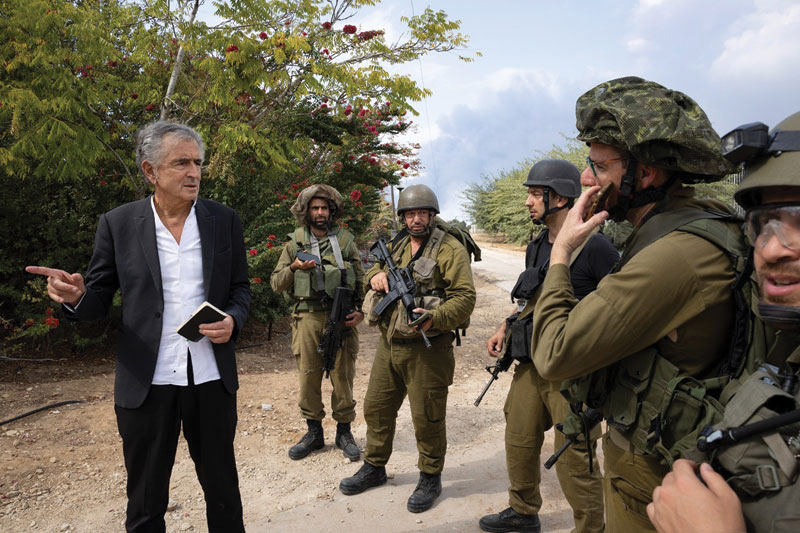
THANE ROSENBAUM: Bernard, we’ve been friends for many years. Even though you’re in France and I’m in New York, we share a lot in common. We’re children of immigrants; we’re both writers with interests in human rights and justice; you’ve made several films and I’ve written novels. Yes, we are separated by an ocean, but we can still take a walk and talk, digitally, about your latest book, “Israel Alone.” 

BERNARD-HENRI LÉVY: I am ready, my friend.

TR: This might be the first time in Jewish history when a French Jew and an American Jew, on different continents, can look out their windows and see the exact same thing. American Jews did not experience the Dreyfus Affair in the early 20th century. A French Jew’s experience in 1941 was vastly more perilous than for someone in Brooklyn. “Israel Alone” not only has this evocative title, but it reminds me of Émile Zola’s “J’Accuse.” Like Zola, you are sounding the alarm about a false accusation, this time not against a Jewish military officer, but a wrongly accused country, Israel. 

BHL: It’s true that if I look through my window and you look through yours, we see the same thing, and this is new, a first. Such a globalization of antisemitism has never happened in history. It’s a real globalization. People always speak of globalization, of the economy, of ecology, but never the globalization of antisemitism. From east to west, north to south, the word “Zionism” has become an insult, though for us, it’s a source of pride. It’s the name of a great, noble adventure. But elsewhere it has become infamous, an “offensive” word. And, yet, the hatred on the campuses is the same in Pakistan, at UCLA, and at Sciences Po. So this is tragically true, yes. I totally agree.

“Such a globalization of antisemitism has never happened in history.”

TR: Another area that we have in common is that after the massacre on Oct. 7, we both had the same impulse to respond with a book. I have a book about Israel coming out, as well. Your book is very much a literary memoir and intellectual polemic in defense of Israel. Mine is about the legal aspects of Israel’s response. We both ask: “Can Israel be honestly judged?” But even asking that question is a risk in this culture, since among writers and intellectuals, Israel is automatically judged guilty. There is a great deal of fear and self-censorship. Most writers would not undertake such a risk. 

BHL: For me, the biggest risk is not the fear of being shunned. I don’t care if I stand alone. In my professional life, very often I was alone: when I defended Darfur, when I pleaded for the bombing of Serbian militias around Sarajevo, when I went to Bangladesh at 24 years old, when I defended the Kurds or democracy in Syria. For me, the biggest risk is not standing for the truth. When you take the risk to think in medias res, in the middle of things, you take a huge risk — which is to be wrong. My way of writing is to write in the middle of events, when things are going on, to try to influence the events. My way of operating, as is yours, is serving as an intellectual weapon for people who need ammunition.

“For me, the biggest risk is not the fear of being shunned. I don’t care if I stand alone.”

TR: Like Zola.

BHL: Zola was a giant. But the method of Zola, yes, when he wrote “J’Accuse.” It’s not just to denounce a disgusting injustice; but it is to repair, to make a difference. To stop the process, to press the pause button on the madness.

TR: And not to analyze the aftermath.

BHL: No, that is left to history. It’s a noble activity. But I am writing here in the middle of the noise. My dream for this book is that at Harvard, UCLA, Columbia and MIT, it should be used and appropriated by brave young students who want to oppose the wave of fascism which invades the university under the Hamas flag. 

TR: But so few will are willing to take that risk. What you write in “Israel Alone” is simply not permitted on a university campus. This is the stifling world of universities right now. Will students have the intellectual freedom and courage to read what you have to say?

BHL: They have to earn this freedom, and fight for it. My modest contribution would be to help them stand up and make the argument,

TR: When we both looked out our windows, should we have been so surprised by what we saw? For instance, as a French Jew, you’ve lived in a country that saw Ilan Halimi tortured by a self-described gang of Islamist barbarians. Two Jewish grandmothers, one a Holocaust survivor, one torched in her apartment, the other thrown from her balcony. Both actions preceded by “Allahu Akbar!” The massacre at the Jewish day school in Toulouse. The kosher market killings in connection with Charlie Hebdo. I wonder whether your book was already in the making — France was a rehearsal for the Nova Festival. 

BHL: Oct. 7 was an “Event,” as I say in the book, an event with a capital “E.” Oct. 7 was unprecedented. Oct. 7 was without premonition, without announcement. It cannot be compared to what happened before — either in France or in Israel. It was a massacre of such barbarism. And then the cry of joy, this shameful howl of joy, that followed in so many places around the world.

“October 7 was unprecedented. October 7 was without premonition, without announcement. It cannot be compared to what happened before—either in France or in Israel. It was a massacre of such barbarism. And then the cry of joy, this shameful howl of joy, that followed in so many places around the world.”

TR: You mean celebration.

BHL: Celebration, yes. Including in America, including by professors whom I cite in the book, whom I name and shame in the book for having rejoiced over Oct. 7. This whole segment of history was morally inconceivable. Yes, of course, there was the killing of Sarah Halimi in Paris in 2017. In the early 21st century, France had become a place where you could kill Jews again in succession. This had not even happened in the 1930s.

TR: Exactly.

BHL: But what happened on Oct. 7, and the celebration that followed in United States and in Europe — this was something completely and significantly different in quality from all the rest. Again, it was an Event, which means that nothing foretold it.

TR: Or even to process the warning signs?

BHL: When the war is over, there will be investigations to find out what failed. How can it be that the best intelligence service in the world did not anticipate the attack? And so, we will probably discover that some pieces of information were known in advance. But the core of the problem is here: no one could believe what they heard; no one could even conceive it.

TR: Reminds me of an anecdote you tell in the book. When Jan Karski, who had seen Auschwitz, came to the United States to warn Franklin Roosevelt, the president wouldn’t listen. Karski next visited the Jewish Supreme Court Justice, Felix Frankfurter. Frankfurter apparently replied, “I’m not saying you’re lying, but I still can’t believe you.”

BHL: That’s probably what happened before Oct. 7. It was unfathomable. Hamas’ leader, Yahya Sinwar, was saved by an Israeli doctor. He had been negotiating some new elements of the blockade. He was being perceived as a new man, not necessarily a terrorist, not as “bad” as before. He was receiving people, sometimes officials, from all over the world. Why would he do such a thing? 

TR: You spent a year of your life that culminated in a very important book: Your search to understand what happened to Daniel Pearl, a reporter for The Wall Street Journal who was an early victim of Islamic extremism. Pearl was beheaded. I see Ilan Halimi, butchered in Paris, and now the Israeli-American Hersh Goldberg-Polin, executed in a tunnel in Gaza, as an un-Holy Trinity of Islamic barbarism, the sadistic murder of Jews in Paris, Pakistan, and Gaza. 

BHL: I agree with this linkage you are making. And let me tell you a foreboding anecdote: A few months ago, I was with Rachel and Jon, the parents of Hersh Goldberg-Polin, in Jerusalem. I was so impressed by their dignity, courage, their endless determination. I told them a lot of things, like my theory about hostages, my hopes, how millions around the world were holding their breath in solidarity with them, and so on. But I did not dare confide in them that I was thinking about the ghost of Daniel Pearl. I was haunted by him. And, while speaking and listening, I silently prayed for Pearl’s ghosts to stay away, for Hersh not to become the next Danny Pearl.

TR: When the Six-Day War broke out in 1967, you were a young man living in France and raced off to Israel to join the fight, but the war ended just before you arrived. You exhibited this same crusading spirit in Ukraine, and with the Kurds. But you did it again immediately after Oct. 7. There’s a parallel connection between the young BHL who rushed to Israel during the Six-Day War, and an older, wiser, more hardened, perhaps more cynical BHL who dashed off this time.

BHL: Not more cynical.

TR: I would think you would be.

BHL: I’m not more cynical. But it might be true that I am wiser. I know more things today than before, but I’m the same. When I arrived on Oct. 8 in Tel Aviv, at night, there was a collapse in my mind, a compression of time I felt the same as the 19-year-old BHL in 1967.

TR: Like a parallel universe, the same person, separated by decades, but the same impulses, same heart.

BHL: The two events, however, are not the same. First, the enemies of Israel have become much more barbaric. The second is that Israel is more vulnerable today than it was in 1967. Contrary to an old cliché, everybody believes that in 1967 Israel was very vulnerable, because it was a new state, with a new army, and so on. But today, the new conditions of war, and the horror on Oct. 7, unleashed a different kind of vulnerability. Plus, there’s the huge danger of Iran.

TR: “Israel Alone” is a wonderfully written literary memoir, sprinkled with philosophy, and philosophers: Hegel, Levinas, Sartre, Theodor Adorno — even Rashi. For a slim book, you packed it with a lot of big thinkers that infuse the conversation with ideas. But as a French intellectual, you are a man out of time. Books and ideas are out of fashion. Today people on campus worship barbarians, not the great books, but the great killers — we are left with intellectual barbarism. The Dreyfus Affair was marked by debate. Today, discourse has surrendered to a death cult.

BHL: No, it is not so different. In the time of the Dreyfus Affair, you had chanting, slogans, insults in the streets of Paris. Among the best-selling morning newspapers was L’ Anti-semite. You had powerful gangs filled with antisemites.

TR: Did you have the murders of an Ilan Halimi, or the two Jewish grandmothers in Paris? 

BHL: No, you did not have that, but in terms of thought reduced to insults, and some violence, that you had. One of Zola’s lawyers was shot in the back with a pistol. 

TR: You’re not worried that France and Europe have lost the intellectual vitality that was crucial to the Enlightenment? You’re a follower of Emmanuel Levinas. He wrote about the ethics of responding to the “Other” by engaging with human beings face-to-face. And your friend, Nicolas Sarkozy, the former French president, once proposed a burqa ban. Now we see the keffiyeh covering faces on streets and campuses. Islam has not only imported a unique form of violence to Europe, but also face-covering, which makes it impossible to see people as human beings.

BHL: A few points about the hijab, burqa, and full-face veil. First, you are right: when you don’t see the face of the other, it’s a negation of any possible ethical relationship. It is a conception of the world where women are veiled in order to keep them outside the bounds of humanity, preventing them from having normal relationships.

Your worry about the European Enlightenment, Islamism is not the only threat. In France, we have a big antisemitic party, a party that openly preaches antisemitism. It is called La France Insoumise, “France Unbowed.” Which, by the way, is not unbowed at all. They are bowing to dictators all over the planet. But they are not Muslims, and …

TR: But what are they politically? Are they on the left, or right?

BHL: They are on the left. And they are antisemitic, but they are not an Islamist party. 

TR: I know. But Bernard, I’m sorry … I need to push back here. You’re in France. I’m not. You’re telling me that this party is not energized by what they see Islamists do on the streets? They may not be Islamists, but they draw strength and solidarity with what Islamists have done to Europe — the No-Go-Zones, the open acts of violence and flag burnings. They might not have the same power or popularity if not for Islam.

BHL: Not as much as you might think. First of all, if they were in power, they would certainly be very tough against these “No-Go-Zones.” You have Muslim antisemitism, sure. But you have also, especially in France and probably in America, antisemites who are not Muslim. One can feed the other, but there are many roots in France Unbowed other than radical Islam.

If you really look at what the majority of French Muslims believe, you will find that the majority are not antisemitic. So, if only for electoral reasons, it would be stupid to be antisemitic. There are better ways to attract the Muslim vote in France than antisemitism. Antisemitism is felt as an insult by many Muslims, and as an embarrassment by others. 

Finally, like the Dreyfus Affair, behind any slogan lies a theory. The theory is always there. Even in America, on the campuses, where you have students who just shout, “Zionists Out!”, behind their ignorant chants you have theories, those of Noam Chomsky, Judith Butler, and other intellectuals. They are the silent fuel that is powering these onomatopoeias, the unspoken words behind the spoken words. 

TR: In your documentary, “Peshmerga,” where you were embedded with the Peshmerga Kurdish army in their fight against ISIS, at one point you say that in the Kurds you discovered an “enlightened Islam.” I remember thinking: “Bernard, the Peshmerga, the Kurds, are the exception of Islam. They are the aberration.” It would be great if Muslims looked to the Kurds and said, “This is how we want to practice our religion in the 21st century.” But, instead, we are forced to make excuses for Islam, to engage in moral relativism — “Who are we to tell them how to live? If they want to cut off heads … that’s their business.”

BHL: I don’t make excuses for Islam. I am a son of the Enlightenment, I have thought at length about democracy, I feel qualified to say—from my experiences in Panjshir, in Dhaka, in Rojava — what a democracy should be. And why it is absolutely conceivable that the politics of Muslim countries can be compatible with democracy. And I also hoped for that in Libya, for example. I spent months and months in Benghazi, in Tripoli.

TR: Well, we know what you think, but you are largely alone among intellectuals? When most people look at the amount of violence in the world in the name of “Allah,” when you see how widespread Islamic violence has spread in enlightened societies, one would think there would be a revolution among Europeans, Americans, Canadians and Australians, and say, “Not in our country.”

BHL: And what I am waiting for, too, is a revolution in these countries of Muslims, saying, not in our name. Not only not in our country. And I am confident that more and more Muslims express this: “Not in our name.”

TR: I don’t see much evidence of this. Yet you remain hopeful?

BHL: This is the battle of our time. Inside Islam, the battle between those who want a dark Islam and those who long for an enlightened Islam. And it’s not only the Kurds who see the light. If it was only the Kurds, okay, I would say it is an exception. But you also have Bosnia, Sarajevo, and enlightened Islam among so many Iranians. The women who chant in the streets for dignity and freedom: you will not hear antisemitic slogans in their mouths. You have a real movement in the Islamic world that is pleading for democratization and friendship with Jews. It’s a war inside Islam, a war to the death. Who will win? I don’t know. But we should help those who are ready to embrace the cause of democracy.

“The women who chant in the streets for dignity and freedom: you will not hear antisemitic slogans in their mouths. You have a real movement in the Islamic world that is pleading for democratization and friendship with Jews.”

TR: After Oct. 7, the world should have stopped spinning once the gang-rapes and beheadings were discovered. Millions should have screamed: “We will not allow this on our planet.” Instead, we were told that Palestinian “resistance” against Israelis is acceptable in any form, even against babies. And the denial that all of it even took place! We saw this with the Holocaust, and we now see it again. Both the celebration and the denial.

BHL: Denial, celebration, appeals to do it again. When people on Madison Avenue, on the Brooklyn Bridge, at Grand Central Station, chant, “From the river to the sea, there will be only one Palestine” — what do they wish for? What are they calling for? They are calling for a repeat act. They call for a thousand Oct. 7s. This is the main topic of “Israel Alone”: That Israel is alone. We have articulate minds who praise Oct. 7 on campuses in America, in the newspapers. This is what drove my revulsion and anger. “Israel Alone” is a book by a man in revolt, and with knowledge, because I have known Israel for 60 years. 

TR: How do we account for the world not revolting in anger?  A million children were killed in the Holocaust, but the world learned of the atrocities later. On Oct. 7, the world knew about the gang-raping and beheadings, instantly. And, yet, no outrage. What is the mentality of someone who rips down posters of the hostages? 

BHL: First, hate. Pure hate. A symbolic repetition of the crime. Then, you have something else: Those who rip off the faces are people who believe that other faces should be in that same place. There are people who believe there is no room on the same wall for two faces, who don’t believe there is space in one heart for two stories of grief and mourning. 

Photo by Benjamin Touati

TR: Because it raises a question of moral equivalence, right? “Our dead people are as valuable as yours, and I don’t see their faces on posters. The Palestinian prisoners you keep are no different from our Israeli hostages.”

BHL: It demonstrates a stingy heart. I believe you can mourn the Sudanese, who die of hunger; and you can also mourn the Syrians killed by Bashar Al Assad. And, you can also mourn the Jews killed on Oct. 7. None are incompatible. Those who tear down the posters are buying into a poisonous theory: that there is competition between victims, and one must choose.

TR: “Israel Alone” has some original observations that many readers may not know. It’s not just that there has never been a Palestinian country, anywhere, so the lands were not stolen by colonialists, unlike, say, French-occupied Algeria. But unlike Algerians, Palestinians never thought of themselves as a separate people; they always saw themselves as part of tribal Arabs and Syrians.

BHL: Yes, the feeling of being part of a Palestinian nation is a rather recent development. Israel did not colonize anything. They decolonized the whole area against the colonization of the time, which was British, and against the Nazis, with whom a lot of Arab countries of that time were allied.

TR: This was another interesting point you raised in the book. We hear the argument, “Why is our land treated as reparations for Jews who survived the Holocaust when it was a European crime that had nothing to do with us?”

BHL: Nazism was a world phenomenon. Nazism was not a European phenomenon. It was born in Germany, but then it spread. It was global. There was a globalization of Nazism that reached Japan, which reached many countries, including some Arab countries: Iraq, Syria, some Palestinian groups, and some dignitaries like the Grand Mufti of Jerusalem, the mentor of Yasser Arafat.

TR: The Grand Mufti spent the war years in Germany.

BHL: He didn’t just spend time in Germany; he was active in the very worst of the worst. He visited Dachau. He advised Hitler to go even further with respect to the Jews. He said he was ready to help finish the job in Palestine. There was a special battalion of SS composed of followers of the Grand Mufti based in Athens. He was a true Nazi, like the Nazis in Romania, Hungary, collaborationist France. Many regimes and dignitaries embraced Nazi ideology, some for tactical reasons, maybe because they were against the Anglo-American world, but also for deeply ideological reasons. So, the Arab world is not innocent in the matter of the Holocaust. I should add, others chose an opposing path, like the King of Morocco, who protected the Jews of his country.

TR: You’re making a complicity argument.

BHL: More than complicity, participation — participation in the process. You are a philosopher of law yourself. But the crime of the Holocaust can be charged to all humans. Not only the Germans; not only the Europeans. You can level it against the whole of humanity. Some by complicity and some by active participation, including in the Arab world.

TR: Your connection to Judaism is both a birthright and as a secular humanist. And in “Israel Alone,” you speak about an essential contribution Jews have made to humanity in the innovation of human rights. But that’s why I used the word cynicism earlier. Given what happened on Oct. 7, is Jewish exceptionalism, and repairing the world, meaningless? How can Jews maintain any optimism about humanity given the resurgence of antisemitism, and the world’s indifference to it?

BHL: Because we’re Jews. We have no choice. This is who and what we are. The haters will not suppress the Jew in me, or in you. I will certainly not give them the power to erase the Jew in me, whatever they do. Whatever the reply, I will remain a Jew; I will keep on being a Jew, and being a Jew means defending certain values, ideals, a creed, and a form of exceptionalism. Even if we are completely alone in the world. I think of Rabbi Akiva who, when he was being killed by the Romans, continued to sing the Shema.

TR: I fear I have lost my voice. Let’s end with a complicated moral question. What should Israel do about the remaining hostages, and the competing mandate to destroy Hamas? There are Israelis who would say, “We demand the release of the hostages, but not if it means not punishing the terrorists and Gazans who committed these crimes.” The release of the hostages cannot be the golden ticket for Sinwar to survive. 

Photo by Marc Roussel

BHL: My reply is as follows. I have two concerns. My concern is not Sinwar. My concern is that there should never be another Oct. 7. Really, never again. The tough task is to reconcile the return of the hostages and the prevention of a new Oct. 7.

TR: But the Israelis remember that Sinwar was once in their prisons. He was released and returned to Gaza, along with hundreds of others, in exchange for Gilad Shalit. They have been here before. The moral universe demands justice, but at what cost?

“In a hostage deal, you have to make concessions. That’s a requirement. The only concession that cannot be made is to allow Hamas, therefore Iran, to declare victory.”

BHL: In a hostage deal, you have to make concessions. That’s a requirement. The only concession that cannot be made is to allow Hamas, therefore Iran, to declare victory. They have to be defeated, defeated like Al Qaeda in Afghanistan, like ISIS in Mosul. But I believe that these two goals, with political will, can be achieved. And as for Sinwar, he deserves the same fate as Eichmann.


Bernard-Henri Lévy will discuss his new book, “Israel Alone,” on Sunday, Sept. 15 at 4:30 pm at the Nova Music Festival Exhibition in Culver City.

Thane Rosenbaum is a novelist, essayist, law professor and Distinguished University Professor at Touro University, where he directs the Forum on Life, Culture & Society. He is the legal analyst for CBS News Radio. His most recent book is titled “Saving Free Speech … From Itself,” and his forthcoming book is titled, “Beyond Proportionality: Is Israel Fighting a Just War in Gaza?”

Intellectual Warrior Read More »

Table for Five: Ki Teitzei

One verse, five voices. Edited by Nina Litvak and Salvador Litvak, the Accidental Talmudist

When you build a new house, you shall make a guardrail for your roof, so that you shall not cause blood [to be spilled] in your house, that the one who falls should fall from it [the roof].

– Deut. 22:8


Yehudit Garmaise
Writer, Marriage and Family Therapy student

Parshas Ki Teizei includes 74 mitzvos, however, Rav Chaim Epstein says that serving Hashem is not the result of following a list of “do’s and don’ts.”

Rather, by making the effort to learn the halachos of 613 mitzvos, Jews develop the seichal [wisdom] to intuit the best course of action in unanticipated situations. Learning “Hashem’s logic” through Torah study makes us more refined, more kind, more sensitive, and more equipped to access our common sense, says Rabbi Yaakov Bender. 

Practically, Hashem reminds us “to place a guardrail around your roof” to keep our families and houseguests safe from, G-d forbid, falling off unenclosed high spaces. But Jews’ bodies are also our “homes,” that we must carefully guard from negative influences on our thoughts, speech, and action. 

The “inner meaning of the guardrail,” the Lubavitcher Rebbe says, represents the preventative measures that Jews faithfully undertake to serve Hashem properly. By making conscious choices about what we say, eat, do, and see, we are doing our holy work of birurim, or sifting through the dross of this world to find and gather the holy sparks. 

When Jews adhere to the delineations decreed by Hashem, we also have the merit to create something new: a beautiful edifice that creates a physical home for G-d, Who manifests in the world as a result of Jews’ bittul [self-nullification] to His will. The Rebbe says that such Jews also benefit themselves by purifying and elevating their bodies, so that their souls soar to even higher states of existence. 


Elan Javanfard
L.M.F.T., Professor & Author, Psycho-Spiritual Insights blog

Rashi on this parsha describes to us the idea of making a fence or guardrail around things to protect what is inside. Psychologically, this can be seen as a metaphor for the necessity of establishing boundaries in our lives, internally and externally. 

Just as a guardrail on a roof protects against physical harm, personal boundaries protect against emotional and psychological harm. These boundaries help maintain healthy relationships by clearly defining what is acceptable and what is not, preventing misunderstandings and potential emotional “falls.” Boundaries can also provide emotional containment and provide us with larger borders to understand the spaces in which we can engage others. 

Growing up in school, our basketball court was on the rooftop. Imagine if that roof did not have a fence around it. How many of us children would play on the edge or shoot from the three-point line, giving us much less space to play. However, since the fence was there, we all ran to the roof and jumped into the padding on the fence, giving us ample space to play. When it comes to children, setting boundaries is especially important. Children need clear, consistent limits to feel secure and to understand the world around them. Just like a guardrail protects from danger, boundaries guide children in their behavior, teaching them self-discipline, respect for others, and the difference between right and wrong. Boundaries overall are not about restricting their freedom but about creating a safe environment where they can grow and thrive. 


Niva Taylor
Freelance Writer

Right before commanding us to build guardrails around a new roof, the Torah details the mitzvah to send a mother bird away from her nest before removing the eggs. This is a curious juxtaposition. Is there a connection between the two mitzvot? 

According to Rabbi Samson Raphael Hirsch, both laws sensitize us to the significance of the home, whether for the animal kingdom or humanity. But the similarities end there. The bird, remarks Rav Hirsch, builds her home instinctively, concerned only for her own survival and that of her offspring. For man, building a home is a moral enterprise, with implications far beyond providing warmth and shelter for one’s immediate family. Unlike the bird, who is preprogrammed to act as she does, human beings have the gift of agency. We can draw up plans with forethought and sensitivity, recognizing that everything we do impacts the klal. We can look beyond ourselves, asking “will my home be a safe place for visitors and future residents?” 

What of those visitors who may be inclined to fall? According to Rashi, the Torah’s choice of words hints that “the fallen one” mentioned in the text may actually deserve to fall due to his crimes. Nevertheless, Rashi continues, we do not want our negligence to be the vehicle for such a catastrophe, for good things are brought about through good people, and bad things only through evil people. Let us use our G-d-given agency to bring blessing into the world, and not, Heaven-forbid, the opposite.  


Rabbi Aryeh Markman
Executive Director, Aish LA

How responsible are you to guard others from any hazard in your home? Consider 100%. 

Building a guardrail around an accessible rooftop is an elaboration of another commandment, “Thou shall not stand by thy brother’s blood.” You are morally liable for whatever happens in your home even if it isn’t your fault. Because if you failed to take the necessary precautions, even though no accident occurs “accidentally” — that is, without God’s consent — nevertheless we are warned not to be the agent through whose fault misfortune occurs. You’re liable. 

Consider this statistic: Rabbi Avigdor Miller would constantly caution parents to keep all dangerous items out of the reach of their children. Indeed, the Directors of children’s emergency wards in Israel have stated that home-related accidents are the primary cause of accidents and deaths among infants and children. When children start to walk and climb, parents must ensure that all medications, cosmetics and poisonous liquids such as bleach and cleaning agents are kept out of their child’s reach as 50% of poisonings come from ingesting these items. Parents must also keep an eye on climbing children to protect them from a dangerous fall. 

The Talmud says that a person is liable for damage even in one’s sleep, such as arms flailing about. Our inherited godliness should not just be focused on creating a caring and just world, but also making sure we are not putting anyone in harm’s way, be it with our actions or possessions.


Rabbi Cheryl Peretz
Associate Dean, Ziegler School of Rabbinic Studies, AJU

Long before the existence of building codes, the Torah identified that flat roofs were potentially dangerous and required the addition of a protective wall. Ancient roofs were often built to bear weight and structures were added to provide shade for people who might sit, sleep, walk or work outside. Consequently, the Torah commands that it was not enough to refrain from pushing someone off the ledge. Rather, the requirement was to anticipate the danger and protect those who might be at risk while in your home. 

The second century Talmudic scholar Rabbi Natan extended the prohibition to include vicious dogs or a precarious ladder. This becomes the source to which Maimonides points as a positive commandment to remove all obstacles and sources of danger from our home and all places in which we live. So, it makes sense that we remove medicines, install child safety locks and repair faulty wires and/or brakes on a car. But, according to Maimonides, there is more. We must guard against every obstacle which constitutes a threat to life and limb. 

Rabbinic text refers to our bodies as homes for the soul. Without careful attention, our own actions can distance us from the essence of our Divine creation. So, we install boundaries and limits to protect against that potential harm. This is the work of our lifetime and is the invitation to reflection and redirection we are offered these days leading to the High Holy Days. 

Start building. Your new house awaits your attention to protection.


Table for Five: Ki Teitzei Read More »

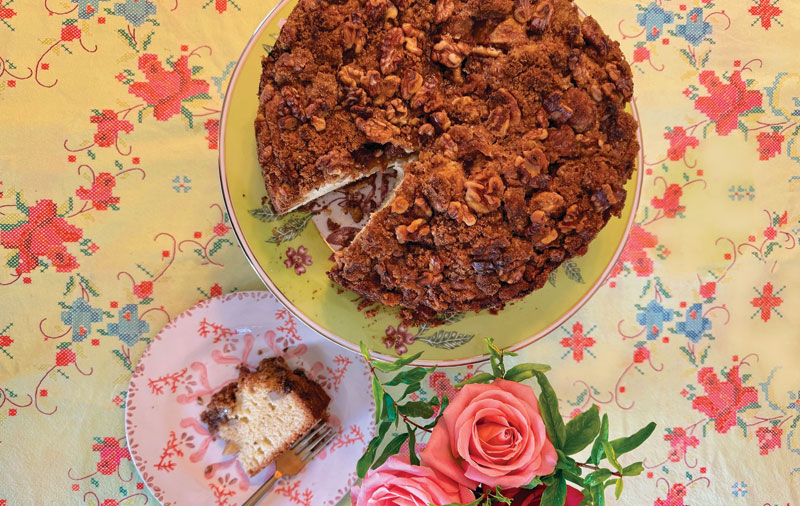
Ode to an Apple Cake

Writing this recipe made an old childhood memory pop up. I hadn’t thought about it in a million years. Perhaps it entered my consciousness because in a few weeks Beverly Hills High School will be hosting my 40th reunion. (I’m still undecided about going.)

When I was in the 3rd grade at Beverly Vista Elementary School, and still fairly new to this country, a friend invited me to her Halloween party. I was very excited to attend. At her home, we played a game I had never experienced before — bobbing for apples. I stood in line and waited my turn, watching the other kids to see how the game was played. Afterwards, my face and my hair were soaking wet, but I experienced the thrill of biting into a juicy, crispy apple and being a part of the group. I miss those days of innocent, old-fashioned fun, with actual (non-electronic) games played in the backyard. Games that left us children full of joy. 

Did you know that bobbing for apples had its start in Europe hundreds of years ago as a courtship game for young lovers?  The female would seek to bite into the apple with the name of her love interest. If she succeeded in biting into the apple with one bob, then fortune favored the lucky couple. If it took two attempts, they could attempt to court, but their love was fated to be short. Sadly, three attempts meant the stars weren’t aligned for this couple. Talk about a “shidduch crisis”!

Bobbing for apples is a game that can be played year-round, but it’s primarily played around autumn and Halloween, also known as peak apple season. 

Here’s how to play:

• Fill a large bucket or basin with water.

• Put apples in the water (since apples are less dense than water, they’ll float to the top).

• Have players attempt to grab as many apples as possible using only their teeth—no hands!

—Rachel

It is fitting that the apple is the symbol of Rosh Hashanah — it has a perfect shape, a fragrant aroma and a sweet taste! Not to mention that they are at their peak of freshness at this time of the year. 

Juicy, crispy, healthy apples are a fiber-filled nutrient-dense fruit and they are a rich source of polyphenols, an important group of antioxidants.

Apples are always on my shopping list (I’m very partial to honeycrisp apples). And I’m always looking for ways to incorporate them into my recipes. Apart from their obvious use in salads, cabbage slaws and fruit salads, apples have found their way into my curries and my roast chicken dishes.

Of course, nothing is better than baking with apples! Cooking releases pectin as well as a melted sweetness, a concentrated apple flavor and an intoxicating scent.

Of course, nothing is better than baking with apples! Cooking releases pectin as well as a melted sweetness, a concentrated apple flavor and an intoxicating scent.

In our very first Rosh Hashanah article, Rachel and I shared Abe Abraham’s Apple Cake recipe. It’s a winner! Foolproof, fail safe and just plain delicious!

This year, we reimagined this recipe. Instead of using our usual Bundt, we used a springform pan. Instead of dredging the apples in sugar and cinnamon, we left some of them plain for layering on top of the batter. Then we went over the top and made a crunchy apple walnut streusel topping.  

This cake is perfect for Rosh Hashanah and any special occasion. It’s a cozy, nostalgic reminder of days past. A sweet taste that portends to a sweet New Year!

Sharon

STREUSEL APPLE CAKE

Streusel:
½ cup melted vegan butter
1 cup firmly packed brown sugar
½ cup all-purpose flour
1 Tbsp cinnamon
½ tsp cardamom (optional)
1 large Granny Smith apple, chopped into cubes
1 cup roughly chopped walnuts 

Melt butter in the microwave for 20 seconds.

Combine the sugar, flour, cinnamon, cardamom and melted butter. Then mix in apple and walnuts until they are well combined. 

Set aside. 

Cake:
5 large Granny Smith apples, chopped into thin wedges
4 eggs
1 cup oil
1/4 cup orange juice
2 1/2 tsp vanilla extract
1 1/2 cups sugar
3 tsp baking powder
1 tsp salt
3 cups flour

Preheat oven to 350°F.

In a large bowl, use a mixer to combine the eggs, oil, orange juice and vanilla until well blended.

Add sugar, baking powder, salt and flour. Mix until well combined. Batter will be very thick. 

Grease a spring form pan, then pour the batter into the pan. Arrange the apples over the batter, then press them into the batter, so that they are partially submerged. 

Sprinkle an even layer of streusel over the top of the cake.

Bake for 1 and 1/2 hours or until golden brown. Keep an eye on the cake, as oven temperatures vary. Test the center with a toothpick after an hour and then every 10 minutes until a toothpick comes out clean.)

Let cake cool completely before removing from pan.

Serve with whipped cream or ice cream.


Sharon Gomperts and Rachel Emquies Sheff have been friends since high school. The Sephardic Spice Girls project has grown from their collaboration on events for the Sephardic Educational Center in Jerusalem. Follow them
on Instagram @sephardicspicegirls and on Facebook at Sephardic Spice SEC Food. Website sephardicspicegirls.com/full-recipes.

Ode to an Apple Cake Read More »

Recipes for National Chicken Month

September is National Chicken Month! It’s the perfect time to explore some new recipes and, perhaps, test drive potential High Holy Day fare. 

“My apricot jam chicken with lemon and dijon mustard is a wonderful blend of sweet, tart and savory flavors,” Beth Lee, author of “The Essential Jewish Baking Cookbook,” cooking teacher and OG food blogger at OMGYummy.com, told the Journal. “And it’s so easy to prepare for a simple weeknight meal or a special holiday dinner.”

Apricot Jam Chicken

1 cup apricot-pineapple preserves (or use apricot jam)
1/3 cup dijon mustard
2 tsp grated lemon rind
1/3 cup fresh lemon juice
1 lemon, sliced (2 if they are small)
½ tsp pepper
½ tsp kosher salt (optional – mustard may be enough salt)
½ tsp dried thyme
8 – 10 boneless, skinless chicken breasts halves or an equivalent amount of boneless thighs or use bone-in chicken

Cut boneless skinless breasts or thighs into appropriate individual serving size pieces and arrange in the baking dish.

Combine preserves, mustard, lemon rind, lemon juice, thyme, salt and pepper in a medium size bowl and whisk together. If you are baking the chicken right away, pour the sauce over the chicken in the baking dish. Then lay a lemon slice on each piece of chicken or evenly cover the whole baking dish with the slices.

Cook at 375°F for 30 minutes uncovered. Or 325°F convection for 40 minutes or 350°F convection for 30 minutes.

Notes: You can prepare the sauce mixture for the chicken ahead of time. 

If you are not cooking the chicken immediately after preparing the sauce, you can refrigerate the sauce or you can pour it over the chicken and then refrigerate the whole baking dish until you are ready to cook. Be sure to let it sit out of the fridge for 15 – 30 minutes before you put it in the oven, if you can.

If you prepare this with bone-in chicken pieces instead, double the cooking time and add the lemon slices halfway through the cooking process. I love when the lemon slices get really toasty but if you prefer them less “burnt” add them halfway through the cooking.

Moroccan chicken is a popular dish in Jamie Schler’s home. A Jewish American writer, living in France, Schler’s blog is Life’s a Feast. 

“My husband lived in Morocco for two years before we met; when our older son was 10, he decided to take him there to discover the country and the food,” Schler told the Journal. “Once my son tasted this dish in Morocco, he not only ordered it in every restaurant they dined in for the rest of the trip, but he demanded I make it once he was back home.”

“Once my son tasted this dish in Morocco, he not only ordered it in every restaurant they dined in for the rest of the trip, but he demanded I make it once he was back home.” – Jamie Schler

Chicken with Preserved Lemon and Olives

½ preserved lemon
1 chicken cut in pieces or 2 leg/thigh sections and 2 breasts
Olive oil
About 6  Tbsp flour, seasoned rather generously with salt and pepper
2 small or 1 medium yellow onion, trimmed, peeled, finely chopped
1 garlic clove, peeled, chopped or minced
½ tsp saffron powder or turmeric
Finely grated zest of one lemon
½ cup (125 ml) water, more as needed
½ cup – 12 or so – large purple or green olives
Salt and freshly ground black pepper
2 Tbsp freshly squeezed lemon juice

Cut the preserved lemon half into 2 or 4 wedges. Pat the chicken pieces clean and dry. Place the seasoned flour in a plate or soup bowl.

Place 2 or 3 tablespoons of olive oil in a large, heavy pot with a lid; heat over medium to medium-high heat. When the oil is hot, and a few drops of water spritzed onto the oil sizzle, dredge the chicken pieces in the seasoned flour, shake off the excess and brown in the oil; you may have to do this in two or three batches as you do not want to crowd the chicken. Turn the pieces to brown well on each side; this could take 6 to 8 minutes per piece. Add more oil to the pot if needed.

As the chicken pieces are browned, carefully lift them out of the pot and place on a plate.

When all of the chicken pieces are well browned and out of the pot, add the chopped onion and garlic to the pot. Cook, stirring, just until tender, scraping up the dark bits from the bottom of the pot.

Add the chicken pieces back to the pot and continue to cook for a few minutes, stirring, until the onion bits are beginning to brown around the edges. Add the saffron or turmeric powder and the lemon zest, tossing the chicken pieces until all are coated.

Add the wedges of preserved lemon and the water; drain the olives and add to the pot. Add salt and pepper and bring just to a boil. Reduce the heat, cover the pot and allow to simmer, checking and adding water as needed, for 30 to 45 minutes or until the chicken is cooked through.

When the chicken is cooked, add the lemon juice, warm through and serve.

Serve with potatoes, couscous, mixed grains or pilaf.


Pam Stein’s Cherry Rosé Wings are the perfect appetizer, tailgate or dinner fare.

“Coated in a glaze of cherries and rosé wine, these are not your ordinary wings,” Stein, In Pam’s Kitchen, told The Journal. “They are sweet and savory in just one bite.”

Cherry Rosé Wings

¼ cup extra virgin olive oil, divided
2 cloves garlic, finely chopped
¼ cup plus 3 Tbsp Rosé wine (a dry rosé), divided
½ cup dried cherries
¼ cup ketchup
2 Tbsp light brown sugar
1 ½ tsp kosher salt, divided
4 pounds chicken wings, patted dry

Preheat the oven to 450°F 

Add 2 tablespoons of oil to a small saucepan over medium heat. Add garlic and cook, stirring occasionally, until tender, about 2 minutes. Add 3 tablespoons of wine, and stir, using a wooden spoon to loosen any browned bits from the bottom of the saucepan. Stir in cherries, ketchup, 1/4 cup wine, brown sugar and ¾ teaspoon of salt. Bring to a simmer, stirring often, until thickened, about 5 minutes.

Remove from heat and let cool slightly, about 10 minutes.

Transfer to a blender and process until smooth, about 15 seconds. Set aside.

In a large bowl, toss chicken wings with the remaining 2 tablespoons of oil and ¾ teaspoon salt.

Place a wire rack over a rimmed baking sheet and coat with cooking spray.

Place the wings on a rack and bake for 10-15 minutes. Brush wings evenly with sauce and continue to bake for an additional 4-5 minutes. Turn wings over and brush the other side with sauce. Bake for an additional 10 minutes. Remove from the oven.

Transfer to a serving platter. Serve warm with a side of celery sticks and ranch dressing.

Recipes for National Chicken Month Read More »

Campus Watch September 12, 2024

Brown Trustee Resigns Over Upcoming Israel Divestment Vote

Hedge fund manager Joseph Edelman announced on Sept. 8 that he is resigning from his position as a member of the Brown University’s board of trustees over the university’s upcoming vote on if the Brown Corporation should divest from companies that conduct business with Israel. 

“I am concerned about what Brown’s willingness to hold such a vote suggests about the university’s attitude toward rising antisemitism on campus and a growing political movement that seeks the destruction of the state of Israel,” Edelman wrote in a Wall Street Journal op-ed, adding that the decision to hold the vote “was made not based on facts or values but based on weakness toward student activists. The university leadership has for some reason chosen to reward, rather than punish, the activists for disrupting campus life, breaking school rules, and promoting violence and antisemitism at Brown.  I am unwilling to lend my name or give my time to a body that lacks basic moral judgment.”

University spokesperson Brian Clark told Bloomberg that Edelman’s op-ed is a “fundamental misunderstanding of the decisions that led to the upcoming vote on divestment. Far from a direct response to current activism, Brown is following an established process that is nearly a half-century old. This long-held process is built on the principle that Brown has an obligation to examine and investigate claims challenging its moral responsibility.”

Rutgers RAs Walk Out of Antisemitism Training

Myriad residential advisors (RAs) at Rutgers University walked out of a virtual training program on antisemitism, Islamophobia and xenophobia over objections to portions of the session on antisemitism.

The Algemeiner, citing reporting from The Daily Targum student newspaper, reported that the RAs “abruptly left the virtual session after a Jewish speaker explained that Hamas’s antisemitism and desire to destroy the world’s only Jewish state precipitated the Oct. 7 massacre.” The RAs who walked out also took umbrage to the session citing the definition of antisemitism used by the Anti-Defamation League (ADL). The university’s Students for Justice in Palestine chapter (SJP) subsequently posted on Instagram that the RAs who walked out viewed the session as promulgating “Zionism, racism, and white supremacy” and that an RA didn’t like that “one of the facilitators even identified as ‘Israeli’ and made mention of this multiple times. He justified his authority on the topic by citing his 12 plus years spent in ’48 Palestine, going so far as to call ‘Israel’ [sic] a ‘beautiful land.’”

The university told The Algemeiner, “Several RAs left the session within the first few minutes and returned shortly afterward. Following the session, RAs and university staff discussed and reflected on the training content.”

UMich Black Student Union Leaves Anti-Israel Coalition Because “Black Identities… Are Not Valued in this Coalition”

The University of Michigan’s Black Student Union (BSU) announced in a Sept. 6 statement that they are leaving the anti-Israel TAHRIR Coalition because, in their view, it seems like the coalition doesn’t value Black voices.

The TAHRIR Coalition is “a group of more than 90 pro-Palestine student organizations,” according to The Michigan Daily. The BSU chapter statement said that while they “support and allyship with the people of Palestine, and our advocacy for a free Palestine remains unshakeable… it has become increasingly apparent that Black identities, voices, and bodies are not valued in this coalition, and thus, we must remove ourselves. Members of our organization and our community have dedicated their time, energy, and well-being to the continued existence and strength of the coalition — despite repeated instances of being erased, belittled, and berated.”

Two Harvard Profs Announce Formation of “Harvard Faculty for Israel” Group

Two professors at Harvard University announced that they have formed a “Harvard Faculty for Israel” group.

Harvard Law School Professor Jesse Fried and Harvard Medical School Genetics and Medicine Professor Matthew Meyerson wrote in a Sept. 5 op-ed in The Harvard Crimson that “at Harvard, students have disrupted an Israeli professor’s lecture, an undergraduate has reported that a professor forced her to leave a classroom after she said she was Israeli, and an outside law firm engaged by Harvard found that another instructor discriminated against Israeli students on the basis of their national origin and Jewish ethnicity. In conversations, Israeli students have told us that they are routinely excluded from student organizations and social activities, and that some of their peers literally turn their backs on them. The message is clear: Zionists are not welcome.” Fried and Meyerson added that the university “bends over backwards to prevent individuals of any other religion or nationality from being singled out for harassment, discrimination, and shunning. The University should similarly have zero tolerance when the victims are Israeli or Jewish.” They concluded the op-ed by stating that they “remember a Harvard where Jews and Israelis were warmly welcomed, just like everyone else. It can be that way again.”

Campus Watch September 12, 2024 Read More »

YIVO Introduces Trendsetting Digital Exhibits for Holocaust Education

In today’s digital world, many museums provide access to online exhibits as “value-added” benefits to what the museums offer in person. Now, some museums are going a step further, curating in-depth exhibitions that are exclusively available online. One example is the YIVO Institute for Jewish Research’s Bruce and Francesca Cernia Slovin Online Museum, which so far has curated two exhibitions, both structured around the lives of teenagers from Vilna during the Holocaust. 

The inaugural exhibition, “Beba Epstein: The Extraordinary Life of an Ordinary Girl,” launched in August 2020. This past July, a second exhibition, “Yitskhok Rudashevski: A Teenager’s Account of Life and Death in the Vilna Ghetto,” also launched. Beba Epstein survived the Vilna ghetto and Auschwitz. After the war she married and built a life in the United States. Yitskhok Rudashevski was murdered by the Nazis at the age of 15.

Karolina Ziulkoski, chief curator of the online museum, calls these exhibits “a groundbreaking approach to digital curation and interactive storytelling. They were planned in a way to demonstrate how technology can breathe new life into historical artifacts, making them relevant to contemporary audiences,” she said. While people were already used to exploring existing on-site collections as digital extensions of physical institutions, Ziulkoski’s challenge was to find effective ways to engage and keep the attention of online visitors. 

“[The exhibits] were planned in a way to demonstrate how technology can breathe new life into historical artifacts, making them relevant to contemporary audiences.” – Karolina Ziulkoski

The stories about these two teenagers are told through “transmedia narratives,” using a combination of written text as well as digital technologies including animations, videos, interactive 3D environments, games, and dozens of archival objects. Complementing one another, these narratives coalesce around a single story or story experience across multiple platforms and formats.

“It’s not just young people who needed these options,” Ziulkoski said. “Today, older people also consume internet content like this. We designed these exhibits for the digital medium, and not an age demographic.” 

The Yitskhok Rudashevski exhibition grew out of a diary the boy kept when he lived in the Vilna ghetto from age 13 to 15. When the diary was first discovered after the war, historians were stunned by the mature insights and remarkable literary powers in a person so young. Many excerpts from the diary are part of the exhibit, both in text format as well as through video dramatizations.  Beba Epstein did not leave a diary but had written a pre-war autobiography for school. Her exhibit grew out of this autobiography, as well as post-war interviews she recorded through a Holocaust survivor testimonies project, contemporaneous letters sent to family members, and historical documents. Both exhibits offer historical context and a flavor of their home and community life both before and during the war. Beba’s post-war journey is explored as well. 

The online museum tries to appeal to multiple audiences, which may explain why some of the material is written in very simple language, as if for an audience with little knowledge or sophistication. Other access points bring the user to much more sophisticated text and historical documents. There is a plethora of historical context from validated sources based on rigorous scholarship.

With a goal of modernizing Holocaust education and making it accessible internationally, YIVO has provided workshops on the Beba Epstein exhibit for K-12 teachers in both Jewish and non-Jewish schools in the United States and Europe, as well as programs for general audiences from around the world. Since the Rudashevski exhibit is brand new, training workshops for it are only now being scheduled.  

Graphic novel by Milo Krimstein based on the diary of Yitskhok Rudashevski, made exclusively for the exhibition. Courtesy of the YIVO Institute for Jewish Research.

Douglas Greene, director of Jewish Community Relations at the Jewish Federation of Greater Charlotte, helped create some of the teacher lessons for the Beba Epstein exhibit, which he called a “unique and deeply personal glimpse into Beba’s life before, during, and after the Holocaust.” While many other Holocaust education resources are too academic for students, the interactive learning approach online can better meet students’ diverse needs, he said. 

Dr. Deborah Fripp is executive director of Teach the Shoah, which trains people of all ages, generations, and backgrounds to share testimony-based stories of the Holocaust. She was impressed with these exhibits’ ability to “teach history through real stories that happened to real people.” Many educators with Teach the Shoah now use excerpts of Yitskhok Rudashevski’s diary in their teaching, and are using these exhibits as additional tools to deepen their students’ understanding of his story. 

Since its launch in 2020, YIVO’s online museum has had close to 51,000 visitors from an astonishing 161 countries, from Afghanistan to Zimbabwe. The Lithuanian government helped pay for the translation of the Beba Epstein exhibit into Lithuanian, as it will be used as part of Holocaust education in their school system. A teacher training program for teachers in Lithuania is currently in the works. 

YIVO’s Chief of Staff Shelly Freeman observes that while the diary of Anne Frank is universally known, the diaries of other Jewish teens, such as Yitskhok Rudashevski and the brief autobiography of Beba Epstein, are bringing new stories to light in Holocaust education. Sharing their own words, along with primary source material such as an Auschwitz logbook of prisoners’ names and tattoo numbers, and a survey Rudashevski designed and carried out to chronicle life in the Vilna ghetto, these people feel more real and relatable. “There were 6 million Rudashevskis,” Freeman observes. “These exhibits not only preserve history but make it viscerally accessible to new generations,” she said.

Access the exhibits here: https://museum.yivo.org/


Judy Gruen is the author of “Bylines and Blessings,” “The Skeptic and the Rabbi,” and several other books. She is also a book editor and writing coach.  

YIVO Introduces Trendsetting Digital Exhibits for Holocaust Education Read More »

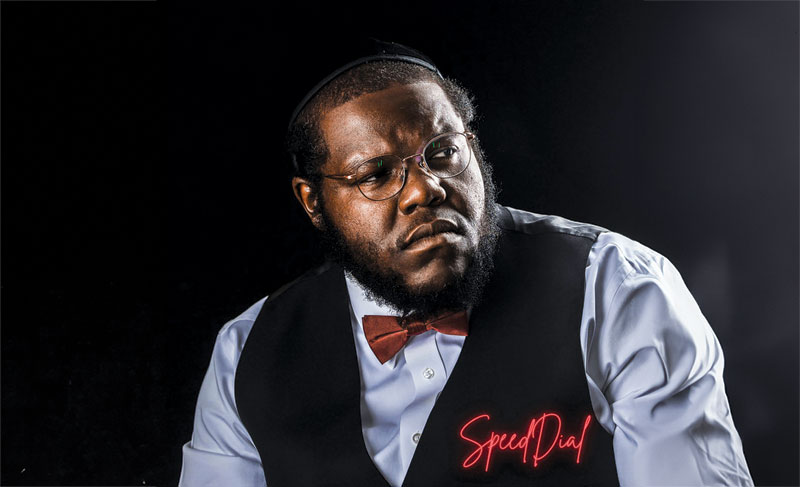
Nissim Black on His New Album and Life After Oct. 7

In times of peril, people turn to their family, friends and community for help. But in his new song, “Speed Dial,” American-Israeli Orthodox Jewish rapper Nissim Black urges people to first go to God for help.

He singsraps, “I’mma talk with you. I’mma walk with you … It’s all for you … You know I got you on speed dial, calling you whenever they push me down.”

It’s an uplifting and motivating anthem that the entire Jewish community needs in a post Oct.7-reality. 

“I hope it makes people feel like running to God,” Black said. “We’ve been forced to think more about our reality and relationships, and the main relationship we can all improve on is with God. I hope people feel fire, love, joy, yearning and elation when they hear my music.”

“I hope people feel fire, love, joy, yearning and elation when they hear my music.” –Nissim Black

The rapper, who lives in Israel with his wife, Adina, and seven children, is known for his inspiring and catchy songs like “Win,” Fly Away” and “Mercy.” His most popular song, “Mothaland Bounce,” features him honoring his black and chosen Jewish identities. The entertaining video has more than 5 million views.

On Aug. 14, Black released his new album, “Glory,” which contains 17 songs, with “Speed Dial” as lead single. Due to the war, Black held off on working on the album for a year and has been putting out videos on staying connected to God and Judaism.

In one Instagram video, he tells his 91,000 followers, “Due to the overwhelming amount of information available we have even a greater chance of being misled by this world. Our only true navigation system is Hashem’s holy words which passed down from Moses to the Holy prophets and so on. Let yourself not be fooled by all the nonsense and stick to God’s advice.”

Still, during the crisis in Israel, Black felt the urge to be creative. He knew that he couldn’t stay silent. 

“It was hard to be patient,” he said. “I just couldn’t imagine putting out an album at that time. As time went on, I wanted to make it something amazing and do a big campaign, but then I thought about how many people over the last year that have told me how much my music has helped them. I realized I must put this out ASAP. As the world gets crazier and darker, we have to infuse light – and lots of it – constantly. The release of this album became an emergency for me.”

Black’s goal is two-fold: Tto inspire his Jewish community, as well as educate others on Israel and help them see the falsehoods that are being broadcasted every day. 

“The world must see the lies and the nonsense that the media portrays,” he said. “Israel is probably the most documented and discussed country for the last 2,000 years. It’s our duty to show the people the Holy Land and its history.”

With his new album, Black is also embarking on a North American tour with concerts scheduled like in Los Angeles, San Francisco, Dallas, Philadelphia, Florida, Cleveland, Toronto, Vancouver, Ottawa and New York. At the same time, he’s working to relaunch his whiskey line, Hava Whiskey, which will be operating in the U.S. and Scotland and made aged with in some of his favorite Israeli wine casks. 

“I’m very excited about that,” he said.

Like all many Israelis, Black has been contending with PTSD from Oct. 7, but he is determined, now, more than ever, to get his message out there to those who need to hear it the most. Music is his way of doing just that. 

“I don’t think anyone could be the same after Oct.7,” he said. “I’ve became even more mission driven. As a people and as a land, it’s like having a loaded gun being pointed at you all the time, not knowing if it will fire. However, it forces one to live every day like it’s your last. I’m on fire to help the world.” 

Nissim Black on His New Album and Life After Oct. 7 Read More »

Three Artists, One Vision: A Vibrant and Eclectic Local Art Show

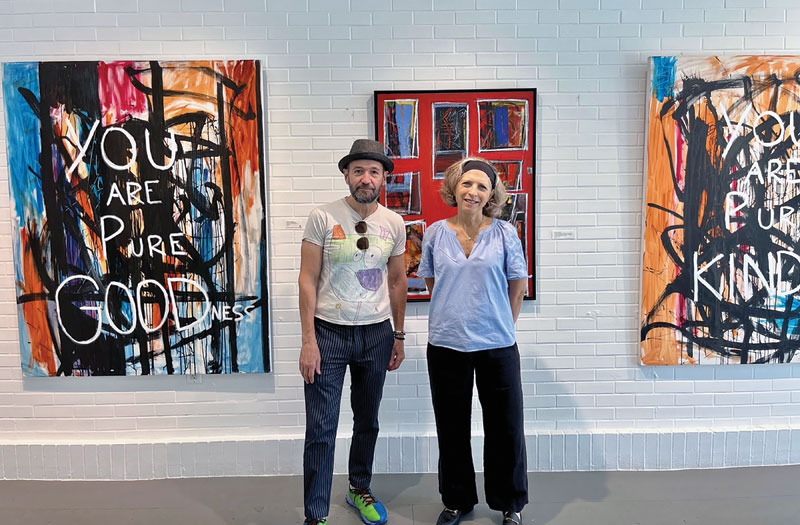
A Muslim, a Christian, and a Jew entered a gallery. And no, this isn’t the beginning of a joke, but rather the start of a vibrant and eclectic art show currently on display at the 7811 Gallery on Melrose Avenue. The exhibit, “Colors and Light,” features the works of three diverse artists: Benson Simmonds, Caty Maxey and Reihaneh.

Maxey, a production designer and art director (“Jurassic World,” “Jason Bourne”) uses multi-colored fused-glass light boxes, plaques, and fabric screens to evoke nature and uplift with their vibrant beauty and joyful interplay of colors and light. Thick acrylic paint and hints of abstraction are used in Reihaneh’s work, in which the artist — originally from Iran and now residing in Los Angeles — depicts the power of nature, childlike wonder and the potential for inner growth and balance. Benson, an energy healer and actor, creates mixed-media and acrylic paintings that dance with color, lines and abstract shapes, resulting in harmonious, soulful art.

The show was curated by Deborah Blum, the gallery’s owner, who carefully selected these artists to craft a dynamic and harmonious experience. “It definitely wasn’t intentional to have these three together,” she said. “Reihaneh doesn’t even identify as Muslim; she says her religion is love. I chose them based on their art. I wanted to create an exhibit that is uplifting and inspiring to people because of all the troubling images we keep seeing and the negative energy that’s out there. We’ve been through so much as a community. I wanted to create something artistic, unusual and interesting.”

“I wanted to create an exhibit that is uplifting and inspiring to people because of all the troubling images we keep seeing and the negative energy that’s out there. We’ve been through so much as a community. I wanted to create something artistic, unusual and interesting.” – Deborah Blum

Blum, an artist herself, opened the gallery with her husband, Warren a year ago. Three years ago, the couple lost their daughter Esther to suicide. The 16-year-old had come out as nonbinary during COVID and struggled with their gender identity. Blum’s love of art helped her navigate the painful loss. “For what I’ve been through, losing a child, I know how much art helped me feel better — not just creating it but also having it around, having it up on the wall. A fundamental aspect of us is our visual sense, and we’re often bombarded with all kinds of images and advertising on our phones and computers. Visual art can allow you to settle yourself quietly or give you energy. You connect with a piece of art, and I’m really happy to have met these artists.”

Benson Simmonds

Simmonds met Blum when she attended his solo exhibition at the Matters Studio Gallery in Mid-City. 

“Deborah really connected with my work and mentioned that she wanted to do a show with me, but was waiting for the right combination of artists. This show with Caty Maxey and Reihaneh was the right moment. She found that the colors and energy we all bring to our work complement each other beautifully.” Simmonds primarily paints abstracts and uses mixed media, acrylic on canvas, acrylic markers, glass and Indian ink. He also has a series of whimsical characters called The Soulbergs. “They represent different aspects of the soul, aimed at awakening joy and spiritual power,” said the artist. “I created these characters on various mediums — T-shirts, canvas, and more. They came to life almost on their own; I just started drawing, and they emerged.”

He also features images of doors and windows, subject to the viewer’s interpretation, and splashes of color with positive messages in bold block letters. “It came to me while I was davening. I felt a voice that said: ‘Take white paint and write: You are Pure Love, You are Pure Kindness, You are Pure Goodness.’ I work in a very intuitive way. I never plan what I’m going to put on canvas. In painting, I have mentors who suggest I try this or that.”

Ideas can come to him anytime, but sometimes they arrive on a Saturday, which can be challenging for an Orthodox Jew who isn’t supposed to write or work on a Shabbat. “One day I had a beautiful melody come to me and I was like, God, please let me remember it. Of course, after Shabbat, I completely forgot the melody but remembered the words. The next morning, as I wrote the words, the melody came back to me. Inspiration comes when it’s meant to and I’ve learned to trust that. Sometimes it’s a melody, sometimes a story, sometimes a visual idea that needs to be expressed. If inspiration strikes on a day when I can’t paint, like on Shabbat, I just trust that the idea will come back when the time is right.”

This is the first time Simmonds has met the other two artists in the show, and he has nothing but positive things to say about both of them. “I have a lot of respect for Caty Maxey and Reihaneh. Caty, for instance, is making her debut as a gallery artist with this show, though she has been a successful set designer for years. I love her use of color and find her work very engaging. The three of us create a diverse and complementary experience for viewers. I think that speaks to the universal themes in our work that resonate beyond cultural boundaries.”

On Thursday, September 19, between 6-8 p.m., the gallery will hold an event, “Artist Talk” with the three artists who will answer questions and talk about their art. “Colors and Light” will be on display until Oct. 6 at 7811 Gallery, 7811 Melrose Avenue (just east of Fairfax), Los Angeles

Three Artists, One Vision: A Vibrant and Eclectic Local Art Show Read More »

RABBIS OF LA | Is Rabbi Levine a Victim of Anti-Zionist Bias at UCI?

For the last three years it has been nearly impossible to secure a seat in Rabbi Daniel Levine’s course on major Jewish texts. Even so, UC Irvine chose not to renew his contract last spring. The campus rabbi and senior Jewish educator at the Hillel Foundation of Orange County was not surprised. He has a theory why his Jewish Studies contract was not renewed. 

“My entire life I have stood up for what I think is right at the risk of offending basically everybody.”

Having spent 14 years on college campuses, Rabbi Levine  has detected a trend that separates Jewish Studies faculty from other ethnic groups. “For a generation,” he said, “there has been a trend countering the (majority) interests of the Jewish people and the Jewish community as a whole. This is most obviously notable in the rise of anti-Zionist Jewish Studies faculty. If being a Zionist means you don’t want Israel destroyed, 95% of American Jews consider themselves, in some ways, Zionist.“ However, among Humanities faculties on campuses, saying you are a Zionist “basically is like walking into a room and saying you are a neo-Nazi or white supremacist.” 

Most Humanities professors, he said are “much more progressive activists than trying to do real education. If you don’t share their opinion, it will be harder for you to get hired, and your co-faculty will shun you.” While Rabbi Levine grants the majority of people interested in Jewish Studies are not anti-Zionist, hiring is a different story. “If a school looks at my background and a rival is a notable anti-Zionist, the anti-Zionist will be hired.”

There’s another issue at UC Irvine: Unlike other universities where there might be a standalone Jewish Studies department, Irvine’s Judaic Studies program is part of the History department. And two weeks after Oct. 7, Prof. Susan Morrissey, the chair of the Irvine’s History department, signed onto a “solidarity statement” in support of Palestinians.

Rabbi Levine, 31, a San Diego native, wants it known his opinions are not from a right-wing perspective. It’s not news, the rabbi noted, that “the university has been captured by dominant left-wing ideology.” The surprise is when he adds “I say this as a liberal. I view myself as a capital ‘L’ Liberal, not a progressive. I think what has happened in the last generation, the history of it is rooted in Soviet influence.” The Soviets, he said “pushed virulent antisemitism. They just called it anti-Zionism.” He believes “a lot of this infiltrated into the way modern left-wing groups talk about Israel and Zionism. These ideas have taken hold in the university.”

Rabbi Levine said that friends and colleagues employed in Humanities departments have had a difficult time since Oct. 7. “Not only did their colleagues not check up on them after Oct. 7 to see how they were doing, instead, there was active hostility: ‘How dare you mourn the lives lost in Israel. Don’t you know Israel is evil, blah, blah, blah?’”

He grew up in “the more Orthodox community” in San Diego. “I still embed myself within the Orthodox community socially, but ideologically, I am no longer Orthodox,” he says. “I grew up more Conservative, then became liberal. I am always going to say what I believe. That’s important.”

As for the chair of the History department, Prof. Morrissey, she is “a notable anti-Zionist” in the rabbi’s opinion. “Do I have smoking gun proof? No. What I do know is my course, Jewish Texts, was always full for the three years, which is rare. Across the country, enrollment in History is down. My evaluations always were top of the university.  

“My class was inspiring more students to study Jewish Studies every year. Forty to 50 students every class. When I began, there were between one and two Jewish Studies minors. Now I think it’s in the 20s.”

Rabbi Levine seeks to make a muscular case for retaining his Jewish Studies post. “For all practical purposes,” he says, “for bolstering enrollment, students being passionate about a class, there was no good reason to not renew the contract. When it was not renewed, there was a lot of pushback.”  A third-year student called his class “the highlight of my week.”

The rabbi described the declining of a contract renewal “at first strange and secret. They weren’t sure in the beginning. Then they said they found somebody who since has been let go.” Two tenure-track professors were hired to replace the rabbi – “and what do you know?” he asked. “Both were affiliated with anti-Zionist organizations.”

Months later, the rabbi still seems in shock. “Imagine if this had happened to any other ethnic studies group,” he asks. “Whether or not the full intent was there, it is part of a general trend at the university.”

Rabbi Levine is currently teaching two “slightly different” classes at Irvine for the School of Social Sciences and the School of Social Ecology. One is on ancient Jewish medieval thought and the other on ancient texts and contemporary problems. “It’s not what I have been teaching the last three years, but we’ll see,” he said.

As the senior Jewish educator for Orange County Hillel, this means he works full-time for Hillel, so he is the rabbi for Hillel at UC Irvine.

“Being a rabbi is not a job. It’s a lifestyle. I don’t work as a rabbi. I am a rabbi. To be a rabbi is to say you are committed to this mission of Jewish education and building Jewish community.”

“Being a rabbi is not a job. It’s a lifestyle. I don’t work as a rabbi. I am a rabbi. To be a rabbi is to say you are committed to this mission of Jewish education and building Jewish community.” 

Rabbi Levine frankly replied to the question of whether he has a realistic chance of regaining his old class: 

“I hope so, but I don’t think so.”

Fast Takes with Rabbi Levine

Jewish Journal: What is your next goal?

Rabbi Levine: To continue the good work many Jewish organizations have done in the past year. I want to try to build: How do we have a Jewish community with diverse thought? How do we have a university with diverse thought?

J.J.: What is your favorite Shabbat food?

R.L.: My wife is Persian. I am a firm believer Persian food is much better than Ashkenazi food. Ghormeh sabzi is my favorite Shabbat food.

J.J.: What is your favorite hobby?

R.L.: I am a rock climber.

RABBIS OF LA | Is Rabbi Levine a Victim of Anti-Zionist Bias at UCI? Read More »

Chef Jeffrey Kollinger: Spice of Life Catering, Gourmet Kosher Cooking and Chilean Sea Bass

Kosher cooking can be gourmet, delicious and fun, according to Chef Jeffrey Kollinger, the driving force behind Spice of Life Catering in Dallas. A celebrated chef and CEO with more than three decades of experience, Kollinger is a renowned kosher caterer and an active part of his Jewish community.

“About 12 or 13 years ago, I took over my first synagogue contract and that was Shearith Israel,” Kollinger, who is third generation Dallas, told the Journal.

Kolinger explained that he was a bar mitzvah there in 1976, his wife had her bat mitzvah there in 1983 and their sons were bar mitzvahed in 2016 and 2019.

“We all stood in the same synagogue,” he said. “I came full circle.”

Kollinger loves cooking for life-cycle events, even though it is just part of his business.

“With life cycle events, you have an opportunity to meet so many people and you go through generations,” Kollinger said.

For instance, he’s catered several community members’ bris or bar mitzvah, then their wedding and their kids’ brises.

“I also like to create from the production side of food: different foods for all types of different people, creating menus … built around the client and their love of food,” he said. “I’m humbled and grateful that I always seem to find something to do or some party to throw.”

Both of Kolllinger’s parents were gourmet chefs; they hosted lavish dinner parties and incredible Shabbat meals.

“They had this huge Louis the XIV table in our dining room that sat 20, and they would have 8, 10, 12 course meals,” he said. “Out of all of that, I just found a love of food.”

After going to school for management marketing, Kollinger said he landed a great job with a wonderful company, and has since excelled in the food industry.

“I’m lucky that I love what I do,” he said. “I really enjoy the food business, the restaurant industry, the hospitality, the production, the design … it’s my passion.”

Whereas kosher Jewish food sometimes gets a bad rap–you can’t mix milk with meat, you need separate kitchens, you can only eat fish with scales–Kollinger believes kosher can be gourmet.

“We have turned kosher upside down [and] spun it around,” he said.

To uplevel your kosher cooking, Chef Kollinger said to stop thinking of it as kosher. It’s just regular food.

“There’s so many distinctive flavors now that you could use that probably weren’t available 10, 12 years ago,” he said “There’s truffle oils, there’s all kinds of different spices.”

All you have to do is change up the recipes a bit to make them work.

“An aioli, a demi [glace] or a sauce [made] from a rich stock can be done in the kosher world because you can [use] them in both dairy and meat,” he said. “Get a good kosher wine – a nice cabernet – reduce the cab, put in some wonderful shiitakes [and] caramelized onion and [you have] a wild mushroom caramelized onion demi.”

You can put a fancy sauce on pretty much anything. For instance, you can do fish with a beurre blanc and fancy vegetables. Chef Kollinger’s recipe for Chilean sea bass is below.

“I think a lot of people [let] the heckscher (kosher certification) throw them off,” he said. “What you need to do is seek out ingredients that match or come close to what you’re trying to [create] and play around with the dish.”

Learn more at TheSpiceofLifeCatering.com.

For the full conversation, listen to the podcast:

Macadamia Nut Crusted Chilean Sea Bass, Basmati “Confetti,” Cippolini Onions and Carrots and Lemon Beurre Blanc

For the Confetti Basmati:

3/4 cup (100 grams) carrot, small dice

3/4 cup (100 grams) yellow onion, small dice

3/4 cup (100 grams) celery, small dice

1/2 cup (100 grams) butter

4 2/3 cups (80 grams) basmati rice, cooked

Combine carrots, onion, celery and butter in a small sauté pan. Sweat over medium-low heat until tender and translucent, around 15 minutes.

Combine the vegetables and rice in a large bowl and mix until homogeneous. This can be done in advance and reheated, covered.

For the Cippolini Onions:

40 medium cippolini onions

Salt to taste

Olive oil to taste

Combine and mix to evenly coat. Roast at 350 F, high fan, until caramelized and cooked. Reserve.

For the Carrots:

20 peeled baby carrots, halved

Parsley, Julienne, to taste

Salt to taste

Olive oil to taste

Combine everything and mix to evenly coat. Roast at 350 F, high fan until caramelized and cooked. Reserve.

For the Chive Oil:

2 cups (100 grams) chives, roughly chopped

1 cup (50 grams) Italian parsley leaves

1 3/4 cup (400 ml) canola oil

Combine and blend on high speed for 1 minute. In an oversized chinoise or colander, lined with a coffee filter, add chive oil and allow to strain. This will take several hours. Once the solids are strained, decant off the oil, discarding the water that sinks to the bottom. Reserve.

For the Lemon Beurre Blanc:

3 1/2 ounces (100 grams) shallots, brunoise

2 garlic cloves, chopped

~ 3 tablespoons (40 grams) butter

1/2 teaspoon (3 grams) salt

Sauté in a small saucepan until lightly caramelized.

Add:

10 tarragon stem and leaves

2 lemons, zest only with a peeler (save the lemons)

Stir to combine and become fragrant.

Deglaze with:

1 cup (250 ml) white wine

2 lemons, juice only

Reduce by half over medium heat. Remove and add piece by piece:

1 3/4 cups + 1 tablespoon (400 grams) cold butter, diced small

Continue whisking to emulsify. Adjust seasoning. Strain through a fine chinoise and reserve in a warm place until service.

For the Crispy Leeks:

2 leeks, bottoms only

Cut leek bottoms into 3” long pieces. Cut each in half and julienne, taking a few layers at a time to ensure they’re all consistent. Hold in an ice bath. Drain and dry before frying.

Fill a large pot halfway with neutral oil, and bring to 275F over medium heat. Add the leeks in several batches to prevent overflowing. Continually stir as they cook and become golden brown and crisp, around 5 minutes. Remove, drain excess oil, and season lightly. Reserve.

For the Sea Bass

10 Chilean Sea Bass, ~ 5 ounce (150-gram) portions

Garlic Aioli (recipe below)

Macadamia Nut Crust (recipe below)

Seared sea bass on one side; then cool.

Spread the aioli evenly on the seared portion of fish. Evenly coat the aioli with the macadamia nut crust, knocking off any excess.

Heat the sea bass in a 375°F oven until the crust is golden and the fish is heated through, about 5-7 minutes.

Garlic Aioli:

2 egg yolks

1 garlic clove, microplaned

1 tablespoon (15 ml) lemon juice

Pinch of fine sea salt

~ 4/5 cup (200 ml) extra virgin olive oil

Add yolks, garlic, lemon juice and sea salt to a small bowl and whisk to combine. Continue whisking while slowly streaming in olive oil. If the emulsion becomes too thick you can add a few drops of boiling water while whisking.

Macadamia Crust:

7 ounces (200 grams) macadamia nuts, toasted and cooled

3/4 cup (150 grams) panko

1/4 cup (60 grams) butter, melted

1/2 tsp (2 grams) salt

Combine everything in the bowl of a food processor. Pulse gently until the mix looks like wet gravel.

To Serve:

Serve each portion of sea bass on a bed of Confetti Basmati, arranging the roasted carrots and Cipollini onions around the rice. Drizzle the chive oil and lemon beurre blanc over and around the dish for added flavor. Finish with a sprinkle of crispy leeks on top for crunch and garnish with a few fresh herbs.


Debra Eckerling is a writer for the Jewish Journal and the host of “Taste Buds with Deb.Subscribe on YouTube or your favorite podcast platform. Email Debra: tastebuds@jewishjournal.com.

Chef Jeffrey Kollinger: Spice of Life Catering, Gourmet Kosher Cooking and Chilean Sea Bass Read More »