Meshel just turned 41 but looks quite a bit younger. In the last five or so years, if Meshel and I talked more than half a dozen times, that would be a lot. I only see Meshel on Saturday mornings at shul during Shabbat services. I do try to always remember to tell him to have a good Shabbos and I always get a “good Shabbos” and a smile back from him.
Occasionally, he might say a few other things to me, but that is rare. Meshel has a beautiful round face and is always in a handsome suit and a kippah. He occasionally wears a tallit. He always has his prayer book and his copy of the Torah. Meshel always sits right up in the front row, as close to the ark as you can get. Because he is a holy person, he is also permitted to sit in the special seat that is reserved for our assistant rabbi, or for visiting rabbis or dignitaries from out of town.
During the service, Meshel continuously seems to be reading or praying with great focus. It’s a type of focus I have never come close to achieving—and probably never will. I don’t have his gift.
Meshel doesn’t know it, but he is one of my teachers. He teaches not with his words, but with what I think is an even higher form, perhaps the ultimate form. He teaches by example.
Meshel doesn’t know it, but he is one of my teachers. He teaches not with his words, but with what I think is an even higher form, perhaps the ultimate form. He teaches by example. At almost any given moment that I look his way, I am moved by what I see. His level of commitment to his prayer is extraordinary. If there was ever a person who might have a direct link to God, Meshel is that person.
I remember pointing out to Rabbi Zev Wiener how high Meshel lifts his head and arms in the air toward heaven to communicate with God. He seems to beseech God. Few people challenge God’s ear quite the way Meshel does. Rabbi Wiener and I agree that Meshel is on a whole other level.
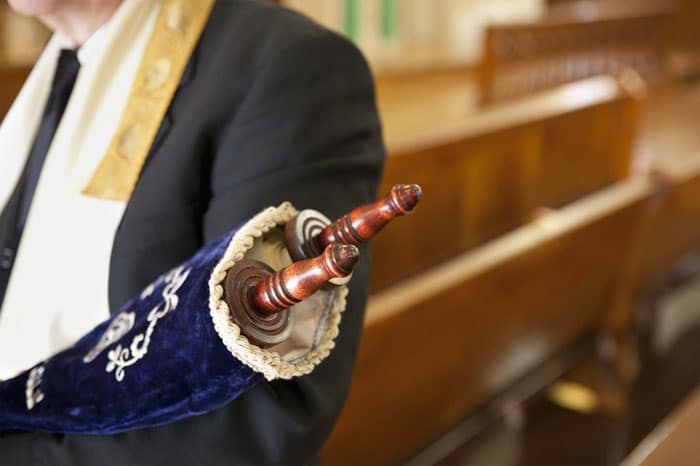
When the Torah is being carried through the crowd, Meshel is one of the first people there to kiss it.
There are certain times during the Shabbat service that we are asked to bow our heads before our Creator. Nobody bows quite like Meshel. To watch him with his Pavarotti-style bow, you might almost believe he just saw God walk into the room. Most people would feel self-conscious about making the grand gestures Meshel makes.
It truly is a remarkable sight.
When Rabbi Muskin, the head of our shul, Young Israel of Century City, speaks on Shabbat, Meshel is right there in the front row listening to every word.
Then comes the big finish. This is where Meshel seems to pray for all of us. At the end of the service is the Aleinu prayer. Aleinu conveys fundamental values of Judaism. You give praise for being a unique person with a unique mission and hope for the time when God’s presence will be fully realized.
The last word of the prayer is “echad.” The Torah says the following about “echad”: “God will reign forever and ever” and “God will be Ruler over the whole Earth and on that day, God will be One, and God’s name will be One.”
There is a point at which the congregation speaks the word “echad” out loud together. That’s when Meshel takes over the entire service. Everyone in the shul stops to hear Meshel as he cries out from deep within his soul the word, “echad.” He does so as loud as he can while holding the note for as long as he can and punctuating the “d” at the end of the word.
While Meshel is holding that note, he hopefully is gathering all our prayers and taking them straight to heaven, which is where we all know his crying out of “echad” is going.
Rebekah Jalali is the administrator of the shul. When I asked her about Meshel she said, “Everyone loves him. He’s amazing. We admire his commitment to his faith. He inspires us all when he davens out loud.”
His mother Diana said, “He is everything and more than I could ever ask for.”
Meshel our teacher has Down syndrome.
Mark Schiff is a comedian, actor and writer.