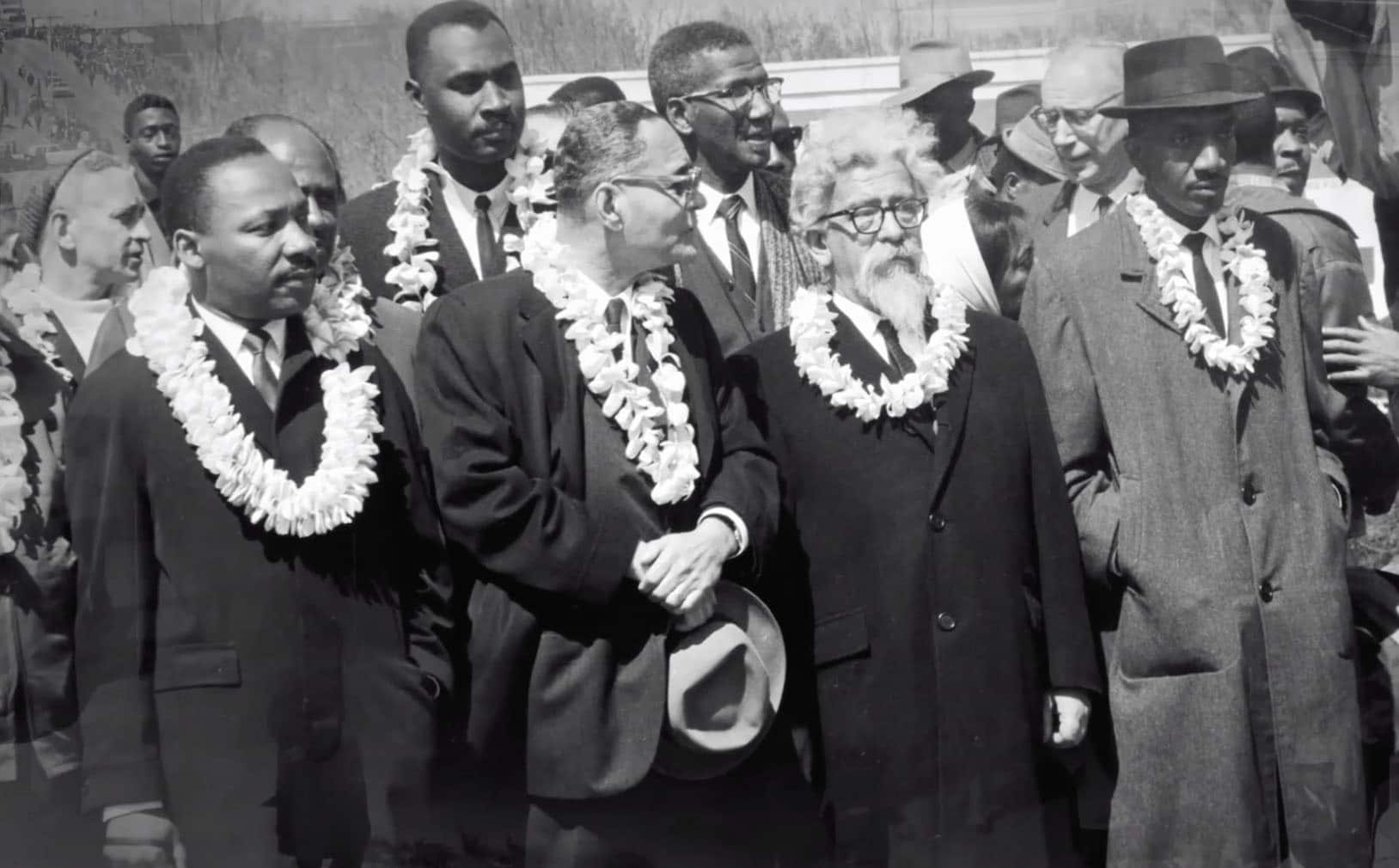
In one of the first scenes in the new documentary, “Spiritual Audacity: The Abraham Joshua Heschel Story,” Rabbi Heschel is marching in Selma, Alabama on March 7, 1965, with Martin Luther King, Jr., and other Black civil rights leaders. This is a fitting opening to the documentary, as this seminal event in the U.S. civil rights movement also cemented Heschel’s status as a civil rights activist as well as a Jewish scholar and educator.
The documentary was made by award-winning filmmaker Martin Doblmeier and his company, Journey Films, and it is now airing on public television stations during May, in tandem with Jewish American Heritage Month. Doblmeier has made more than 30 films focused on religion, faith and spirituality, and he therefore found Heschel a natural subject. Heschel not only fought for Black civil rights and on behalf of Soviet Jewry but also against the Vietnam War. He also promoted interfaith dialogue.
“He is not simply a figure from history but someone with wisdom and conviction that seems more relevant than ever,” Doblmeier said in a statement to the press. “Heschel understood well the price of indifference and he refused to stand on the sidelines. He wanted to awaken the conscience of the American people through discourse and non-violence.”
Heschel was born in Warsaw, Poland, in 1907 to a Hasidic dynasty, apparently so brilliant that he gave lectures in shul even as a child. He studied at the University of Berlin for a doctoral program in the Hebrew prophets, but the Nazis arrested and then deported him in 1938. He came to the United States in 1940 on a visa obtained through the Hebrew Union College, but his mother and three sisters were unable to leave and were killed in the Holocaust. The film does not mention what became of his father.
Several of the interviewees in the film, including Heschel’s daughter, Dr. Susannah Heschel, a Jewish studies professor at Dartmouth College, likened him to a modern-day prophet. Just as the prophets needed to both feel God’s own pain and be part of the world, so too did Heschel, who witnessed Europe obliterated during the Holocaust. Rabbi Shai Held, president of the Hadar Institute, explained, “God cares. A prophet identifies so much with God’s pathos that they are overcome. Prophets are there to make us uncomfortable. If injustice exists, we are all complicit.”
“Prophets are there to make us uncomfortable. If injustice exists, we are all complicit.”
Susannah Heschel explained that her father’s commitment to social justice issues was based on spiritual principles: “These were moral decisions. It was clear to him what he had to do.” When Heschel’s original doctoral dissertation on the Prophets was translated into English from the original German, it greatly expanded his renown.
The documentary includes interviews from many leaders from the civil rights movement, including the late U.S. Representative John Lewis, former Congressman Andrew Young and Reverend Jesse Jackson. They lauded Heschel’s courage in linking his name and reputation with the movement at a time when many Jews feared an anti-Semitic reaction from such involvement.
It is especially striking to be reminded of the solidarity between the Black and Jewish communities at the time. As John Lewis said, “We compared ourselves with the children of Israel; we had been held as slaves.” Andrew Young notably wore a lapel pin with both U.S. and Israeli flags.
The documentary also recounts how Heschel built bridges with Christians. This was deeply unpopular among Jews in the 1960s, as Christian indifference to Jewish suffering during World War II was so painfully fresh. (Pope Pious XII failed to speak out against Nazi atrocities.) Heschel flew to Rome to meet with Pope Paul VI and worked with a German Catholic as the Vatican developed the landmark Vatican II document, which spelled out the Church’s relationship with non-Christian religions. Heschel wanted the Church to fully repudiate any calls for Jews to be converted and excise all anti-Semitic references. In 1965 the Church finally published the Nostra Aetate, which called for mutual respect and repudiated previous accusations against Jews as “Christ killers.”
Heschel’s religious foundation in early twentieth-century Europe was at odds with the environments he found at his new academic home at Hebrew Union College in New York, which he found to be “spiritually vacuous.” Kosher food was not served, and he felt students weren’t interested in theological issues. Yet Heschel was also disillusioned with the Jewish Theological Seminary, a Conservative institution that seemed “more interested in being the Harvard of the Jewish world” than in exploring piety and mysticism. He also expressed alarm about the institutional viability of synagogues, whose services he found spiritually lacking. The documentary quotes him as wondering, “Has the synagogue become a graveyard where prayer was buried?”
Doblemeier seems most enamored of his subject’s political activism, but Heschel was a major theologian as well. His Jewish scholarship and books earned him increasing respect and fame — even years after his passing. His books include the influential “Man Is Not Alone,” which expresses the idea of “radical amazement” as a reaction to creation. His subsequent book, “The Sabbath,” further expanded his audience and retains strong sales more than 60 years after publication.
Heschel worked hard despite his fragile health. At only 65 years old, he died in his sleep of a heart attack on December 23, 1972 — a Shabbat. At the time, he was actively campaigning for Democrat presidential candidate George McGovern and continuing his anti-Vietnam war activities. As Susannah Heschel noted in the documentary, in Judaism, to die in one’s sleep “is the kiss of God.”
“My father identified with the passion of the prophets and expected us to be in partnership with God,” she said. “Compassion was a key word for my father, and everything we do can be imbued with God’s presence, even simple things like walking, talking, we treat people in everyday moments.”
Learn more about the film on the website of Journey Films.
Judy Gruen is a writer and editor. Her books include “The Skeptic and the Rabbi: Falling in Love with Faith.”