
There is a good deed for which you might get punished: giving charity in the USA.
It took me a while to understand not what to give but how to give. I once donated to a children’s charity that resulted in me receiving a slew of mailings asking me to support cash-strapped schools in the Appalachians, toy drives in Texas and campaigns to restore the chastity of Christian born-again virgins in Texas. If Evangelical virgins can achieve their goals with a gentle swipe of my Mastercard, then praise the good Lord and all virginal Jewish mothers.
It took me a while to figure it out, but the thing I object to is the organizations who gratefully receive your donation and then sell your information to other charities. You give with an open heart, and they sell your address with an open wallet. This way they can double-dip, triple their money and quadruple your junk mail.
Fortunately this is not done by everyone. Crowdfunding websites are a safe bet, along with synagogues and smaller organizations who sensibly cultivate their own donors rather than push them towards other charities in return for short-term profit. My life was saved with the help of the Los Angeles-based Jewish crowdfunding platform Jewcer, which generously waived fees as friends and family donated to help me with out-of-control medical costs after life-saving surgeries. Through their help I was able to survive, continue my life in the United States and move forward on the road to recovery.
There is no Hebrew word for charity. The frequently mentioned verse “Tzedek Tzedek Tirdof” means “Justice, Justice you shall pursue” (Deuteronomy 16:20). Tzedakah translates as “Justice” or “Righteousness” but not as charity. Giving tzedakah is a commandment, a mitzvah that changes us and the world around us. The seventh Lubavitcher Rebbe, Menachem Mendel Schneerson, ran a campaign for everyone to have a tzedakah box in their house and to give something every day, and the first Lubavitcher Rebbe, Rabbi Schneur Zalman of Liadi, taught that every coin we give is like a piece of chainmail that provides us with spiritual armor to protect us from negative forces. If we have $100 to give, it is better to give $1 per day over 100 days, since each donation is a separate mitzvah, and it changes us because on Day 101 it would feel strange not to donate something. Giving tzedakah changes both the donor and the recipient.
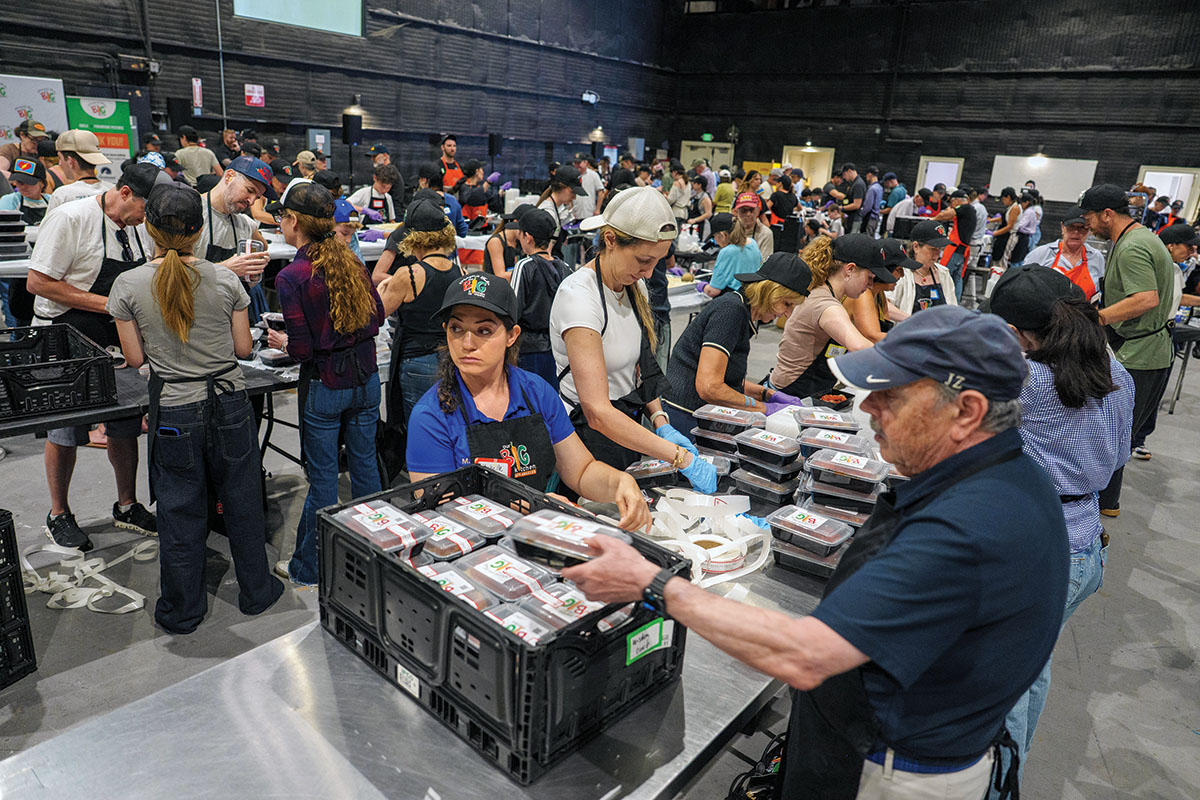
My first introduction to American-style giving was a culture shock. As someone who grew up on a small island — 1.5 United Kingdoms could fit into the land mass of California — I was astonished to see the huge galas at Beverly Hills ballrooms, where donors publicly stand up and pledge $100,000 or more to support Israeli ambulances, hospitals, pro-Israel advocacy on campuses or other worthy organizations. While my inner Brit balked at the apparent lack of modesty, my born-again American self appreciated its brilliance. Generous donors attracted more generous donors and momentum built as fundraising goals were met and surpassed. Baruch Hashem.
My first introduction to American-style giving was a culture shock.
Less inspiring was the junk mail from random charities, where you receive a letter with a quarter and a picture of the downtrodden attached. You can put the quarter towards your next latte and deprive the hungry children, or you can return their coin with interest. I would do the latter but routinely feel manipulated. Nevertheless, from a spiritual perspective, a mitzvah is still a mitzvah, and this is an important one.
A fun new way to support charities is via the Cameo app, where you can book celebrities to record a personal message for yourself or a friend. You can get Jerry Springer, Lindsay Lohan or even Carol Baskin from Netflix’s “Tiger King,” who was accused of killing her first husband by feeding him to her tigers. Many celebs donate their fees directly to charity, and Baskin’s proceeds go towards her sanctuary for healing abused cats. As of yet there is no channel for disgruntled divorcees to donate their ex-husbands.
Red Nose Day in the United States falls on March 19, 2021. That event, a fundraising day that seeks to end child poverty, grew from the original UK Comic Relief event in 1988 that was co-founded by “Four Weddings and a Funeral” writer Richard Curtis. It is a great opportunity to give freely with an open heart and clownlike facial couture. I look forward to the fun and will then call my local rabbi to expiate past transgressions and reinstate me as the born-again virgin Marcus.
Marcus J Freed www.marcusjfreed.com @marcusjfreed