fbpx

March 12, 2021

JVS and AFSCME Local 800 Reach A Fair Agreement

Just in time for the post-vaccination economic reawakening, JVS SoCal (formerly Jewish Vocational Services) and its workers, represented by AFSCME (American Federation of State, County and Municipal Employees) Local 800 have reached a bargaining agreement that offers reasonable cost of living increases, strong benefits and much-needed job protections for employees.

The JVS administrative/original unit members will receive a 3.25% immediate increase in pay (3% retroactive to July 1, 2019 and the full 3.25% retroactive to July 1, 2020), another 1.5% increase on July 1, 2021 and 1.75% on July 1, 2022, a $500 bonus, plus improved severance benefits in case of layoffs.  JVS GAIN employees will receive a 3%-5% increase over the 1 ½ year agreement. The workers also won improved sick leave and vacation benefits and recall rights for laid-off employees. People who have been employed for less than one year will see a 5% increase in their first year.

This contract was achieved, not only through negotiation but also through protracted involvement by a broad range of community stakeholders. More than a dozen rabbis and over one hundred Jewish community members signed a letter of solidarity with the workers. Clergy and Laity United for Economic Justice joined with the LA County Federation of Labor and other organizations to send letters of their own. The West Hollywood City Council, led by Mayor Lindsey Horvath and Councilmember John Erickson, unanimously passed a resolution supporting the union workers, and LA City Councilman Paul Koretz sent a letter to JVS SoCal leadership. Every Los Angeles County Supervisor contacted JVS management to express their concerns and their support for the bargaining unit.

More than a dozen rabbis and over one hundred Jewish community members signed a letter of solidarity with the workers.

Ultimately, JVS SoCal leadership agreed to fair worker compensation. Those of us who have interacted with the JVS staff know how dedicated they are to helping working people rise and prosper. It is only right that an agency with the mission of helping workers will be equitable with its own stellar employees.

So mask up, accept your vaccinations and, when the time is right, check out JVS SoCal’s awesome array of services. And remember them when you are secure enough to make donations again.

Please check out your local union to see how they can help you achieve equity in your own workplace. Remember them for donations, too.


Rabbi Robin Podolsky serves on the Board of Governors for the Sandra Caplan Community Bet Din, writes at shondaland.com and jewishjournal.com, advises the Jewish Student Union at Occidental College and serves as writing facilitator and dramaturg for Queerwise, a spoken word and writing group. She also serves on the National Ritual Committee for Bend the Arc.

JVS and AFSCME Local 800 Reach A Fair Agreement Read More »

Bakersfield Chabad Creating a Holocaust Memorial Out of Six Million Buttons

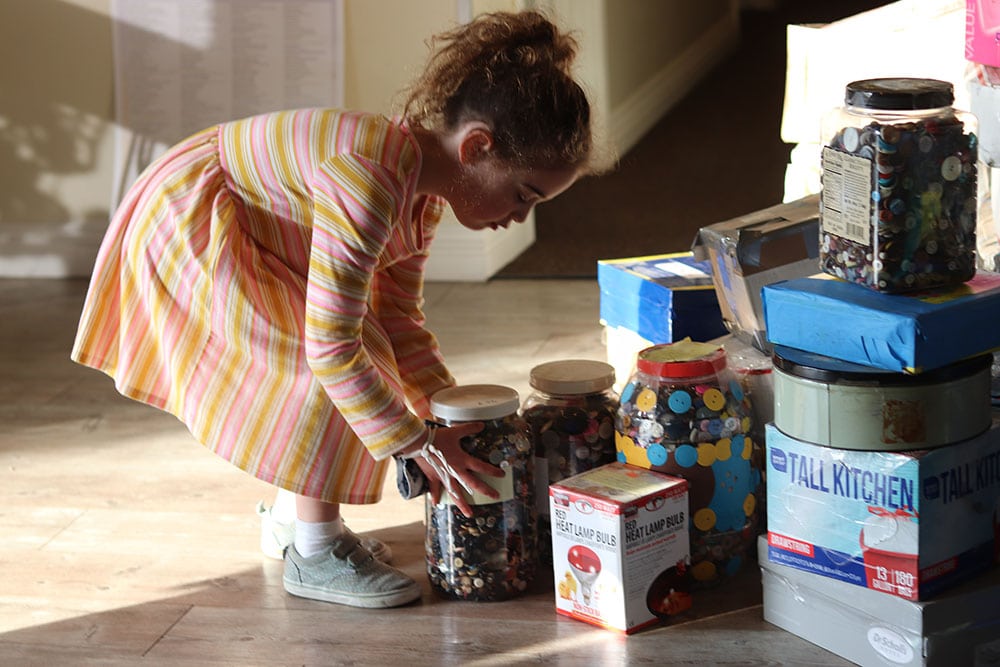
Cynthia Fischer always had a dream: She wanted to create a Holocaust memorial out of six million buttons she’d collected herself and from others over 10 years. However, she couldn’t quite figure out how to do it.

That all changed in 2020, when Fischer met Rabbi Shmuel Schlanger, director of her local Chabad Jewish Community Center in Bakersfield. Fischer had been sending her grandchild to the Chabad every Sunday to learn in the Hebrew school, which is on an idyllic campus at 6901 Ming Avenue.

“Cynthia loved the look of our place and asked us if we were interested in making her dream a reality,” Rabbi Schlanger told the Journal. “We have a community center that used to be a tennis club, and it’s very pretty. She felt this would be the best place for it. We thought it was a great idea.”

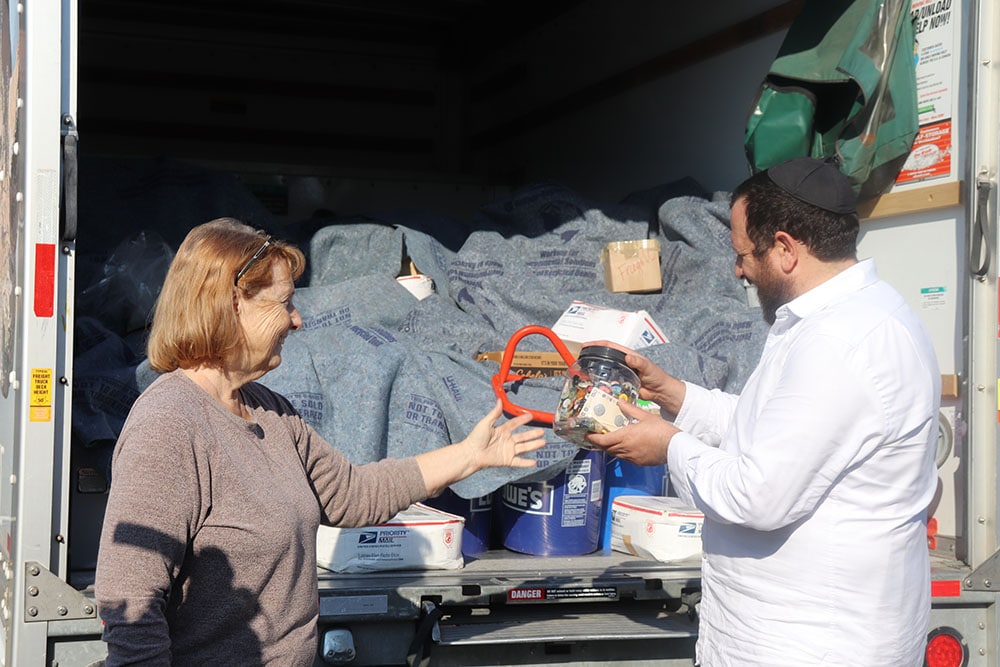
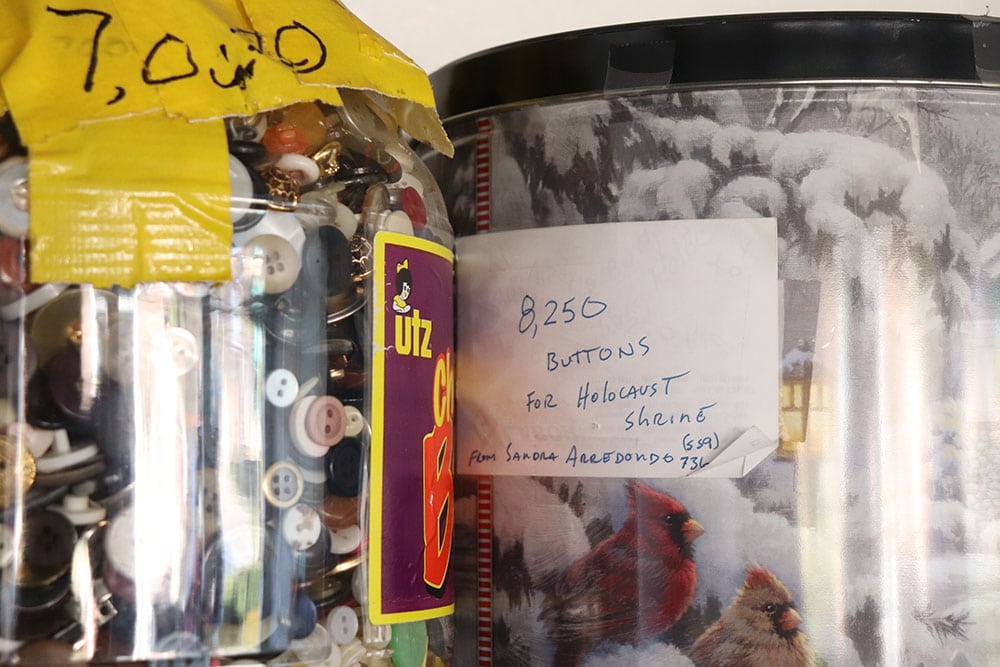
Now, the rabbi and his wife, Esther, have taken over the project, and they have 5.5 million buttons and counting. Each button has a number on it so that the rabbi can keep track. People drop off their buttons at the Chabad and tell the rabbi about themselves.

“Everyone walks in with their own story and talks about how sentimental the buttons are,” he said. “They are so happy they’re going towards a meaningful project.”

According to Rabbi Schlanger, one woman was holding a button when she burst out crying and explained that it was on her father’s uniform in World War II; he had liberated one of the camps. “This is just one of the many stories from the people who come in and drop off their buttons,” he said.

The rabbi isn’t quite sure yet what the memorial will look like, but he knows he wants it to be something positive. He doesn’t want to turn the Chabad house into a Holocaust museum but instead wants to use it to bring Jews closer to Judaism and be a light unto the nations of the world, like the Rebbe taught. He sees the wall as a continuation of his work in Bakersfield for the past 20 years, where, along with serving as the Chabad rabbi, he was a Jewish chaplain in a local prison.

“There’s a certain ignorance here,” he said. “I witnessed anti-Semitic sentiments in the prison. But every day when I walk in the street, and when I go into Trader Joe’s, I walk in smiling and everyone smiles right back.”

He and his wife are always trying to build bridges with the Jewish and non-Jewish people in their community. They allow Alcoholics Anonymous to meet on their grounds, and the members have ended up participating in Chabad activities.

“We’ve become so close with this wonderful group of people,” Rabbi Schlanger said. “They came to our outdoor Chanukah menorah lighting. They’ve become part of our family. The opportunities to educate are so great.”

Esther said that with the memorial, she and her family hope to continue educating people, specifically local students, about the scale of the Holocaust. “Six million is a statistic, and sometimes it loses its meaning in the enormity of the number. Bringing students to the memorial to see the buttons, six million of them, will really bring the magnitude of that number to reality.”

“Bringing students to the memorial to see the buttons, six million of them, will really bring the magnitude of that number to reality.”

She also said they will be teaching the students about the victims, who were mothers, fathers, sister, brothers, babies, writers, artists and homemakers. “We hope to share these ideas with [them] and create an emotional impact on them. They should be able to internalize the power of hate and prejudice, what they can cause and hopefully take to heart to do the opposite, [which means] to be kind and do better.”

The rabbi’s ultimate goal with the memorial is to partake in tikkun olam and rectify the world, as well as to bring Jewish people closer to Judaism.

“We want the Jewish people to have a deeper understanding and knowledge of who they are, and to increase their enthusiasm in being part of the Jewish people,” he said. “We’re portraying it through love and peace. I hope it brings the non-Jewish people a greater understanding of the world. We’re preparing the world for the coming of the moshiach, where Hashem will dwell amongst us.”

The memorial will be a place to remember those that were lost and a place to inspire us to do better, be kinder and help turn this world into the garden G-d intended it to be. You can be apart of it. Chabad of Bakersfield still needs YOUR BUTTONS to reach the six million goal. Message or reach out to Chabad of Bakersfield at info@chabadofbakersfield.com or call 661-834-1512 and ask how to donate your buttons. You can also donate any amount to help us make this dream a reality at www.chabadofbakersfield.com/buttonmemorial or contact Rabbi Schlanger for sponsorship.


Kylie Ora Lobell is a writer for the Jewish Journal of Los Angeles, The Forward, Tablet Magazine, Aish, and Chabad.org and the author of the first children’s book for the children of Jewish converts, “Jewish Just Like You.”

Bakersfield Chabad Creating a Holocaust Memorial Out of Six Million Buttons Read More »

Q&A with Rep. Ted Lieu on Combating Anti-Semitism

This month, Congressman Ted Lieu (D-CA) was named co-chair of the House Bipartisan Task Force for Combating Anti-Semitism, which, according to a statement, will work with the Biden administration, civil society partners, foreign leaders and other members of Congress to “root out anti-Semitism and memorialize the Holocaust.”

The task force has eight co-chairs, including Lieu, as well as Representatives Ted Deutch (D-FL), Chris Smith (R-NJ), Marc Veasey (D-TX), Kay Granger (R-TX), Grace Meng (D-NY), Randy Weber (R-TX) and Brian Fitzpatrick (R-PA). It has 100 members from the U.S. House of Representatives.

Lieu, who represents California’s 33rd congressional district (a large area that includes Agoura Hills, Brentwood, Beverly Hills, the Fairfax District, Santa Monica and Rancho Palos Verdes), is the second Taiwanese American task force co-chair, in addition to Congresswoman Grace Meng (D-NY). Lieu and Meng replaced Representatives Eliot Engel and Nita Lowey, both of New York (Engel, a 16-term congressman, lost the Democratic primary last year; Lowey retired). Their departure leaves Deutch as the task force’s only Jewish co-chair.

First elected in 2014, Lieu took over Henry Waxman’s congressional seat (Waxman retired after serving 40 years). In 2015, Lieu famously broke party ranks to vote against President Barack Obama’s Joint Comprehensive Plan of Action (JCPOA), also known as the Iran nuclear deal.

In his third term in Congress, Lieu is sitting on the House Foreign Affairs Committee as well as the House Judiciary Committee. A former active duty officer in the U.S. Air Force, Lieu currently serves as a Colonel in the Reserves. He and his family immigrated to the United States when he was three years old.

The Jewish Journal asked Lieu about his new role on the task force and how serving the 33rd district has informed his commitment to protecting the American Jewish community.

Jewish Journal: What motivated you to serve as co-chair of the House Bipartisan Task Force for Combating Anti-Semitism?

Congressman Ted Lieu: During a time when anti-Semitic acts of violence and discrimination are on the rise, I believe we all have a role to play in protecting our communities and condemning hatred in all its forms. I have been appalled by recent acts of anti-Semitism within my own community, such as the vandalism at Nessah Synagogue in Beverly Hills and anti-Semitic graffiti along the California incline off of Pacific Coast Highway in Santa Monica. In addition, as the coronavirus continues to surge globally, anti-Semitic, xenophobic and hateful messages and conspiracy theories are proliferating rapidly online. As members of congress, we cannot stand back and do nothing. That is why I’m pleased to serve as co-chair of the House Bipartisan Task Force for Combating Anti-Semitism, which will work to root out anti-Semitism and promote Holocaust remembrance.

JJ: How can American leaders bypass hyperpartisanship to work together in uprooting anti-Semitism and protecting the American Jewish community?

TL: Addressing anti-Semitism is not a Democratic or Republican issue — it’s about human decency. It is an unfortunate truth that anti-Semitism is a problem in numerous communities around the country, including those represented by people across the political spectrum. Because of that, we have to be able to work together to eliminate hate speech and acts of violence toward Jewish Americans. I look forward to working with my colleagues across the aisle to protect Jewish Americans everywhere.

“Addressing anti-Semitism is not a Democratic or Republican issue — it’s about human decency.”

JJ: The task force is also committed to memorializing the Holocaust. Have you met with Holocaust survivors in your district? How have those experiences affected you?

TL: At various points in my life, I have had the honor and privilege to hear from Holocaust survivors. I am in awe of their strength and resiliency after having faced and experienced obscene inhumanity. We owe it to them and their bravery to never allow an atrocity like the Holocaust to happen again.

JJ: In a 2020 study, two-thirds of young American adults claimed they did not know that six million Jews were killed during the Holocaust (with 12% claiming they had never heard of the Holocaust). How will the task force work to ensure that younger generations of Americans are better educated about the Holocaust? 

TL: Anti-Semitism is not a thing of the past. Seventy-six years after the end of World War II, there are still those who deny and attempt to rewrite the history of the Holocaust, which took the lives of six million Jews. As the famous quote states, “Those who do not learn history are doomed to repeat it.” The task force will work to promote Holocaust remembrance by championing not only education efforts within Congress but [also] supporting legislation like the Never Again Education Act, which will strengthen Holocaust education efforts in the United States. 

JJ: How has representing California’s 33rd district informed and affected your commitment to protect the American Jewish community?

TL: My district is home to a large and diverse Jewish community. We have heard from a rising number of constituents who are alarmed by recent displays of Nazi symbols at synagogues, hate-filled rhetoric and assaults on Jews. There is a heightened awareness in my district, and certainly many of my constituents share my concern about the rise in anti-Semitism in our country and community.

JJ: Hate crimes against Asian Americans are on the rise. As a Taiwanese American, how do you think the American Asian and Jewish communities can strengthen their bonds? Are these communities currently engaged enough with one another?

TL: There are many commonalities in the histories of Jewish and Asian communities in the United States. I believe that shared understanding creates a wonderful foundation for collaboration in a number of ways, including addressing rising violence and discrimination against each group. I look forward to using my position as co-chair of the task force to further facilitate relationships between Asian American and Jewish American communities.

JJ: Anti-Zionism, including elements of the Boycott, Divestment and Sanctions (BDS) movement, is the latest form of anti-Semitism. How can Congress fight against this form of anti-Semitism without infringing on free speech rights to express criticism of policy?

TL: In order for Congress to effectively combat anti-Semitism, we must address the issue in all its forms. We cannot tolerate when anti-Zionism is used as a euphemism to disguise anti-Semitic sentiment. Congress must reaffirm the United States’ commitment to supporting its strongest ally in the Middle East, Israel, and resist antisemitic dog whistles.

JJ: The task force is committed to educating House members about anti-Semitism. Will this include informing members of Congress about the anti-Semitic activities of foreign states such as Iran, which continues to deny the Holocaust while hosting Holocaust cartoon conferences (and whose leaders continue to call Israel a “cancerous tumor that must be removed from the Earth”)?

TL: One of the goals of the task force is to collaborate with foreign leaders, the Biden Administration, civil society organizations and other members to root out this systemic problem across the globe. Our efforts will include educating members of Congress on threats to Jewish communities everywhere.


Tabby Refael is a Los Angeles-based writer, speaker and activist. Follow her on Twitter @RefaelTabby

Q&A with Rep. Ted Lieu on Combating Anti-Semitism Read More »

Is it Proper to Open Someone Else’s Mail?

Dear all,

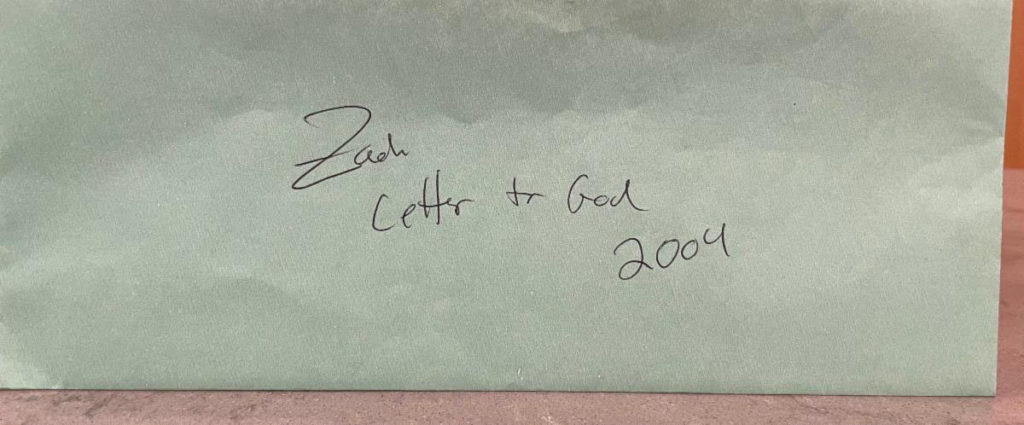
I was doing some research this week when I came across an envelope that was hidden in one of my Torah commentaries. It was from an assignment I did with my 7th grade Religious School class in 2004: writing a letter to God.

I hesitated as I held the unopened letter in my hand, a letter that revealed what was on a 33 year old, younger version of Rabbi Zach’s mind.

But the letter was addressed to God, not to me. So is it proper to open?

Perhaps reading the letter will bring God closer to me.
Perhaps reading the letter will bring me closer to God.
Or perhaps I leave the letter sealed and write a new one.

I left the letter on my desk, for now. Here’s where I need your advice. Take a moment in time to share your thoughts by clicking the link below. What would you do? I look forward to your responses!

With love and shalom,

Rabbi Zach Shapiro

Is it Proper to Open Someone Else’s Mail? Read More »

On Cuomo’s Past Words and a Lesson from Passover

It’s important to watch our words, especially when they’re preachy and self-righteous. We never know when they may come back to bite us.

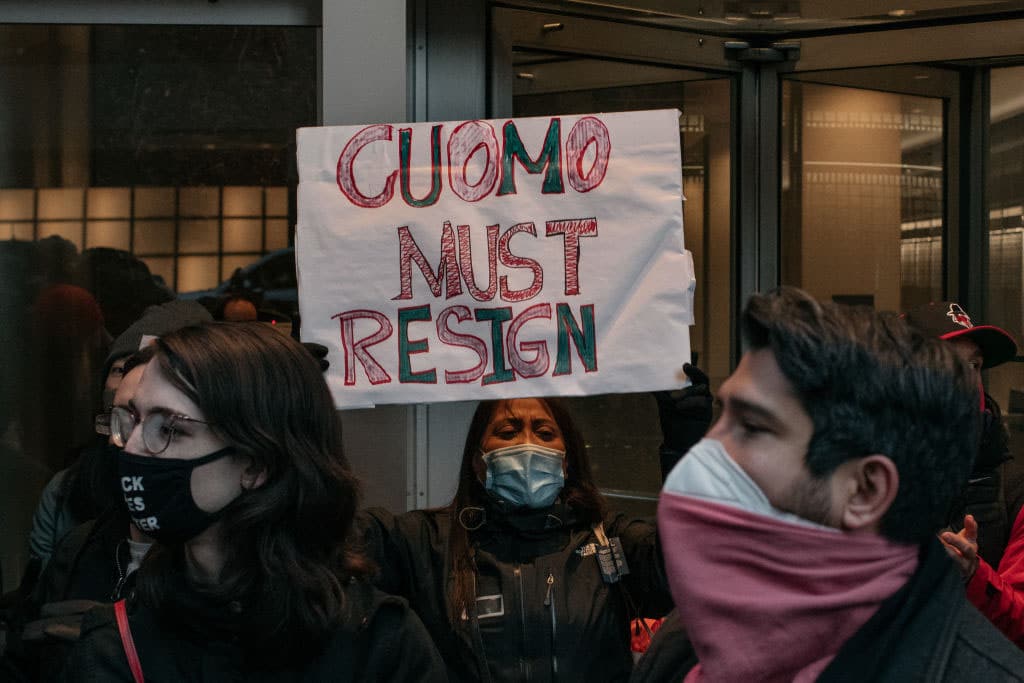
Take the case of New York Gov. Andrew Cuomo, who has come under growing pressure to resign over sexual misconduct accusations leveled against him. So far, he has repeatedly refused to step down.

But not too long ago, as reported in the New York Post, he was “quick to call for the resignations of powerful Albany lawmakers accused of sexually harassing aides — including known harassers Vito Lopez, Micah Kellner and Dennis Gabryszak.”

In 2012, for example, Cuomo demanded that Brooklyn Assemblyman Vito Lopez resign from his post after two female aides accused him of groping, kissing and verbally abusing them, the Post reported. The Post cites several other examples.

I wonder if his refusal to follow his own advice is haunting the conscience of Gov. Cuomo at the moment. It’s not as if he can deny his own words.

My hunch is that the pressure has become so strong that he may have no choice but to step down, lest he be impeached. As of Friday morning, several Democratic members of New York’s congressional delegation, including Rep. Alexandria Ocasio-Cortez and veteran Rep. Jerry Nadler, joined the call for him to resign.

“This week, the second sexual assault allegation and the sixth harassment allegation was leveled against Governor Cuomo,” said Ocasio-Cortez (D-Bronx/Queens) in a joint statement with Rep. Jamaal Bowman (D-Bronx/Westchester), a fellow member of the progressive “Squad.”

“As members of the New York delegation to the U.S. House of Representatives, we believe these women, we believe the reporting, we believe the Attorney General, and we believe the fifty-five members of the New York State legislature, including the State Senate Majority Leader, who have concluded that Governor Cuomo can no longer effectively lead in the face of so many challenges.”

Perhaps the most powerful argument in favor of resigning is when a leader loses the trust of the lawmakers he serves with. In Cuomo’s case, this clearly seems to be happening. His words have come back to haunt him. 

When we prepare for the eight days, we are commanded to clean out the chametz from our homes, not the homes of our neighbors.

The Jewish holiday of Passover offers us a cautionary lesson in lashing out at others: we can easily overlook our own faults. When we prepare for the eight days, we are commanded to clean out the chametz from our homes, not the homes of our neighbors.

May we spend more time working on our faults and less on the faults of others.

Shabbat shalom.

On Cuomo’s Past Words and a Lesson from Passover Read More »

The Bagel Report

The Bagel Report: The Podcast: The Series w/ Julia Lester!

The Bagels welcome Julia Lester, one of the stars of “High School Musical: The Musical: The Series.” After some getting-to-know-you conversations and Jewish geography, we talk about her character Ashlyn on the Disney+ reboot and what it’s like to be a part of the 15-year-old franchise. Erin geeks out with Julia over a cappella connections and Esther does her best to understand nostalgia for a show she never watched. Plus, a speed round of questions delving into favorite Broadway shows, bat mitzvah themes and beyond!!

Follow ErinEsther and The Bagel Report on Twitter! 

The Bagel Report: The Podcast: The Series w/ Julia Lester! Read More »

US-Iran Stalemate May Deepen American Difficulties With EU, Says Expert

(The Media Line) Joe Biden’s presidential campaign promise that the United States would return to the Iran nuclear deal was welcomed by leaders of the European Union. However, the subsequent continuing impasse in relations between Washington and Tehran may cause difficulties between the trans-Atlantic partners, a European expert says.

The US, under former President Donald Trump, withdrew from the nuclear accord, called the Joint Comprehensive Plan of Action (JCPOA), in May 2018. The EU persisted in its adherence to the agreement and its belief in the agreement’s merits.

Now, almost two months after Biden’s inauguration, an American return to the deal is nowhere in sight. The White House is demanding that Iran first resume compliance with its obligations, while the Iranians insist that the US make the first move and lift the economic sanctions placed on the country.

In the meantime, tensions between the countries are on the rise as Iranian-backed militias attack American troops on Middle East bases, and the US retaliates. This week, the US sanctioned two Iranian Revolutionary Guard members “for gross human rights violations.”

“The situation is stalled now because both Washington and Tehran are convinced they are coming into the negotiations with increased leverage,” Dr. Christopher Bolan, a senior fellow at the Philadelphia-based Foreign Policy Research Institute’s Middle East Program, and a professor of Middle East security studies at the Strategic Studies Institute of the US Army War College in Carlisle, Pennsylvania, told The Media Line.

“From a US vantage point, US unilateral sanctions, especially secondary sanctions, have proved more powerful and durable than expected,” Bolan said. The Iranians, in turn, “have reversed much of their compliance with the JCPOA,” and “have made some progress in creating a ‘resistance economy’ that will allow them to ride out sanctions,” he added.

In the present situation, “both sides feel vindicated in demanding the other side move first,” Bolan said.

The US is adamant that Iran first respect its obligations as stipulated in the 2015 nuclear agreement. The Iranians have violated their commitments by wide margins, enriching uranium beyond the limit set in the agreement and producing uranium metal, a material banned by the accord, which can be used in the construction of nuclear weapons.

This week, US Secretary of State Antony Blinken reaffirmed the American position again when he said that Iranian funds held by South Korea in accordance with US sanctions will not be released until Iran returns to compliance, despite Iranian claims to the contrary. However, the Biden administration has offered to negotiate with Tehran, an offer the Islamic Republic refused.

Mohammad Javad Zarif, the Iranian foreign minister, has repeatedly pointed a blaming finger at the US for failing to abide by the agreement. In a February 21 tweet, he said that: “As the offending side, US must take corrective measures: commit to JCPOA, effectively fulfill obligations. Iran would reciprocate immediately by reversing its remedial measures.”

In response to Blinken’s statement that funds will not be released until Tehran returns to compliance, the Iranian foreign minister tweeted that the “US claims it favors diplomacy; not Trump’s failed policy of ‘maximum pressure.’”

The JCPOA was reached in 2015 under pressure from President Barack Obama by the US, United Kingdom, France, Germany, the EU, Russia, China and Iran. It was intended to significantly limit Iran’s ability to produce nuclear weaponry, and to place Iran’s nuclear facilities under international supervision. US allies such as Saudi Arabia and Israel were staunchly opposed to the deal.

In 2018, Trump withdrew the US from the accord and imposed strict sanctions on Iran in a policy he termed “maximum pressure.” Trump’s actions were in keeping with his campaign rhetoric, in which he called the agreement “the worst deal ever negotiated.”

The withdrawal was received with displeasure by the US’s European allies and the EU.

Since then, the EU has stuck to the deal, refusing to align with Washington and reimpose sanctions on Iran that were lifted as part of the nuclear deal, and insisting it is a diplomatic success that will prevent Iran from producing nuclear armaments.

Josep Borrell, the EU’s foreign policy chief, recently said during a virtual address to the Atlantic Council: “For us, the Europeans, the Iran nuclear deal, it’s a triumph of diplomacy, and we are very proud of it.” He also said that returning the US to the agreement is currently “the most urgent and important” subject in US-EU relations.

Biden’s promise that the US would return to the deal was a cause for hope in the EU, and Borrell said on January 11: “We welcome President-elect Biden’s positive statements on the JCPOA, and look forward to working with the incoming US-administration.”

The EU is currently gauging the position of the new US administration. It has fought hard to preserve the 2015 deal during the previous years, but is now unsure which way Washington will go.

However, as the weeks go by, European confidence in the promise is shaking.

A report this week from the think tank the European Council on Foreign Relations (ECFR), penned by Julien Barnes-Dacey and Ellie Geranmayeh, also pointed out the contrast between Biden’s promise and the current American policy.

“Despite his pledges to readjust US policy on Iran, Biden is still essentially pursuing the Trump-era maximum pressure campaign, designed to force Tehran to make concessions first,” the document said.

The ECFR report cautioned that if Washington does not “urgently” take diplomatic steps, with the aid of European brokerage, tensions between Iran and the US may escalate out of control.

Adebahr pointed to another issue that may arise if the US does not return to the agreement.

“The Biden administration and the EU as well as the 27 member-states are aiming to devise common policies in a number of areas where the two sides previously diverged. This is easier said than done on issues from China to world trade to climate change,” Adebahr said.

Notably, the Iranian issue is one in which there is a “considerable overlap of interests,” he added, “and neither side wishes to add another thorny issue to the trans-Atlantic in-tray.”

However, if the current situation perseveres, “this may actually cement the – untenable – status quo, if and when Washington does not undertake the course correction that candidate Biden had promised,” Adebahr said.

Bolan, meanwhile, agrees with the European belief that movement forward should be made without delay, and cautioned that “slow progress makes a return to the JCPOA less likely and more problematic.”

While he believes a US return will take some time, “windows of opportunity never last forever,” he said.

In his eyes, the way forward is evident: “Both sides engaging with each other to develop a step-by-step plan to simultaneously move back toward compliance in graduated steps.”

However, Bolan believes that the chances of deterioration in US-EU relations because of the Iran issues are slim.

“While there are differences in the US and European position, too much commentary dismisses the vast areas of overlapping interests,” he said. “The differences are comparatively slight, with EU tactical preference for a quick return to the JCPOA to form the basis for a larger deal, and the US Biden administration unwilling to lift sanctions as a precondition in the absence of Iranian compliance,” the American expert explained.

“Moreover, the longer Iran remains out of compliance with the terms of the JCPOA, mounting EU security concerns will increasingly leave Iran − not the US − isolated in terms of EU policy,” Bolan said.

US-Iran Stalemate May Deepen American Difficulties With EU, Says Expert Read More »

Mark Schiff on the Good Old Days

Dear God, you made many, many poor people.

I realize, of course, that it’s no shame to be poor.

But it’s no great honor either!

—Fiddler on the Roof by Jerry Bock/Sheldon Harnick

California’s crime rate has gone through the roof. Still, I guess if you are going to be a crime victim, Los Angeles is still one of the nicer places for that to take place. My wife recently asked, “If we were to move, where would you want to move to?” I quickly answered, “I’m not sure where, but I’ll need two things: a Jewish neighborhood and to be near a hospital.” All Jews need to live near an MRI. But if I could only pick one, I’d pick a Jewish neighborhood.

Even though we were not religious, my parents always liked living in Jewish neighborhoods. Although it was not strictly Jewish, the Bronx was cheap, and it was New York, so there was a smattering of all types. We lived in the Bronx until I was 10 and moved in 1962. It was a vibrant, noisy, one-step-up-from-poverty neighborhood. To this day, I have never lived anywhere quiet.

We lived in a six-floor walkup (no elevator). When I was 5, I fell down three of those flights. I fell down one flight, got up, and then fell down another. My mother took me to get stitches in my head from someone up the block. I think they were a doctor — or at least wanted to be one.

Just like Abe Lincoln, no matter what the weather was like, I walked to school. I remember many mornings when the snow was taller than me, begging my mother to let me stay home. Her answer was always, “Too bad. Wear boots and gloves.”

I am also an only child, but I had plenty of friends if you consider roaches, water bugs and, in the summer, mosquitos. No matter how clean my mother kept the apartment — and she did keep it clean — we could not get rid of the bugs that lived behind the walls and down our pipes. Sometimes, if my father was trying to kill a bug and missed, he yelled, “Come here you. Come here you.”

We had no air conditioning. Just like the city swimming pools (which also doubled as urinals) that were open from June until September, so were our screenless windows. If the mosquitos were hungry, they knew they could always pop in for a quick bite. My mother, being a good Jewish mother, said she hated seeing even the mosquitos fly on an empty stomach.

Our sinks never stopped dripping. There was a perpetual brown stain where the water dripped, making the sink look like it was a heavy Camel smoker. When you took a glass of water from the sink, you had to wait for it to clear up. We lived in a virtual petri dish.

In the frozen New York winters, occasionally the superintendent would send up some steam heat. To get the heat sent up, we had to bang on the pipes, so the superintendent got the message people upstairs were popsicle-izing. But steam heat sucks all the moisture from your skin; my poor father had to get a third job to keep my mother supplied with lotions. She would scare me half to death when she would tell me her skin was about to fall off.

To get rid of our garbage, we had something called a dumbwaiter in the apartment. A dumbwaiter is a small platform made of wood, attached to a pulley system, located behind a small door inside a brick chute, that you pulled up and down by hand. If you had garbage, you pulled the platform to your floor, put the garbage on the platform, then lowered it back down. Sometimes during the day, the superintendent would pull the garbage out from the chute. If it was one of those days when he was shorting you on heat, you might drop a bag of soaking wet garbage on his head.

All our water pipes were made of lead. Our bathroom and kitchen were always covered with lead paint. I drank lead-based water and ate lead paint chips that fell into my cereal and my mother’s cake batter. The lead flakes looked like dried coconut shavings. In school, I would chew on number 2 lead pencils. And when my father gassed up the car, I stood near the gas tank and sucked in the lead fumes. Because of my high lead content, my doctor had me stand in front of his patients while x-raying them instead of making them wear the lead vest.

Because of my high lead content, my doctor had me stand in front of his patients while x-raying them instead of making them wear the lead vest.

Growing up, the only reason I knew we were semi-poor is because my mother always complained about it. My father’s answer was, “What do you want me to do? I’m already working sixteen hours a day.”

When I look back, I remember the Bronx as a powerful place to grow up. The Bronx was my little Isaac Bashevis Singer moment. Singer had Warsaw. I had the Bronx and the cast of characters that came along with it. But my mother’s mantra was, “One day I want to get the hell out of the Bronx. I have had it with the roaches.”

Like the Jeffersons, my parents eventually did move out and moved on up a few notches to Forest Hills (also in a Jewish neighborhood). No roaches, no water bugs and a much nicer place. We had screens on the windows and an elevator to our fourth-floor apartment. I was skinny in the Bronx and got fatter when I started riding the elevator instead of walking 25 flights a day.

My parents are gone, and the Bronx is a fading memory. I now live with my wife in a lovely 1700 square-foot, 40 million dollar, 100-year-old copper piped house in Los Angeles. Until I moved to California, I never lived in anything with more than one door. My little house has two. Like my parents, I live in a mixed but mostly Jewish neighborhood. When I walk my neighborhood, I feel very much at home and feel a surge of gratitude for what I have. Seeing tzitzit hanging out of a shirt lowers my blood pressure. My life has somehow worked out much better than I could ever have imagined.

Occasionally, when it gets extremely hot and has not rained for a long period of time, we might spot a water bug or three come up through the pipes looking for a drink. Before it crawls in my mouth and before I kill it, I first smile and remember the Bronx, especially my father chasing the bugs in his underwear, yelling, “Come here you. Come here you.” Ah, the good old days.


Mark Schiff is a comedian, actor and writer.

Mark Schiff on the Good Old Days Read More »

Satirical Semite: Good Deeds Unpunished

There is a good deed for which you might get punished: giving charity in the USA.

It took me a while to understand not what to give but how to give. I once donated to a children’s charity that resulted in me receiving a slew of mailings asking me to support cash-strapped schools in the Appalachians, toy drives in Texas and campaigns to restore the chastity of Christian born-again virgins in Texas. If Evangelical virgins can achieve their goals with a gentle swipe of my Mastercard, then praise the good Lord and all virginal Jewish mothers.

It took me a while to figure it out, but the thing I object to is the organizations who gratefully receive your donation and then sell your information to other charities. You give with an open heart, and they sell your address with an open wallet. This way they can double-dip, triple their money and quadruple your junk mail.

Fortunately this is not done by everyone. Crowdfunding websites are a safe bet, along with synagogues and smaller organizations who sensibly cultivate their own donors rather than push them towards other charities in return for short-term profit. My life was saved with the help of the Los Angeles-based Jewish crowdfunding platform Jewcer, which generously waived fees as friends and family donated to help me with out-of-control medical costs after life-saving surgeries. Through their help I was able to survive, continue my life in the United States and move forward on the road to recovery.

There is no Hebrew word for charity. The frequently mentioned verse “Tzedek Tzedek Tirdof” means “Justice, Justice you shall pursue” (Deuteronomy 16:20). Tzedakah translates as “Justice” or “Righteousness” but not as charity. Giving tzedakah is a commandment, a mitzvah that changes us and the world around us. The seventh Lubavitcher Rebbe, Menachem Mendel Schneerson, ran a campaign for everyone to have a tzedakah box in their house and to give something every day, and the first Lubavitcher Rebbe, Rabbi Schneur Zalman of Liadi, taught that every coin we give is like a piece of chainmail that provides us with spiritual armor to protect us from negative forces. If we have $100 to give, it is better to give $1 per day over 100 days, since each donation is a separate mitzvah, and it changes us because on Day 101 it would feel strange not to donate something. Giving tzedakah changes both the donor and the recipient.

My first introduction to American-style giving was a culture shock. As someone who grew up on a small island — 1.5 United Kingdoms could fit into the land mass of California — I was astonished to see the huge galas at Beverly Hills ballrooms, where donors publicly stand up and pledge $100,000 or more to support Israeli ambulances, hospitals, pro-Israel advocacy on campuses or other worthy organizations. While my inner Brit balked at the apparent lack of modesty, my born-again American self appreciated its brilliance. Generous donors attracted more generous donors and momentum built as fundraising goals were met and surpassed. Baruch Hashem.

My first introduction to American-style giving was a culture shock.

Less inspiring was the junk mail from random charities, where you receive a letter with a quarter and a picture of the downtrodden attached. You can put the quarter towards your next latte and deprive the hungry children, or you can return their coin with interest. I would do the latter but routinely feel manipulated. Nevertheless, from a spiritual perspective, a mitzvah is still a mitzvah, and this is an important one.

A fun new way to support charities is via the Cameo app, where you can book celebrities to record a personal message for yourself or a friend. You can get Jerry Springer, Lindsay Lohan or even Carol Baskin from Netflix’s “Tiger King,” who was accused of killing her first husband by feeding him to her tigers. Many celebs donate their fees directly to charity, and Baskin’s proceeds go towards her sanctuary for healing abused cats. As of yet there is no channel for disgruntled divorcees to donate their ex-husbands.

Red Nose Day in the United States falls on March 19, 2021. That event, a fundraising day that seeks to end child poverty, grew from the original UK Comic Relief event in 1988 that was co-founded by “Four Weddings and a Funeral” writer Richard Curtis. It is a great opportunity to give freely with an open heart and clownlike facial couture. I look forward to the fun and will then call my local rabbi to expiate past transgressions and reinstate me as the born-again virgin Marcus.


Marcus J Freed www.marcusjfreed.com @marcusjfreed

Satirical Semite: Good Deeds Unpunished Read More »