The Inner Mystery and Healing Trauma – Comments on Torah Portion Chayei Sarah
©Rabbi Mordecai Finley
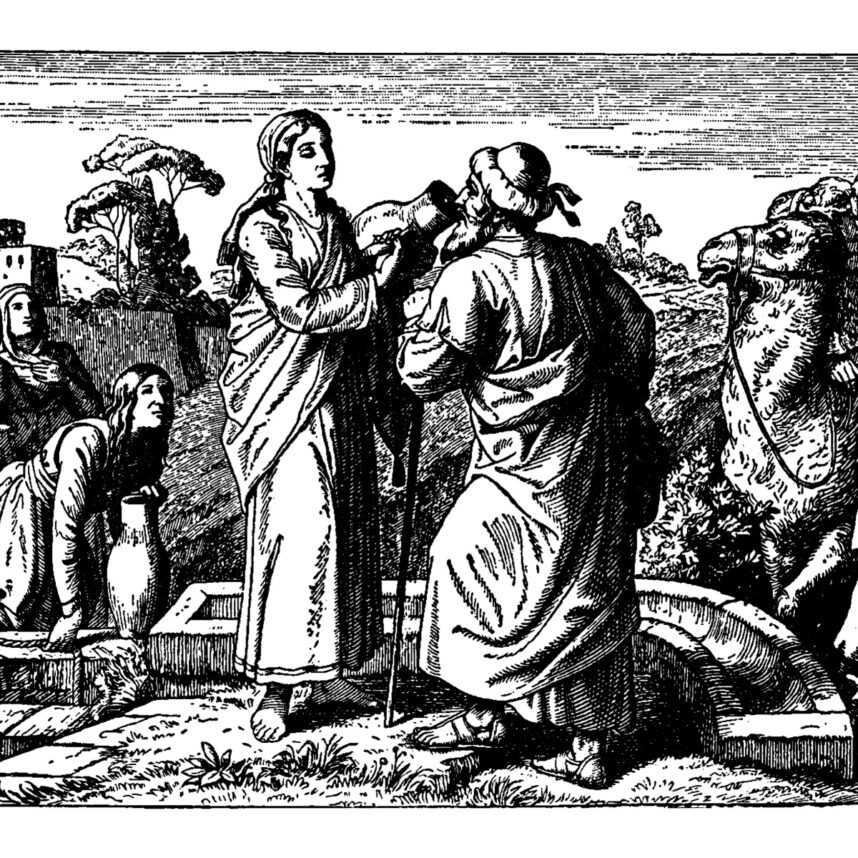
I imagine Rebecca when she arrived in Canaan, at the end of Genesis 24. Abraham’s servant Eliezer had gone up to the homeland in Paddan Aram to arrange a bride for Abraham’s son, Isaac. He found Rebecca, a distant cousin, and brought Rebecca home with him.
I would suppose that the kinfolk in Paddan Aram had heard something of the strange things going on down in Canaan, but the rumors were so crazy that one really believed them. Old Abraham had tried to sacrifice his son Isaac at God’s behest, but an angel had stopped him? What?
It was a 600-mile donkey ride back from Paddan Aran to Canaan (Mt. Shasta to Los Angeles, for example), so there was plenty of time to talk. Upon being asked, however, Eliezer probably told Rebecca that what happens in Canaan stays in Canaan. She would learn all about it when she got there.
He probably filled her in bit, however, when they passed by Mt. Moriah, where the attempted killing was nearly done, not far from Ir Shalem (later Jerusalem).
“So, the rumors are true?” she said with some outrage. In a flash, she knew she would take care of this traumatized, bereaved and damaged Isaac, and protect him from both his apparently deranged father and from his suspicious God. She was at least somewhat sure that Abraham had misunderstood what God told him to do, but she would have to find out for herself.
My sense of Rebecca is that once she arrived in Canaan, she knew what it would it take to suture the psychic wounds of her new husband and straighten out the whole tribe. Isaac was technically the chieftain, but Rebecca took over. She knew she would need guidance.
Fortunately for her, there was a local Wisdom Academy called the Study Hall of Shem and Eber. (“Study Hall” is an English term for “Beit Midrash” – literary, a “House of Seeking.”). She enrolled in continuing education classes in archetypal psychology and spiritual leadership and decided she would take classes in parenting the soul of the child when the time came (more about that in next week’s Torah portion).
I have been promising for decades (!) to write out the Midrash of Rebecca, and I’d like to start this week with the first chapters of that Midrash, “Helping Others Heal from Trauma.”
Here is what Rebecca learned in the first class in Approaches to Counseling: Don’t assume you know what another person’s suffering is, or what their suffering means to them, even if you have some knowledge of an event that occurred. For example, everyone had a theory about Isaac’s trauma, but nobody had actually asked him. What about his progressive blindness? Rebecca knew that she and Isaac were characters in a tragedy and therefore the blindness was a symbol, she didn’t know what the symbol stood for. (Rebecca wouldn’t know how essential Isaac’s blindness was to plot until next week’s Torah portion. But even so, the function of feature in story doesn’t mean it does not have symbolic power its own. More on that next week).
Back to trauma: We ought not arrive at the inner door of a suffering person with a theory in mind. Centuries later, this would be known as “Existentialist Psychology.” No single psychological method or theory can be applied to, and therefore work for, most people. Many schools of thought – philosophic, psychological, political, etc. – claim to know the essence of the human condition. Existentialists doubt claims that anyone can divine the essence of something through a dogma. For existentialists, the essential nature of the human condition is best known poetically, and therefore metaphorically – essentially unknowable and rendered best through art.
Another key element of the first class on counseling at the Beit Midrash of Shem and Eber that Rebecca took is that we arrive at the door of the inner life of another only if we are willing to exit the door of our habitual self. Only a mystery can encounter a mystery. Certainly, some of those carrying the mystery of their being have gained insight into their own souls, but no insight is final. Insight into ourselves can help us approach the mystery of another, but beware: encountering the mystery of another can radically shift our sense of reality and therefore the self. Knowing the truth of another can shatter the world we thought we knew.
After the first class, Rebecca felt confident enough to ask God, “What happened between you, my husband and my father-in-law?” To understand the generational trauma of this family, she wanted to go back to where it all started. Luckily for her, the world was still young then.
We’ll discuss all this and more Friday night, 7 pm Pacific time.
Shabbat Shalom!
Rabbi Finley
If you would like to read another of my teachings on this Torah portion, please see here.
Life Torn and Sewn Together – Comments on Chayei Sarah