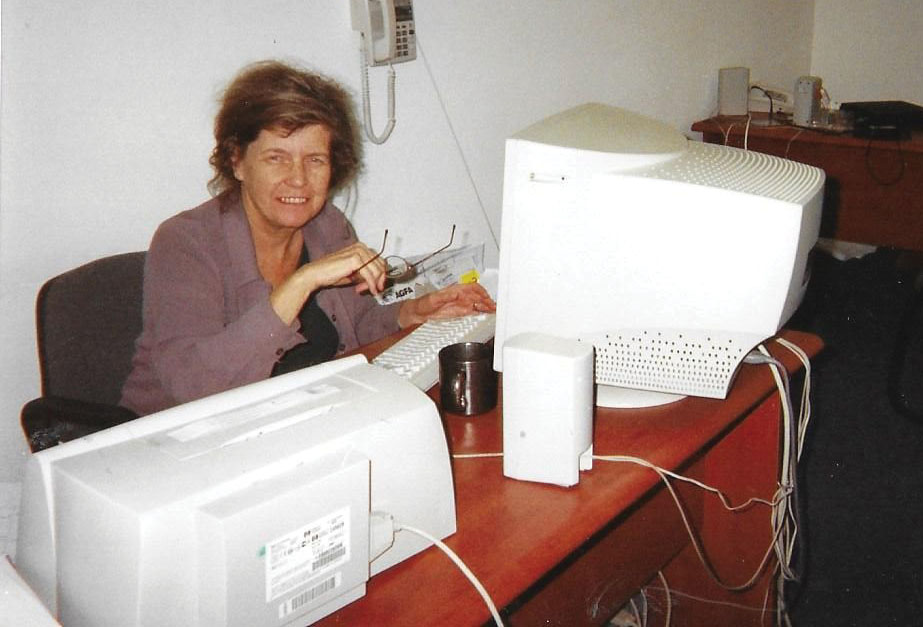
Sometimes a person comes into one’s life who is an inspiration, a mentor, a colleague, a friend. Such a person was Rochelle (Rachel Cohen) Furstenberg for me. In addition, she was simply a pleasure to be around. No matter how serious the topic under discussion, she was upbeat and positive.
Furstenberg has been an iconic writer and editor in Israeli and American publications for decades, including for the L.A. Jewish Journal, and her death, even at the age of 90, on the eve of Rosh Hashana, deeply moved Jerusalemites who knew her, worked with her, or have been reading her articles for many years. I’ve been blessed to have both a personal and professional relationship with her since 1976. But first, some background.
Rochelle grew up in Chicago, and later moved to New York to continue her studies. Rochelle’s husband, Professor Hillel Furstenberg, winner of the Israel Prize for Mathematics in 1993 and the Wolf Prize in mathematics in 2007, was born in Berlin and escaped with his family to New York shortly after Kristallnacht, in 1939.
My husband Yaakov and I made a shiva call to the family together, as Yaakov had studied math under the professor in Hebrew University, and later taught math and/or history to their three sons in high school yeshivas.
I asked Professor Furstenberg how he and Rochelle met, and he told us with a twinkle in his eye that a friend of his saw a young woman reading a philosophy book on the subway, which was unusual, and some time later thought he saw her again at an event for Orthodox singles. The young man asked if that was indeed her, and when she said yes, he asked if he could give her phone number to his friend (Hillel). She said yes, and another friend of Hillel’s in Chicago also sent him her phone number. That’s how it all began.
They got married in 1958 and made aliya in 1965 to Jerusalem.
I first met Rochelle in 1976 when Rabbi Adin Steinsaltz, whose extra-curricular adult education programs I directed for his Shefa research institute, asked me to include in the panel of our first program, held at the Van Leer Institute, Rochelle Furstenberg and Tamar (Wohlgelernter) Ross. I remember being a bit awed in the presence of those two illustrious women.
Rochelle was already a prolific journalist and literary critic and Tamar was a well-known scholar. She eventually specialized in the writings of Rav Kook, Jewish philosophy and mysticism, with an emphasis on moral education. (In that Jerusalem spiderweb of connections, my husband also worked in Rabbi Steinsaltz’s Shefa institute, as a researcher and writer.)
The only thing I remember from that meeting is their friendly and intellectual banter, and the fact that Ross showed us a few pages of what became, in her family, “The book of wisdoms,” in which she recorded clever things her children said from toddler-hood and up.
Later, when Rochelle was editor of Emunah Magazine, she hired me to write two ground-breaking stories. The first, titled “Family Planning, Health and Halakha,” published in 1989, was definitely a bold leap for an Orthodox magazine. I remember working closely with her, discussing the books I’d quote from and the various experts I’d interview. The latter were a Who’s Who of rabbinic and medical scholarship and expertise, from a variety of viewpoints.
The second article she assigned me, published in 1991, was a cover story called “Wise Women,” in which I interviewed three eminent women deeply involved in the advanced study and teaching of Torah. They were author and lecturer Dr. Avivah Gottlieb Zornberg, Malke (Milikovsky) Bina, founder of Matan Women’s Institute for Torah Studies, and, again, Dr. Tamar Ross, later to become Professor Ross. Today, women who are eminent in higher Torah education and scholarship are ubiquitous, but this was 1991, and the women I interviewed were ground-breakers.
Fast forward to 1999.
After three grueling years of investment-seeking and content creation for WholeFamily.com, a family psychology website that employs short dramas, in addition to articles and write-in columns, founded by Dr. Michael Tobin and myself, we were able to open our office and hire division editors; I was the editor-in-chief. One of the first people I hired, to direct our Senior Center (a name we later changed to “Grandparent Center”) was Rochelle Furstenberg. We also have a marital center and a parenting center, that includes a teen section.
In addition to her own writing, Rochelle reached out and commissioned wonderful independent writers, such as Leah Abramowitz, co-founder of Melabev, an organization for dementia patients in Israel which has 10 centers in Jerusalem and more in surrounding areas; Dvora Waysman, a prolific Jerusalem author; and many others, from Israel and America. Even though we had to close our brick-and-mortar office when the dot-com bubble burst in 2000, the site has stayed online and the work of Rochelle and others is still there to enjoy and learn from. Rochelle’s work can be found at: https://www.wholefamily.com/grandparent-center/grandparent-center)
Sara K. Eisen, who at the time was our Teen Center director, wrote to me, when I let her know about Rochelle’s passing: “Rochelle was two generations my senior but I never felt her to be old; when we worked together she actually had some of the coolest ideas I encountered. A fresh, wise, learned perspective every time, presented in a down-to-earth way, with a laugh and a breezy adjustment of her fantastic thick hair.”
Sherri Mandell, in-house writer and award-winning author, and, later, co-founder of the Koby Mandell Foundation, wrote simply, “I adored her.”
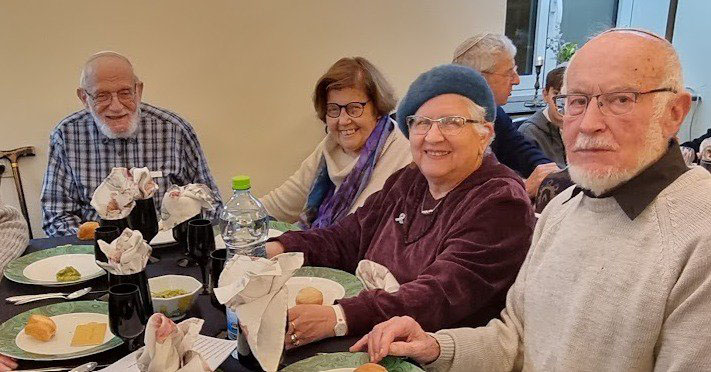
Yaakov and I most recently met Rochelle and Professor Furstenberg at a 2026 Yom Ha’atzmaut dinner in the home of mutual friends, Professor Carl and Phyllis Posy. Rochelle was as vibrant and animated as ever, asking what I was working on, and requesting that I send her links of my recent articles and plays.
There is so much of her writing that could and should be shared, and as I surfed through the WholeFamily Grandparent Center, I found a piece called “Some Nice and Funny Things We Like About Our Moms and About Being Mothers” to which Rochelle also contributed. Here is what she wrote, and it is a window on who she was as much as it is a window on her mother:
“GIFTS
“My mother is a giver of gifts; birthday gifts, anniversary gifts; graduation gifts. She believes in celebrating, marking occasions, this moment, this event. We must capture it, comprehend it, for one long deep breath in the rush of time. Knowing that man’s life is but the dust of a flower, a passing shadow, a fleeting dream. A gift is a way of holding onto loved ones in the embrace of time, a particular opportunity to connect, to bring a far-flung family together from all parts of the world. But to express true love, a gift cannot be chosen casually. My mother would agonize for weeks over the right present to give each grandchild when she came to visit.
“Even more so, she would know when her adult children were in need, and although not a rich woman herself, she would always come through. Yes, there have been many, many gifts but the greatest gift of all has been the lesson of generosity. Particularly, the generosity of parents to children, as an outpouring of love, given freely without expectation of return, in the hope that they will do the same with their children, in one eternal chain of giving and bounty.”
– Rochelle Furstenberg
Now Rochelle’s children and grandchildren can write about the gifts she left them. You can read their thoughts, tributes by others, and some of her own written work at: https://rochellefurstenberg.com.
May she continue to inspire her children and their progeny, her colleagues and friends, and her readers for generations to come, and may her memory be a blessing.
The writer is an award-winning journalist and theater director.