Rabbi Chaim Shmuelevitz, the head of the Mir Yeshiva in Jerusalem during the 1960s and ’70s, would often visit Rachel’s Tomb. One day he overheard a woman on the other side of the divider, tearfully offering this prayer: “Our mother Rachel, you too were once childless, and you know well the depth of the pain and anguish it brings. Please be an advocate for me, that I too may merit a son, just as you did.”
This woman’s prayer profoundly moved Rabbi Chaim, and afterward he said to her: “I am certain that your prayer will be accepted. And when you have that son, I will be honored to serve as the sandak [godfather].”
And so it was. A year later she had a baby boy, and Rabbi Chaim was the sandak.
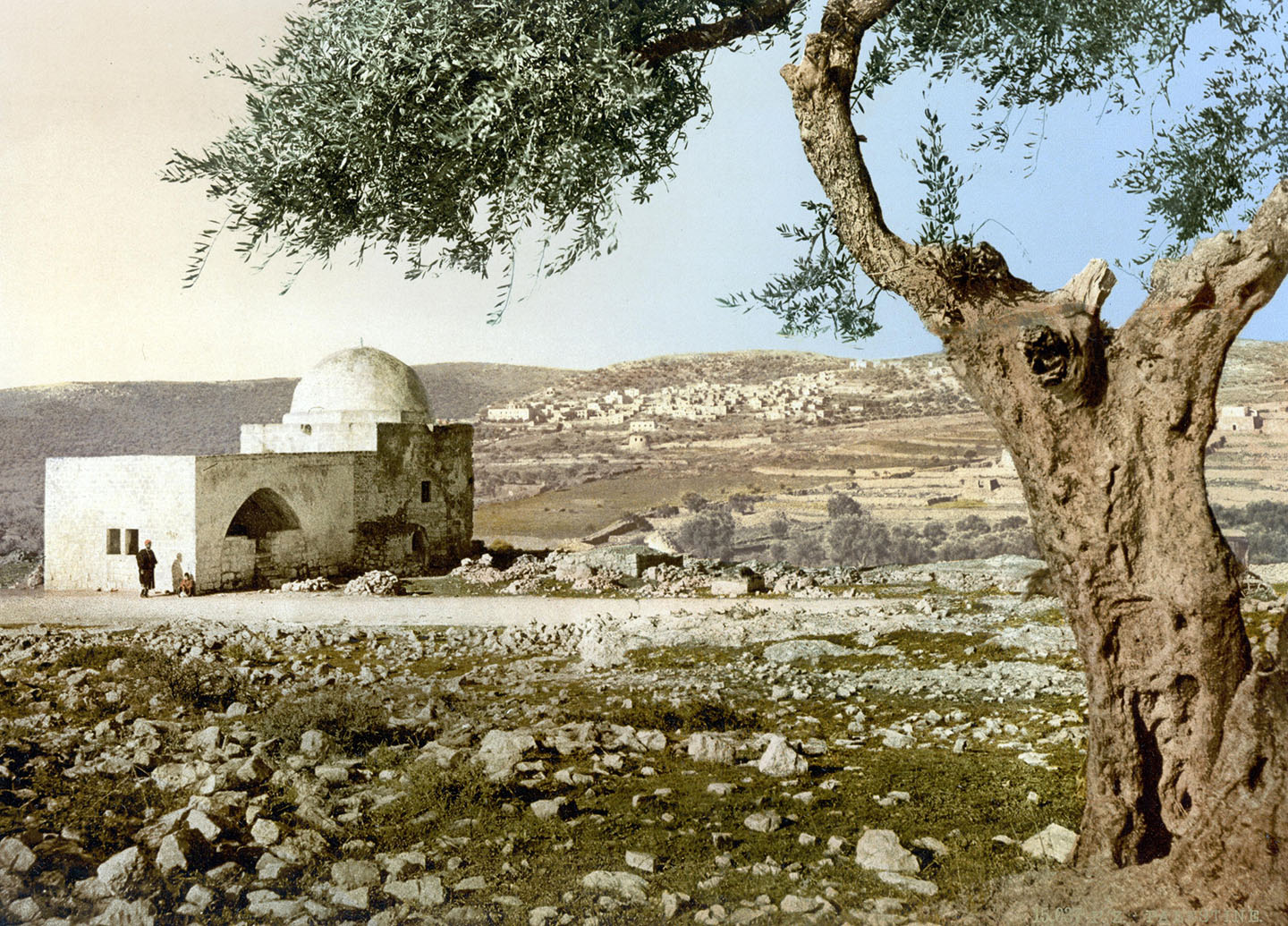
For millennia, supplicants have found their way to Rachel’s Tomb. A Christian visitor from Bordeaux in 333 mentions that “From Jerusalem, as you go to Bethlehem, four miles above the road on the right-hand side is the tomb where Rachel, wife of Jacob, is buried.” In the 1100s, Jacob ben Nathaniel Hakohen described how, “the grave of our mother Rachel, in Ephrath, is a tower built of hewn stones with four doors. There are eleven stones on her grave, for they say that Benjamin was small and could not bring his stone and the top stone was erected there by our father Jacob.” Benjamin of Tudela, who visited in the same century, noted that “all the Jews that pass by carve their names upon the stones of the pillar.”
During pilgrimages to Israel in the 1800s, Judith and Moses Montefiore visited Rachel’s Tomb several times. Judith, who like Rachel had her own struggle with infertility, was particularly drawn to Rachel’s Tomb. The Montefiores donated money to renovate and expand the building. Back in England, they built a replica of Rachel’s Tomb on their estate in Ramsgate, where they were both buried.
In more recent times, “authentic red strings from Rachel’s Tomb” are sold around the globe, to Jews and non-Jews alike. These red strings bring Rachel’s blessing to those who wear them. Rachel’s Tomb is a house of prayer for the hopeful and heartbroken.
What makes the prayers recited at Rachel’s Tomb unique? Much of their mystique derives from a passage in the Book of Jeremiah, which says:
“Thus says the Lord:
‘A voice was heard in Ramah,
Lamentation and bitter weeping,
Rachel weeping for her children,
Refusing to be comforted for her children,
Because they are no more.’”
From this tomb, Rachel in heaven cries for her suffering children.
Rachel’s life was profoundly tragic. She was in love with Jacob, but her father switched her with her sister Leah at the wedding. Rachel married Jacob a week later, joining Leah as a co-wife. God gave Leah children while Rachel remained barren and brokenhearted. Soon after arriving in Israel, Rachel died in childbirth, and was buried hastily on the side of the road.
Rachel’s death represents the tragic crescendo of an already tragic life. And, by its very geography, Rachel’s Tomb tells the story of a woman whose dreams were left unfulfilled.
However, this is the very draw of this tomb. The heartbroken come here because they see Rachel as a kindred spirit who will intercede for them. So many have turned to Rachel for help because she knows their pain, and will intercede for them.
During the British Mandate, Rachel’s Tomb attracted more visitors than ever before; King Alfonso of Spain, General Bernard Montgomery, and George Bernard Shaw were among those who signed the guest book. Along with them came pioneers who dreamed of a future Jewish State. When Chaim Nachman Bialik visited Rachel’s Tomb, he wrote the following in the guest book: “Our mother Rachel. When will the exile come to an end? From me, your son who honors you, Ḥayyim Naḥman Bialik … May it be that in place of weeping there will be—song.”
Bialik was asking Mother Rachel to bring her children home. And that is what Rachel has always done. Jeremiah describes God’s response to Rachel’s cries:
“Thus says the Lord:
‘Refrain your voice from weeping,
And your eyes from tears;
For your work shall be rewarded, says the Lord,
And they shall come back from the land of the enemy.
There is hope in your future, says the Lord,
That your children shall return to their homeland.’”
Rachel’s Tomb is where redemption begins. She cries for all of the exiles.
Rachel’s Tomb is where redemption begins. She cries for all of the exiles.
But one has to wonder: Why is Rachel held out as the symbol of redemption? And why will this forsaken tomb be ground zero of redemption?
The Talmud and Midrash add a great deal to Rachel’s story. First, they explain why Jacob buried Rachel on the side of the road. Hizkuni and other commentaries assume that because Rachel died in childbirth, her body was too bloody to be transported to the family burial plot.
But Rashi, citing the Midrash, says: “But know that it was by divine command that I buried her there, so that she would be a help to her children when Nebuzaradan would exile them. As they would pass by her grave, Rachel would come out and weep and plead for mercy on their behalf.”
God chose where Rachel is to be buried, not Jacob.
Even more fascinating is the assertion of the Talmud and the Midrash that Rachel knew her father would switch her with Leah at the wedding. Worried that Jacob would find out and embarrass Leah, Rachel assisted her sister in the ruse; according to the Midrash, Rachel even hid under the bed that night and spoke for Leah, so that Jacob wouldn’t recognize Leah’s voice!
The Midrash concludes that it is because of this, even after God rejects the prayers of Abraham, Isaac, Jacob and Moses, He listens to Rachel:
“I performed an act of kindness for her, I was not jealous of her, and I did not lead her to humiliation. If I, who is flesh and blood, was not jealous of my rival, and I did not lead her to humiliation and shame, You who are a living and eternal merciful King, why were You jealous of idol worship that has no substance, and You exiled my descendants …’ Immediately, the mercy of the Holy One blessed be He was aroused and He said: ‘For you, Rachel, I will restore Israel to its place.”
Rachel had shown exceptional grace in her own life; God simply could not turn her prayers away.
These Midrashim are dramatic; they describe Rachel as an exceptional hero. But the question is: Where is this heroism hinted at in the biblical text?
It begins with Rachel dying during childbirth. She calls the boy ben oni. The word oni has several possible translations. The Ramban translates oni as mourning; Rachel is grieving her own death. But many other commentaries translate oni as pain; she is referring to the enormous suffering she has to endure to give birth to this child.
That is the key. Rachel suffers unto death during childbirth, but she does so with a purpose; she wants another child, and is willing to sacrifice her own life for it.
Rachel, who sacrifices herself for future generations, is the one God listens to. And in the last century, Rachel’s sacrifice was rewarded; her children returned to their homeland.
Jeremiah’s words, v’shavu vanim ligvulam, “your children shall return to their homeland,” have become a rallying cry in the past two years, as people around the world called for the return of the hostages.
Today, all of them are home, except for one: Ron Gvili. Ron was 24 years old and a member of a special police unit. He was off-duty awaiting surgery on a broken shoulder. But despite his injury, Ron ran to the front on October 7th, heroically fighting off terrorists outside of Alumim. He died in battle, and Hamas took his body hostage.
As Ron’s mother Talik put it: “The first to go and the last to return.”
It is time for Ron to come home.
I have no doubt that Rachel is crying for him. And so are we.
V’shavu vanim ligvulam.
Rabbi Chaim Steinmetz is the Senior Rabbi of Congregation Kehilath Jeshurun in New York.