The Athletic, the sports section of The New York Times, published an article last week that discussed a very interesting fact. The perfect game is not the rarest magnificent accomplishment in baseball. The four-home-run game is. Twenty-four pitchers have thrown perfect games. Nineteen sluggers have hit four home runs in a game. No one has ever done either twice.
Yet, every six-year-old American boy knows about the perfect game. Within a couple of years, he is likely to know at least a couple of the pitchers who have thrown one — perhaps Don Larsen, Cy Young, Randy Johnson or David Wells. Yet, there is not even a name for the four-home-run game. A youthful baseball fan will be able to guess a few of the hitters who have done this — perhaps Lou Gehrig, Willie Mays, Shawn Green and Carlos Delgado. But he won’t know.
Why do we value the perfect game so much more than the four-home-run game? As with all questions, we can turn to the Torah — which yields at least three reasons:
1. Jewish literature records an ancient contest — among the sages, about what the most important Torah verse is. Rabbi Akiva said: “Love your fellow as yourself.” Shimon ben Azzi contributed: “Man is created in the image of God.” Ben Zoma’s entry was: “Shema Yisrael — Hear O Israel!”
These are home-run verses — spectacular statements, each of which pack an enormous amount of spiritual power whose meanings and lessons have inspired and instructed the generations.
But none of them won.
The winning verse — winning by such a margin that we are told that it was declared victorious “by acclaim” — was contributed by Shimon Ben Pazi. His verse was Exodus 29:39: “The first lamb you shall sacrifice in the morning, the second in the afternoon.”
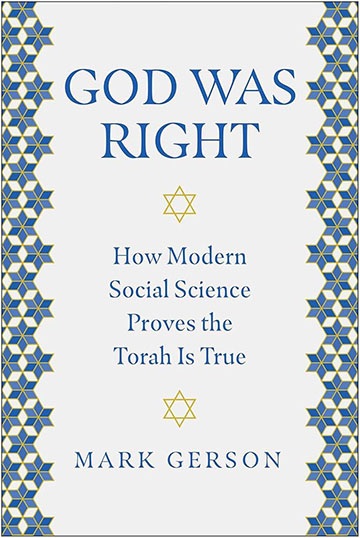 Why did Ben Pazi so convincingly win? I explore this in the chapter on Routine in my forthcoming book, “God Was Right: How Modern Social Science Proves the Torah is True.” The Jewish tradition recognizes that what we do consistently — in the morning and the afternoon on ordinary days — defines who we are.
The perfect game — 27 batters up, 27 batters down — is the quintessential display of consistency. Americans appreciate it, seemingly for the same reason that the sages who judged Ben Pazi the winner did.
The Jewish tradition recognizes that what we do consistently — in the morning and the afternoon on ordinary days — defines who we are.
2. Partnership. In early Genesis, God says: “Let us make man.” Who was he talking to? There was no one around to help. And that’s the point. God was not talking to anyone else; he was talking to us. Everything valuable is done in partnership with others. This was true of the Exodus (where God partnered with Moses), the building of the Tabernacle (which involved lots of people with enumerated skills) and the leadership of the people through the desert (where Moses the political leader partnered with Aaron the high priest).
A slugger does not need anyone else to help him hit four home runs in a game. In fact, no one else can do so. It is just the hitter and his bat. By contrast, no pitcher has ever come close to achieving a perfect game with 27 strikeouts. Sandy Koufax and Matt Cain came the closest — with 14. Every perfect game has relied on great team defense — sometimes, as with Mark Buehrle’s perfect game in 2009 — a spectacular fielding play or two.
3. Wholeness. Perhaps the best word in Judaism is Shalom (peace). This notion of peace is not only absence of conflict. It is also — as is reflected in its root (shalem) — wholesomeness. In Leviticus, we learn that God will only accept an offering that is “wholesome” — one that is without blemish, and has complete integrity.
The perfect game — one in which the pitcher, with the help of his defense, retires every batter consecutively and (by definition) wins the game — embodies the integrity of his craft and the game. Seventeen of the 19 sluggers who hit four home runs in a game recorded an out in their remarkable performance. And three of these 19 hitters went home disappointed or at least incomplete — as their team lost the game.
So why do Americans love the perfect game — but barely notice the more rare four-home-run performance? It is more evidence, I think, that America is a nation whose soul is the Torah.
Mark Gerson is the author of the forthcoming book, “God Was Right: How Modern Social Science Proves the Torah is True.”