
Everyone loves Jewish food and Italian food.
“It’s the best combo,” Benedetta Jasmine Guetta, author of “Cooking alla Giudia: A Celebration of the Jewish Food of Italy,” said. “It’s like if you had a bubbe who is also Italian. How much better can you get?”
An Italian food writer and photographer, Guetta, 33, who grew up in Milan and now lives in Santa Monica, has become an ambassador of Jewish Italian cuisine.
With a collection of kosher recipes from all regions of Italy, “Cooking alla Giudia” illustrates how the Jews changed Italian food.
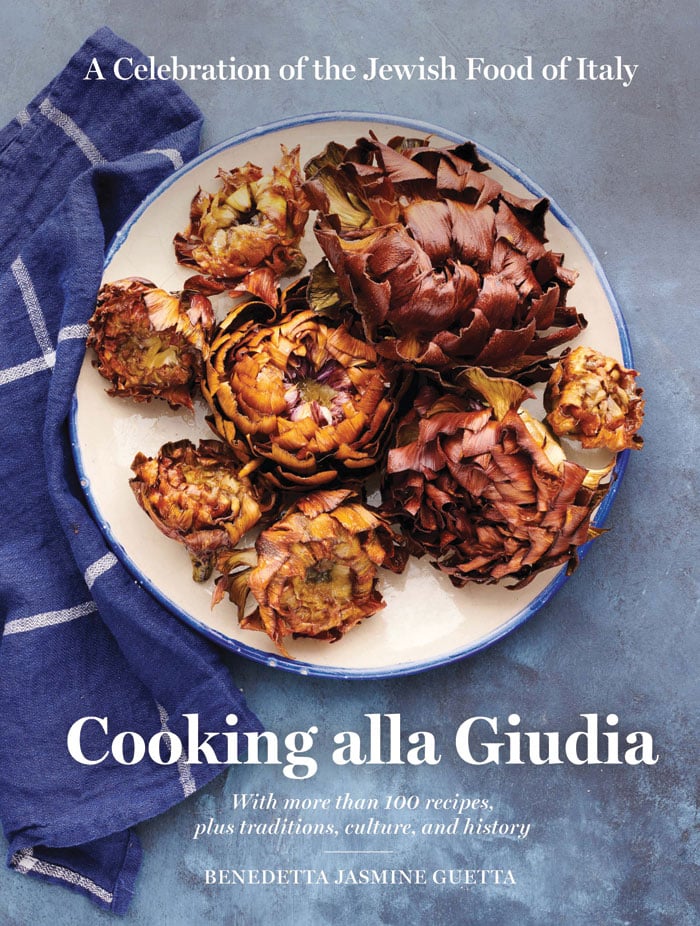 “Jewish Italian food is a thing of its own,” the author said. “Our cuisine is very specific in that it’s Italian in its flavors, but it’s also very Jewish in its adherence to the regulations and its specificity for the Jewish holidays.”
While it’s very different compared to what people in the U.S. think of as Jewish – for instance, Italian Jews do not eat matzo balls, Guetta said – it’s still the homey and cozy food of the Jews combined with the colorful Mediterranean style of the Italian culinary tradition.
“Most of the Jewish population of Milan, as of today, is the result of immigration in the 1960s and the 1970s,” she said. “My family came from Libya and many Jews came from Iran [and] Lebanon, so the community of Milan is a mixed bag.”
Guetta, who owns Café LOVI in Santa Monica, has taught the recipes of the cuisine to people in cooking schools, synagogues and community centers. Her food journey started in 2009, when she co-founded the Labna blog with Manuel Kanah.
“Labna was born as a collection of recipes from the cooking classes that I was teaching with a friend of mine,” Guetta said. “We didn’t set out to be a Jewish blog, but there was so much interest and enthusiasm that we ended up writing a lot about that.”
From there, Guetta started researching Jewish food in general, and then, specifically, the Jewish food of Italy. She visited Jewish communities throughout Italy, recording recipes for her knowledge, the blog and eventually the book.
“The Jewish communities of Italy are also very small so, for example, the Jewish community of Venice is [made up of around] 400 people,” she said.
Many of the residents are older. “I was chatting with all of these really cute grandmas,” Guetta said.
She felt it was almost her duty to preserve their recipes for the next generation.
“There’s a bit of a gap in the way these recipes are going to be passed on, and I do have a vivid sense that a lot of those recipes would have died with these people,” she said.
Some of Italy’s best-known dishes are Jewish in origin, Guetta said, but little is known about them. For instance, it was the Jews who taught Italians to eat the eggplant.
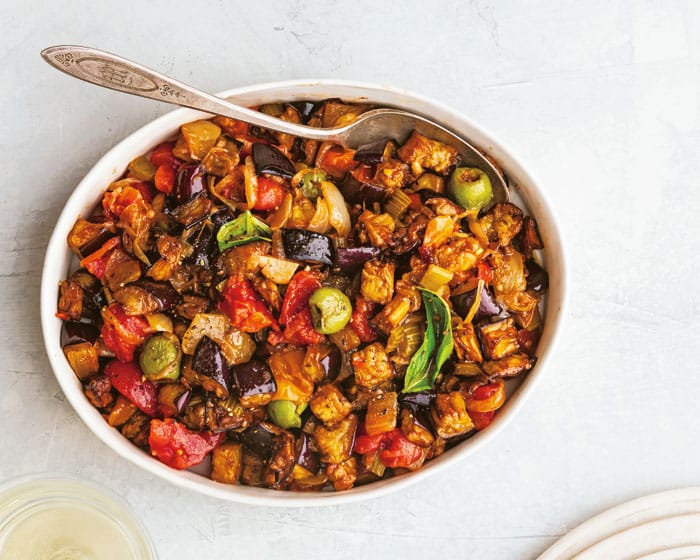
“Eggplant Caponata is this excellent dish that people think of as Italian, but it’s actually of Jewish origin; people just don’t know it,” Guetta said. “It’s one of those dishes that have obviously a Jewish history that I wanted to sort of claim back [for] the Jews.”
Caponata alla giudia
Eggplant and Vegetable Stew
Excerpted from “Cooking alla Giudia”
“Caponata is somewhere between a cooked salad and a vegetarian stew that vaguely resembles ratatouille. It’s one of the most ancient preparations of Sicilian cuisine, and it likely has Jewish origins, indicated by the presence of eggplant in the dish. As you slowly cook the eggplant with tomatoes, celery, olives, capers, and herbs, it all turns into a savory, briny mix, one that tastes even better the next day.
Serves 4
3 eggplants
Kosher salt
1½ onions
2 celery ribs
5 cherry tomatoes
¼ cup (60 ml) extra-virgin olive oil
2 garlic cloves, smashed
1 cup (200 g) chopped ripe tomatoes
or canned diced tomatoes, with
their liquid
2 tablespoons mixed black and green
olives, pitted
1 tablespoon capers
½ cup (120 ml) white wine vinegar
1 tablespoon sugar
Sunflower or peanut oil for deep-frying
Freshly ground black pepper
5 basil leaves
Cut the eggplants into ¾-inch (2 cm) cubes. Transfer them to a colander, salt generously, weigh them down with a plate, and let drain for 30 minutes.
Cut the half onion into very thin slices. Cut the whole onion into chunks roughly the same size as the eggplant cubes. Cut the celery into chunks and cut the cherry tomatoes in half.
Pour the olive oil into a large nonstick skillet set over medium heat, add the sliced onion and garlic, and cook for about 3 minutes, until the garlic is slightly browned. Add the celery, tomatoes (both cherry and chopped), olives, capers, and the chopped onion to the pan and cook for 10 minutes, until the vegetables begin to soften. Add the vinegar and sugar and cook for another 10 minutes. Remove from the heat.
Remove the plate covering the eggplant and squeeze the eggplant in the colander to remove any remaining liquid.
Pour 1 inch (3 cm) of sunflower or peanut oil into a large saucepan and warm over medium heat until a deep-fry thermometer reads 350°F (180°C). You can test the oil by dropping a small piece of food, such as a slice of apple, into it: if it sizzles nicely but doesn’t bubble up too wildly, the oil is ready. (An apple is said to help minimize the smell of the frying oil, so I generally go for that, but any bit of food will do.)
Add only as many eggplant cubes to the pan as will fit in a single layer without crowding and fry until golden, turning often. Remove the eggplant with a slotted spoon and spread out on a paper towel–lined plate to drain. Cook the remaining eggplant cubes in the same manner, adding more oil if needed.
Once the fried eggplant has drained, add it to the pot of vegetables. Season with ½ teaspoon salt and pepper to taste, adding a bit of water if the vegetables look dry, and cook the caponata over medium heat, stirring frequently, for 5 minutes.
Stir in the basil leaves, remove from the heat, and let the caponata cool to room temperature before serving.
Caponata keeps well in the fridge, in a bowl covered with plastic wrap or in an airtight container, for 3 to 5 days; it can also be frozen. Leftovers can also be used to dress pasta, in which case, add either grated Parmesan cheese or mozzarella, torn into small pieces, to the caponata.”