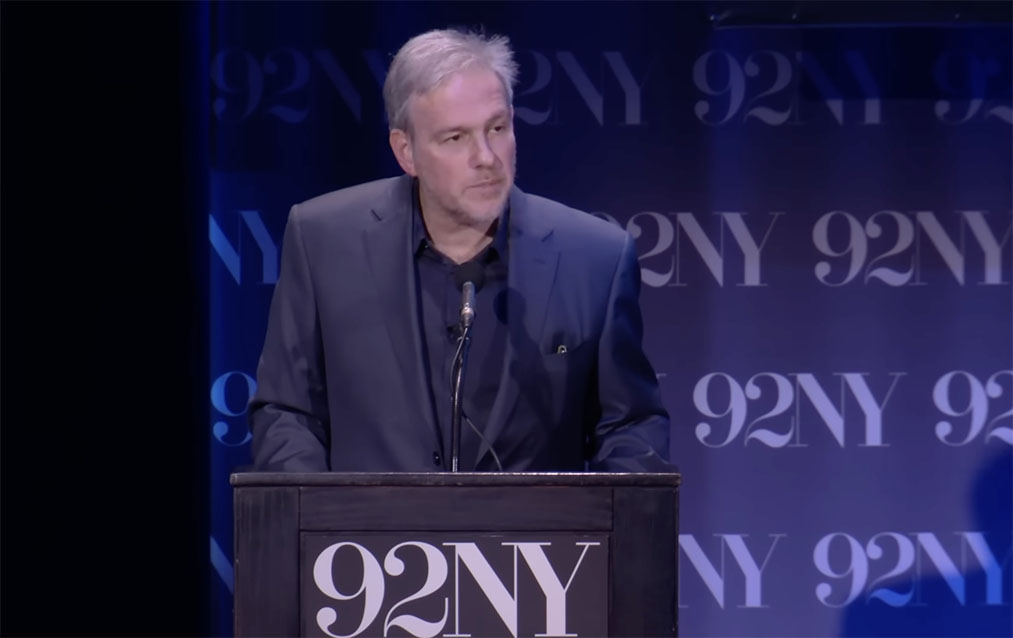

Before Anita Diamant wrote herself into Jewish literary stardom with her best-selling and much-loved novel “The Red Tent,” she was already an accomplished writer of both fiction and non-fiction. One of those books was “The New Jewish Wedding,” which has now been brought fully up to date and published as “The Jewish Wedding Now.” Her admiring readers will not be surprised to learn that Diamant has taken a fresh new look at the ancient traditions of Jewish marriage. After all, she did the same thing with the biblical story of Dinah in “The Red Tent.”
“When ‘The New Jewish Wedding’ was first published in 1985,” Diamant explains, “just the words Jewish wedding summoned up the vanished world of ‘Fiddler on the Roof’ or the extravagant excess of ‘Goodbye, Columbus.’ ” The newly published edition, however, reflects “a new appreciation for the rituals, cuisines, music, and customs of other Jewish communities,” including “Jews of color, LGBTQ Jews, and those with roots in other countries and cultures.”
Diamant is respectful of tradition but always is willing to entertain new ideas about what it means — and what it feels like — to be a Jewish bride and groom. “Under the huppah, time dissolves. All the lists and decisions about where, when, what to wear and whom to invite: it all recedes into a radical now,” she rhapsodizes. “Your wedding takes place in the same time zone as the first wedding, when God braided Eve’s hair and stood with Adam as a witness.”
Like every aspect of Judaism, much of what we understand to be authentic and essential is actually an accretion of observance and practice that has built up over centuries and millennia. A kosher wedding, she explains, really only requires that “the bride accept an object worth more than a dime from a groom; the groom recites a ritual formula to consecrate the transaction; these actions must be witnessed by two people who are not related to either bride or groom. That’s it.”
All the rest — even the breaking of a glass, the seven blessings and the presence of a rabbi — are customs (minhagim) that have come to be embraced by Jews over time. “The nostalgic fantasy that there was once a standard, universal, and correct way to do a Jewish wedding ignores the differences in everything from clothes to the fact that for centuries some Jews practiced polygamy,” she boldly points out.
While Diamant can appreciate the value of both nostalgia and fantasy, she is also willing to confront her readers with the realities of Jewish weddings in the 21st century. “How do we arrange the processional with two sets of divorced parents in the mix?” she wonders. Even more problematic are the challenges faced by wedding couples of the same gender or couples that include a Jew and a non-Jew. But she has practical solutions to every question she raises, and she insists that “[a] Jewish wedding connects every couple under every huppah to a language of holiness, to a living history, and to a diverse and vital culture.”
Indeed, Diamant overlooks no aspect of the wedding. For example, she provides suggested wording for the invitation and the ketubah (wedding contract), and she illustrates the book with examples of especially artful ketubot. Significantly, the sample ketubot include egalitarian, mystical and romantic variants of the document. She even acknowledges that some couples seek to avoid “gendered modes of dress,” and suggest that both can wear the short white robe called a kittel or drape themselves in prayer shawls.
“Your wedding takes place in the same time zone as the first wedding, when God braided Eve’s hair and stood with Adam as a witness.” — Anita Diamant
Mindful of the aphorism “Two Jews, three opinions,” Diamant offers solutions for problems that many readers will not even have considered. The two witnesses who must participate in a kosher Jewish wedding are meant to be observant Jews, but that’s a debatable point among Jews. “A person who is considered observant by some will be a heretic to others,” she writes, “so to avoid discord it became customary for the rabbi and the cantor or other community leader to serve as witnesses.” She also defers to the presiding rabbi on other points of potential friction. “No religious rule forbids photography or videography under the huppah, but this is something to clear with your rabbi.”
Not coincidentally, Diamant devotes a chapter to the traditional visit of the bride to the ritual bath called the mikveh. As it happens, she is the founding president of Mayyim Hayyim, a community mikveh in the Boston area where she lives. “For centuries, Jewish brides have immersed to prepare for their wedding nights, traditionally the beginning of sexual intimacy and also the start of monthly immersions following menstruation,” she writes. “Today, the pre-wedding mikveh has been embraced by the larger Jewish community that has recognized and reclaimed the beauty of the ritual.”
When she describes the wedding processional, she delicately refers to “the complexity of modern families,” that is, the divorced and remarried parents and children from previous or subsequent marriages whose presence requires “alternative choreography” when it comes to who will walk down the aisle with the bride and groom. Always practical and flexible, Diamant proposes that “[i]f there are too many competing claims, the couple can avoid conflict by entering side by side.”
Diamant describes the moment when we step under the huppah as “that crazy-sacred now at the heart of every wedding.” Clearly, the book is the single best gift that you could give to anyone contemplating or planning a Jewish wedding, far more practical and inspiring than a toaster oven. But the book is not just for the betrothed. “The Jewish Wedding Now” offers a surprising new look at an ancient rite for every curious reader.
Jonathan Kirsch, book editor of the Jewish journal, is the author of “The Harlot by the Side of the Road,” among other titles.