During the week of April 16-23 that marked both Holocaust Remembrance Day (April 20-21) and Palestinian Prisoner’s Day, a number of anti-Semitic online vitriol linked Israel and Jews to the coronavirus (COVID-19).
An online Holocaust Remembrance Day event held by the Israeli embassy in Germany was suspended after being disrupted by neo-Nazis and on April 20, a pro-Palestinian group’s Facebook page announced an event to be held across Italy marking Italy’s independence from fascist and Nazi occupation, tying it to “the occupation and colonization of Palestine.”
On the evening of Yom Hashoah, the BDS National Committee released a fact sheet titled “Coronavirus Under Israeli Apartheid” that claimed Israel as an apartheid system has been systematically spreading racism throughout the coronavirus crisis.
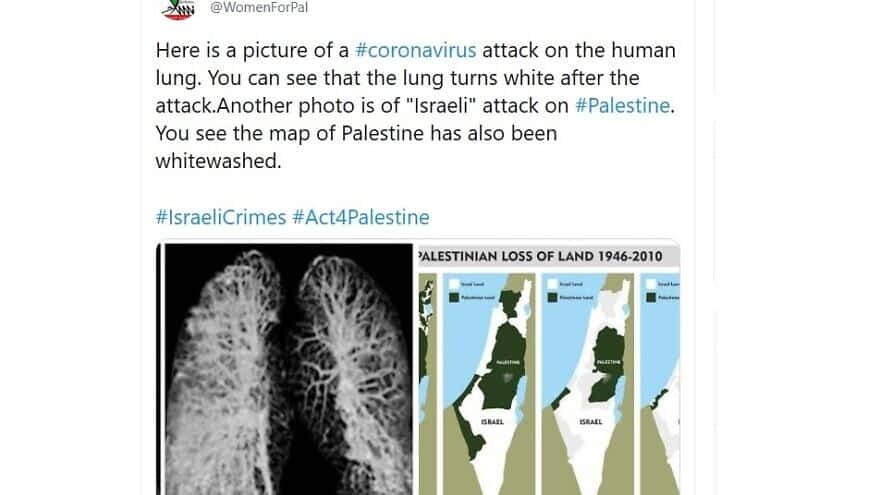
The following day, Women for Palestine tweeted images comparing the growth and “attack” of a Jewish presence in Israel to the spread of coronavirus in the lungs.
Numerous Twitter accounts from the Arab world also employed the hashtag #COVID48 and urged other Twitter users to tweet the hashtag at 7 p.m. on April 20 to coincide with the start of Yom Hashoah (and oddly enough, Adolf Hitler’s birthday). The hashtag was accompanied by images promoting anti-Semitic conspiracies, including the characterization of Israel as COVID-19, and the claim that Israel and the United States created the virus for financial gain.
Research suggests that the #COVID48 hashtag originated from a Facebook event coordinated by a group called “The Children of the Refugee Camps–The Jordanian Group.” The hashtag has already reached more than 500,000 Twitter accounts with an impression count of some 1 million.
Others who participated in activities for Palestinian Prisoner’s Day, including the NGOs Palestinian Youth Movement-USA and NY4Palestine, posted anti-Semitic content on social media, including the conspiracy that Israel is purposely infecting Palestinian prisoners with COVID-19.
On April 20, Jewish Voice for Peace tweeted a quote from former Palestinian political prisoner Sami Mohammed, who compared Israel to a virus, saying, “The social solidarity we witness nowadays due to the corona pandemic reminds me of the First Intifada when Palestinians were united to resist the other heavy virus.”