There has been much agitation about the perceived exclusivity of the contemporary Tikkun Olam movement. The complaint is that Orthodox Jews — especially ones who lean conservative politically — do not feel welcome at the table when issues of social justice are discussed.
Whether that’s because of the red lines we draw around certain criticism of Israel, or because of our adherence to Jewish customs that create friction with social norms, it seems safe to say we’re not happy about being left out.
But I’m starting to wonder how it looks from the outside looking in at our Orthodox bubble. I met with a representative from an organization that fights for one segment of society’s vulnerable, who was hoping that I would write about some of the work their nonprofit is doing in the Los Angeles area. They demonstrated the merits of the organization’s cause at great length, describing its historical importance both to the United States and the Jewish people. They offered statistics indicating the issue’s bipartisan appeal. Finally, they rattled off a list of local Jewish institutions that had taken up the cause.
“Any Orthodox?” I asked.
The representative said that was a much shorter list. They explained that while they work with Orthodox synagogues, many others were skeptical of the cause. The nonprofit’s presence also was limited in L.A., and most of this organizer’s connections were with Conservative, Reform or nondenominational Jewish institutions. Moreover, I was informed that the majority of Jews in the Los Angeles area are not even members of a synagogue. From a purely numerical standpoint, it did not make sense to heavily invest in outreach to Orthodox shuls. Already spread thin, and with no shortage of other groups that wanted to partner with the nonprofit, why bother barking up the Orthodox tree?
When we talk about “the radical middle,” the radical part is us meeting our end of the bargain by extending our arms and welcoming in the stranger.
That wasn’t all. They conceded that taking only the low-hanging fruit was just one factor. They also had personal reasons for staying out of shul. “We’re talking about going into a place where I’m not considered a real Jew, where my marriage isn’t recognized nor where I could be considered Jewish enough to become a rabbi,” they said, “because I’m gay.”
Mind you, that’s not because of this person’s politics — which our community already is at one another’s throats about — but because of their religious choices and sexual orientation. The skepticism of an Orthodox audience about the topic was just a layer on top of its palpable suspicion about the speaker.
I identify as an Orthodox Jew, and my fear is being left behind because my cohort can’t bring itself to express humanity in disagreement, and because other cohorts have given up on us as uncompromising, unwelcoming or discriminatory. But I’m not giving up yet. I’m not ready to write off frum Jews.
The moment struck me as a breakdown of communication between denominations more than anything else. Could the attitudes of my own crowd be so retrograde? Or had I been naive to think they’d be any other way? Or maybe I’m not Orthodox, if that’s what Orthodox people think. If that’s how we make other Jews feel.
Meanwhile, as I talked with this person for the first time, I scrawled in my notebook: “Leaving Orthodox Jews Behind!!!” We are missing out on critical soul enrichment, avenues to nurture compassion, opportunities to sanctify God’s name, by shunning people who fight for the oppressed but don’t wear kippot or date a member of the same gender.
We have to die on the hill of letting, nay, inviting these people into our spaces, so they can see what we’re about and so we may benefit from their Jewish perspective. Repeat after me: Your experience is just as valid and as Jewish as mine.
I identify as an Orthodox Jew, and my fear is being left behind because my cohort can’t bring itself to express humanity in disagreement, and because other cohorts have given up on us as uncompromising, unwelcoming or discriminatory. But I’m not giving up yet. I’m not ready to write off frum Jews. I know how essential it is — as it always has been — to have us at the table when we fight for the needy.
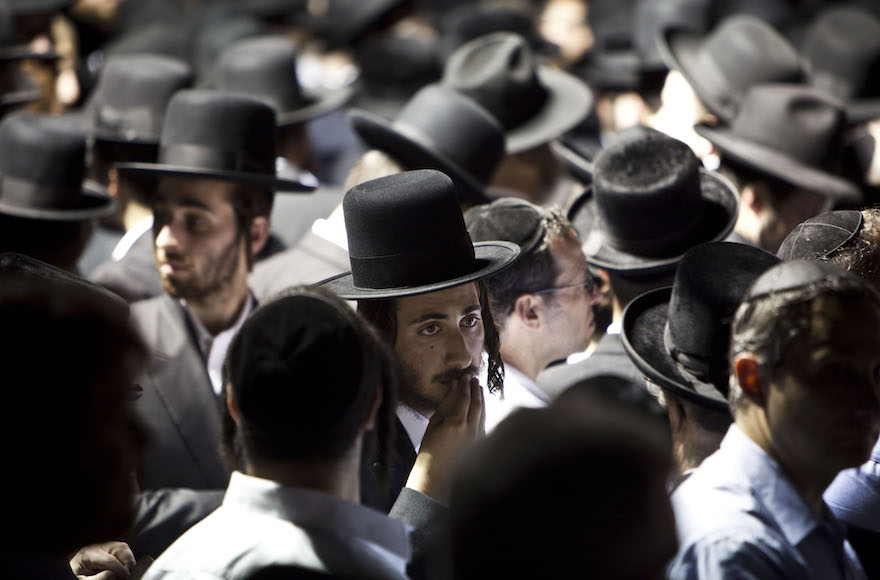
I want to do Tikkun Olam, and I want to bring other Shomer Shabbat, shomer kashrut, Observant Jews with me. Jews who drive vans and Jews who wear black hats and Jews who wear payot. (Is there really anyone who opposes making the world a better place?) When we talk about “the radical middle,” the radical part might be us getting there. We’re not so different from other Jews. Where our ways of life diverge, we should recognize that those very distinctions give each of us special value — especially when it comes to lifting up people.
Louis Keene is a writer living in Los Angeles. He’s on Twitter at @thislouis.