When you first move to Los Angeles from New York, it’s hard to immediately jump into the dating scene. In Manhattan, you get used to falling in love almost every other block — so easy is it to bump into yet another adorable woman outside say, the 92nd Street Y, Zabar’s, Makor, the midtown area. This makes for many a lovely stroll there.
You can’t converse so easily here. Sure, I find myself driving right next to many, many terrific-looking single women. At least they look single at the traffic light, applying makeup in their Cabriolet. Sometimes they sing along to their CD player or fix their hair in the rearview.
Can someone explain if I’m picking up the signals: If she’s talking on the phone, does this mean she’s too busy to roll down a damn window and say hello? I’m getting tired of waving my baseball cap.
Too much driving and dreaming makes me practically a native here, I suppose. When I complained to my friend Stuart back East, he said: “Slow down. Pull over. Take a class.”
Jewish meditation groups are popular now in many a yoga temple/locker room, so I signed up. My first instructor, Miriam, offered a unique “practice,” featuring a mix of Torah and hatha. This involved a lot of stretching and davening as a way of bringing us to mindfulness.
Alison, one of my classmates, said breathlessly how Miriam started a whole “Chasidica-aerobica” discipline years ago. I eagerly took to repeating over and over Miriam’s chant, “Om shalom.” I figured I’d attain enlightenment, or giggles.
After a session one evening, Miriam invited me to her little cottage in Venice and showed me how to touch and kiss her mezuzah. She said she liked “doing a mindless ritual every day” — one mindless ritual every day, but at the same time, “be aware” that she was doing it. “To be mindful that you’re doing it mindlessly.”
A fascinating woman, Miriam, and quite unlike most I’ve met here, at least on this side of Mandeville Canyon. A favorite quote of hers, from Abraham Joshua Heschel, was stuck onto her refrigerator in sweeping black calligraphic form: “It takes three things to attain a sense of significant being: God, a soul and a moment — and the three are always present.”
I tried for weeks to get my mind around this concept. But I was too busy to live in the present: this is Los Angeles. Even God would have to work his beard off for more exposure if he lived in Los Angeles.
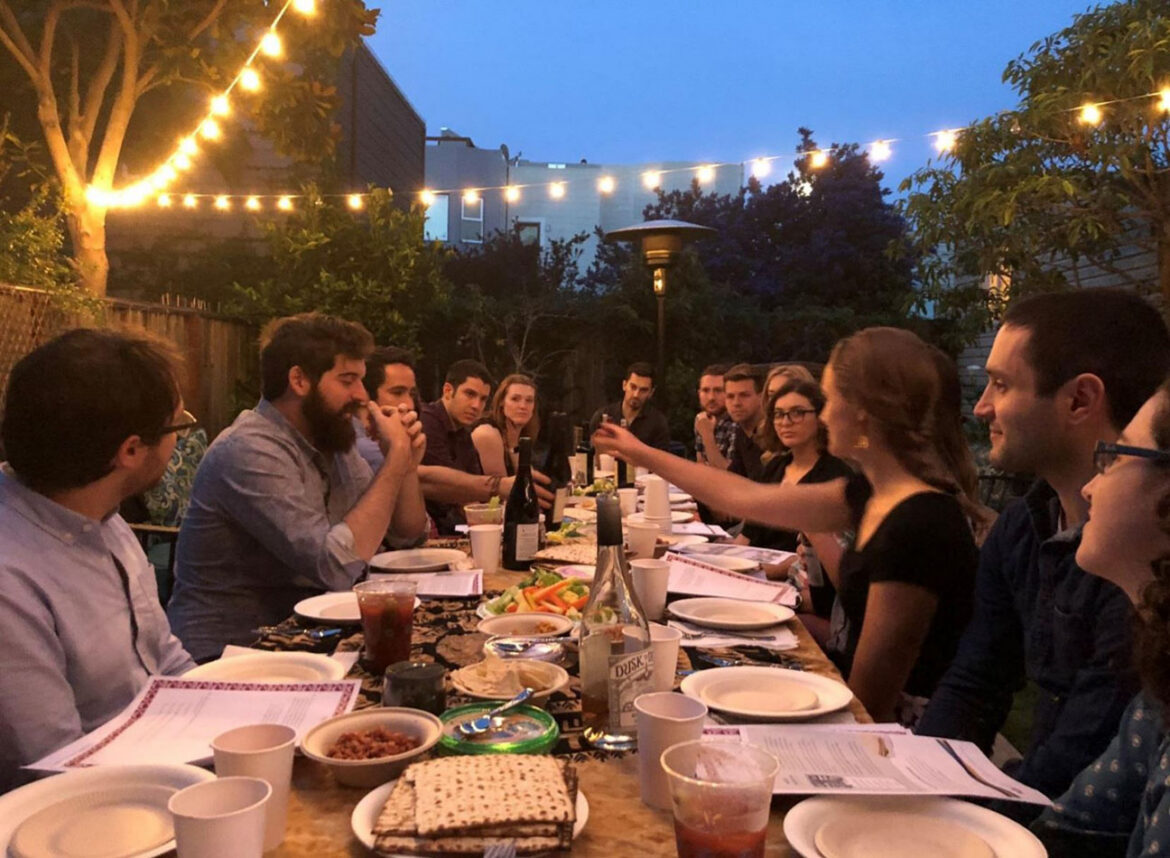
But Miriam’s smile lifted the room like a chuppah. Her shoulders were softer than the pillows our forefathers rested upon in Jerusalem. And she looked beautiful carrying a candle, so I took her to join my family in San Diego for a seder. It’s a rather Reform affair — this year, we used the new “Dr. Seuss Haggadah”:
“One gefilte, two gefilte, three gefilte four/red horseradish, white horseradish/what do you mean you don’t want more?”
On the drive south, Miriam and I stopped to meditate, finding ourselves in our own little bubble of oneness right there at the Self-Realization Fellowship Center meditation garden in Encinitas. We sat on a bluff, the purple ocean and algae down below. After an hour, we reached a point where she said “I’m sorry” to a passing dragonfly. She taught me to let go of just about everything, except my family.
In Del Mar that weekend, Miriam showed us the deep mystery that is the real religious experience. Modern religion kills this feeling, she explained, showing how the triangles of the Star of David symbolize fire and water, with the heart center of it containing an ineffable mixture of the two. Nice.
My parents naturally loved her, and I still have the photographs to prove it. But after our return, via the San Joaquin Hills toll road, something changed. I was trying to sell out, nobody was buying, I had many irons in the fire and was getting burned by every one of them — well, you know. Life in L.A. By Shavuot, she found a new boyfriend, one who she claimed was a monk.
I said to her: “You mean a saint?” (Women often tell me how their previous boyfriends were “saints.”) Miriam said no, Jason was really a monk who lived in a monastery making beer. They were wilder than you think, these guys, she said. That hurt.
I think often now about a midrash that Miriam elucidated and performed for my family in San Diego. This was a “folkloric sentiment” that could point out, she said, the blessing of life. She stood before us, pulling two pieces of paper from her pocket. One said: “The world was created for me.” Which made us feel great. Then she held out the other piece of paper and read it: “I am nothing but dust.”
Hank Rosenfeld will appear on “The Savvy Traveler,” KPCC 89.3, May 18 at 11 a.m. and 8 p.m.