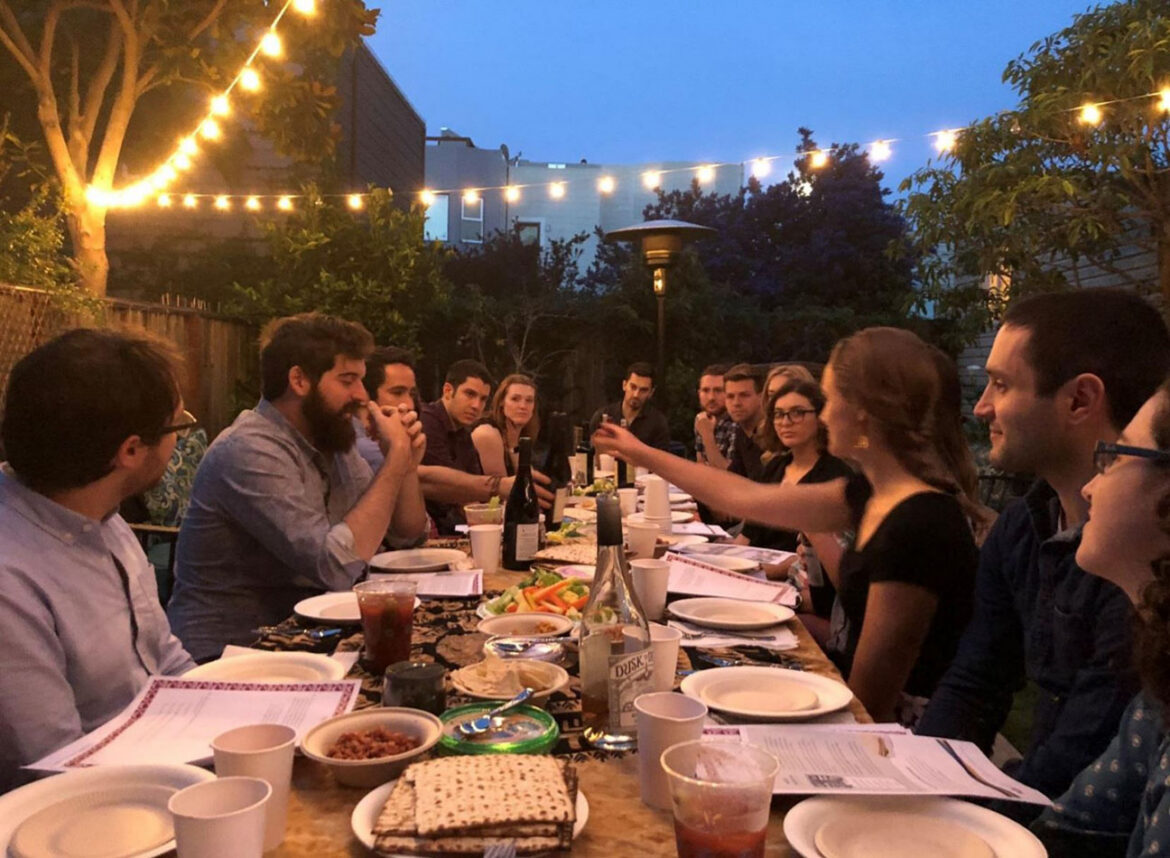
At Temple Adat Chaverim in the San Fernando Valley, the High Holiday services make no reference to a supernatural God. Adat Chaverim — and members of a sister group in Los Angeles — will join some 40,000 secular Jews throughout the world in Humanistic services.
“A Humanistic Rosh Hashanah and Yom Kippur emancipates us from the beliefs and rites of those who prostrate themselves before an all-powerful deity,” Adat Chaverim reader Joe Steinberg will say when explaining the meaning of the observance to the congregation. “They offer self-forgiveness and the occasion to restate our belief in personal and human responsibility for our lives, our behavior and our destiny. For us, the High Holidays are not a punishment or a threat, but an opportunity to gain ongoing insights into our being.”
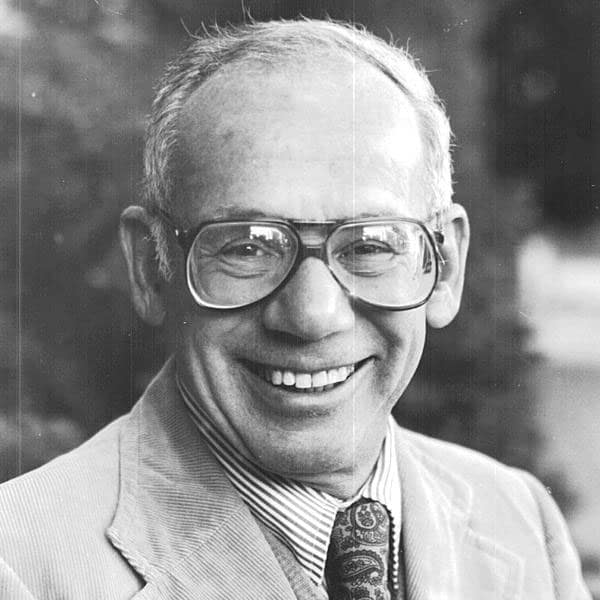
The numbers of Humanistic Judaism are small — especially given the millions of Jews in the world who identify themselves as nonreligious — but Rabbi Sherwin T. Wine of Detroit, who founded the Society for Humanistic Judaism in 1969, remains optimistic.
He notes, for one, that Sivan Malkin Haas, the first Israeli to complete the five-year rabbinical course at the International Institute for Secular Humanistic Judaism, is returning to Jerusalem to lead the Humanistic congregation in the Jewish State.
In North America, some 40 Humanistic “communities” will observe the High Holidays, mostly guided by madrichim (trained lay leaders). Only in eight cities — New York, Washington, D.C., Chicago, Detroit, San Francisco, Boston, Toronto and the Miami area — will ordained Humanistic rabbis be available to conduct the services.
At Adat Chaverim, the Valley Congregation for Humanistic Judaism, the resident madrich is Steinberg, who organized the group with three other people two years ago.
“Now we have 53 members,” Steinberg said, “and we rent space from a Methodist church in Tarzana. The next step is to get our own storefront place.”
Adat Chaverim broke away from the older Los Angeles chapter, partially to shorten driving distances, but mainly because “we wanted more music and ritual,” Steinberg said.
A vigorous 82, Steinberg worries about the aging membership of Adat Chaverim, a general concern among many Humanistic communities, as among Jewish organizations and synagogues in general. To attract younger families, Steinberg doubles as director of the congregation’s Children’s Jewish Cultural School. Its goal, notes a brochure, is to teach children “the real history of a real people in all its diversity” and to allow them “to develop their own convictions honestly on the basis of knowledge.”
Attorney Shirley Monson serves as treasurer of the Los Angeles Society for Humanistic Judaism, with some 60 members.
Her grandfather was Orthodox, her parents Conservative and Monson attended a Reform temple, “until I grew out of it and became a Humanistic Jew,” she said. “I also didn’t want my kids to get a [religious] education they didn’t believe in.”
As a secular woman, Monson rarely encounters antagonism when meeting members of more conventional Jewish denominations. But occasionally, when the conversation turns to religion and she mentions that she doesn’t pray to God, “they’ll treat me like I had leprosy” Monson said.
A third center of secular Judaism in the Los Angeles area is The Sholem Community, which consists of 120 families and operates a Sunday school, from kindergarten through ninth grade, for 75 students. The center’s credo is encapsulated in the words, “To the best of our abilities, we are the authors and publishers of our Book of Life.”
Hershl Hartman, Sholem’s vegvayser, Yiddish for guide, recalled that the first secular Yom Kippur was celebrated in Los Angeles in 1973. In preparation for the upcoming High Holidays, Hartman said, “Some traditions change, so we don’t sacrifice a young bull, a ram and seven lambs. Some traditions don’t change, so we blow the shofar.”
It is difficult to ascertain the number and percentage of secular Jews in the United States, with Wine putting the figure at a high of 47 percent.
The 2001 American Jewish Identity Survey by the Center for Jewish Studies at the City University of New York, cited 1.7 million self-identified Jews who described their households as atheist, agnostic, secular, humanist, or having no religion.
Whatever the precise number, given the large pool of like-minded Jews, why is membership in the Society of Humanistic Jews, and similar groups in 11 other countries, so low?
According to Wine, some 15,000 to 20,000 North American Jews are “fully connected” to the Society, up from 10,000 a decade ago, while an additional 20,000 attend lectures and other activities, or get married under Humanistic auspices.
Wine believes that the future growth of his movement is linked directly to the number of trained rabbis it can produce, saying that Humanistic congregations led by rabbis, rather than lay leaders, are expanding and attracting young families.
Currently, there are six candidates studying in the rabbinical program, but, “If I had 50 rabbis to send out, the movement would grow rapidly,” Wine said.
He is convinced that secular Jews must get together and organize, especially in the face of the growing fervor of religious fundamentalists.
“Unless we are organized, we have no voice,” Wine observed. “And ours is a voice that needs to be heard.”
For information on the Society for Humanistic Judaism,visit www.shj.org .