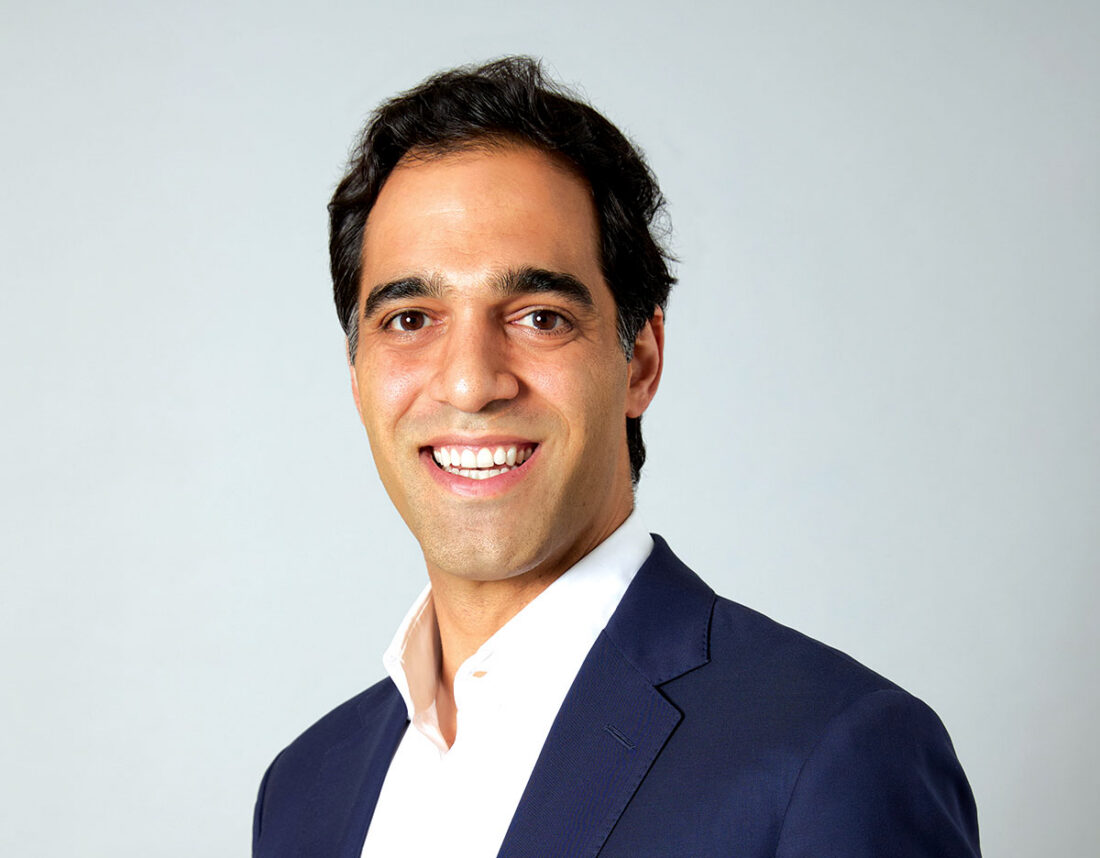
Eyal Biram has deep roots in Israel; his family’s presence in the region can be traced back eight generations on both sides. “I think it’s amazing, something unique in Israel. Most of the people are immigrants,” he said. His father’s family is from Hebron; his mother’s, Jerusalem. His maternal great-great grandfather, Yoel Moshe Salomon, was the founder of Petah Tiqvah. Israel is in his DNA.
Biram grew up on a small moshav (agricultural settlement) called Ramot haShavim in the center of the country. He said the highlight of his early years was spending 12 years with the youth movement Haichud Hahaklai (Agricultural Union). By the time he graduated from high school, he had decided to delay military service in order to do a year of volunteer work with the youth movement. “Now, it was my turn to give to the children like all the guys who did that for me,” Biram said.
With his year of volunteer national service complete, Biram felt more “mature, more ready to start my army service,” he said. Biram was drafted into an elite combat unit, and, after two years of regular service, as intended, went on to become an officer.
He served in the military for six years, double the mandatory three years for men, and was discharged at age 26. “I was worried that I would get out of the army when I was very old. But during my service, I realized how much the army gives me skills for life,” Biram said. “I think my six years in the army was equal to 12 years in civilian life.”
After the intensity of serving in 2014’s Operation Protective Edge in Gaza, Biram needed a break. He was granted a three-month leave to travel and clear his head. This sojourn to the Far East would provide him with an “aha moment” he never could have foreseen.
While in the Philippines, Biram had a short but life-changing conversation with a local Filipino in a bar. He said that this young man had heard a lot about Israel on the news but had never met an Israeli. During their brief encounter, Biram realized he had an incredible power: the power to shift people’s perceptions of Israel.
“They didn’t know that it wasn’t at war all the time,” Biram said. “They didn’t understand the complexities of Israel, that it’s not just black and white.”
Biram isn’t just an officer, he is also a diplomat.
It is an Israeli cultural phenomenon to take long trips to far-flung places after being discharged from the military. Indeed, the Israeli post-discharge backpacker has become ubiquitous from South America to Southeast Asia. In these backpackers, Biram saw a built-in distribution network for soft diplomacy, and he returned to the military determined to realize this potential.
“I think my six years in the army was equal to 12 years in civilian life.” — Eyal Biram
As Israel increasingly is losing the battle to project a positive public image, Biram is at the forefront of advocacy innovation.
“With the thousands of Israelis traveling abroad, we have a specific and efficient way to make great hasbarah (advocacy) for Israel, but no one has used this before,” he said.
While still in the army, Biram began to plan to harness the post-discharge traveler’s potential. He quickly found friends and mentors to support his idea of training soldiers pre- and post-discharge in basic communication and advocacy tools. After being discharged in June 2017, he launched the nongovernmental organization ISRAELis, working in full cooperation with the Israel Defense Forces and other educational partners to prepare Israeli soldiers to act as “ambassadors” during their post-discharge trips.
By July 2018, ISRAELis is projected to have 30,000 soldiers complete a one-hour training as part of their official mandatory discharge educational program. “Most of our work is teaching them that they are actually ambassadors. We give them the tools to tell their personal stories [and] include Israel in order to make a positive impact in this encounter.”
ISRAELis offers an advanced, full-day workshop for those who want to delve deeper, and these men and women form the basis of the travelers network. A digital platform of resources also is planned to launch this year.
And Biram, like most Israelis his age, already has a few trips planned.