fbpx

January 17, 2018

Film Reveals Woman’s Struggles for Her Art

At one point in the 40-minute documentary “Heaven Is a Traffic Jam on the 405,” artist Mindy Alper rocks back and forth, her hands trembling on her knees. Some of the medications she’s taken during a lifetime of depression and anxiety have stopped working, and she’s been experiencing hallucinations as her doctors search for a new regimen.

“I hear sounds of the city screaming in my ears,” she says.

How Alper uses her art to document and heal her traumas is the subject of the movie, which is among 10 short documentaries that will be up for an Oscar nomination on Jan. 23.

Alper’s medication dilemma was not the first time she experienced extreme mental duress. In the movie, the artist, who was born in 1963, reveals that when she was 27 a nervous breakdown rendered her unable to speak, on and off, for a decade. She became suicidal, was admitted to a mental hospital and underwent shock therapy in 1999.

Back then, as well as in the film, art has been Alper’s salvation — a way for her to express her troubles and what she still has difficulty outlining in words.

It’s not the first time Stiefel has made a film about an extraordinarily brave woman.

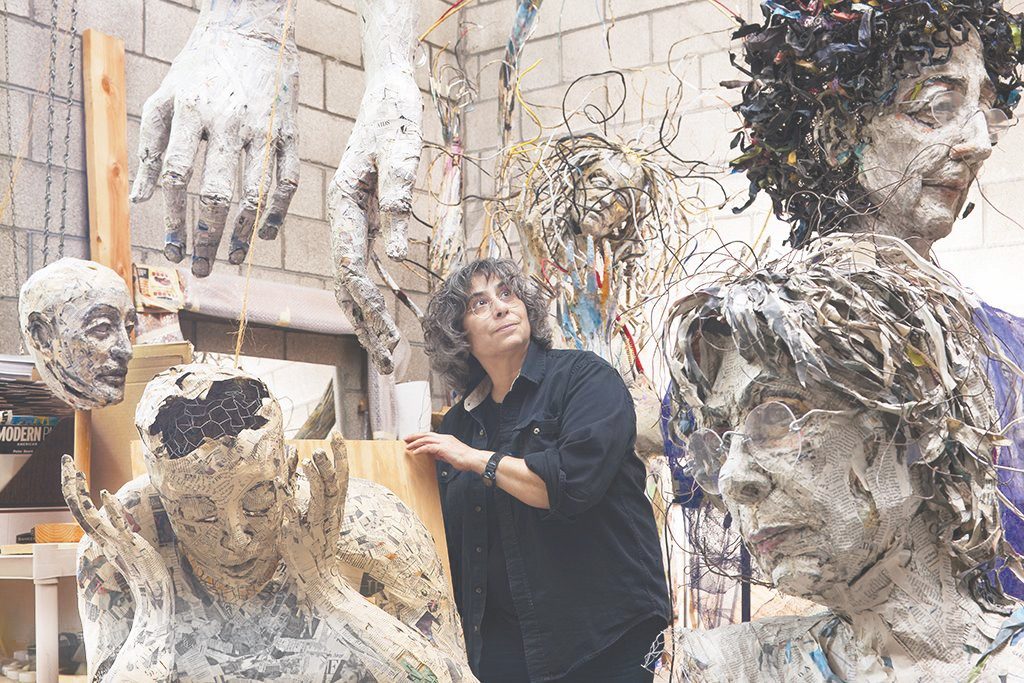
The movie displays several dozen such art works, including complex line drawings of frightening adults or monsters devouring Alper. A more peaceful piece depicts the Los Angeles artist sitting in traffic on the 405 freeway, where she feels safe and calm. Then there is the giant papier-mache figure of Alper’s beloved psychiatrist, Dr. Shoshana, which she is in the process of constructing for an art gallery show in Santa Monica.

Filmmaker Frank Stiefel was drawn to the artist and decided to create the documentary after meeting Alper through his wife, who is also an artist. “Mindy’s work was so emotionally sophisticated,” Stiefel, 70, told the Journal. “It was so psychologically precise about a given moment.”

It’s not the first time Stiefel has made a film about an extraordinarily brave woman. In 2009 his short documentary, “Ingelore,” captured his mother’s story as a deaf survivor of the Holocaust.
(She escaped Germany at 15 after reading the lips of a United States embassy official and convincing him that she could hear.)

During Stiefel’s more than 20 hours of on-camera interviews with Alper, the artist revealed how her fraught childhood exacerbated her mental illness. She grew up Jewish in Los Angeles with a father who was a rageaholic and a mother who couldn’t bear to touch her for much of her childhood. (Mother and daughter are
now close.)

Alper and Stiefel became good friends while shooting the movie over the past four years. When Alper became unable to drive as a result of her anxiety, Stiefel shuttled her to doctors’ appointments.

Production shut down two years ago when Stiefel was diagnosed with lung cancer. After six months of treatment, surgery and chemotherapy, he went into remission and finished editing the film.

Alper is shown coming out of her funk as her exhibition approaches. She’s initially nervous: “I have shpielkis,” she says of her trepidations about the public showing of her art. “I’m so embarrassed. I wanted no one to see how horrible these things are.” But when Alper sees her pieces on display, she says, “I actually was quite moved.”

“I describe Mindy as the most human of humans,” Stiefel said. “She’s willing to reveal all her vulnerabilities — those things that we hide and keep cloistered from one another.”

To view “Heaven Is a Traffic Jam on the 405” on YouTube, visit https://youtu.be/09M3C4VD1Fg.

Film Reveals Woman’s Struggles for Her Art Read More »
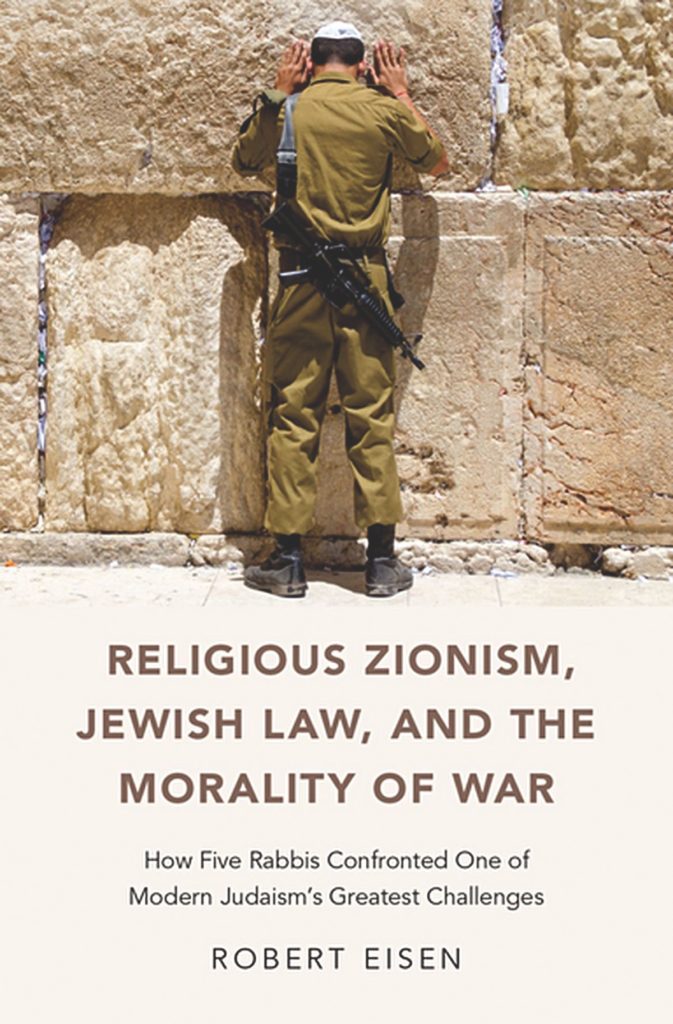
The Moral Dilemma of Jews in War

A couple of millennia passed between the occupation of ancient Judea by a Roman army and the founding of the modern State of Israel. For that reason, the body of Jewish religious law that is collected in the halachah had little to say about war until the mid-20th century, when modern rabbis encountered the new and startling realities of a Jewish state and a Jewish army.

To understand how Judaism copes with war, Robert Eisen, professor of religion and Judaic studies at George Washington University in Washington, D.C., focused on the writings and teachings of five influential rabbis in the religious Zionist movement, ranging from Abraham Isaac Kook (1865-1935) to Shlomo Goren (1918-1994), the first chief rabbi of the Israel Defense Forces (IDF) and “the only one of our rabbinic figures to have actually served in the Israeli army and engaged in combat.”

The result of Eisen’s remarkable enterprise is “Religious Zionism, Jewish Law, and the Morality of War: How Five Rabbis Confronted One of Modern Judaism’s Greatest Challenges” (Oxford). Unlike much else in the ponderings of the rabbis and sages, what they have to say about the ethics of war are urgent, enduring and more timely today than at any other time since statehood.

“In fact, Israel has never known a time when it has been entirely free of war,” Eisen points out. “Even when not engaged in actual war, Israel has always had to prepare for the next war on the presumption that it is not likely to be far off.”

Conscription, the risk of civilian casualties, the moral distinctions between defensive and offensive wars and between “mandatory” and “discretionary” wars, and the conflict between the duties of a combat soldier and the duties of a pious Jew are only some of the challenges faced by a Jewish state that is both sovereign and observant. All of them were considered in detail by the rabbis whom Eisen has studied. But the rabbis go far beyond the question of what is permitted and what is forbidden on the battlefield and grapple with the ultimate theological questions.

“The rabbis in this community have had to ask why God has required Jews to engage in violence in order to return to their homeland,” Eisen explains. “This question has in turn been connected to the larger issue of God’s plan for history and the role of the state of Israel in that plan. Does the establishment of Israel have messianic significance, and if so, what role does violence play in that enterprise?”

From the beginning of statehood, as we learn in Eisen’s scholarly but also superbly written book, some religious Zionists advocated the creation of medinat ha-torah — “a state according to Torah” — but it remained only aspirational “because Israel’s secular public had no interest in it” and because “the religious Zionist camp did not have a clear idea of what medinat ha-torah meant.” Indeed, as Eisen writes, “it was not clear from a halachic standpoint that such a state could go to war at all, even for defensive purposes.”

“Israel has never known a time when it has been entirely free of war.” — Robert Eisen

Yet war confronted the Jewish state with “facts on the ground.” In 1948, when a young man named Tuvia Bir, a member of the Ezra youth movement, posed seven questions about service in the Haganah (the former Jewish paramilitary organization) to Rabbi Isaac Halevi Herzog (1888-1959) — including a question about fighting on the Sabbath — Herzog declared that he found the very question to be incomprehensible. “In the present situation, if we did not volunteer for defensive operations, then, God forbid, the danger of annihilation would be expected for all of us,” he responded. “What alternative do we have? To surrender to the enemy?” Like Kook, Herzog ruled that, as Eisen explains, “everyday Halakhah and wartime Halakhah are different from each other.”

The touchstone for all of the rabbinical discourse about war is the Torah, which provides an abundance of examples of Jews at war. We are told in the Book of Numbers, for example, that Moses commanded the Twelve Tribes of Israel to conduct a war of extermination against the Midianites to punish them for luring the Israelites into idol-worship. Rabbi Sha’ul Yisraeli (1910-1995) cites the biblical incident as legal precedent for the decision of the Israeli government to send commandos on a rescue mission to Entebbe in an operation that “risked not only the lives of the Israeli commandos but also the lives of the hostages themselves.”

For Yisraeli, the mission was not merely heroic but holy — an act of Kiddush hashem, the “sanctification of the divine name” — because the hijackers had freed the non-Jewish passengers and held only the Jews as hostages. “In singling out the Jews, the hijackers were publically targeting the Jewish people and thus targeting God as well,” Eisen explains. “R. Yisraeli applies the notion of kidush ha-shem to the Midianite war, all subsequent wars initiated by enemy nations, and the Entebbe situation.”

I doubt that such rabbinical musings come up in the war room of the IDF or, for that matter, the front lines where Israeli soldiers actually fight. In fact, Rabbi Goren recognized that nonobservant Jews have always represented a majority of the Jewish population in Israel, and he “stated quite openly that a conscious effort should be made by rabbinic authorities to come up with halakhic positions that would be acceptable to the secular population in Israel.” Above all, Goren came to recognize that there is an inevitable and irreconcilable tension between “the need to wage war and the goal of seeking peace, between the imperative to defeat Israel’s enemies and the obligation to be sensitive to the moral dilemmas war raises.”

Nowadays, “wartime Halakhah” is increasingly relevant, not only because Israel is always at risk of war but also because observant (if not ultra-Orthodox) Jews are serving in the IDF in ever greater numbers. Eisen points out that religious Jews, who represent only 10 percent of the population of Israel, “made up 20 percent of the soldiers in infantry brigades” by the 1990s, “and among combat lieutenants and captains, the ratio of religious to secular was two to one.” So Israel is closer to being a medinat ha-torah than it has been at any time since the pioneering generation of secular Zionists like Ze’ev Jabotinsky and David Ben-Gurion.


Jonathan Kirsch, author and publishing attorney, is the book editor of the Jewish Journal.

The Moral Dilemma of Jews in War Read More »

Stop Me If You’ve Heard This One…

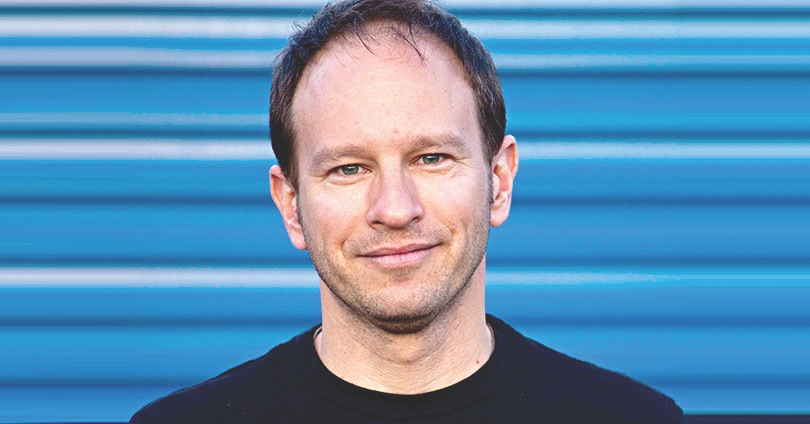
Sam Hoffman is perhaps best known for his popular video web series, “Old Jews Telling Jokes,” which spotlights, well, old Jews telling jokes — often corny but nevertheless hilarious.

Now his new film, “Humor Me,” features some of those jokes, as told by actor Elliott Gould and his elderly co-stars. Gould portrays Bob, the father of a failed playwright, Nate, who is forced to move in with his father after his wife leaves him for a French billionaire. The Jewish Bob is a consummate jokester, which irks Nate and adds tension as the father and son try to work out their fraught relationship.

Viewers would groan at the jokes were they not told by elderly Jews. (Sample: A doctor tells a man to stop masturbating. “Why?” the patient asks. “So I can examine you,” the physician replies.)

“A lot of these jokes are old,” said the filmmaker, who lives in Manhattan. “Some of them are funny, some are borderline offensive and some are, in a way, stale. But when they’re delivered by someone who is old or older than the joke, somehow it doesn’t feel that way. It’s sort of appropriate.”

“The same joke told by an 80-year-old is much funnier than a joke told by a 30-year-old.” — Sam Hoffman

Hoffman — who is also the executive producer of CBS’ “Madam Secretary” — grew up with plenty of older Jews telling jokes. His father, Barnett, a retired judge, had dozens of cousins “and they were all competitive about being funny,” he said. “And our family would always try to be funny around the dinner table. My wife would be like, ‘You know, it’s more important to chew and swallow than to get the timing right on a joke.’ ”

Hoffman, 51, previously worked as a producer and an assistant director for filmmakers such as Woody Allen and Wes Anderson.

He got the idea for “Old Jews Telling Jokes” when some friends asked him if he had any ideas for internet content back in 2008.

“I suggested it would be great to tape my dad, his cousins and friends telling jokes,” he said. “But it wouldn’t just be about the joke; it would include a portrait of the person who was telling the joke.

“My dad did all the casting,” he added.

The first shoot took place in a storefront in Hoffman’s hometown of Highland Park, N.J.; more tapings followed in New York, Los Angeles and Boca Raton, Fla. The series made a splash on the internet when it premiered in 2009.

Featuring about 500 jokes told by several hundred Jews older than 60, the series garnered millions of hits and was subsequently adapted into a book and a successful off-Broadway show.

Of both “Old Jews” and “Humor Me,” Hoffman said, “The same joke told by an 80-year-old is much funnier than a joke told by a 30-year-old. It’s the idea that these people are of a certain generation where they probably had a parent or a grandparent who spoke fluent Yiddish. They have a sense of inflection that younger people don’t necessarily have.

“There are themes in these jokes that are indicative of certain Jewish cultural phenomena,” he added. “It’s that sense of being the ‘chosen underdog’ — the idea that we’re the chosen people, but with a bit of self-deprecation.”

“Humor Me” began with “one of the character types I got from the ‘Old Jews Telling Jokes’ experience,” Hoffman recalled. “It was the character of a man of a certain age who tells jokes to both communicate and also to avoid communication. It’s like, ‘I’m not going to tell you how I really feel, but I’ll tell you a parable about it in the form of a joke.’ ”

Hoffman also liked the idea of having the jokes serve as a kind of Greek chorus — a counternarrative to the story of the movie.

As many of the real joke tellers are dying off, Hoffman said he regards himself as something of a folklorist. “What I’ve collected is a specific ethnological portrait of a generation,” he said.

“Humor Me” opens Jan. 19 in Los Angeles theaters.

Stop Me If You’ve Heard This One… Read More »

Shear’s Jewish Roots Help Him Connect With His Role in ‘The Alienist’

In the 10-part miniseries “The Alienist,” TNT’s adaptation of Caleb Carr’s 1994 novel set in New York City in 1896, a criminal psychologist, a newspaper illustrator and a police department secretary investigate a series of grisly serial murders. Joining them are 20-something Jewish fraternal twins Lucius (Matthew Shear) and Marcus Isaacson (Douglas Smith), criminal science and forensics experts serving as detective sergeants under the new police commissioner, Teddy Roosevelt, later to become the 26th president of the United States.

“I felt very connected to the story of Jewish brothers making their way in New York City,” said Shear, who is Jewish and a New York native. His mother, a first-generation American, “had to negotiate what it means to be Jewish and the daughter of immigrant parents who were fleeing the Holocaust,” he said. “She became a scientist, which was not expected of her.”

Shear said the miniseries follows the narrative of the book but also expands on some of the storylines, including scenes involving the Isaacsons. The show brings viewers into their home, where they live with their mother and light candles on Shabbat.

Shear described Lucius as a mama’s boy who speaks Yiddish and is more traditional and religious than the more assimilated, modern Marcus. When Marcus begins a sexual relationship with a young Jewish woman, conflict arises because Lucius thinks he should marry her, while Marcus has more progressive views.

“Marcus is trying to find his own Jewish identity as an American,” Shear said.

As Jews in a predominantly gentile police force that Roosevelt is trying to modernize and rid of corruption, the Isaacsons are sometimes the butt of jokes and anti-Semitic comments from fellow officers.

“There’s a scene toward the end of the season where we interrogate an Irish police officer suspected of a crime,” Shear said. “As we try to get information from him, he is defiant and throws a lot of hateful language at us and says we’re unfit to do police work because we’re Jewish.”

As the brothers help to solve crimes, “they bicker, but work in tandem,” Shear said. “They have a dynamic that you don’t see with the other characters.”

The actor emphasized that the close relationship the brothers have with each other and their mother stands in contrast to the troubled and lonely souls that populate much of “The Alienist.”

“ ‘Jewish’ is not a restrictive category. There are so many kinds of Jewish people. If I end up playing more Jewish characters, I’d be happy to.” — Matthew Shear

As research for his role, Shear relished delving into forensics history, preparing for scenes by studying how then-new methods like fingerprinting and crime scene photography were used in 1896. He and Smith “were trained in the use of an original box camera from the period,” he said.

“The premise of the show fascinated me because I’m pretty interested in psychology and the mystery of the mind,” Shear said.

During the six-month shoot in Budapest, Hungary, Shear made time to visit Jewish heritage sites, including the Grand Dohany Street Synagogue and the adjacent Tree of Life Holocaust Memorial several times. When his parents came to visit, his Yiddish tutor, also a tour guide and an amateur cantor, took them through the Old Jewish Quarter. “I really enjoyed living in Budapest, though it has a very dark history for Jews,” he said.

Raised in Manhattan and in Larchmont, N.Y., Shear, 33, grew up in a Reform Jewish home, attended Hebrew school, celebrated Jewish holidays and became a bar mitzvah.

“My dad’s grandparents emigrated from Russia in the 1890s and my mom’s parents were able to flee Belgium during World War II. They got Bolivian visas and went to Cuba,” he said, noting that he feels very connected to his Jewish identity and culture. He now belongs to a Reform synagogue on New York ‘s Upper West Side and celebrates the major holidays with his family.

Exposed to movies and theater as a child, Shear followed his older brother into school plays and became hooked. “Taking Woodstock” (2009) was his first film, and he’s been in three movies directed by Noah Baumbach: “While We’re Young,” “Mistress America” and “The Meyerowitz Stories (New and Selected).”

Lucius Isaacson is his third Jewish character in a row, after roles in “Meyerowitz” and the forthcoming “The Boy Downstairs,” in which he plays the title role of Ben, whose ex-girlfriend is played by Zosia Mamet. “I don’t feel compelled to only play Jewish characters, but there’s something very rewarding about it,” he said, adding that he’s not concerned about typecasting.

“I’ve played non-Jewish characters. I played an Italian-American in ‘Mistress America,’ my first substantial break,” he said. “I hope to play a range of characters.  [And] ‘Jewish’ is not a restrictive category. There are so many kinds of Jewish people. If I end up playing more Jewish characters, I’d be happy to.”

Now, Shear said, he is ready for his next adventure, wherever it takes him:

“I’m in a nice place where I’m open to trying something new.”

“The Alienist” premieres at 9 p.m. Jan. 22 on TNT.

Shear’s Jewish Roots Help Him Connect With His Role in ‘The Alienist’ Read More »

Zioness Movement Joins Women’s March

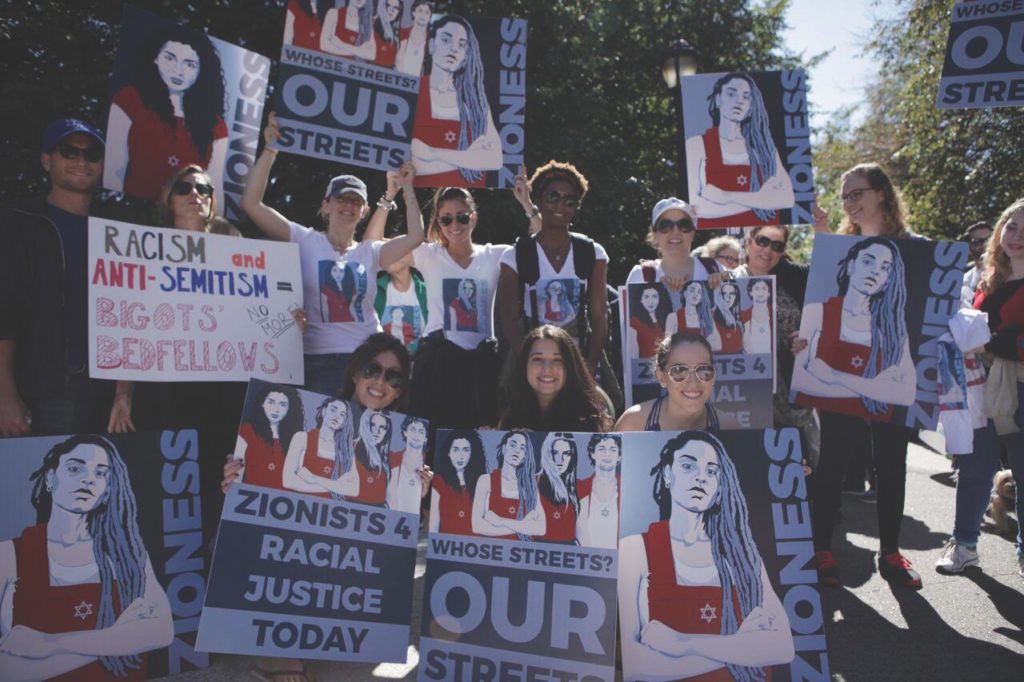
With the second annual Women’s March scheduled for Jan. 20, the 5-month-old Zioness movement has rallied an impressive roster of national feminist leaders to bring progressive Zionists to marches around the country.

Zioness was established in August 2017, after a group of 20 progressive Zionists banded together to participate in the Chicago SlutWalk. However, as had occurred in the same city just three months earlier at the Dyke March, the group was banned for waving a Star of David flag because it was deemed a Zionist symbol of nationalism and oppression.

Civil rights attorney and Zioness co-founder and CEO Amanda Berman is spearheading the Zioness march in New York. She told the Journal that Zioness’ goal is “to activate and empower progressive Zionists — Jews on the left who believe not only in self-determination of the Jewish people but of all communities. We care deeply about social justice and economic justice. Jews and Zionists have always been on the forefront of these movements.”

But in the wake of episodes like those in Chicago, Berman said, “Our community has been staying home because we have been feeling unwelcome and unwanted.”

“Zioness is about showing up and saying anyone who would tell Jews and Zionists to go home and to not empower their own and other communities to fight for equality is not sincerely progressive.” — Amanda Berman

By bringing together powerful, progressive Zionist women to lead marches around the country this year, Berman said she believes up to 1,000 people will march under the Zioness banner.

Berman said she has received emails from around the world, with many saying they were active in the women’s liberation movement in the 1960s and ’70s but pulled away because of the anti-Semitism they encountered on the left.

“People were saying, ‘I’ve been waiting decades for people like you to stand up and say I am a proud, progressive Zionist and I’m not going to check my Zionism or Jewish identity at the door to engage,’ ” Berman said.

Ann Lewis, who served as White House director of communications for President Bill Clinton and as a senior adviser to Hillary Clinton, will head the Zioness contingent at the Women’s March in Washington, D.C.

“I am proud to march with the young people of Zioness,” Lewis said in a statement. “Zioness is inspiring and empowering our country’s next generation of progressive leaders to wear their Zionist identities proudly, as they fight for human rights and women’s rights, health care, education, compassionate immigration reform, equal pay and equal dignity.”

Mimi Bergman, a member of the Women’s March’s Host Planning Committee and the Behavioral Health Committee for the League of Women Voters, will lead hundreds of Zioness members at the Jan. 21 Power to the Polls march in Las Vegas.

In an official statement, Bergman said, “I’m proud to be a part of the Zioness Movement, which is an exciting new initiative that is re-energizing passionate Jewish activists to fight for equality and justice as they always have.”

Pushing back against those who have tried to turn away progressive Zionists from marches and demonstrations by stating they are not anti-Semitic, merely anti-Zionist, Berman said, “I think it’s possible to be anti-Zionist and not anti-Semitic, but, unfortunately, anti-Zionism very often manifests itself as anti-Semitism. But that conversation has no place in a march for women’s empowerment or a march for the LGBTQ community.”

During the first Women’s March last year, a great deal of attention was paid to Linda Sarsour, who helped spearhead the event and whose views on Zionism have been a flashpoint for many on the progressive left.

“I see a lot of discussion about Sarsour on Zioness’ social media,” Berman said, “and while we find her views reprehensible, I don’t think it’s productive for us to focus any of our energy on this one individual. The productive response is to show directly what she says about our community is wrong and hurtful and, frankly, discriminatory. Zioness is about showing up and saying anyone who would tell Jews and Zionists to go home and to not empower their own and other communities to fight for equality is not sincerely progressive.”

Progressive Zionism, social justice and tikkun olam are very much part and parcel of Taylor Nicole Stern’s raison d’être. The Jewish educator, who is organizing the Los Angeles march, first met Berman in college. Raised in Chicago, Stern spent several years as a Jewish educator at Milken Community High School and said when she heard about what Berman was doing to create Zioness, “it spoke to a void I didn’t even realize was forming.”

Reading about how Jews were being excluded from progressive and resistance movements since President Donald Trump took office galvanized her into becoming deeply involved with Zioness.

Zioness will meet up at 8 a.m. Jan. 20 at Coffee Bean & Tea Leaf at 7th and Flower before walking to the march. For more information, visit zioness.org

Zioness Movement Joins Women’s March Read More »

Talking With the Godfather of Israel Branding

Since leaving his diplomatic post in Los Angeles in 1998, Ido Aharoni has become arguably the foremost expert in branding for the Jewish state — except he no longer uses that term.

“I don’t really feel comfortable with the word ‘branding’ anymore,” Aharoni said during a recent visit to the Jewish Journal office.

Instead, he prefers the word “positioning,” which lacks the negative stigma of “branding.” Although he was careful about the words he picked to describe his life’s work, Aharoni returned to Los Angeles free of the constraints of officially representing the Israeli government. In 2016, he retired from a 25-year diplomatic career that included stints as Israel’s longest-serving consul general in New York and its first head of brand management.

“We should never view Israel as a perfect nation.”

Now a consultant and professor at New York University, he was more keen to inform than to persuade, and the conversation quickly evolved into a master class on positioning the brand of the Jewish state. Here are four branding basics Aharoni laid out in his Jan. 10 interview with the Journal.

1. It’s not branding — it’s positioning.

What exactly is the difference? Aharoni said that “positioning” takes into account the organic nature of Israel’s approach.

“Many people see many things in Israel at the same time, but there’s only one positioning, and that is the positioning of the story,” he said. “The story that Israel is telling is the story of its creative people, the story of people that created something out of nothing. I call it the story of ordinary people achieving extraordinary things.”

2. Focus on creativity

Plenty of places are creative, Aharoni said, but no place is quite like Israel.

“L.A. is creative,” he said. “Barcelona is creative. Berlin is creative. But Israeli creativity is different. In what way? Israeli creativity, first of all, stems from our Jewish roots, from the permission we’re given to argue, to challenge authority, and to refuse to accept limitations. So the positioning of Israel is Israel’s creative spirit. This is the DNA of the place. It goes way beyond ‘Startup Nation.’ ”

3. Israel is not perfect

“We should never view Israel as a perfect nation,” Aharoni said.

Rather than explaining and apologizing, Aharoni said, Israel advocates should recognize Israel’s flaws and sympathize with the Palestinian struggle without seeking to directly take on detractors. In a digital world saturated with information, debating critics one by one is a futile effort, he said.

“Even if you win the debate, today, because of these devices,” he said, lifting up his cellphone, “you still stand to lose. Because it’s not about winning debates anymore.”

4. Ethnocentrism is the central challenge to Israeli diplomacy

“The fact is that Israel is a very self-centered, self-absorbed, parochial, ethnocentric society, and there are historical reasons for it,” Aharoni said. “I happen to think that this very ethnocentrism is the biggest threat to Israel, more than the Iranians.”

He laid the blame on ethnocentrism for what he called Israel’s “colossal, dramatic failure” in presenting itself to the world, which he said resulted in low tourism numbers. Specifically, he said, ethnocentrism is responsible for a failing approach to branding — namely, a focus on conflict.

“We thought that because the Israeli-Palestinian conflict is on the top of our agenda, that it should be also on the top of your agenda,” he said.

Here again, Aharoni returned to the language of marketing and branding to make his point.

“Israel became defined by its problems,” he said. “The last thing a brand wants is to be known for its problems, and that’s the reason why Israel is underperforming.”

Talking With the Godfather of Israel Branding Read More »

Sephardic Voices Out of North Africa

Author Nina Lichtenstein’s blond hair is pulled back into a bun and she’s dressed head to toe in black, which makes her already fair skin appear even paler. She’s standing on the small stage at The Braid Theatre in Santa Monica, speaking to a small but rapt audience about her latest book, “Sephardic Women’s Voices: Out of North Africa.”

“I get this question a lot,” she confessed. “People look at me and ask, ‘What does this Ashkenazi name, and you, with your blond hair and fair skin — how does it all come together?’ ”

Lichtenstein then explained how she was born and raised in Oslo, Norway, and how her maiden name was Christensen. “You should have seen the faces of the three rabbis at the beit din when I presented myself for conversion with the name Christensen,” she quipped.

But, she said, that was before she was married with three children, and this was not what she had come to talk about. Rather, Lichtenstein, who now lives in Maine, was invited on Jan. 9 to talk about her book, sponsored by the Jewish Women’s Theatre and Jews Indigenous to the Middle East and North Africa.

Lichtenstein acknowledged that, of course, there were Sephardic Jews throughout the Middle East, but her book is focused on the Maghreb women — those who came from Algeria, Tunisia and Morocco.

“We were learning the literature of the French colonies and there was a lot about Arab women writing from under the veil.” — Nina Lichtenstein

The book has been praised as a “timely and necessary work.” Author Ruth Knaffo Setton wrote: “Nina Lichtenstein illuminates the shrouded histories and complicated religious, political, and cultural identities of seven 20th century Sephardic women writers born in Algeria, Morocco, and Tunisia. By placing them in the context of the little-known Jewish world of the Maghreb, Lichtenstein offers valuable perspectives on the Jewish experience of Diaspora, memory, identity, and the search for home.”

Lichtenstein said her interest in the subject was piqued when she was an undergraduate studying French, while simultaneously learning with a rabbi for her conversion. He encouraged her to take some Jewish studies classes, which quickly turned into 10 courses, then a minor, and a major, and ultimately graduate courses in Jewish studies.

Searching for a topic for her doctoral thesis, Lichtenstein said, “We were learning the literature of the French colonies and there was a lot about Arab women writing from under the veil.” But she couldn’t find any Jewish voices from that part of the world, except for a couple of male voices.

After much digging, Lichtenstein said, “I found stories that resonated in some ways with the experience I had of leaving my own homeland, and feeling on one hand deeply immersed and assimilated, but on the other hand having a feeling that you’re not really quite there and you can’t really go home — or if you can go home you feel like a stranger.”

Lichtenstein has delineated her book into two parts: The first contextualizes the history of the authors, while the second looks at excerpts from their novels and memoirs and how being forced to flee their homeland affected their lives. While many of those fleeing made their way to South America or Israel, the majority went to France because they were French citizens.

“I write about what that feeling was like, when they had to up and go, which was often traumatic, what it was like to be the last generation of Jews from North Africa and how arriving in France impacted their lives,” she said.

Lichtenstein uses a quote in her book that she feels best sums up these women’s experiences. It comes from Algerian-born writer and activist Helene Siksou who noted their lives were like “leaves on a tree menaced by the wind.”

Said Lichtenstein, “It’s the notion that every time Jews are in a country, even though you may have a passport, the leaves are always there, but if there’s a wind, you feel completely vulnerable.”

Sephardic Voices Out of North Africa Read More »

#MeToo and Mashiach

I did not expect to hear a Torah teaching about the #MeToo movement in a Chasidic synagogue. Rabbi Reuven Wolf, however, is not your typical Chasidic rabbi.

On a recent Shabbat, he expounded some verses from one of the lesser-known books of the Bible, Habakkuk:

He shall speak of the end, and it shall not fail; though it tarry, wait for it, for it shall surely come, it shall not delay.

The earth shall be filled with the knowledge of the glory of the Lord as the water fills the sea … and

… a stone shall cry out from the wall.

In this prophetic description, the Age of Mashiach, i.e., the messianic age, will not be accompanied only by peace and goodness — the lion lying down with the lamb, etc. —  but also with knowledge of God, God’s plan and the true meaning of the elements in that plan. We will thus finally understand the spiritual purpose of everything, and everyone, in our physical environment.

At that time, even the rocks will testify whether we walked over them for a wholesome purpose or a selfish purpose. In other words, did we employ our resources to make God’s creation a place of greater holiness or less? A place of greater justice or less? A place of greater kindness or less?

If so for the rocks, Rabbi Wolf said, how much for the people in our lives? We will be called to account for the ways we treated everyone we met, and particularly those closest to us. Did we help them realize their true purpose in the creation, or did we exploit them for our own selfish ends?

It is a fact of biology that the human male gives the seed of life and the female receives it. Each provides half the DNA, but the female egg is vast compared with the tiny sperm, and it is the woman alone who nurtures the new embryo for the next nine months. So you would think that the male would be a humble, nurturing partner in the relationship.

Sadly, this has not been the case. Throughout the history of humanity, many men have exploited their size, strength and patriarchal role as giver of the seed to get what they want from women. The sexual relationship should be the holiest interaction on earth, one that enables both partners to join with God in the creation of new life, but men have often hijacked it to give themselves pleasure at the expense of women’s dignity. This is a grave sin — one that harms the woman, the man and the whole of creation.

The fact that we have now crossed a line, that people will no longer tolerate such an established pattern of behavior, is beyond momentous. In the annals of humankind, it is a change akin to the advents of consciousness, fire, language, agriculture, cities and democracy.

According to Rabbi Wolf, the #MeToo movement is not only a world changer, but evidence that the Shabbat of history is at our doorstep.

In the Hebrew calendar, the year is 5778. We are 222 years from Y6K, the dawn of the seventh millennium — a time that will be holy like the seventh day. Our Sages often liken the Age of Mashiach to Shabbat. And just as Shabbat begins before night actually falls, the messianic age is now settling in around us like dusk.

Jewish tradition, like Habakkuk, holds that the end “shall surely come,” and it will not come later than its appointed time. It may, however, come earlier.

We can hasten the redemption by earning it. If the human world grows in kindness and righteousness, Mashiach will come sooner and without pain. If we cannot achieve such growth, Mashiach will come with a sharp birth pang, more commonly known as the apocalyptic battle of Gog and Magog.

Such a battle is not hard to imagine on the current world stage, and its consequences would be horrific.

Let’s avoid that fate. Let’s buy in to Rabbi Wolf’s vision of an Age of Mashiach that we usher in by increasing peace, justice, lovingkindness and dignity in the world.

Let’s make sure the #MeToo movement succeeds in protecting women from exploitation and enables them to realize their true purpose as equal partners in the creation.

It’s a good bet. Even if Rabbi Wolf is mistaken, what have we lost? And if he’s right …


Salvador Litvak shares his love of Judaism with a million followers every day at accidentaltalmudist.org.

#MeToo and Mashiach Read More »

82 Rabbis and Jewish Activists Arrested During DACA Protest

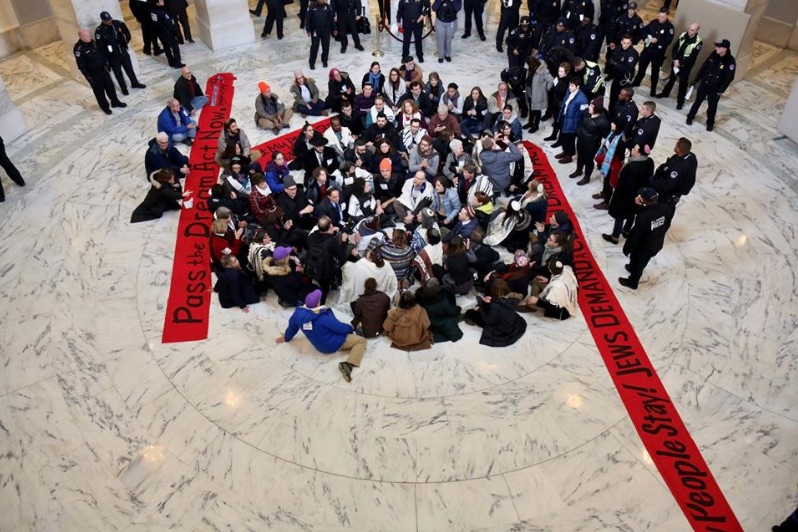
A total of 82 rabbis and Jewish activists were arrested on Wednesday during a protest against President Trump ending the Deferred Action for Childhood Arrivals (DACA) program.

The protest occurred on Capitol Hill, where over 100 rabbis and Jewish activists conducted a sit-in in the Rotunda of the Russell Senate Office Building. The protesters chanted “We will not be moved!” and “Let my people stay!” in favor of the Dreamers. The protesters were also surrounded by red paper that read, “Jews demand a clean Dream Act!”

The 82 protesters were arrested for “crowding, obstructing, or incommoding” in a public building, but most of them are expected to be released.

“We as Jews know the experience of being immigrants,” Religious Action Center of the Reform Movement Associate Director Barbara Weinstein told the Huffington Post, “and as Americans, we’re deeply aware of our history as a nation of immigrants, and that throughout that history immigrants have been a source of strength for this country.”

Before the sit-in, the protesters handed out petitions to congressional members that featured over 5,000 signatures advocating for Congress to pass the Dream Act.

The Anti-Defamation League (ADL) and Bend the Arc were among the Jewish organizations at the protest. Members of Congress who stopped by to support the protesters included Sen. Pat Leahy (D-VT), Rep. Debbie Wasserman Schultz (D-FL) and Rep. Ted Deutch (D-FL).

DACA was first implemented as an executive order under the Obama administration in 2012that prevented 800,000 Dreamers from being deported.

The protests come as Congress and the White House are attempting to reach a deal on DACA, but so far no deal appears to be imminent. Congressional Democrats are threatening to block a spending bill that funds the government if there is no DACA deal by Friday.

82 Rabbis and Jewish Activists Arrested During DACA Protest Read More »

Christmas Borscht in a Jewish Town

Perhaps one of the most surprising things about my visit to Veselka, a renowned Ukrainian restaurant on Manhattan’s very Jewish-centric Lower East Side, is that the restaurant is, in fact, not Jewish. After my many visits to Veselka over the years, so many bowls of matzo ball soup and having eaten more than my weight in pierogi and potato pancakes, I guess I just assumed it was a Jewish restaurant. To add to my confusion, a larger-than-life “Happy Challahdays” sign is one of the first things you notice when you walk into the buzzing luncheonette.

That’s the thing about New York and Jewish food. Words like shlep and schmear and farkakteh are such an integral part of the everyday New Yorker’s lexicon, sometimes it’s hard to imagine that the whole city is not just one big Jewish enclave.

I once read that the Lower East Side of Manhattan is considered the “Plymouth Rock of American Jewry.” When you consider that five out of six American Jews have origins in Eastern Europe, the vast majority of whom immigrated to cities and towns on the East Coast, it stands to reason that Jewish influence would have tremendous impact on the food and culture.

Because food is the greatest and most powerful unifier, imagine the joy hundreds of thousands of Eastern Europeans felt for that shared cuisine when Veselka opened in 1954 as a small newspaper, candy and cigarette stand. With only six stools in the original U-shaped diner, it began to sell sandwiches and coffee as well as Ukrainian specialties such as pierogi and borscht to meet the demand of the more than 60,000 Ukrainian immigrants who called the area their home at the time.

Words like shlep and schmear and farkakteh are such an integral part of the everyday New Yorker’s lexicon, sometimes it’s hard to imagine that the whole city is not just one big Jewish conclave.

Germans, Italians, Poles — Jews and non-Jews alike — made up the fabric of the neighborhood in the 1950s and contributed rich and diverse dishes from their homelands.

This is one of the many reasons to love this part of New York City.  Even with the city’s neverending push to reinvent itself, phasing out the mom-and-pop diners and gentrifying neighborhoods whose inhabitants seem sewn into the landscape, there are and always will be gems like Veselka that serve the kind of soul food that manages to pull the heartstrings at first bite.

Although Veselka’s renowned borscht is made with pork butt and topped with sour cream, making it doubly unkosher, I was lucky enough to be there to watch its equally iconic Christmas borsht prepared. Ukrainian and Polish Christmas Eve is a fasting day when no meat is consumed. But the day culminates in a 12-course feast of which the first course is always vegetarian Christmas borscht. This works perfectly for Jews as well because a fabulous big bowl of “Veselka Red” just begs for a heaping dollop of sour cream and chopped dill.

Veselka’s Christmas borscht is served with dreamy little mushroom-and-onion dumplings called vushka (tiny ears in Ukrainian.) We will leave those for another day, but I’ve found that adding some sliced porcini or portobello mushrooms to the borscht will approximate the texture and contrast nicely with the earthy beet stock. Also, as a departure from Veselka’s recipe and Christmas borscht in general, I like to add back in some of the beets as well as all of the vegetables because I like my soup chunky. Feel free to follow the recipe exactly if you prefer a more brothlike soup.

Don’t get overwhelmed by the number of steps in this recipe. They are all very simple, and the soup itself can be prepared over a few days if you wish. It also freezes beautifully. Feel free to use chicken or beef stock in place of vegetable stock, and then perhaps use an inferior but better-than-nothing nondairy sour cream alternative.

Any way you want to make this soup, though, know that it’s much more than just a bowl of ruby red beets and humble vegetables. It’s the shared dreams and goals of the people of ancient lands and common heritage who happened to find themselves pressed together in the little bubble that is the Lower East Side.

VESELKA’S
CHRISTMAS BORSCHT
(Adapted from “The Veselka Cookbook” by Tom Birchard and Natalie Danford (Thomas Dunne Books, 2009)
2 pounds beets, trimmed and scrubbed,
unpeeled (small, young beets are best)
¾ cup white or apple cider vinegar (if you are sensitive to the taste of vinegar,
reduce the amount but don’t  leave it out entirely as it keeps the beets their vibrant red color)
4 cups water
1 carrot, peeled and diced
1 stalk celery, diced
1 medium yellow onion, diced
1 cup porcini or white button mushrooms,
sliced (optional)
4 cups vegetable stock
2 bay leaves
5 whole allspice berries
1 teaspoon sugar, more to taste
1 garlic clove, finely chopped
1 ½ teaspoons freshly ground
black pepper
1 ½ teaspoons salt, more to taste
3 tablespoons fresh dill, finely chopped,
for garnish
4 tablespoons sour cream or crème
fraiche, for garnish

Coarsely chop the beets in a food processor. In a medium pot, combine beets, vinegar and 4 cups of water and bring to a boil. Reduce heat and simmer, uncovered, until beets are soft, about 45 minutes. Strain and set aside juice. Veselka uses these cooked beets for its wonderful beet salad. I like to put half of them back into the stock and eat them in the soup.

In another medium pot, add carrot, celery, onion, mushrooms (if using), vegetable stock, bay leaves and allspice berries, and bring to a boil. Reduce heat and simmer, uncovered until vegetables are soft, about 30 minutes. Strain and discard vegetables and aromatics. Again, Veselka discards the vegetables. I don’t. Rather, I pick out the bay leaves and allspice berries and keep the vegetables.

Combine strained stock and beet juice and simmer 5 minutes. Add sugar, garlic, black pepper, and season with sugar and salt to taste. Serve with half the beets, the vegetables and sprinkled with dill. Top with sour cream if desired.

Makes 4 to 6 servings.

Christmas Borscht in a Jewish Town Read More »