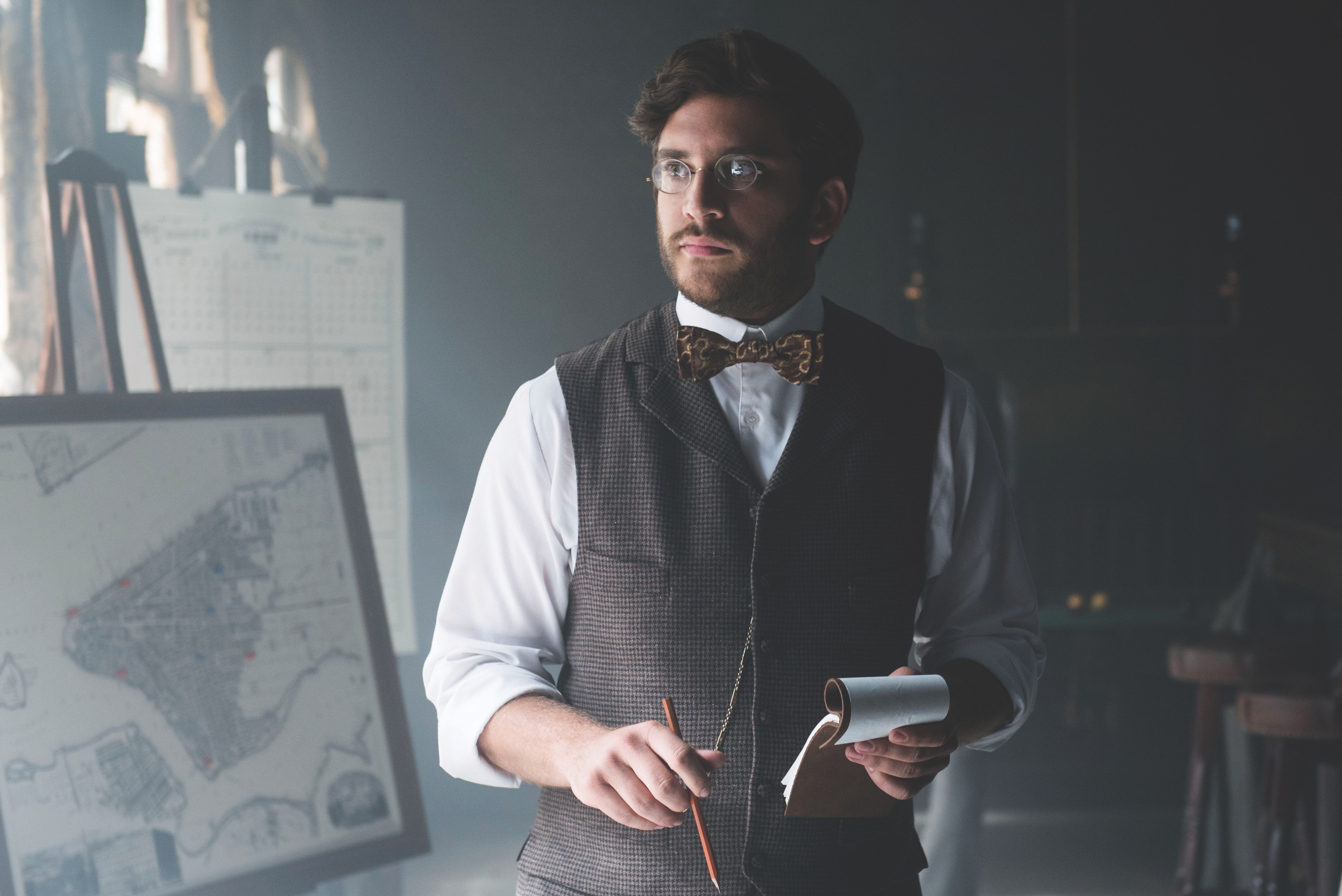
In the 10-part miniseries “The Alienist,” TNT’s adaptation of Caleb Carr’s 1994 novel set in New York City in 1896, a criminal psychologist, a newspaper illustrator and a police department secretary investigate a series of grisly serial murders. Joining them are 20-something Jewish fraternal twins Lucius (Matthew Shear) and Marcus Isaacson (Douglas Smith), criminal science and forensics experts serving as detective sergeants under the new police commissioner, Teddy Roosevelt, later to become the 26th president of the United States.
“I felt very connected to the story of Jewish brothers making their way in New York City,” said Shear, who is Jewish and a New York native. His mother, a first-generation American, “had to negotiate what it means to be Jewish and the daughter of immigrant parents who were fleeing the Holocaust,” he said. “She became a scientist, which was not expected of her.”
Shear said the miniseries follows the narrative of the book but also expands on some of the storylines, including scenes involving the Isaacsons. The show brings viewers into their home, where they live with their mother and light candles on Shabbat.
Shear described Lucius as a mama’s boy who speaks Yiddish and is more traditional and religious than the more assimilated, modern Marcus. When Marcus begins a sexual relationship with a young Jewish woman, conflict arises because Lucius thinks he should marry her, while Marcus has more progressive views.
“Marcus is trying to find his own Jewish identity as an American,” Shear said.
As Jews in a predominantly gentile police force that Roosevelt is trying to modernize and rid of corruption, the Isaacsons are sometimes the butt of jokes and anti-Semitic comments from fellow officers.
“There’s a scene toward the end of the season where we interrogate an Irish police officer suspected of a crime,” Shear said. “As we try to get information from him, he is defiant and throws a lot of hateful language at us and says we’re unfit to do police work because we’re Jewish.”
As the brothers help to solve crimes, “they bicker, but work in tandem,” Shear said. “They have a dynamic that you don’t see with the other characters.”
The actor emphasized that the close relationship the brothers have with each other and their mother stands in contrast to the troubled and lonely souls that populate much of “The Alienist.”
“ ‘Jewish’ is not a restrictive category. There are so many kinds of Jewish people. If I end up playing more Jewish characters, I’d be happy to.” — Matthew Shear
As research for his role, Shear relished delving into forensics history, preparing for scenes by studying how then-new methods like fingerprinting and crime scene photography were used in 1896. He and Smith “were trained in the use of an original box camera from the period,” he said.
“The premise of the show fascinated me because I’m pretty interested in psychology and the mystery of the mind,” Shear said.
During the six-month shoot in Budapest, Hungary, Shear made time to visit Jewish heritage sites, including the Grand Dohany Street Synagogue and the adjacent Tree of Life Holocaust Memorial several times. When his parents came to visit, his Yiddish tutor, also a tour guide and an amateur cantor, took them through the Old Jewish Quarter. “I really enjoyed living in Budapest, though it has a very dark history for Jews,” he said.
Raised in Manhattan and in Larchmont, N.Y., Shear, 33, grew up in a Reform Jewish home, attended Hebrew school, celebrated Jewish holidays and became a bar mitzvah.
“My dad’s grandparents emigrated from Russia in the 1890s and my mom’s parents were able to flee Belgium during World War II. They got Bolivian visas and went to Cuba,” he said, noting that he feels very connected to his Jewish identity and culture. He now belongs to a Reform synagogue on New York ‘s Upper West Side and celebrates the major holidays with his family.
Exposed to movies and theater as a child, Shear followed his older brother into school plays and became hooked. “Taking Woodstock” (2009) was his first film, and he’s been in three movies directed by Noah Baumbach: “While We’re Young,” “Mistress America” and “The Meyerowitz Stories (New and Selected).”
Lucius Isaacson is his third Jewish character in a row, after roles in “Meyerowitz” and the forthcoming “The Boy Downstairs,” in which he plays the title role of Ben, whose ex-girlfriend is played by Zosia Mamet. “I don’t feel compelled to only play Jewish characters, but there’s something very rewarding about it,” he said, adding that he’s not concerned about typecasting.
“I’ve played non-Jewish characters. I played an Italian-American in ‘Mistress America,’ my first substantial break,” he said. “I hope to play a range of characters. [And] ‘Jewish’ is not a restrictive category. There are so many kinds of Jewish people. If I end up playing more Jewish characters, I’d be happy to.”
Now, Shear said, he is ready for his next adventure, wherever it takes him:
“I’m in a nice place where I’m open to trying something new.”
“The Alienist” premieres at 9 p.m. Jan. 22 on TNT.