fbpx

May 7, 2026

Braid Celebrates America’s 250th Birthday with ‘L’Chaim America’

As America’s 250th birthday approaches, The Braid Jewish theater company’s latest show highlights the diversity of contemporary Jewish-American life.

Supported by the National Endowment for the Arts, “L’chaim America” brings together true stories in The Braid’s signature immersive salon-performance style. “The National Endowment for the Arts grant played a catalytic role in bringing this project to life and was deeply affirming,” Sharon Landau, The Braid’s executive director, told The Journal. “At a time when Jewish voices can feel marginalized, that kind of national recognition … sends a powerful signal that Jewish storytelling is an essential part of the American story; [it] affirms that these stories belong on the national stage and are part of the fabric of this country.”

The title, “L’Chaim America,” beautifully honors the vitality of Jewish life in America. “As the country approaches its 250th anniversary, The Braid is also marking its 18th year, our chai year, a symbol of life,” Landau said. “L’chaim, to life, is both a toast and an affirmation; it is a distinctly Jewish expression of joy, presence and continuity, and a way of looking ahead with hope.”

Stories came from community submissions, adapting interviews and converting previously written autobiographical material into stage-worthy fare.

“I was looking for diverse voices in the Jewish American landscape, and I was looking for a variety of stories, highlighting different blessings that we as Jews in America experience,” The Braid’s founder and artistic director Ronda Spinak told The Journal. “The United States is far from a perfect country – especially in these uncertain times – but we as Jews have thrived here, despite the obstacles and the antisemitism, and I wanted to focus on that.”

Stories include:

• Screenwriter Robin Uriel Russin (“On Deadly Ground”) reflecting on Jewish identity in Wyoming.

• New York Times-featured author Emily Bowen Cohen exploring America through the lens of her Native American and Jewish heritages.

• Solomon Dueñas, an immigrant from El Salvador who escaped civil war, arriving in the U.S. determined to reclaim his family’s suppressed Jewish roots and open one of the first Jewish bakeries in Orange County.

• Los Angeles Black Jewish writer and performer Joshua Silverstein, tracing how Ashkenazi activists built alliances with the Black community to help elect their city’s first Black mayor. “I wrote this story because I feel that there’s a part of American history that is often swept under the proverbial rug,” Silverstein told The Journal. “In order for this country to be its best we need to learn how to stand together, regardless of ethnicity, culture, religion or nationality.

“Being from Los Angeles, I’m very excited to share a story about this country that — while the main characters are no longer with us — their impact is ever lasting.”

Landau, who also has a piece in the show, is gratified to not just steward these stories but also contribute to the collective narrative. “Lost in Translation” is about growing up as a new Israeli immigrant in Los Angeles. “It centers on a memory of my mother encountering signs in our neighborhood that led to a cultural misunderstanding,” she said. “On the surface, it’s funny, and I hope audiences laugh, but underneath, it’s about the immigrant experience in America, how we interpret the world through where we come from and how even small moments shape our sense of belonging and possibility in America.”

“L’Chaim America’s” writing and music includes noted Iranian Jewish author Esther Amini (“Concealed”), Latin Jewish Los Angeles and New York Times writer Sonia Nazario, celebrated composer Mike Himelstein (“The Tonight Show”), acclaimed essayist Susan Baskin (writer of the Academy Award-winning film “Violet”), Vanessa Bloom and David Chiu (producers of The Braid’s “What Do I Do with All This Heritage?”), child psychology writer and Soviet Jewish immigrant Natalya Bogopolskaya, Iraqi-Israeli American Aharon Zagayer and songwriter Rhiannon Lewis.

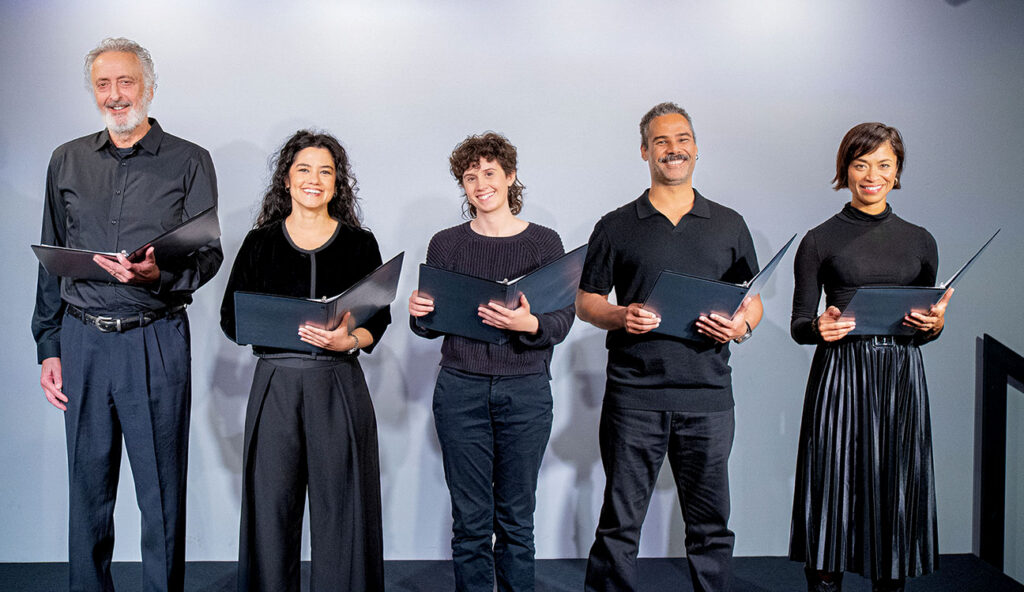
Directed by producing director Susan Morgenstern, the cast features Silverstein (“The Late Late Show with James Corden”) and Lewis (“Traveler’s Prayer”), as well as Kimberly Green (“Lucifer”), Zoë Hall (“La La Land”), Lillian Mimi McKenzie (“What Do I Do with All This Heritage?”), and Marcelo Tubert (“Star Trek: Picard”).

“The Braid in its storytelling is always so artful about mixing higher profile writers with ‘regular folks,’ creating a beautiful mosaic of today’s contemporary community,” Chiu, a writer of numerous stories for The Braid and The Braid’s communications manager, told The Journal.

As an Asian American Jew, the son of an immigrant and the great-grandson of immigrants, Chiu wanted to share how the American story has impacted his life. “It’s literally why I even exist at all,” he said. “Some folks will be surprised to learn there are Asian Jews, Black Jews, Iranian Jews, Latin Jews, Native American Jews and more; that Jews live not just in cities but on the plains of Wyoming; that every facet of the American story is a part of our story,” Chiu said. “This isn’t just a nod to the bountiful diversity of the American Jewish community, but it says something about America. In America, anything is possible — even a Chinese Jew like me.”

At its core, Landau said, “L’Chaim America!” is an invitation to come together, to listen and to celebrate the richness and diversity of Jewish life in this country. “It is also a reminder that storytelling is not just entertainment; it is a powerful tool for connection, understanding and resilience,” she said. “In a moment when so many people feel fractured or disconnected, gathering in community, whether in person or virtually, to share and celebrate these stories feels more important than ever.

“Everyone, whether they are Jewish or not, will appreciate the uplifting of everyday stories that connect us to the America in our hearts.”

“L’chaim America” premieres at the Braid on May 12 and runs through June 17 in and around Los Angeles; in San Francisco May 29 – 31; and via Zoom June 4 and 7. The show will be performed at the Merage JCC in Irvine on June 28 and at the Museum of Jewish Heritage in New York City on July 12.

A special performance will be held on June 7 at the Skirball Cultural Center in Los Angeles, as part of a community-wide celebration in partnership with the Jewish Federation of Los Angeles, the Jews of Color Initiative, the American Jewish Committee, Challah and Soul, the Iranian American Jewish Federation, the Iranian Jewish Women’s Organization, Jewtina y Co, JIMENA and The LUNAR Collective.

For tickets and more information, the-braid.org/america. 

Braid Celebrates America’s 250th Birthday with ‘L’Chaim America’ Read More »
‘We Met at Grossinger’s’ Brings the Borscht Belt to Los Angeles Jewish Film Festival

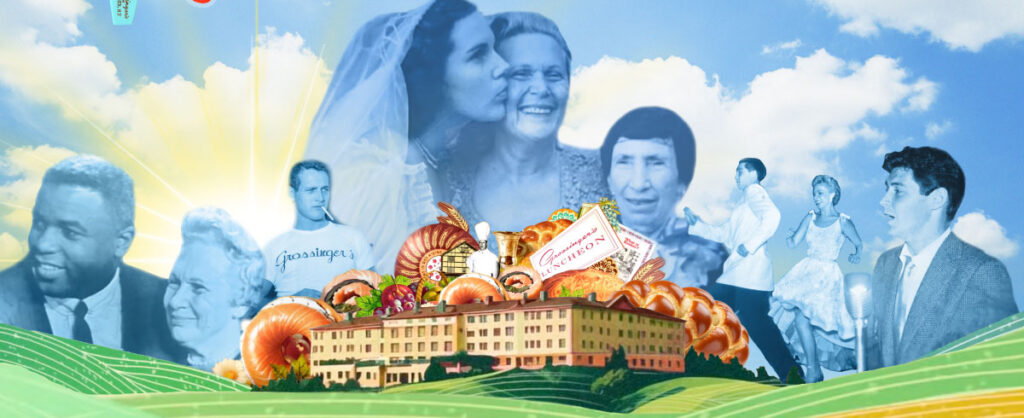
At first glance, “We Met at Grossinger’s” looks like another nostalgic documentary about post-World War II New Yorkers spending summers in the Catskills. Funny Jews, famous Jews, swimming pools, dancing, food, weddings, sports and the vanished world of the Borscht Belt.

That story has been told many times. Director Paula Eiselt’s documentary acknowledges the early careers of Mel Brooks, Buddy Hackett, Carl Reiner, Joan Rivers and Jerry Lewis. It also goes deeper into why Grossinger’s Resort and Hotel had to exist in the first place.

The documentary screens May 13 as part of the Los Angeles Jewish Film Festival, with a Q&A scheduled to include Elon Gold, Melissa Rivers, producer Robert Friedman and executive producer Mike Powers. Melissa Rivers is the daughter of Joan Rivers, one of the comedians whose career took off in the Borscht Belt.

Hilary Helstein, executive director of the Los Angeles Jewish Film Festival, said “We Met at Grossinger’s” was the first film she knew she wanted to show this year. “I watched the film early on in our review process and was elated to see such a nostalgic, feel-good documentary about an important slice of Jewish American history,” Helstein told The Journal. She added that the film would resonate with Angelenos, including New York transplants like herself.

“We Met at Grossinger’s” treats the resort as an answer to American exclusion. Jews were barred from many hotels, clubs and vacation spaces long into the 1970s in the U.S. The film shows still photographs of signs that read, “No Jews or dogs allowed,” and “no Hebrews allowed.” The film shows “The Jewish Vacationers Guide,” originally written around 1919, which listed places where Jewish Americans were welcome. It was an inspiration for the “Green Book,” used by Black American travelers. The resort is presented within a larger American history of minorities needing a “for us, by us” guide to know where they could sleep, eat, gather and be accepted without humiliation. And along the way, make some allies too. 

The story begins with Jennie Grossinger, a Jewish immigrant who arrived in New York from Galicia, Austria, in 1900 with her family when she was 8 years old. The family moved to the Catskills where they made a failed attempt at farming. They pivoted into hospitality, first through a small boarding house and later through what became Grossinger’s.

Helstein said she was drawn to the film’s details about the women behind the resort. “I love the way the story unfolds about strong Jewish women who ran the resort and brought together a community,” Helstein said. “It was a feel-good part of our past that we can hold onto.”

Grossinger’s had three swimming pools, a golf course, two kosher kitchens, an airstrip and a post office. At its peak in the mid-1950s, the Catskills was home to 538 hotels, 50,000 bungalows and 1,000 boarding houses.

Grossinger’s gave Jewish vacationers a scenic, serene place to have their own family summer camp without having to sand down their Jewishness. The Catskills were also respite for recently-immigrated Holocaust survivors. It was another place, besides the synagogue and Shabbat table, to meet and connect with other survivors.

Then-Brooklyn Dodgers star Jackie Robinson’s connection to Grossinger’s might be the most potent moment of the documentary. It presents Grossinger’s as a place where acceptance far beyond the Jewish community became public. Elaine Grossinger says that her mother was inspired by Robinson and the breaking down of societal walls of exclusion. So the Grossinger family invited Robinson and his family to the hotel. Robinson initially hesitated because of his lifetime of seeing exclusion of the black community. He couldn’t even stay at some of the same hotels as his team mates on road trips. He traveled to Grossinger’s with his wife and three children from their home in Stamford, Connecticut.

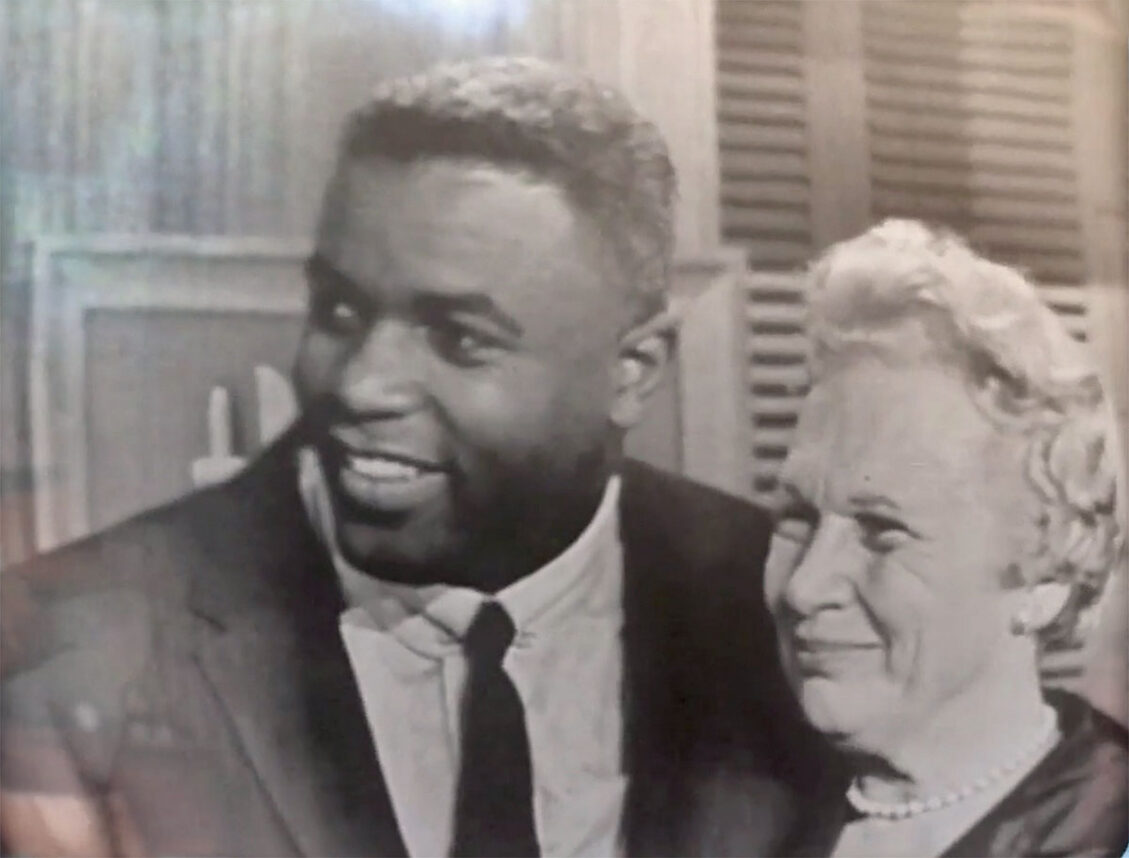
Then comes the nationally televised moment on “This Is Your Life” in 1954, where Jennie bypassed a formal handshake to pull Robinson into a warm, shared hug. The documentary notes this was “the first interracial hug on television.”

“Jennie’s always made me and my family welcome,” Robinson said on the show, with his left arm wrapped around Jennie’s shoulder. The following year, Robinson said on a radio show, “We are always made to feel so much at home, and, of course, we think so very, very much of Jennie Grossinger, and the friendliness of all the people, not only their staff here. I think the guests themselves are all the same, just like one great, big, happy family.”

Jackie Robinson with Jennie Grossinger on “This Is Your Life” in 1954

Helstein said the film stands apart from other Borscht Belt documentaries because of its family details and its connection to mainstream performers in 2026 whose roots traced back to Grossinger’s. “I love that this film shares the details of the family and their charming stories, but also, their unwavering dedication to their patrons and creating something wonderful,” Helstein said. “I love that even today, there are comedians who were touched by Grossinger’s and the ‘Borscht Belt’ and all that it represented.”

As the 1960s wore on, the national mood in the U.S. was shifting. By 1970, a generation of Baby Boomers, who came of age during the civil rights and women’s liberation movements and the Vietnam War, found the traditional Catskills style increasingly out of step with their lives.

The conditions that made the Borscht Belt necessary had changed. Air conditioning meant New Yorkers didn’t need the Catskills for cool summer air. Air travel was becoming more accessible to the average family. Jews had gained the mainstream societal acceptance earlier generations had desperately craved and access to places that barred them for decades. The Borscht Belt became less necessary, less fresh and less central to Jewish-American life that had assimilated into the mainstream.

Grossinger’s closed its doors and was sold in 1986. The film’s final images show dilapidated empty land and abandoned resort spaces. The gardens and serene roads that welcomed visitors for years are long gone, replaced by a chain-link fence running through overgrown greenery in a forest in Liberty, New York.

That may be why the film lands with more force now than it might have a few years ago. Since the attacks of Oct. 7, 2023, hostility toward Jews permeates back into American life. This documentary shows that a productive response to antisemitism can include entertainment, hospitality, humor, nature, sports, friendship and family. It can mean forming new alliances without dissolving who we are.

Grossinger’s began because Jews were pushed out. At its best, the film shows what happened when they answered by building something full of life.

“We Met at Grossinger’s” screens Wednesday, May 13, at 7 p.m. at the Laemmle in Santa Monica as part of the Los Angeles Jewish Film Festival. A Q&A follows with Elon Gold, Melissa Rivers, producer Robert Friedman and executive producer Mike Powers.  An encore screening will be held in Encino on May 16, shorturl.at/jFsD9

‘We Met at Grossinger’s’ Brings the Borscht Belt to Los Angeles Jewish Film Festival Read More »

Exodus from Los Angeles: Outmigration, AI, and the Fate of Jewish Angelenos

Los Angeles, a city once synonymous with star-studded ambition and boundless opportunity, finds itself at a crossroads. According to new statistics, L.A. now leads all American cities in outmigration, indicating a mass movement of residents packing their bags and seeking greener pastures elsewhere. The reasons are significant and life-altering. Specifically, housing prices that are 12 times the median income, economic pressures such as the lack of affordable childcare that squeeze families, and a new digital reality where artificial intelligence is rewriting the rules of employment are forcing Angelenos to vote with their feet. For the vibrant Jewish community, this seismic shift is reshaping dreams, traditions and the very fabric of their future.

Outmigration isn’t just a demographic statistic; it’s a story unfolding in real time. Los Angeles’ once-bustling neighborhoods of Fairfax, Pico-Robertson, Encino are witnessing a steady drain of families and young professionals, many of whom are Jewish Angelenos. With rents well above $2,000 a month and homeownership a distant fantasy for anyone who doesn’t come from substantial generational wealth, the dream of staying in L.A. is slipping away. Instead, cities like Phoenix, Las Vegas and Dallas beckon with affordable homes, thriving Jewish communities and the promise of a fresh start. But what happens when a community disperses? Synagogues, schools, and cultural landmarks are left wrestling with shrinking memberships and dwindling engagement. A once tightly knit network of Jewish life now faces the challenge of maintaining connections across vast distances. The next generation is acutely affected: programming shrinks, youth groups struggle and the sense of belonging that once defined Jewish Los Angeles begins to fade.

Yet the challenges aren’t limited to housing alone. The rise of artificial intelligence is casting a long shadow over the job market, especially in fields that once guaranteed security and prosperity. AI-powered systems are streamlining legal, financial and medical processes reducing the need for entry-level workers and making it harder for recent graduates to break into high-paying careers. Jewish Angelenos, who have historically pursued advanced education and careers in these sectors, find themselves at a crossroads. The competition is fierce, the opportunities fewer, and the landscape of work is changing faster than ever before.

This convergence of unaffordable housing and technological disruption has prompted a wave of departures. Young Jewish professionals are leaving the city not just in search of cheaper living, but also for places where their skills and ambitions can thrive without being eclipsed by algorithms. As the population ages, the city’s Jewish institutions must contend with a loss of youthful energy, creativity and leadership that once propelled innovation and communal growth.

For those who remain, the struggle is real. Housing shortages driven by restrictive zoning and speculative investors have pushed families to the margins of neighborhoods they once called home. The loss isn’t merely financial, but emotional and cultural, too. Generations of Jewish life in LA, from bustling kosher bakeries to lively Shabbat dinners, are threatened as families scatter to new locales.

Jewish schools and camps feel the ripple effects. Lower enrollment means fewer resources, less programming and a diminished sense of community. Opportunities for Jewish youth to connect, grow and lead are vanishing, replaced by uncertainty and disruption. Even so, this moment sparks creativity: organizations are pivoting to virtual events, remote learning, and cross-city collaborations, hoping to bridge the gap between those who’ve stayed and those who’ve left.

As artificial intelligence continues to reshape the world of work, young Jewish Angelenos are rethinking their paths. Coding, data science and entrepreneurship are rising as new pillars of opportunity, and technology is increasingly leveraged to maintain connections and foster community despite geographic distances. The Jewish spirit of resilience and innovation persists, fueling new ways to express identity, build networks and champion social justice even as tradition adapts to modern realities.

The exodus from Los Angeles should serve as a wake-up call. If the city hopes to retain its diverse and vibrant Jewish population, bold action is needed from affordable housing reform to championing economic opportunities in the age of automation. The story of Jewish Angelenos is still being written, shaped by those who stay, those who leave, and those who find new ways to belong. In the midst of change, the enduring values of community, creativity and hope are lighting the path forward for the next generation.


Lisa Ansell is the Associate Director of the USC Casden Institute and Lecturer of Hebrew Language at Hebrew Union College-Jewish Institute of Religion Los Angeles.

Exodus from Los Angeles: Outmigration, AI, and the Fate of Jewish Angelenos Read More »

Mt. Sinai and Forest Lawn Warn LA Bike Lane Plan Could Disrupt Funeral Access on Forest Lawn Drive

Forest Lawn and Mount Sinai Memorial Parks are expressing growing concern over a City of Los Angeles proposal to reduce Forest Lawn Drive to a single lane in each direction in order to make room for protected bike lanes. Mount Sinai estimates the road carries about 20,000 vehicles per day and provides the only route to both memorial parks, including large funeral processions.

After repeated appeals since 2024 to Mayor Karen Bass, the Department of Transportation and Councilmember Nithya Raman, city officials have moved forward with the plan, which, according to the two cemeteries, could create significant traffic congestion during funerals, particularly when multiple services take place at the same time.

The proposal has drawn strong opposition from Jewish leaders, who warn it could severely disrupt access to Mount Sinai Memorial Park, the largest Jewish memorial park in California. In a letter to the city, Mount Sinai General Manager Randy Schwab wrote that the change would “make it impossible for our memorial parks to operate to meet the needs of the families we serve.”

Local Neighborhood Councils, business owners and religious leaders have also voiced objections, including senior rabbis of Sinai Temple, who emphasized in an earlier letter the importance of ensuring timely arrival for mourning families.

In an interview with The Journal, Schwab expressed frustration, saying he has been trying to reach officials involved in the project but has not received responses. “We have left phone messages, written letters and gotten nothing from the Department of Transportation. No one wants to talk to Forest Lawn or Mount Sinai,” he said.

Two years ago, in 2024, Schwab met with Councilmember Nithya Raman to explain the potential impact on the two cemeteries and the traffic congestion the plan could create. “At the time she promised not to do it, but then I think Safer Streets LA got in touch with her and convinced her that it should be brought back.”

After senior rabbis, Councilmember Katy Yaroslavsky and the head of the Armenian Church appealed to Mayor Karen Bass, the plan was placed on hold. However, Schwab said it has since been revived for reasons unknown to him.

“When this was originally being proposed, we hired Lanham, a world-renowned engineering firm, to show what would happen if this actually took place,” Schwab said. “They did a computer model of all the traffic flow over a month and used real counts. We also did an animation presentation to show what it would look like and shared it with the City Council office, but they weren’t interested in looking at it.”

Lanham Engineering, which designs traffic solutions using data-driven methods, developed an alternative plan that preserved two lanes in each direction while also adding a dedicated bike lane. “We gave it to the Department of Transportation and the City Council office, and nothing,” Schwab said. “They have not communicated with us. They simply decided they are going to go with their plan, whether there is community uproar or not.”

The Journal contacted Councilmember Raman’s office and received the following response: “Forest Lawn Drive provides Angelenos access to key destinations, like Griffith Park and the LA Zoo, and is used by people driving, biking and running. About half of all drivers on Forest Lawn are speeding above the 45 mph legal limit, and at those speeds, a pedestrian or bicyclist struck by a car has a 50% chance of being killed. That is not acceptable, and we have been working to change it.”

Her office said the Forest Lawn Drive Safety & Mobility Project is intended to address these safety concerns by reducing vehicle speeds, adding physical protection for cyclists, and improving conditions for all users of the corridor. It also said the plan includes improved turns for both cemeteries and the Junior Achievement Center. A Raman spokesperson said issues raised by cemetery representatives were taken into account during the design process, and LADOT’s proposal includes expanded turn lanes.

However, Schwab said the response does not address his core problem with the reduction to a single lane in each direction, which he believes will severely impact operations and create “a traffic nightmare.”

“And this is only in front of the two cemeteries, not in front of Warner Brothers, or anywhere else in the area,” he said. “My fear is that she doesn’t understand the damage that this is going to do to the Jewish community. What will happen when there are 500 people coming to the park at the same time and we have one lane to get them in?”

Schwab said both cemeteries have tried to reach Mayor Bass and the Department of Transportation for the past 18 months, including through legal counsel, but have not received a response.

“I want to be clear, we do care about bikers and that’s why we spent money to give them exactly what they want to do, a protected bike lane. We have a plan that can do just that and it’s not more expensive than theirs, but they don’t care about it.”

He said that during the week only a small number of cyclists use the roadway, while on weekends the figure rises to an estimated 50 to 75 riders.

A spokesperson from Raman’s office said its traffic analysis for the corridor estimates the project would have a relatively minor impact on travel times, even during the busiest periods of the day. “According to LADOT guidelines,” they said, “anticipated delays are considered low and do not necessitate special consideration.”

However, Schwab disputed that assessment, saying the Department of Transportation’s analysis was based on only eight to 10 hours of data, which he argued does not reflect real-world funeral conditions.

“We have 25–27 funeral services a day,” he said. “On Sundays we have thousands of people coming to the park. What happens in case of an emergency? How is an ambulance going to get into the park?”

Raman’s office said that work is expected to begin in June.

Schwab said he still hopes city officials will reconsider the decision, which he believes would significantly impact many Angelenos. He said that that once the project is completed, it would be difficult to reverse due to cost.

“We have tried the assembly people who are in favor and asked Nithya to speak with us, but everything falls on deaf ears.”

The Journal reached out to the office of Karen Bass and the Los Angeles Department of Transportation but did not receive a response by press time.

Mt. Sinai and Forest Lawn Warn LA Bike Lane Plan Could Disrupt Funeral Access on Forest Lawn Drive Read More »

LAUSD Makes History with Jewish American Heritage Month Recognition

At a time when antisemitism in schools is on the rise, the Los Angeles Unified School District (LAUSD) has taken a historic step: for the first time, it has unanimously recognized May as Jewish American Heritage Month and named Eighteen Education as an official resource for its more than 560,000 students.

Eighteen, the organization behind the curriculum, was founded in 2024 by Noa Tishby. Its mission is to combat antisemitism, support Israel and foster Jewish pride through media, education and cultural initiatives. The organization has developed content and programming designed to engage both Jewish students and their peers in a way that resonates – through short, engaging video content.

In an age of shrinking attention spans and endless scrolling, Tishby believes educators must adapt to how students consume information. The actress and producer turned activist and author has spent the past year developing the program. “There is a profound gap in how Jewish history and identity are taught, or not taught, in American schools,” she told The Journal. Jewish American Heritage Month, she said, should not be treated as a symbolic gesture, but as an opportunity to educate, engage and tell the Jewish story.

For Tishby, the district’s decision carries both cultural and practical weight. “When we realized that LAUSD had never acknowledged Jewish American Heritage Month, we were a little surprised. To see it pass unanimously, and to work closely with Nick Melvoin to make it happen, means the world,” she said.

LAUSD Board Member Nick Melvoin recommended the curriculum to LAUSD, and the board unanimously voted to recognize Jewish American Heritage Month. Melvoin said during the board meeting that Eighteen’s curriculum is intended to ensure the resolution is not just “checking a box,” but encourages meaningful education and engagement.

Tishby, who has been advocating for Israel through her Instagram account, where she has 1 million followers, sees education as the primary tool in addressing rising antisemitism. “I think it all begins and ends with education. We need to make sure we weed out bad curricula and replace them with ones that spread knowledge and love rather than hate.”

According to Tishby, the issues seen on college campuses often begin much earlier.  “When kids show up on college campuses, it doesn’t come out of nowhere that they get radicalized,” she said. “It happens before – ideas are already in the system, often without parents even realizing it.”

At the same time, she acknowledges that much of today’s learning happens outside the classroom. “We’ve essentially delegated a lot of our children’s education to social media,” she said, adding that while parents can try to limit screen time, schools must ensure students are exposed to accurate and responsible curricula.

That reality is part of what shaped the program’s format. Tishby said short-form video is one of the most effective ways to reach younger audiences. “You have to meet them where they are,” she said. “And where they are is on social media.”

The video series, “What Is,” which took about a year to develop, was designed with that in mind. The educational videos provide a clear, accessible foundation on key topics including Judaism, the land of Israel, antisemitism and the Holocaust.

Each episode is approximately five minutes long and breaks down complex subject matter into digestible, fact-based content for students, educators, journalists and the broader public. The videos aim to support informed conversations by grounding viewers in essential historical context at a time when these topics are increasingly part of the national dialogue.

The curriculum is simple to implement – four episodes, once a week throughout the month of May.

“When people see it, they’ll understand the level of effort that went into it,” she said. “It’s very high-level, well-researched and visually engaging.”

Tishby said the curriculum was designed to be broadly accessible, even beyond the classroom. While the video series itself can resonate with a wide range of audiences, the structured curriculum is currently geared toward older students. “We created the series in a way that could work for younger audiences as well as adults,” she said. “But the curriculum itself is aimed at middle school and high school.”

Tishby noted that Jewish American Heritage Month itself has yet to fully take hold in the public consciousness. “I didn’t even know about it until a few years ago,” she said. “We haven’t yet turned it into a real, loud celebration, and that’s something that needs to happen – with or without this curriculum.”

While she believes the program can play an important role in addressing antisemitism, Tishby emphasized that no single initiative can solve the problem on its own. “It will be a tool, but let’s not kid ourselves that one thing is going to be the answer,” she said. “I have found throughout the years that a lot of people want quick fixes and they’re like, where’s the answer? What is the one thing we need to do?”

She pointed instead to the need for a broad, coordinated response. At this moment, she said, addressing antisemitism requires an “all hands on deck” approach – spanning education, entertainment, academia, business and public safety. Antisemitism, she added, has become pervasive, and confronting it will require sustained effort across every sector of society.

After the videos – on Judaism and antisemitism – were screened for students at a Los Angeles public school, early reactions highlighted how impactful basic education can be.  One moment stood out.

“A girl raised her hand and said, ‘Wow, I didn’t realize antisemitism is so old,’” Tishby recalled. “She simply didn’t know. She thought it was something new that started with the war with Hamas. A lot of the time, what we see is a lack of understanding. People just need to be informed.”

LAUSD Makes History with Jewish American Heritage Month Recognition Read More »

Recipes and Food Memories for Mother’s Day

Some of our strongest memories live in the kitchen. Mother’s Day is a time to celebrate Mom while savoring those foods and food memories.

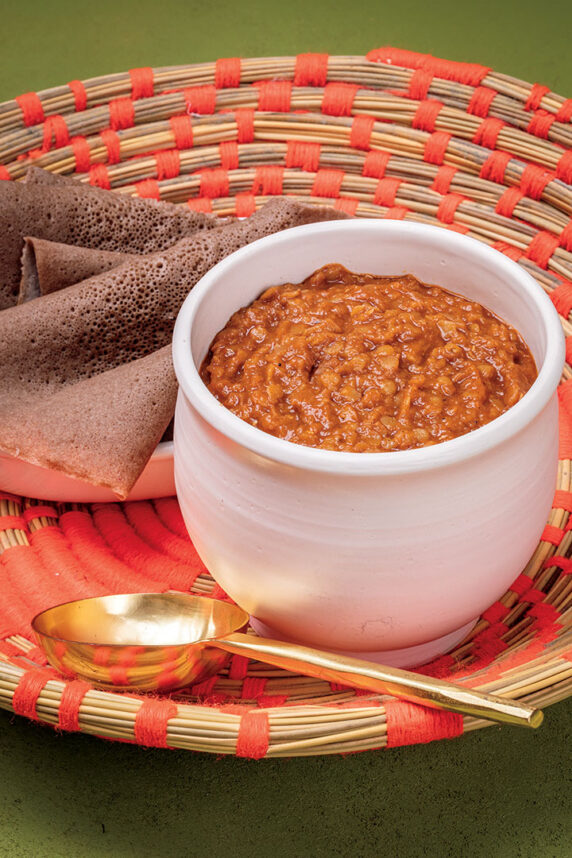
Ethiopian Jewish chef and cookbook author Beejhy Barhany associates her Messer Wot (Birsen Tsebhi), a red lentil stew, with her mom.

“This rich yet simple dish is a staple comfort food in Ethiopian Jewish households, with a history tracing back to the biblical story of Esau and Jacob,” Barhany, author of “Gursha: Timeless Recipes for Modern Kitchens, from Ethiopia, Israel, Harlem and Beyond,” told The Journal. “My mother was an expert at preparing these red lentils; they were always delicious, warming and a true staple in our home.”

Barhany now prepares this dish for her own children, and it has become one of their favorite comfort foods.

“The dish serves as a beautiful reminder of how our recipes connect us across generations and is a memory that sustained my family during our journey from Ethiopia to Israel,” she said. “It’s incredibly versatile: packed with nutrients and protein, can be served hot or cold and pairs well with rice, injera or salad. It can even be used as a spread or dip.”

Messer Wot/Birsen Tsebhi

Slow-Cooked Red Lentil Stew

Serves 6 to 8

Photos for the Gursha Cookbook by Chef Beejhy Barhany shot at Tsion Cafe in Harlem.
© Clay Williams / http://claywilliamsphoto.com

While red lentils cook much more quickly than other types, taking our time helps them develop the right flavor and texture. This recipe makes a medium-spiced stew; feel free to add more berbere.

4 medium red onions, quartered, soaked briefly in water (to reduce the astringency) and drained

1 Tbsp minced garlic

1 Tbsp minced fresh ginger

3/4 cup vegetable oil, plus more as needed

3 Tbsp Berbere (a fiery, aromatic spice blend featuring chili peppers, fenugreek, ginger, garlic, cardamom, cinnamon and cloves)

1 1/2 tsp fine sea salt, plus more to taste

1 1/2 tsp black pepper, plus more to taste

1 (6- ounce) can tomato paste

3 cups red lentils, rinsed well

1 tsp ground roasted korarima or ground cardamom

In a food processor, process the onions, garlic and ginger into a thick paste. Pour into a large pot and bring to a simmer over medium heat. Cook, stirring occasionally, until most of the liquid has evaporated, 5 to 10 minutes. Add the oil and simmer for another 10 minutes.

Stir in the berbere, salt and pepper. Simmer, stirring and scraping constantly, until the stew is deep red and thickened and the onions are melting into each other, 15 to 20 minutes, adding a few tablespoons of water to help loosen anything sticking to the bottom of the pot and adding a few tablespoons more oil if the mixture begins to look dry.

Add the tomato paste. Half-fill the empty tomato paste can with water, scrape the remaining paste off the sides of the can into the water, and pour that into the pot. Bring to a boil and simmer until the tomato paste melts into the base, 15 to 20 minutes, adding up to another cup of water to help integrate the two if necessary.

Stir in the lentils and 4 cups of water, return to a simmer, and cook for 10 minutes. Add 1 cup water and cook until the lentils begin to disintegrate into the stew, about 10 minutes longer. Stir in the korarima. Taste and add salt and pepper, if necessary. Serve warm.


“Every Friday before Shabbat, my mom made a big batch of schnitzel; [we had] dinner plus leftovers for days,” Sababa Foods founder and home cook Amy Dell told The Journal. “My dad and I would steal the crispy edge pieces while she chased us away from her perfectly stacked pile.”

They always dipped the schnitzel in the family’s Saturday sauce. Saturday Sauce is a slightly spicy tomato-based sauce; it’s like the base of shakshuka.

“Saturday Sauce was always on the table for Shabbat in general because we always dredged our challah in it,” she said.

This is Dell’s version of her mom’s recipe.

Saturday Sauce, Green Beans and Schnitzel

1 lb. skinless, boneless chicken breasts

2 eggs

2 cups breadcrumbs

Recommended seasonings for the breadcrumbs: paprika, turmeric, dried parsley, onion powder, garlic powder, kosher salt, black pepper, sesame seeds

Canola oil for frying

1 16 oz. bag trimmed green beans

Water for boiling

1 16 oz. jar Saturday Sauce

Optional: Juice from a lemon

Clean and pound your chicken breasts; remove tendons (using a fork) and pound thin.

In a bowl, whisk two eggs. In another bowl, mix your breadcrumbs and preferred seasonings.

Dip your chicken cutlets into the egg on each side (with one hand – your wet hand) and then into the breadcrumb mixture on each side (with your other hand – your dry hand). Press the cutlets down into the breadcrumb mixture to make sure all sides have been thoroughly coated.

Pour a generous amount of canola oil into a frying pan. Heat to medium-high. Once the oil is heated, dip your chicken cutlets into the oil and allow to fry on each side (around 5-7 mins. per side depending on the thickness of your chicken) until golden brown and crispy.

I recommend having a plate with a paper towel on top to place the chicken cutlets once they’re cooked, to soak up excess oil.

Heat a pot of salted water on the stove. Once boiling, add your cleaned and trimmed green beans. Boil for no more than 5 minutes. While the beans are boiling, get a bowl and fill it with ice and cold water. Once 5 minutes are up, put your cooked green beans into the ice water so that they do not continue to cook.

Once cooled, drain and dry your green beans. Coat them with a generous amount of Saturday Sauce.

Alternatively, you can sauté your green beans in olive oil or avocado oil and then add Saturday Sauce.

Squeeze fresh lemon juice on top and enjoy.

Happy Mother’s Day!

Recipes and Food Memories for Mother’s Day Read More »

Blessings and Best Scone Recipe

For the past 26 years, it has been my privilege to host our family Mother’s Day brunch. I love doing it. I love decorating the table with fresh flowers and pretty napkins. I love the informality of the meal. I love the relaxed feel of dining in my garden with nowhere else in the world to be.

I love the food — quiche and frittata, smoked salmon and whitefish, cheeses and freshly baked breads, breakfast potatoes and grilled mushrooms, leafy green salads and an Israeli salad, well, because we’re Israeli.

But the highlight of the meal are my freshly baked scones served with whipped cream and strawberry preserves.

G-d bless Anna, the seventh Duchess of Bedford, for making scones a staple of Afternoon Tea in 1840. It was during this era that baking powder was introduced and that meant that scones became the lighter, floury, buttery cakes we know today.

I learned to bake scones as a young girl in Australia. I’m still amazed that simple ingredients like a bit of flour, butter and whole milk can be transformed into such delicious bites. The trick is to use very cold butter and a light touch when kneading. The dough will be sticky and wet and that’s fine. Don’t be tempted to add more flour. Just pop the scones into a hot oven for 15 minutes.

While I appreciate the creativity of the sweeter, richer American scones, with variations like orange and cranberry, lemon and blueberry, chocolate chip and vanilla frosted, I still prefer the classic plain British scone.

For me, the tender, crumbly texture and buttery taste are just perfect with the sweetness of the jam and richness of the freshly whipped cream.

That’s the thing about food, it tells so much about who we are, where we come from and the stories we want to tell about ourselves. The frittata is an homage to my grandmother Nana Aziza. She knew how to lavish a table with an abundance of incredible food. The Israeli salad and the other salads are inspired by my mother Nana Sue, the original queen of salads. The scones, a reminder of where I grew up.

What I have learned from these Sunday brunches is how special it is to take the time to show my amazing mother and mother-in-law (and the other beautiful mothers in our family), a little bit of the love and appreciation that they richly deserve. I pray that Hashem gives us many more years to celebrate together.

As a mother, a daughter, a daughter-in-law, a sister-in-law and a friend it is my greatest honor to celebrate around the table. It’s not about the food. The food is just the excuse to bring everyone to the table.

Last Mother’s Day, our little granddaughter Noa was a little bundle of joy and still breastfeeding. This year, I’m very excited to feed her all the healthy foods that her mother has taught her to love. In my role as Nana Sharon, I’m excited to see her little smile as she takes her first bite of scone.

– Sharon

Best Scone Recipe

2 cups all purpose flour, sifted

1 tsp salt

4 tsp baking powder

1 Tbsp sugar

5 Tbsp butter

1 cup full fat milk

1 tsp vanilla extract

Preheat oven to 400°F.

Line a baking sheet with parchment paper.

In a large bowl, combine the flour, salt, baking powder and sugar. Cut in the cold butter and work quickly to rub the butter into the flour to have a sand like texture.

Add the milk and the vanilla and knead gently and quickly, until the dough comes together.

Place the dough on a lightly floured surface and smooth into a log that is 2 inches high.

Use a dough cutter or sharp knife to cut into 2 inch squares.

Place the scones on the baking sheets and bake for 15 minutes, until scones are slightly golden on the outside.

Serve scones warm with your favorite jam and freshly whipped heavy cream.

Note

Store scones in an airtight container for two days or in the refrigerator for up to five days.

Reheat before serving.


Sharon Gomperts and Rachel Emquies Sheff have been friends since high school. The Sephardic Spice Girls project has grown from their collaboration on events for the Sephardic Educational Center in Jerusalem. Follow them
on Instagram @sephardicspicegirls and on Facebook at Sephardic Spice SEC Food. Website sephardicspicegirls.com/full-recipes.

Blessings and Best Scone Recipe Read More »